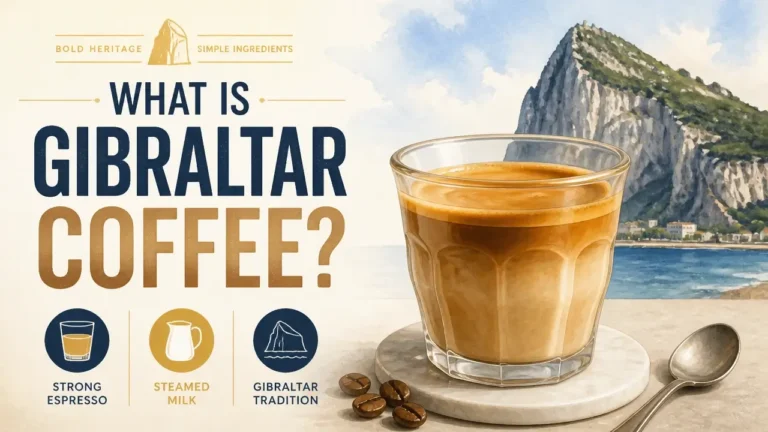

Boldly espresso-forward, Gibraltar coffee sits in a category all its own on specialty café menus – even though what’s inside the glass has been around for decades. It’s a double shot cut with an equal pour of lightly steamed milk, served in a specific 4.5 oz Libbey rocks glass that gave the drink its name.
The story behind it runs straight through Blue Bottle Coffee in San Francisco, and it ends with a truth most coffee professionals already know: a Gibraltar and a cortado are the same drink wearing different labels.
What Exactly Is a Gibraltar Coffee?
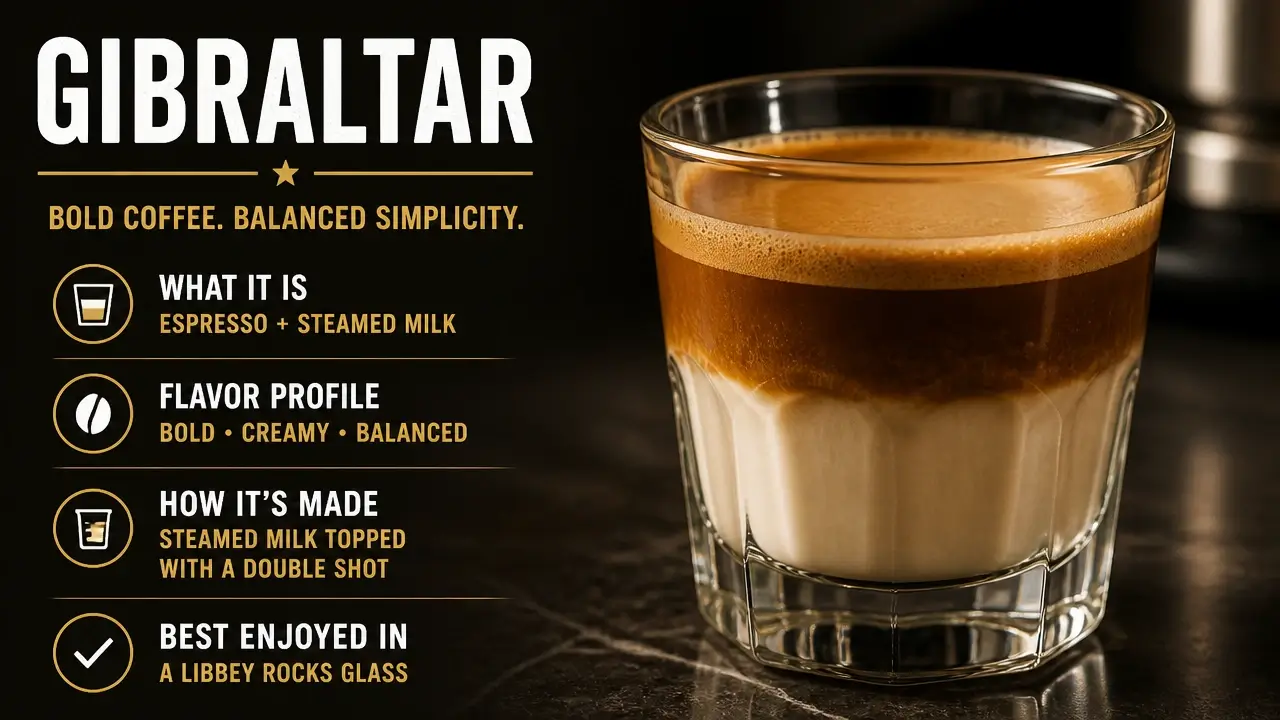
Gibraltar coffee is a concentrated, equal-parts espresso-and-milk drink – roughly 2 ounces of double espresso (often a double ristretto) poured into about 2 ounces of lightly steamed milk, for a total volume of 4 to 4.5 ounces. That small total is the first thing that separates it from the drinks most people order daily. It’s not a latte. It’s not a cappuccino. It lands somewhere between macchiato territory and cortado country – strong, smooth, and deliberately compact.
The defining detail, though, isn’t the ratio. It’s the vessel. The drink is served in a 4.5 oz Libbey Gibraltar rocks glass – and it’s literally named after that glass. Take the glass away, and what you have is a cortado. Which is why you’ll hear those two names used interchangeably across specialty coffee menus, especially on the West Coast.
Sensory-wise, expect something espresso-forward with a velvety edge. The milk softens the shot without sweetening it the way a latte would. There’s no drowning the espresso here – it stays front and center, with the milk playing a supporting role rather than taking over.
The editorial team at Sprudge, the world’s premier specialty coffee publication, has described the Gibraltar as a close cousin of the cortado – a drink named specifically for the Libbey rocks glass it’s served in, first offered off-menu at Blue Bottle Coffee in the Bay Area during the mid-2000s. That origin is exactly where the name starts making sense.
Here’s a look at what the drink actually looks like when it’s built correctly – layered espresso meeting textured milk in that distinctive low glass.
The Accidental Origin: How a Glass Named a Drink
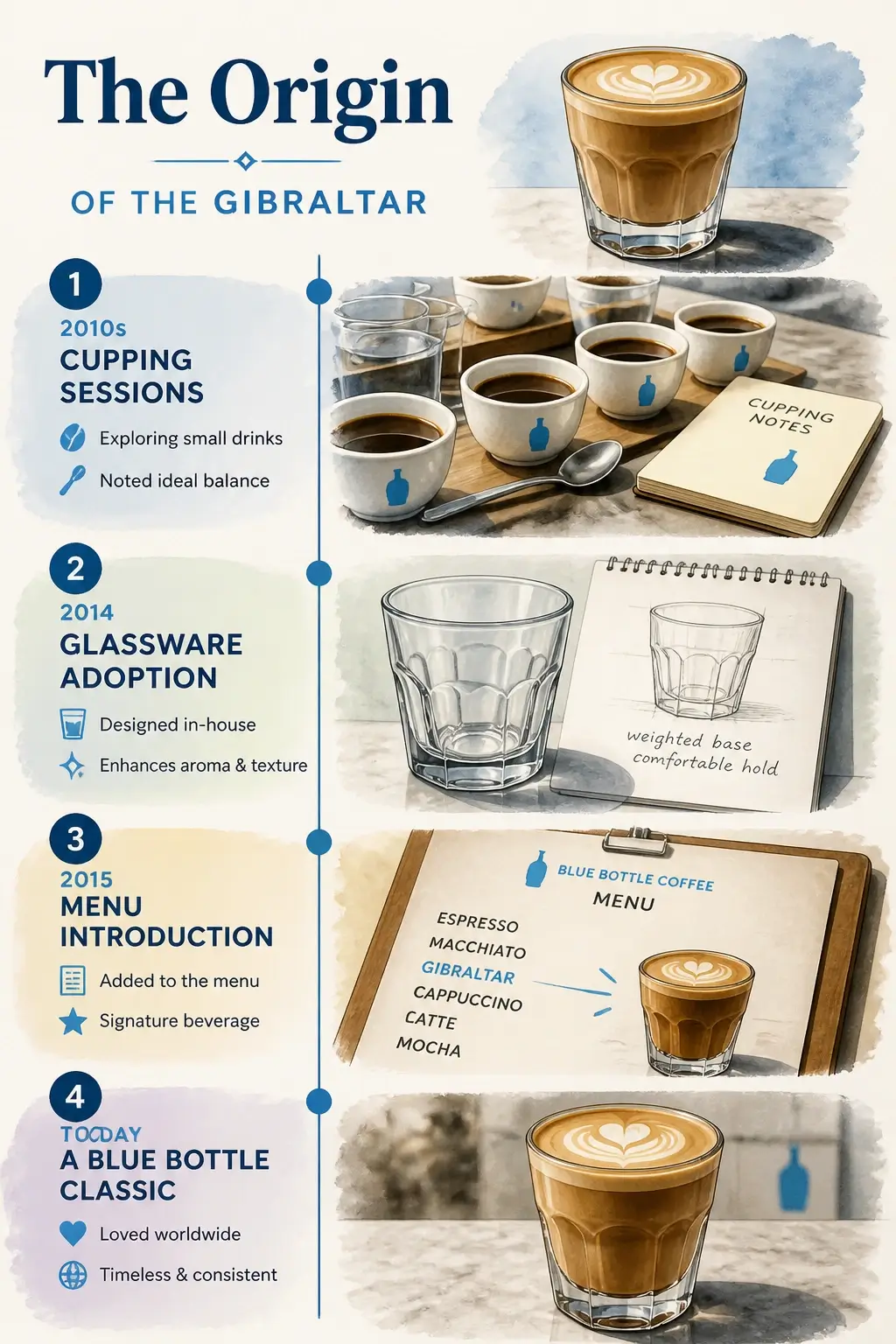
Blue Bottle Coffee didn’t set out to create a new drink category. In the mid-2000s, at their Hayes Valley Kiosk in San Francisco, the team ordered inexpensive 4.5 oz Libbey Gibraltar rocks glasses for coffee cupping – the professional tasting practice where small, neutral vessels help evaluate espresso without distraction.
The glasses were practical and cheap. What happened next was accidental.
Baristas started using those same cupping glasses to serve an espresso-and-milk drink to customers and colleagues behind the counter. The drink itself wasn’t new – it was essentially a cortado, equal parts espresso and lightly steamed milk. But the glass was distinctive enough that customers began asking for it by the vessel rather than any recipe name. “I’ll have what’s in the Gibraltar glass” became shorthand, and eventually the name stuck to the drink itself.
Steve Ford, a former Blue Bottle barista widely credited as the drink’s creator, formulated what was essentially a cortado-style recipe and named it after the glass it was served in. The Gibraltar’s reach extended beyond the Bay Area when Ford later worked shifts at Café Grumpy in New York, bringing the drink – and its name – east with him. Blue Bottle’s eventual menu adoption cemented the term across the specialty coffee world.
The name “Gibraltar” itself comes from Libbey’s product line. The glass manufacturer simply named their 4.5 oz rocks glass after the famous Rock of Gibraltar – presumably for its low, solid profile. The coffee world borrowed the name wholesale.
Here’s a visual timeline of how the drink traveled from a cupping table in Hayes Valley to specialty menus nationwide.
Gibraltar vs. Cortado: The Real Differences (and Similarities)
This is the question that trips up even regular specialty coffee drinkers, and the honest answer isn’t complicated: these are the same core drink. The Gibraltar is a cortado served in a specific branded glass with a San Francisco origin story attached to it. The recipe inside the vessel is functionally identical. Where the confusion comes from is a mix of regional branding, blog-post speculation, and the natural human impulse to make things more distinct than they are.
What Gibraltar and Cortado Actually Share
A traditional cortado is espresso cut with an equal amount of steamed milk – minimal foam, a short drink, typically served in a carajillo-style glass, with a final volume hovering around 5 oz. The emphasis is on balance: the milk moderates the intensity of the espresso without overwhelming it.
The Gibraltar follows the same logic. A double ristretto – a shorter, more concentrated pull – sits at the base, with equal milk poured over or alongside it. The Libbey Gibraltar glass holds the whole thing at 4.5 oz. The ratio, the milk texture, the intent – all of it maps directly onto a cortado. The only material difference is the glassware and the zip code where the name was coined.
Why the Industry Debate Persists Despite the Evidence
The most common attempt to separate these two drinks goes something like this: one has foam, the other doesn’t. Or the steaming technique differs. Or one is built on a double ristretto while the other uses a standard double espresso. None of these distinctions hold up under scrutiny – there is no industry-wide standard governing foam levels for either drink.
Barista consensus, across coffee forums and professional communities, overwhelmingly treats Gibraltar and cortado as interchangeable. The founder of Blue Bottle Coffee has publicly acknowledged that the Gibraltar is, at its core, a cortado. The weight of practitioner experience collapses any attempt to define them as categorically separate recipes.
One definitional error worth correcting directly: some sources have tried to position the Gibraltar as a “large macchiato.” That’s a category error. The macchiato family is defined by milk marking the espresso in a small amount – a few drops or a dollop. Equal volumes of espresso and milk is an entirely different structural relationship. A Gibraltar is not a macchiato, large or otherwise.
The table below maps out the most commonly cited differences between the two drinks against what the evidence actually shows.
| Feature | Claimed Difference | What the Evidence Shows |
|---|---|---|
| Ratio | Gibraltar = 1:1; Cortado = varies | Both are 1:1 espresso to milk by convention |
| Foam | Gibraltar has no foam; Cortado has some | No industry standard governs foam for either |
| Glass | Gibraltar uses Libbey rocks glass; Cortado uses carajillo glass | True – this is the only consistent physical difference |
| Espresso base | Gibraltar uses double ristretto; Cortado uses standard double | Common practice, not a fixed rule for either |
| Interchangeability | Treated as distinct drinks | Most baristas and coffee professionals use the names interchangeably |
| Origin | Different drinks from different traditions | Gibraltar is a branded American version of the cortado concept |
The Espresso Base: Why a Double Ristretto?
A double ristretto drives the Gibraltar’s flavor identity more than any other single variable. Where a standard double espresso pulls roughly 60 ml of liquid through the grounds, a double ristretto stops earlier – around 30 to 40 ml total – extracting the first, richest wave of soluble compounds before the later, more bitter fractions have a chance to follow.
What that shorter pull actually produces is a syrupy, concentrated shot with pronounced sweetness and a heavier body. Less bitterness. More of the sugars and aromatic compounds that define the coffee’s origin character. In a drink as small as a Gibraltar, that distinction matters enormously – because the milk has only 2 ounces of coffee to work with, and if that base lacks intensity, the whole drink collapses into something thin and forgettable.
A peer-reviewed study published in Foods (MDPI, 2023), examining espresso extraction kinetics across ristretto, espresso, and lungo volumes, measured time-resolved extraction of both trigonelline – a sugar-related compound associated with sweetness – and caffeine, a primary bitter constituent. The findings showed that the shorter ristretto pull captures a higher proportion of the early-extracted, sugar-rich solutes while extracting proportionally less of the later-arriving bitter compounds. The chemistry backs up what experienced baristas have long known: stopping the pull early shifts the cup toward sweetness and body, away from bitterness.
On caffeine: a common misconception is that a ristretto delivers meaningfully less caffeine than a standard double espresso. The practical difference is marginal. A double espresso base – whether ristretto or normale – still delivers roughly 120 to 140 mg of caffeine in a Gibraltar. The drink hits hard. It’s just a cleaner, sweeter kind of hard.
Some cafés build their Gibraltar on a standard double espresso rather than a ristretto, and the result is still a good drink. But it loses the exaggerated sweetness and syrupy body that made Blue Bottle’s original version distinctive. If you have the choice, the double ristretto is the right call.
Milk, Texture, and the Unwritten Rules
Lightly textured milk is where the Gibraltar’s balance lives or dies, and it’s also where most of the disagreement between cafés actually originates. The ratio itself is simple: roughly 2 ounces of milk to a double shot of espresso, which brings the total volume to 4 to 4.5 ounces. Everything else – temperature, foam, technique – sits in a gray zone with no universal standard.
A target milk temperature of around 130°F appears in several café recipes, and it makes sense for this drink. That’s warm enough to integrate smoothly with the espresso and to bring out the milk’s natural sweetness, but well below the scalding-hot range of larger milk drinks where temperature is easier to hide behind volume. In a Gibraltar, there’s nowhere for a poorly steamed pour to hide.
The texture goal is lightly steamed milk with a thin, fine layer of microfoam – silky and velvety, not airy or dry the way a cappuccino foam is. The microfoam should be integrated into the milk rather than sitting on top of it as a separate layer. Whether any visible foam should appear on the finished drink is genuinely contested, and no conclusive answer exists. Some baristas pour clean with almost no surface foam; others leave a thin cap. Both versions show up at reputable specialty cafés.
According to reporting by Perfect Daily Grind, more baristas are actively paying attention to milk temperature precision in short milk drinks – a trend that reflects the growing understanding that temperature directly affects perceived sweetness and mouthfeel, particularly in compact drinks where the espresso-to-milk ratio is tight.
The underlying principle is straightforward: the milk’s job in a Gibraltar is to soften and balance the concentrated espresso, not to dominate it. That’s what separates this drink from a latte, where the milk is the main event. Here, precision matters more because the margin for error is smaller. A latte can absorb a slightly over-steamed pour. A Gibraltar cannot.
How to Order and Make a Gibraltar Anywhere
The single most reliable ordering strategy for a Gibraltar is to skip the name entirely. Not every café uses the term, and the ones that don’t may not know what you’re asking for even if they’ve made the drink a hundred times under a different label. Describe the components instead. The script that works anywhere: “A double shot of espresso with about two ounces of lightly steamed milk, in a small glass.” Every trained barista understands that, regardless of what their menu says.
If you’re at a specialty café that does use the term, ordering a Gibraltar or a cortado will get you to the same place – so use whichever one the menu offers.
For home brewers, a true Gibraltar requires an espresso machine. But if you don’t have one, a strong French press approximation gets you close enough to understand the drink. Brew a small, concentrated batch – use more coffee than you normally would, around a 1:10 or even 1:8 ratio – and steam or froth about 2 ounces of whole milk on the stovetop or with a handheld frother until it’s warm and lightly aerated. Pour the coffee first, then the milk, in equal amounts.
Be honest with yourself about the trade-off: a French press version lacks the crema, the syrupy body, and the extraction profile of actual espresso. The result is a satisfying near-equivalent, not a replica. The ratio and the temperature will feel right; the texture and intensity of the base will be different. For a casual weekday morning, that gap is acceptable. For understanding what the drink is supposed to taste like at its best, an espresso machine is the only path.
For a close look at how proper milk steaming technique actually works – the science behind microfoam, temperature, and texture – this training video from Sunergos walks through the mechanics clearly.
Beyond the Name: What Really Defines This Drink
Drink components, not terminology, are what actually matter here – and by now the blueprint should be clear. A Gibraltar is a short, equal-ratio espresso-and-milk drink: canonically a double ristretto with about 2 ounces of lightly steamed milk, served in the 4.5 oz Libbey Gibraltar glass. That’s the whole structure.
The only material difference between a Gibraltar and a traditional cortado is the glass and the brand story attached to it. The drinking experience is interchangeable in the eyes of most coffee professionals, and no amount of blog-post differentiation changes that. The weight of barista consensus, practitioner experience, and the public statements of the drink’s own creators all point to the same conclusion.
There is no consensus on a definitive foam standard for this drink – and there probably won’t be, because the specialty coffee world doesn’t have a governing body deciding these things. Worrying about whether your Gibraltar has the “correct” amount of foam is unproductive. What actually matters is the ratio and the temperature that suit your palate. Start with equal parts, aim for 130°F milk, and adjust from there.
The actionable takeaway is this: knowing the component blueprint – double shot, equal milk, small glass – gives you the language to receive exactly what you want at any café, whether the menu says Gibraltar, cortado, or something else entirely. The name is a label. The structure is the drink.
Key Takeaways on Gibraltar Coffee
- Gibraltar coffee is a double shot of espresso with an equal volume of lightly steamed milk, totaling 4 to 4.5 ounces.
- The drink is named after the 4.5 oz Libbey Gibraltar rocks glass, not a recipe innovation – the glass came first.
- Blue Bottle Coffee in San Francisco popularized the term in the mid-2000s, starting from a barista practice at the Hayes Valley Kiosk.
- A Gibraltar and a cortado are the same core drink; the glass and the origin story are the only real differences.
- A double ristretto base delivers more sweetness and less bitterness than a standard double espresso, which is why it suits this small-format drink.
- Knowing the component blueprint – double shot, equal milk, small glass – lets you order this drink correctly at any café regardless of what it’s called on the menu.
Frequently Asked Questions About Gibraltar Coffee
What’s the difference between a Gibraltar and a cortado?
There’s no meaningful recipe difference – both are equal parts espresso and lightly steamed milk in a short glass. The Gibraltar is essentially a cortado that was named after the specific Libbey rocks glass Blue Bottle Coffee used to serve it.
Is a Gibraltar stronger than a latte?
Yes, significantly. A latte typically uses a double shot in 8 to 12 ounces of milk, which dilutes the espresso heavily. A Gibraltar uses the same double shot in only 2 ounces of milk, so the espresso flavor is far more concentrated and forward.
Can you order a Gibraltar at any coffee shop?
Not by name – many cafés don’t use the term, especially outside the West Coast. Your best move is to describe the drink: a double espresso with about two ounces of lightly steamed milk in a small glass. Any trained barista will know exactly what to make.
Does a Gibraltar have foam on top?
There’s no agreed-upon standard. Some baristas pour it clean with almost no surface foam; others leave a thin cap of microfoam. The more important variable is that the milk itself should be lightly textured and velvety, not dry and airy like a cappuccino.
Why does Blue Bottle Coffee get credit for the Gibraltar?
Blue Bottle didn’t invent the espresso-and-milk ratio – that’s a cortado, a much older drink. What they did was give it a new name tied to a specific piece of glassware, then popularize that name through their cafés and through baristas like Steve Ford who spread it to other cities.
Is a double ristretto required, or can you use a regular double espresso?
A regular double espresso works fine, and many cafés use one. The double ristretto produces a sweeter, more syrupy base with less bitterness, which is what gives the classic Gibraltar its distinctive flavor profile. If your café only pulls standard doubles, the drink is still good – just slightly less intense.
How is a Gibraltar different from a macchiato?
They’re structurally different drinks. A macchiato uses a small amount of milk to “mark” the espresso – a few drops or a dollop. A Gibraltar uses equal volumes of espresso and milk, which produces a much more integrated, balanced flavor rather than espresso with a milk accent on top.
What size glass should a Gibraltar be served in?
The canonical vessel is the 4.5 oz Libbey Gibraltar rocks glass – that’s literally where the name comes from. In practice, any small glass in the 4 to 5 oz range works without meaningfully changing the drink.
References
- The Gibraltar, Cortado, Flat White – What Are These Drinks Anyway? – Sprudge.com
- What Is a Gibraltar Coffee? A Complete Guide to the Trendy Espresso Drink – MensJournal.com
- Foods – Influence of Flow Rate, Particle Size, and Temperature on Espresso Extraction Kinetics – MDPI.com
- More Baristas Are Focusing on Milk Temperature in Coffee Shops – PerfectDailyGrind.com