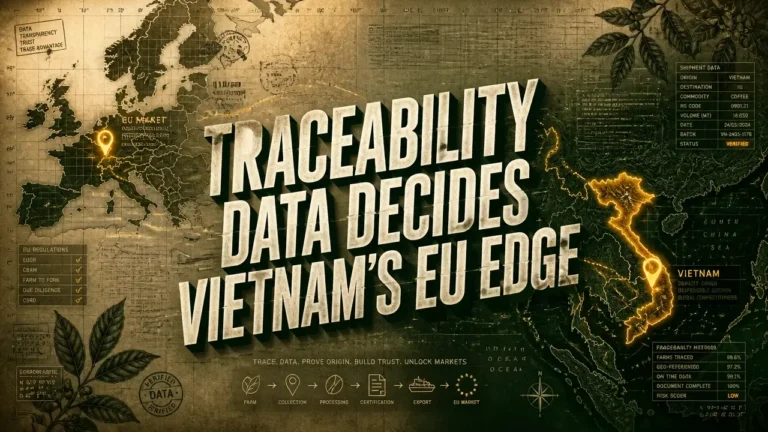

Vietnam’s designation as a “low-risk” country under the European Union’s anti-deforestation law is giving its coffee sector a regulatory edge in Europe, but industry data show that most export supply still needs rapid upgrading before full enforcement begins at the end of 2026.
According to a report from Báo Nông nghiệp và Môi trường, the EU Deforestation Regulation (EUDR) requires coffee entering the bloc to be deforestation-free, legally produced and traceable to its production area, with documentation linked to every stage from farm to final shipment. The same report states that the EUDR, which took legal effect in 2023, will apply from December 30, 2026 for large and medium-sized enterprises and June 30, 2027 for most micro and small enterprises.
The stakes for Vietnamese coffee are high. In the first half of 2026, Vietnam exported 1.1 million tons of coffee worth $4.78 billion, up 9.7 per cent in volume but down 14.4 per cent in value year-on-year, with the EU remaining the largest destination and accounting for more than 40 per cent of export value, VnEconomy reported on August 5. The same article noted that Germany, Italy and the United States were Vietnam’s three largest coffee markets, with market shares of 14.1 per cent, 7.9 per cent and 6.9 per cent respectively.
Yet only a minority of current supply appears ready for the new rules. The Viet Nam Coffee-Cocoa Association (Vicofa) estimates that about 35–40 per cent of Vietnam’s current coffee supply is capable of meeting EUDR requirements, according to Báo Nông nghiệp và Môi trường. In the same report, Vicofa Chairman Nguyen Nam Hai said, “Viet Nam has an advantage in being classified by the EU as a low-risk country. Foreign buyers are now showing interest in and seeking out Vietnamese coffee sources capable of meeting EUDR requirements.”
The European Commission’s low-risk classification means Vietnamese exports will be subject to a simplified due-diligence mechanism and a lower inspection rate than competitors from higher-risk origins. Only 1 per cent of Vietnamese businesses exporting to Europe are subject to strict inspections, compared with 3 per cent for standard-risk and 9 per cent for high-risk countries, VnEconomy reported in May 2025, citing the EU risk-tier framework.
Even with that regulatory advantage, building compliant supply is proving costly and complex. To meet traceability requirements, coffee exporters must link information on land plots, growers, purchasing, sorting, storage and processing to each export shipment, and identify and separate EUDR-compliant coffee from the point of purchase, Báo Nông nghiệp và Môi trường reported. The same article noted that domestic production relies mainly on smallholder households, with purchasing often handled by cooperatives, agents and traders.
One major exporter, Vinh Hiep Co., Ltd., told VnEconomy it has invested approximately VND30–40 billion ($1.15–1.54 million) to review and standardize its production-area database in preparation for EUDR compliance. Chairman and General Director Thai Nhu Hiep said coffee sourced from verified and compliant regions is already sufficient to supply about 40 per cent of the company’s exports to the EU, and that Vinh Hiep generated roughly $1 billion in export revenue in 2025.
However, Hiep also highlighted sector-wide gaps in readiness. In the same interview, he stated that many businesses are relying solely on data from certification bodies without their own verification, and that “some companies barely understand what EUDR requires yet still declare themselves compliant.” He described the challenge in reputational terms, saying compliance is “not simply about selling another shipment” but about “the reputation of Vietnamese businesses and the country’s international standing.”
Early market signals suggest that verified coffee is already being priced differently. Some EUDR-compliant supply sources are commanding prices roughly $50 per ton above the market rate, according to Báo Nông nghiệp và Môi trường. The same report notes that Viet Nam is the EU’s 12th-largest agricultural export partner, and quotes Nguyen Nam Hai as saying that low-risk status and buyer interest “opens an opportunity for Vietnamese coffee to maintain its EU market share once the new regulation takes effect.”
At the regulatory level, the scope of the law has recently become clearer. On July 13, the EU adopted the EUDR Delegated Act finalising the list of covered commodities, adding instant coffee, certain palm oil derivatives and frozen bovine tongues to the regulation’s reach, VietnamPlus reported. The same article stated that only shipments fully satisfying the EUDR’s data requirements will qualify for export to the EU, and described the remaining months before the December 30, 2026 deadline for large companies as a “golden window” for Vietnamese exporters to establish product data management systems.
As these systems take shape, the Ministry of Agriculture and Rural Development notes that the European Commission has increased the budget for its “Team Europe” initiative to €86 million to support developing countries’ transition to legal, sustainable and deforestation-free supply chains, and has issued technical guidelines and frequently asked questions to “ensure easy and efficient data entry for all users,” underscoring that market access for Vietnamese coffee will depend on the quality of traceability data behind each shipment.