

Commercial coffee cultivation exists inside one of the tightest geographical cages in agriculture. The Bean Belt – that narrow equatorial band where Arabica and Robusta actually thrive – isn’t drawn on the map by economists or trade agreements. It’s drawn by biology.
Europe sits entirely above 36°N. Canada doesn’t dip below 49°N. Both are so far outside the belt that the question isn’t really “how do we grow coffee there?” The question is why the plant refuses to cooperate at all – and the answer goes deeper than most coffee lovers expect.
Key Takeaways on Coffee Cultivation
- Commercial coffee cultivation is biologically confined to a band between roughly 25°N and 30°S, with no viable exceptions in Europe or Canada.
- A single frost event can kill a mature coffee tree or destroy an entire season’s fruit; coffee has no cold-hardening mechanism.
- Coffee’s internal flowering and ripening calendar is set by equatorial day length – approximately 12 hours year-round – which high-latitude seasonal swings permanently disrupt.
- Arabica evolved in the Ethiopian highlands as a narrow-niche specialist, trading climate adaptability for the precise conditions that produce its flavor complexity.
- Hawaii sits inside the Bean Belt at 19°N to 22°N; California’s experimental farms at 33°N to 34°N are economically marginal and geographically unrepeatable in Europe.
- Greenhouse coffee is biologically possible but commercially absurd: energy and infrastructure costs push the price per pound into the hundreds of dollars, far beyond any retail price point.
The Invisible Fence: Where Coffee Draws Its Line
Coffee cultivation is commercially possible only within a specific band wrapping the planet’s midsection: roughly 25° North to 30° South of the equator. Farmers, agronomists, and trade routes didn’t draw this boundary. The plant did.
That band has a name: the Bean Belt. And calling it a suggestion would be like calling gravity a preference. Step outside it, and the conditions that coffee needs to complete its full biological cycle – flower, fruit, ripen, repeat – simply stop existing.
Europe falls entirely above 36°N. Canada’s southernmost point sits at 42°N, and most of the country is far above 49°N. Neither continent grazes the edge of the Bean Belt. They aren’t close calls. They’re disqualifications.
Two species dominate commercial coffee cultivation: Arabica, the high-quality, altitude-loving variety prized for its complex flavor, and Robusta, the tougher, lower-altitude species used heavily in espresso blends and instant coffee. Different in many ways, they share one hard rule: neither one escapes the latitude constraint. Arabica is pickier about almost everything. Robusta can handle more heat and humidity. But ask either plant to thrive in Munich or Montreal, and you’ll get the same answer.
The objection comes quickly: “But we have warm summers in southern Europe. Spain gets hot. Italy is sunny.” That’s true. But coffee doesn’t need a warm season. It needs a specific set of conditions maintained year-round, without interruption, for a fruit maturation cycle that runs seven to nine months. A Mediterranean summer doesn’t solve a Mediterranean winter. The plant is keeping a longer calendar than we are.
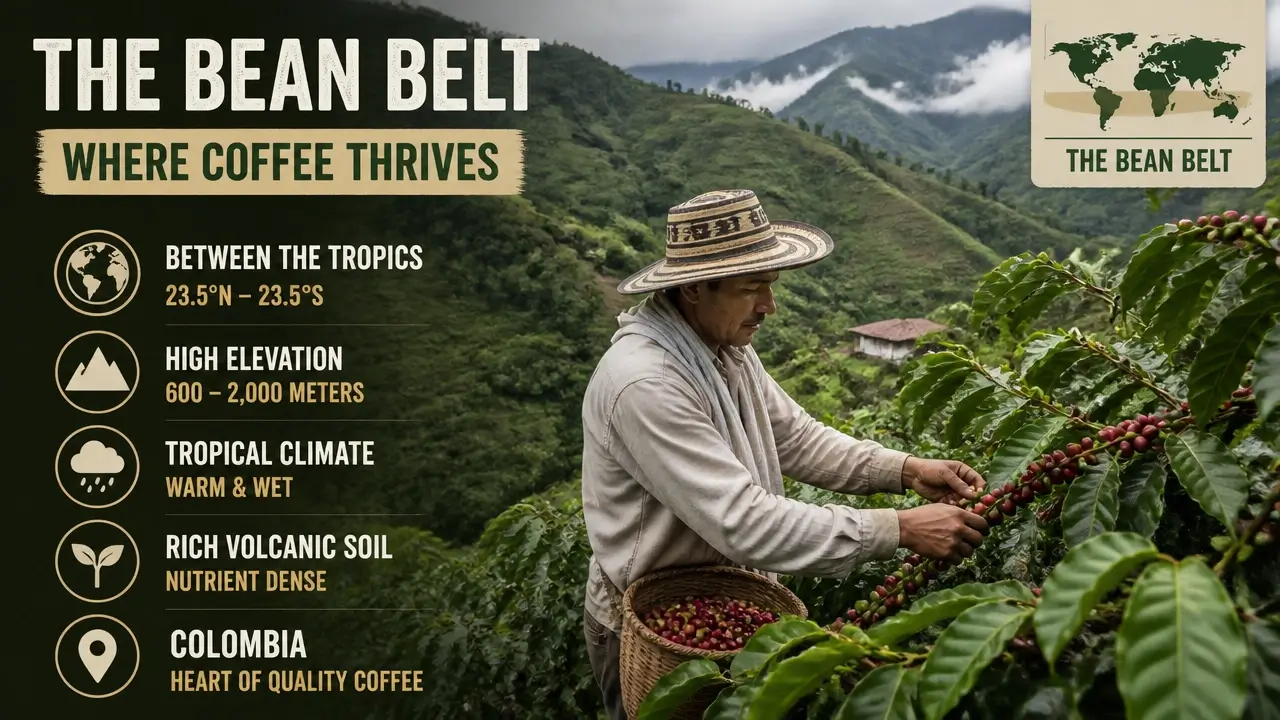
Here’s what the starting point looks like on the ground.
The Thermometer Tyrant: Temperature as the First Gatekeeper
Temperature is the most immediate enforcer of the Bean Belt, and it operates with zero tolerance. Arabica’s ideal annual average sits between 18°C and 22°C (64°F to 72°F). That’s a band of just four degrees Celsius. Push outside it consistently in either direction and the plant’s productivity collapses. Push below freezing even once, and the damage can be permanent.
Frost is not a stressor for coffee. It’s a death sentence. A single frost event – one night where temperatures dip below 0°C – can kill a mature coffee tree outright, or wipe out the developing fruit for an entire season. The plant has no cold-hardening mechanism. Its cellular structure was never built to handle ice crystal formation in its tissues, because in its native evolutionary environment, that threat never existed.
Europe and Canada fail this test in two ways, not one. The first is the obvious one: winter temperatures in both regions drop far below freezing, into territory where coffee roots and wood tissue sustain irreversible damage even without a hard freeze. But the second failure is subtler and equally damaging. Months spent below 10°C (50°F) – even without actual frost – cause what plant physiologists call chilling injury. Cellular processes slow, membrane integrity degrades, and the plant cannot recover its full metabolic function when warmth returns.
The contrast is stark when you put it side by side. In January, a Colombian coffee farm at 1,500 meters elevation in Antioquia sits at roughly 18°C to 21°C. A farm in Andalusia, Spain – the warmest agricultural region in Europe – sits at 8°C to 12°C in the same month, with nighttime lows regularly approaching 3°C to 5°C. That’s not a small gap to bridge. That’s a different climate category entirely.
Statistical Data: A 2017 frost event in Yunnan, China damaged approximately 10,000 hectares of coffee farmland – about 9% of the region’s total harvest area – generating an estimated US$10 million in crop losses. – Source: Nature Portfolio
Yunnan is at roughly 25°N latitude, sitting right at the northern edge of the Bean Belt. That frost event happened at the absolute frontier of viable coffee cultivation – the very margin where temperatures are already borderline. Europe and Canada sit hundreds of miles further north, where that kind of cold is not a rare event. It’s the standard winter.
The Sun’s Schedule: Photoperiodism and the Calendar Coffee Obeys
Even if you could somehow guarantee warmth year-round in Canada – heated soil, insulated fields, some elaborate engineering project – you would still face a second biological wall. Photoperiodism: the coffee plant’s internal clock, set by the length of day and night, and calibrated to a very specific latitude.
Arabica coffee evolved near the equator, where day length stays close to 12 hours of daylight every single day of the year. Not 12 hours in spring and 16 hours in summer. Twelve hours, consistently, through every month. That constancy isn’t scenery. It’s the metronome the plant’s entire reproductive cycle keeps time to.
The plant reads the ratio of light to darkness to trigger its key biological events: when to flower, when to set fruit, when to push energy into ripening. These aren’t flexible preferences. They’re hardwired developmental programs. And they were written for equatorial day-length patterns.
A 2020 study published in Tree Physiology experimentally exposed Coffea arabica to both a standard 12-hour photoperiod and a shortened 8-hour photoperiod, then tracked the molecular consequences. The results showed large-scale reprogramming of the plant’s gene expression – including core clock genes – along with measurable physical changes: reduced growth rates, thinner leaves, lower chlorophyll content, and disrupted secondary metabolism. The study demonstrates that day-length sensitivity is a core molecular mechanism governing coffee’s development, not a minor environmental preference.
Now apply that to Europe and Canada. In summer, days at 48°N to 55°N stretch to 16 to 18 hours of light. The plant’s flowering signals get scrambled. In winter, those same locations collapse to 8 to 9 hours of daylight – insufficient photosynthetic energy to sustain the fruit through its seven-to-nine-month maturation period. The plant isn’t confused because it’s fragile. It’s confused because the instructions it received from 600,000 years of equatorial evolution don’t include a chapter for Nordic winters.
And here’s the constraint that separates photoperiodism from temperature: you can build a greenhouse and run heaters. You cannot tilt the Earth’s axis over your farm. The seasonal swing in day length at high latitudes is a fixed astronomical fact. No amount of money or engineering reverses it outdoors.
A Child of the Highlands: Coffee’s Evolutionary Handcuffs
Coffee’s rigidity isn’t a flaw in the species. It’s the logical outcome of where it came from. Coffea arabica evolved as an understory shrub in the highland forests of Ethiopia, growing beneath a forest canopy at elevations between 1,500 and 2,000 meters. That environment was extraordinarily stable: consistent temperatures, consistent rainfall patterns with a distinct dry season to trigger flowering, and that near-constant 12-hour photoperiod. For hundreds of thousands of years, the plant never needed to adapt to anything else.
Evolutionary specialization works like this: the more precisely an organism is tuned to a specific environment, the better it performs there, and the worse it performs anywhere else. Coffee traded broad adaptability for exceptional performance in one narrow ecological niche. Its entire biochemistry – the enzyme systems, the hormonal triggers, the metabolic pathways – is calibrated to those Ethiopian highland signals. Expose it to a different signal set and the calibration fails.
Compare that to tea, Camellia sinensis. Tea evolved in the seasonal monsoon climates of East Asia, where temperatures drop significantly in winter and day length swings dramatically between seasons. That evolutionary history built flexibility into the plant’s architecture. Tea can handle the cold winters of England, the variable days of Darjeeling, the humidity swings of coastal Japan. It has the genetic toolkit for range. Coffee simply doesn’t, because its ancestral home never demanded it.
The irony worth sitting with is this: the same narrow environmental requirements that exclude coffee from most of the planet are responsible for the flavor complexity that makes it worth drinking. The slow, even maturation in stable highland conditions – driven by that specific temperature range, that specific light schedule, that specific rainfall pattern – is what builds the layered acidity, sweetness, and aromatic compounds in a good Arabica bean. The pickiness and the quality come from the same source.
Mapping the Impossible: The Bean Belt vs. Europe and Canada
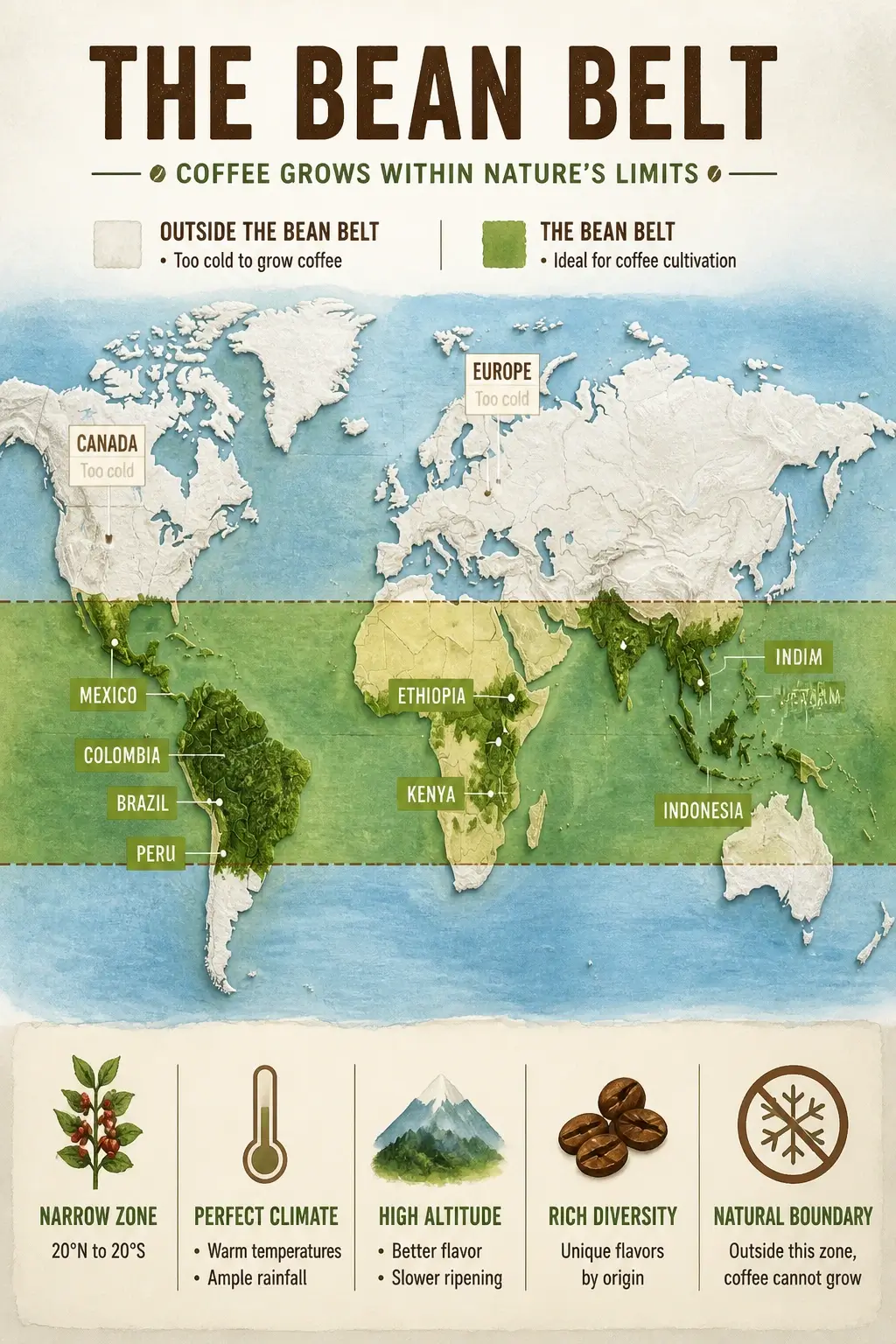
The coffee belt becomes unmistakable the moment you look at a production map. It’s a horizontal band wrapped around the planet’s equatorial waist, anchored between the Tropics of Cancer (23.5°N) and Capricorn (23.5°S), with extensions to about 30° in locations where elevation or coastal microclimates soften the rules slightly. Outside that band: nothing.
The major producing regions all sit squarely inside it. Central and South America – Colombia, Brazil, Guatemala, Costa Rica – occupy the western arc. Africa contributes Ethiopia and Kenya from the east. Southeast Asia fills out the picture with Vietnam and Indonesia. These aren’t random agricultural choices. They’re the only places where the biological checklist gets fully satisfied.
On that same map, all of Europe and all of Canada are a blank. Not sparse. Blank. The southernmost point of mainland Europe is Tarifa, Spain, at 36°N – already more than 600 kilometers north of the Tropic of Cancer, and still well outside even the most generous extension of the Bean Belt. No European location, however sunny, however sheltered, sits inside the zone.
Hawaii and California are the questions that always follow, and they’re worth addressing precisely. Hawaii sits between 19°N and 22°N – squarely inside the Bean Belt – which is why Kona coffee is real and commercially viable, though expensive. Southern California has a handful of experimental farms clinging to 33°N to 34°N, where a unique combination of coastal fog, marine temperature moderation, and intensive management creates borderline viability. The economics are brutal and the yields are tiny, but the biology is marginally workable. No location in Europe or Canada has that combination of latitude and coastal microclimate. The comparison doesn’t transfer.
The map isn’t reflecting trade history or colonial accident. It’s reflecting biology. The colors stop exactly where the plant stops cooperating.
The Greenhouse Gambit: Why Breaking the Rules Costs a Fortune
Greenhouse coffee farming is biologically real. You can grow a Coffea arabica plant in a pot in the UK, in a botanical garden in Canada, in a climate-controlled room in Sweden. The plant will live. It might even produce a small amount of fruit. This is not in dispute.
What’s in dispute is whether any of that constitutes coffee cultivation in any commercially meaningful sense. And when you run the numbers, the answer is unambiguous.
Start with the baseline output. A single coffee tree at peak productivity yields roughly 1 pound (0.45 kg) of roasted coffee per year. That’s the equatorial farm number, where conditions are optimal and the plant is doing exactly what it evolved to do. It also takes three to four years from planting to first harvest. You are committing years of investment before the first bean.
Now move that tree to a Canadian winter greenhouse. To keep it alive and productive, you need to maintain temperatures above 16°C year-round, which means continuous heating through a climate that regularly hits -20°C outside. You need supplemental lighting to correct the day-length signal – high-intensity grow lights running on a 12-hour schedule through winters where natural light is available for only eight hours. You need humidity management, because Canadian indoor air in winter is desert-dry. You need soil management, because the mycorrhizal ecosystems of Ethiopian highland soil don’t transplant themselves.
The energy cost per pound of coffee produced in that environment would run into the hundreds of dollars. A pound of exceptional Colombian single-origin coffee retails for $15 to $20. A pound of the world’s most expensive commercially traded coffees – Jamaican Blue Mountain, Panama Geisha – might reach $50 to $80. The greenhouse-grown Canadian pound would cost more to produce than any of them, by a wide margin, while likely producing an inferior result because the plant is fighting its environment rather than thriving in it.
Coffee cultivation doesn’t fail in Europe and Canada because the plant refuses to exist there. It fails because the plant refuses to be profitable there. The latitude barrier holds, enforced not by any law or trade agreement, but by the combined weight of biology and basic arithmetic. Those two forces have never lost an argument with a greenhouse operator.
Frequently Asked Questions About Coffee Cultivation
What latitude does coffee grow at?
Commercial coffee cultivation generally runs between 25°N and 30°S of the equator, though the core of production clusters even tighter, between the Tropics of Cancer and Capricorn at 23.5°N and 23.5°S.
How far north can coffee grow commercially?
The absolute northern fringe sits around 30°N to 34°N in locations with exceptional microclimates, like Hawaii or a handful of experimental California farms. Beyond that, the combination of winter cold and disrupted day length makes commercial production economically impossible.
Why can’t technology just solve the climate problem for coffee?
Temperature can be engineered around with greenhouses and heaters. Day length cannot – the Earth’s axial tilt determines photoperiod at any given latitude, and no farming technology changes that outdoors. Indoors, correcting it with supplemental lighting costs far more than the coffee is worth.
Does Robusta have the same geographical limits as Arabica?
Robusta tolerates lower altitudes, higher humidity, and slightly higher temperatures than Arabica, but it doesn’t escape the latitude constraint. It’s still a tropical plant that requires frost-free conditions year-round and a consistent equatorial-style climate.
Could climate change eventually allow coffee farming in southern Europe?
Warming temperatures might reduce frost risk in some Mediterranean locations, but they won’t fix the photoperiod problem. Day length at 36°N to 40°N is set by latitude, not temperature. Warmer winters alone don’t make southern Europe viable for commercial coffee.
Why can tea grow in England but coffee can’t?
Tea (Camellia sinensis) evolved in the seasonal monsoon climates of East Asia, where cold winters and variable day lengths are normal. That evolutionary history built cold tolerance and photoperiodic flexibility into the plant. Coffee evolved in the stable Ethiopian highlands and never developed either trait.
Is there any coffee grown in Europe at all?
Portugal’s Azores islands, which sit at roughly 38°N in the Atlantic, host a small commercial coffee operation on the island of São Jorge. The Atlantic microclimate moderates temperatures enough to make it marginally viable, but output is tiny and costs are high. It’s the exception that proves the rule, not a template for mainland Europe.
What makes the Ethiopian highlands so important to coffee cultivation?
The Ethiopian highlands are where Coffea arabica evolved, and the conditions there – stable temperatures between 18°C and 22°C, consistent rainfall with a dry trigger period, and near-constant 12-hour days – are the exact template the plant’s biology is built around. Every commercial coffee farm on Earth is essentially trying to replicate those conditions.
References
- Photoperiod-dependent transcriptional modifications in key metabolic pathways in Coffea arabica | Oxford Academic (Tree Physiology)
- Frost impacts on coffee cultivation in Yunnan, China | Nature Portfolio