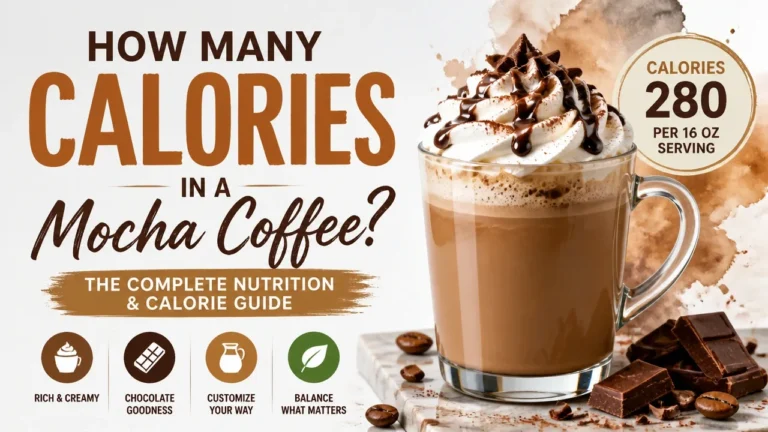

Mocha coffee calories are one of the most misread numbers in any café menu – because most people blame the espresso when the real culprits are the chocolate sauce, steamed milk, and the cloud of whipped cream on top. A standard Grande Caffè Mocha at Starbucks clocks in at around 370 calories, but that number swings dramatically depending on size, milk type, and how many pumps of chocolate syrup end up in the cup.
Understanding where those calories actually live – and why a white mocha hits harder than a standard one – changes how you order. This guide walks through the full size matrix, the component math, and the swaps that cut the count without gutting the drink.
What’s Actually in a Mocha Coffee
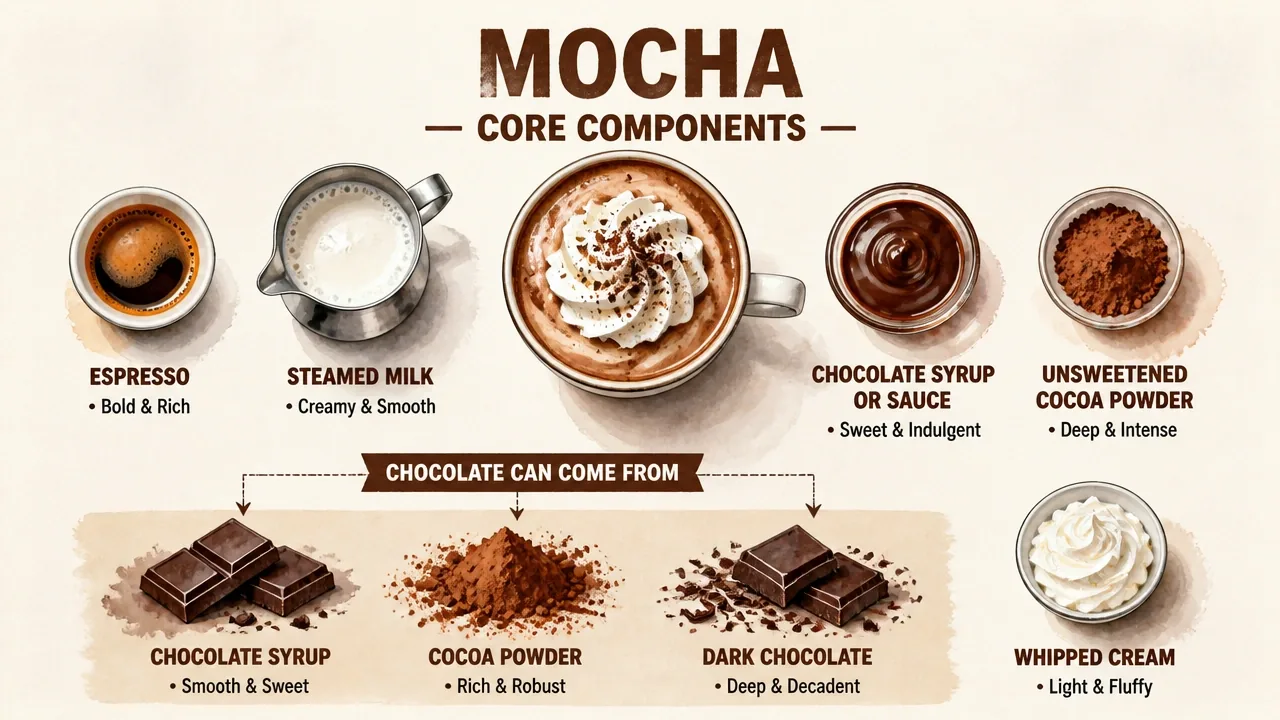
A cafe mocha is built from three core layers: an espresso or strong-brewed coffee base, steamed milk, and some form of chocolate flavoring – usually a sauce, syrup, or powder. Most versions are finished with whipped cream. That’s the standard build, and it’s deceptively simple on the surface.
The part that trips people up is the word “chocolate.” It sounds like one ingredient, but it isn’t. A mocha chocolate sauce – the kind Starbucks pumps into the cup – is a sweetened, emulsified product that behaves more like a flavored sugar syrup than a spoonful of cocoa. Unsweetened cocoa or cacao powder, by contrast, is nearly calorie-free per teaspoon and carries none of the added sugar. These two things are not interchangeable from a calorie standpoint, and confusing them leads to wildly wrong estimates.
The coffee base itself – two shots of espresso – contributes almost nothing to the calorie total. Around 5 to 10 calories, total. The milk, the chocolate component, and the whipped cream are where the numbers actually live, and those three ingredients vary enough between recipes that two drinks called “mocha” can differ by 200 calories or more.
That gap gets even wider when white mocha syrup enters the picture. Standard thin chocolate syrups run roughly 20 calories per pump. White mocha sauce – which is thicker, richer, and sweeter – has been reported closer to 49 to 60 calories per pump. Order a Grande with white mocha instead of classic mocha sauce, and you’ve already shifted the calorie center of gravity before the milk even hits the cup.
While traditional builds rely on dark or milk chocolate sauce, variations like the white caramel mocha substitute cocoa bases with sweet confectionary sauces that noticeably alter the final calorie count.
Starbucks Mocha Calories by Size
The fastest answer: a standard Tall 12 oz Starbucks mocha with 2% milk and whipped cream lands at approximately 290 calories with 27 grams of sugar. That’s the most commonly ordered size, and it’s a reasonable calorie benchmark.
But the number moves meaningfully as the size goes up. Here’s the full matrix based on a standard build with 2% milk:
| Size | Oz | Calories (with whip) | Calories (no whip) | Sugar |
|---|---|---|---|---|
| Short | 8 oz | 200 | 140 | 18g |
| Tall | 12 oz | 290 | 210 | 27g |
| Grande | 16 oz | 370 | 290 | 35g |
| Venti | 20 oz | 450 | 370 | 45g |
The whipped cream alone accounts for roughly 70 to 100 calories at every size – which means skipping it on a Grande drops you from 370 to around 290 in a single decision.
One honest caveat: these numbers are reliable benchmarks, not exact receipts. Milk volume, chocolate pump calibration, and machine settings vary by store and by barista. Community observations from working baristas consistently note that a “standard build” in practice isn’t always the same as the one on the nutrition sheet. Use the matrix as a confident estimate, not a precise measurement.
The Grande Iced Mocha is worth a separate mention: it comes in at roughly 350 calories, compared with 370 for the hot version. The slight difference comes from the ice displacing some milk volume. It’s not a dramatic swap, but it’s real.
For those looking to explore beyond the classic recipe, comparing these figures against other popular chocolate drinks at starbucks reveals how milk fats and syrup volumes shift the nutritional scale.
The Calorie Mechanism: Component Math Behind Every Mocha
Every mocha calorie total is the sum of four parts. Once you see the drink that way, you can estimate any mocha – café, machine, or homemade – without needing a nutrition label.
Espresso, Milk, Syrup, and Topping Ranges
Here’s how the four components stack up in a typical build:
- Espresso base (1–2 shots): 5–10 calories. Essentially noise.
- Steamed 2% or whole milk (8 oz): 120–150 calories. This is the foundation of the drink’s calorie load.
- Chocolate syrup or sauce (3 pumps): 75–100 calories. Varies significantly by product type – standard mocha sauce vs. white mocha sauce is not an apples-to-apples comparison.
- Whipped cream topping: 70–100 calories. Optional, but it’s on by default at most cafés.
Add those up and you land squarely in the 270 to 360 calorie range for a medium-sized drink – which aligns directly with the Starbucks figures above. The math is consistent because the physics is consistent.
Reverse-Engineering Drink Totals
Take a Tall mocha at 290 calories with whip. Back it out: roughly 5 calories of espresso, 100 calories of milk (smaller cup, less milk), 80 calories of chocolate syrup, and 80–90 calories of whipped cream. That adds up to 265–275 calories, close enough to confirm the model is working.
A Grande mocha at 370 calories follows the same logic: more milk (around 130–150 calories), more chocolate pumps (90–100 calories), same whipped cream (80–100 calories). The espresso still contributes almost nothing.
The practical value of this isn’t just trivia. When a nutrition label is missing – at a local café, a hotel breakfast station, or a friend’s kitchen – you can build a credible estimate from the ground up. Ask what milk they’re using, how many pumps of chocolate, and whether whipped cream is included. Those three answers give you 95% of the information you need.
Is Your Daily Mocha Making You Gain Weight?
One Grande Caffè Mocha per day at 370 calories is easy to absorb into a morning routine without noticing. But if those 370 calories sit on top of your normal maintenance intake – meaning your body doesn’t need them for energy – they accumulate to about 2,590 extra calories per week. Using the standard 3,500-calorie-per-pound approximation, that’s roughly 0.74 pounds of body fat per week, or close to 3 pounds per month.
The sugar picture is just as worth examining. One Grande mocha contains about 35 grams of added sugar. The American Heart Association’s guidelines, drawn from a scientific statement published in Circulation, recommend limiting added sugars to no more than 100 calories per day for most women (roughly 25g) and 150 calories per day for most men (roughly 36g). A single Grande mocha already exceeds the women’s target and nearly hits the men’s – before any food has been eaten.
A 2009 AHA scientific statement in Circulation found that over a 30-year period, total calorie intake rose by 150 to 300 calories per day, with roughly half of that increase coming from liquid calories – primarily sugar-sweetened beverages. The statement also noted that a persistent daily energy surplus of just 50 calories could result in up to 5 pounds of weight gain over a single year. – From the study “Dietary Sugars Intake and Cardiovascular Health: A Scientific Statement From the American Heart Association“
That finding matters because a mocha is liquid calories in the most literal sense – it doesn’t register in the brain the same way a meal does. Most people don’t eat less at breakfast because they had a mocha on the way in. The drink adds on top, not instead of.
Dr. Penny Kris-Etherton, Evan Pugh University Professor of Nutritional Sciences Emeritus at Penn State, puts the size-swap math plainly:
According to Dr. Kris-Etherton, writing for the American Heart Association, something as straightforward as downsizing your coffee order can cut sugar intake by more than half – moving from the largest pumpkin spice drink to the smallest drops you from nearly 16 teaspoons of sugar to just over 6. For anyone not ready to give up the drink entirely, she recommends that as a first, practical step.
The mocha parallel is direct: the same size-reduction logic that applies to a pumpkin spice drink applies here. Dropping from a Venti to a Tall, before changing anything else, cuts roughly 160 calories and about 18 grams of sugar.
The Skinny Mocha Strategy: Cut 50%+ Without Losing Chocolate Flavor
Getting a Skinny Mocha down to 140–160 calories doesn’t require ordering something you won’t enjoy. It requires three targeted swaps, each of which attacks one of the three major calorie components.
Swap one: skip the whipped cream. This is the highest-leverage single change you can make. Whipped cream adds 70–100 calories and is entirely optional. Most cafés will leave it off on request, and the chocolate flavor underneath doesn’t change at all.
Swap two: switch the milk. Moving from whole milk to skim milk saves roughly 40–50 calories per drink. Moving to unsweetened almond milk saves a similar amount – sometimes more – and brings the sugar content down as well. The texture changes slightly, but the core character of the drink holds.
Swap three: cut the chocolate pumps in half. A standard Grande mocha uses four pumps of chocolate sauce. Asking for two pumps saves roughly 50 calories and about 12 grams of added sugar. The drink still tastes like a mocha – it’s just a less intensely sweet one.
Apply all three swaps to a Grande, and you move from approximately 370 calories to roughly 140–160 calories. That’s a 55–60% reduction without switching to a different drink category or giving up the espresso-and-chocolate combination entirely.
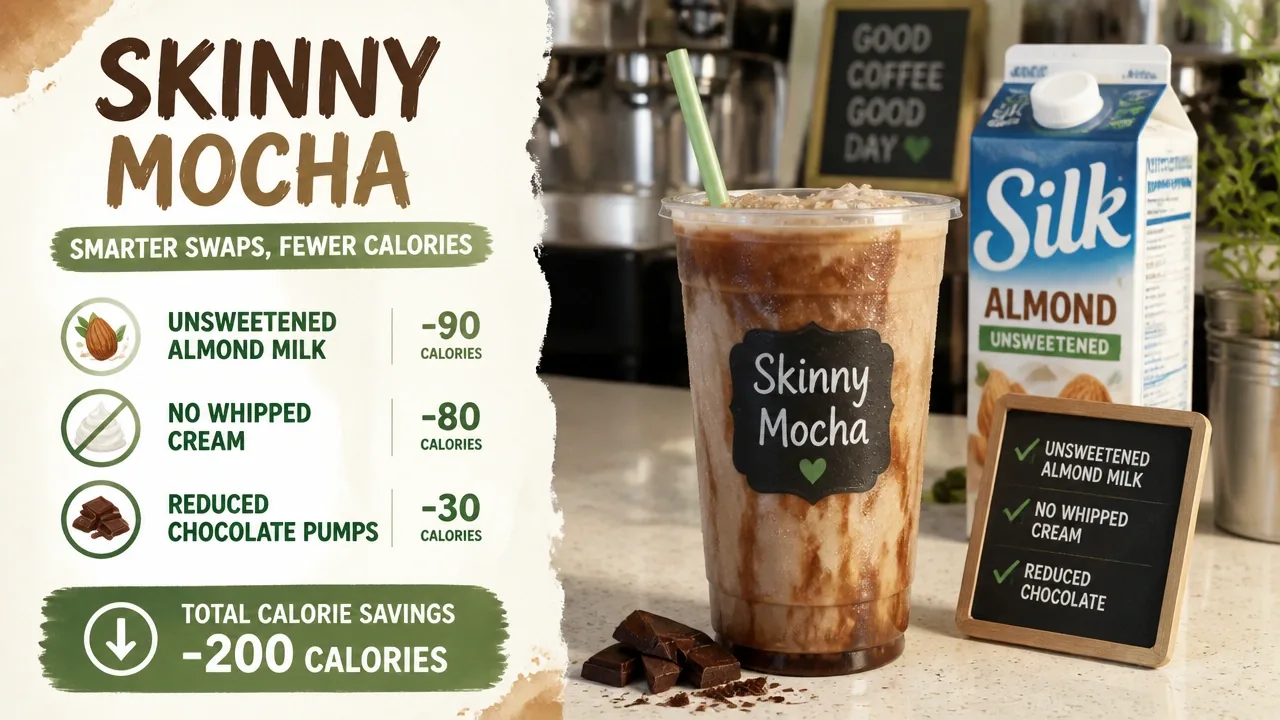
The order in which you make these swaps matters strategically, not calorically. If you can only make one change today, skip the whipped cream. It’s the fastest calorie cut with the least impact on flavor. Add the milk swap next. Reduce the pumps last, once your palate has adjusted to a less sugary baseline.
Mocha vs. Other Espresso Drinks: The Calorie Hierarchy
A cafe mocha is the highest-calorie staple in the standard espresso lineup, and the reason isn’t subtle: it’s the only drink in that lineup that adds both chocolate syrup and whipped cream on top of an already milk-heavy espresso base.
Here’s where it sits relative to familiar alternatives:
| Drink | Approximate Calories (16 oz) |
|---|---|
| Black Americano | 5–10 |
| Cappuccino (whole milk) | 120–140 |
| Caffe Latte (whole milk) | 150–220 |
| Caffe Mocha (whole milk + whip) | 360–450 |
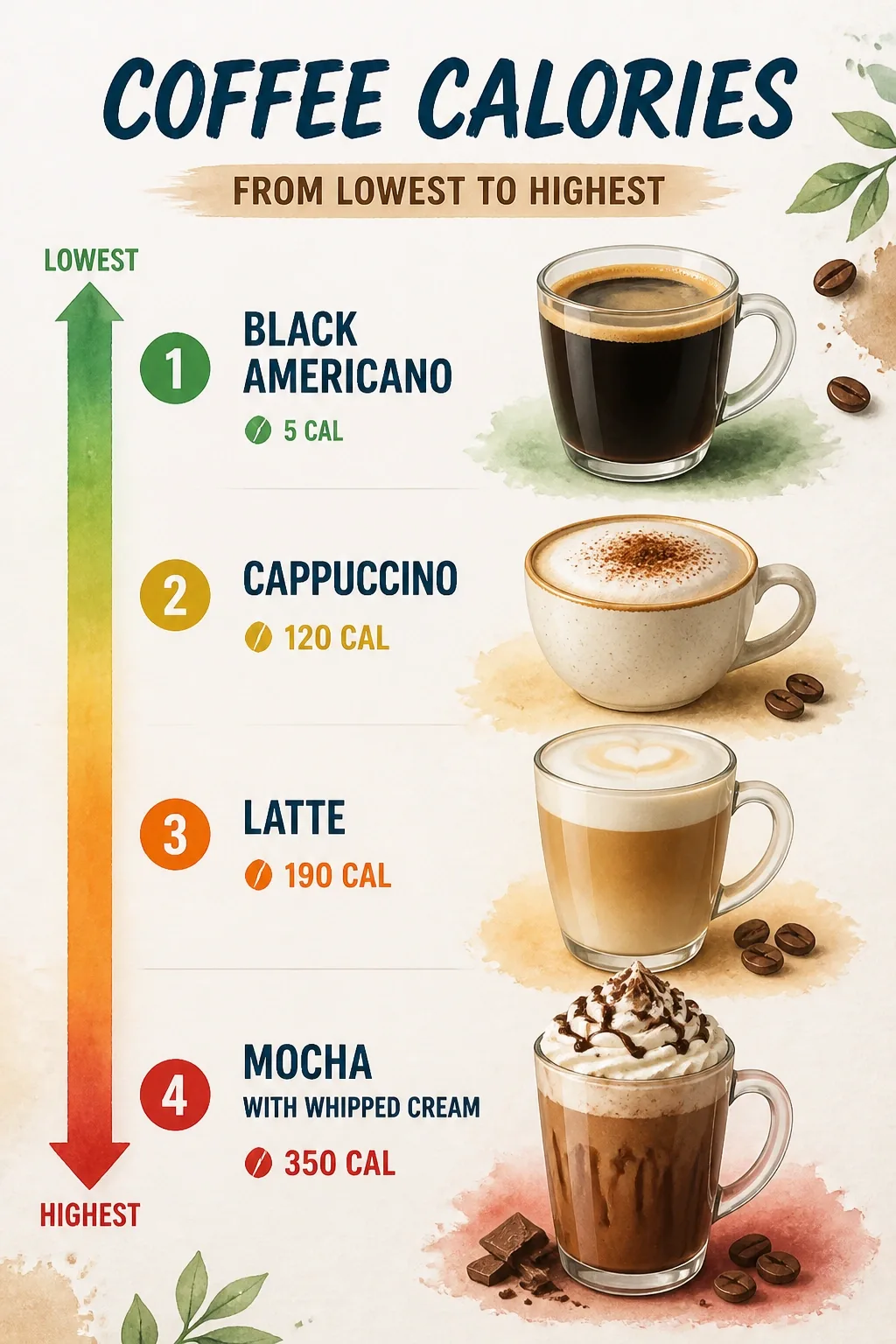
A cappuccino uses roughly the same espresso base but far less milk – it’s mostly foam – and no added chocolate or sweetener. A latte uses more milk than a cappuccino but still stops before the chocolate layer. The mocha adds that entire chocolate component on top of the latte’s milk base, then crowns it with whipped cream. Each addition is individually modest; together, they push the total to nearly three times what a latte contains.
If you’re comparing drinks and trying to find the lowest-calorie option with some coffee flavor, a black Americano – espresso diluted with hot water – is the answer. It has essentially no calories and no sugar. A cappuccino is the next step up if you want milk without the weight of a full latte or mocha.
Understanding this extreme caloric density clarifies the stark nutritional contrast highlighted in any standard mocha vs macchiato comparison.
Beyond the Menu: Coffee Machine Mochas, Homemade Mochas, and Your Real Number
Not every mocha comes from a café counter. Office coffee machines, hotel breakfast stations, and home kitchens produce plenty of mocha-style drinks – and those are the ones where the calorie estimate most often goes wrong.
Automated Dispenser Servings
When a mocha comes from a coffee machine – the kind that uses powder sachets or pressurized units – the cup volume tells you almost nothing. What you need to count is the number of sachets or powder scoops the machine dispenses per serving, plus any milk or water added separately.
A standard machine sachet might list 80 calories per serving, but that number assumes a specific water ratio and no additional milk. If the machine also steams milk into the cup, or if you’re adding creamer on top, the actual total is higher. The variables that public nutrition guides typically flatten – milk-to-coffee ratio, sweetened vs. unsweetened chocolate powder, pump or unit count – are exactly the ones that matter most in a machine context.
Residential Brewing Parameters
Making a mocha-style drink at home gives you more control than any café order. The coffee base doesn’t require an espresso machine. A French press or pour-over brewed with whole beans roasted within the last 30 days, ground on a burr grinder, using a medium roast at a 1:15 coffee-to-water ratio, with water between 195 and 205°F, produces a strong, clean base that works well as a mocha foundation.
From there, the chocolate layer is your biggest calorie lever. Unsweetened cacao powder dissolves well in hot liquid and adds genuine chocolate flavor with almost no calories. Pair that with unsweetened almond milk and a zero-calorie sweetener, and you have a mocha-style drink that can land around 65 calories total – a number that would be impossible to achieve at a standard café without a custom order conversation.
Component-Order Assembly and Benchmark Comparison
Build the home version in this sequence: prepared coffee base → milk alternative → unsweetened cocoa or cacao powder → optional zero-calorie sweetener. Mix the cocoa powder with a small amount of hot coffee first before adding the milk – it dissolves more evenly that way and avoids clumping.
When comparing against commercial benchmarks, a 16 oz homemade mocha assembled this way lands well below anything on a café menu. You may occasionally see a 16 oz cafe mocha listed at 89 calories in nutrition databases or fitness apps – practitioners generally flag that figure as non-standard. A number that low almost certainly reflects an unusual milk choice (water, unsweetened oat milk), unsweetened powder instead of syrup, and a zero-calorie sweetener. It’s technically achievable, but it’s not what most people picture when they order a mocha. Treat it as a data point for what’s possible with aggressive substitutions, not as a typical baseline.
Here’s a video that walks through three ways to build a mocha at home, from the simplest version to a more refined approach:
Key Takeaways on Mocha Coffee Calories
- Espresso contributes almost nothing to mocha calories; milk, chocolate sauce, and whipped cream are the three real drivers.
- A Grande Starbucks Mocha with whipped cream runs about 370 calories and 35g of added sugar – exceeding the AHA daily sugar limit for women in a single drink.
- Skipping whipped cream is the single highest-leverage swap, cutting 70–100 calories instantly with no flavor loss.
- White mocha syrup runs 49–60 calories per pump versus roughly 20 for standard chocolate syrup – the chocolate type matters as much as the size.
- A homemade mocha built with unsweetened cacao powder and almond milk can come in around 65 calories for a 16 oz serving.
- Knowing the four-component model (espresso, milk, chocolate, topping) lets you estimate any mocha’s calories even without a nutrition label.
Frequently Asked Questions About Mocha Coffee Calories
How many calories are in a regular mocha coffee?
It depends on size and build, but a standard 16 oz mocha with whole milk and whipped cream typically lands between 360 and 450 calories. At Starbucks specifically, a Grande with 2% milk and whip is about 370 calories.
Is mocha coffee high in sugar?
Yes – a Grande Starbucks mocha contains about 35 grams of added sugar, which already exceeds the American Heart Association’s daily recommended limit for women and nearly meets the limit for men.
How many calories are in a mocha made in a coffee machine?
It varies more than most people expect. The sachet or powder count, the milk type, and whether the machine adds milk separately all affect the total. Don’t rely on cup volume – read the sachet label and account for any milk added.
Which coffee is lowest in calories?
A black Americano – espresso diluted with hot water – has roughly 5 to 10 calories and no sugar. It’s the lowest-calorie option with genuine coffee flavor in any café lineup.
Does iced mocha have fewer calories than hot mocha?
Slightly. A Grande Iced Mocha is about 350 calories compared to 370 for the hot version, because ice displaces some milk volume. It’s a real difference, but not a dramatic one.
What’s the difference in calories between white mocha and regular mocha?
White mocha syrup is significantly denser – around 49 to 60 calories per pump versus roughly 20 for standard chocolate syrup. In a Grande with four pumps, that difference can add 100 to 160 extra calories before anything else changes.
Can I make a mocha under 200 calories at Starbucks?
Yes. Order a Tall with skim or unsweetened almond milk, no whipped cream, and two pumps of mocha sauce instead of three. That combination typically lands in the 130 to 160 calorie range.
Does the type of milk change mocha calories significantly?
It does. Whole milk adds roughly 150 calories per 8 oz; 2% milk is around 120; skim milk drops to about 80; unsweetened almond milk comes in around 30 to 40. Over time, that gap compounds across daily orders.
References
- Dietary Sugars Intake and Cardiovascular Health: A Scientific Statement From the American Heart Association | ahajournals.org
- Why Sugar Matters and How to Cut Back If You Are Eating Too Much of It | heart.org