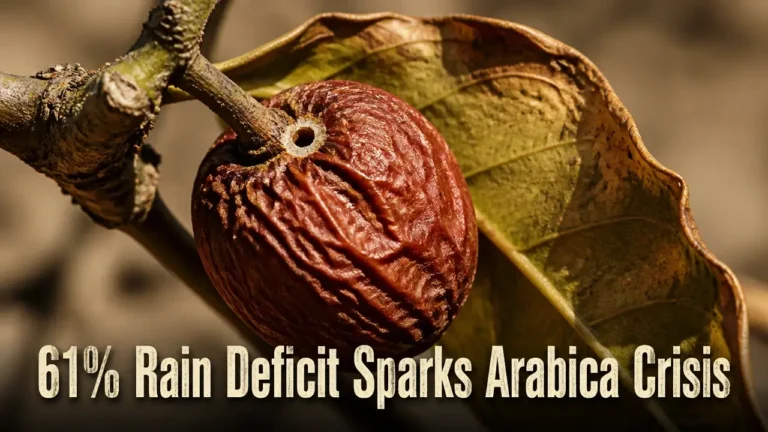

India’s Arabica coffee sector is facing a new season of pressure as weak monsoon rains and resurgent white stem borer outbreaks collide with a pattern of overly optimistic official crop estimates, according to growers, meteorological data and government statistics compiled in mid-August.
The four main coffee-growing districts in the southern states of Karnataka and Kerala have recorded rainfall deficits ranging from 2 to 61 percent since the start of India’s southwest monsoon on 1 June, based on Indian Meteorological Department figures cited by The HinduBusinessLine on 12 August. In Kodagu, India’s largest coffee-producing district, cumulative rainfall between 1 June and 11 August was 1,260.6 mm against a normal 1,677.3 mm — a deficit of about 25 percent. Hassan in Karnataka has seen the steepest shortfall, at 173.7 mm versus a normal 445.7 mm, or a 61 percent deficit, while Wayanad in Kerala has received 955 mm against a normal 1,904.2 mm, implying a 50 percent deficit.
Grower leaders interviewed by the same report warned that these dry spells are feeding a surge in white stem borer (WSB), a long‑standing pest of Arabica. “About 70 per cent of the places have not received the required rainfall,” said Nanda Belliappa, chairman of the Coorg Planters Association, adding that “the concern for arabica growers is the flare up in white stem borer this year due to the dry spells” and that “some growers have started removing the WSB affected plants.” Belliappa stated, “Arabica will be definitely affected but we will have to wait and watch.”
Earlier in the season, from 1 to 17 June, initial monsoon deficits were already sizeable in the same districts, ranging from 29 percent in Hassan to 45 percent in Wayanad, according to a 18 June report in The HinduBusinessLine that also quoted concerns from grower bodies. In that article, former Karnataka Growers Federation president B.S. Jayaram said that “due to the lack of normal rains, growers are unable to take up the manuring and normal cultural activities on the coffee farms,” and warned that “there’s already a flare up of stem borer and berry borers in some areas.”
While Robusta, which accounts for more than 75 percent of India’s coffee output, is described as relatively stable in the current season, the outlook for Arabica is more fragile. “While the robusta crop looks okay, there could be a drop in the production of arabicas,” said M. Salman Baseer, chairman of the Karnataka Planters Association, in the 12 August report. In a June interview with The HinduBusinessLine, Baseer said that “due to the weak monsoon the berry development is bad” and described the white stem borer infestation in Arabicas as “huge.”
Against this on-the-ground picture, India’s official Coffee Board has released an upbeat post‑blossom estimate for the 2026‑27 crop year, which begins in October. The Board projects total production at 4.04 lakh tonnes (404,000 metric tons), including 1.20 lakh tonnes of Arabica and 2.84 lakh tonnes of Robusta, according to Board statistics reported by The HinduBusinessLine on 15 July. Karnataka, the country’s leading state producer, is forecast at 279,275 tonnes, up from 256,695 tonnes in 2025‑26.
However, the same 15 July article noted that for 2025‑26 the Coffee Board initially estimated output at 4.03 lakh tonnes before revising its final estimate down to 3.73 lakh tonnes, and reported that “the final output typically turns out to be lower than the initial estimate.” For the upcoming season, there is also a gap between the Board’s post‑blossom projection of 404,000 tonnes and a separate assessment by the Foreign Agricultural Service (FAS) of the United States Department of Agriculture. In its Coffee Annual for India, FAS Mumbai forecasts India’s MY 2026/27 production at approximately 368,400 metric tons, or about 6.14 million 60‑kilogram bags, comprising 93,600 tonnes of Arabica and 274,800 tonnes of Robusta.
The FAS report further projects an 8 percent year‑on‑year decline in Arabica yields to 452 kilograms per hectare and a 2 percent fall in Robusta yields to 1,239 kilograms per hectare. It attributes Arabica underperformance to aging trees, pest and disease pressure such as white stem borer, greater dependence on rainfed conditions, and lower input intensity. These structural factors, combined with the current season’s documented rainfall shortfalls and grower‑reported pest flare‑ups, frame the mounting challenge for India’s Arabica segment even as overall national coffee output is still officially forecast to rise.
Looking at this season’s monsoon, Sahadev Balakrishna, chairman of the UPASI Coffee Committee, told The HinduBusinessLine on 12 August that “after a very slow start from June till mid-July, the monsoon has picked up in several coffee-growing regions from July 15 onwards,” though he added that it has been “uneven across the coffee regions” and warned that “a weak monsoon will have a negative impact on the macro environment factors like rivers, water bodies and availability of water resources for the coming season.”
India’s 2026‑27 coffee crop year will begin in October, and both the Coffee Board and FAS Mumbai figures indicate that Robusta is expected to continue dominating national production, while Arabica faces yield pressure and structural constraints noted in the Coffee Annual alongside the weather and pest challenges highlighted by growers and regional associations in Karnataka and Kerala.