
Calculating Americano caffeine content is pure arithmetic – two inputs, one multiplication, and you’re done. The only variables that matter are how many espresso shots are in the drink and how many milligrams each shot carries based on roast and bean type.
The catch isn’t the math. It’s that most people feed the formula the wrong numbers – a generic per-shot average from a forum, a size assumption that ignores the barista’s roast default, or a miscount on shots in a large cup. Nail the inputs, and the formula is bulletproof.
What You Need Before You Calculate
Calculating Americano caffeine content demands exactly two pieces of information: the total number of espresso shots in your drink, and the caffeine content per shot for the specific beans and roast being pulled. That’s it. No lab kit, no refractometer, no chemistry background – just those two numbers and a multiplication sign.
The arithmetic itself is something you can do in your head at the counter. What takes a little more intention is sourcing accurate inputs. For a home setup, that means knowing your basket size and checking whether your roaster publishes caffeine specs. For a café order, it means opening the chain’s app or asking two direct questions before the barista starts pulling shots.
One principle anchors everything else in this guide: dilution adds zero caffeine. When hot water gets added to those shots to make an Americano, the only thing that changes is how concentrated each mouthful is. The total milligrams you consume are locked in the moment extraction ends. So every bit of effort you put into this calculation goes toward nailing the baseline espresso caffeine – the water is a non-factor.
MDPI Foods Journal, a peer-reviewed Spanish market study, puts the espresso baseline in concrete terms:
“The evaluation of the most conventional methods for preparing espresso coffees showed that an espresso contains between 88–116 mg of caffeine.”
That range – 88 to 116 mg – is your anchor for a single shot pulled on a commercial machine from an Arabica-dominant blend. Keep it in your back pocket. Everything that follows is about knowing when to use that number and when to replace it with something more precise.
The Unbreakable Rule: Water Adds Flavor, Not Caffeine
The caffeine conservation principle is non-negotiable: the total caffeine in an Americano equals the total caffeine extracted from the espresso shots, full stop. Adding water doesn’t create caffeine molecules, and it doesn’t destroy them.
What water does change is concentration – and that distinction matters more than most caffeine guides acknowledge. Say you pull a double shot: 120 mg of caffeine in roughly 60 ml of liquid. Concentration at that point is 2 mg/ml. Add 120 ml of hot water to make your Americano, and concentration drops to 0.67 mg/ml. But the total dose is still 120 mg. If you’re tracking daily intake for performance, health, or sleep timing, the only number you care about is that total – concentration is irrelevant.
This also kills the folk wisdom that a bigger cup means more caffeine. It doesn’t. Size changes volume, never dose.
Cole Torode, two-time Canadian Barista Champion and Director of Coffee at Forward Specialty Coffee, makes the practical implication clear:
“An americano is a diluted espresso whereas a filter coffee is made with an intentional and individual recipe… customers generally assume that an americano is ‘stronger’ than filter coffee. However, the concentration of both beverages will depend entirely on the brew ratio, and specifically how much water you use to dilute the americano.”
Here’s where this principle gets useful with real chain data. A Grande (16 oz) Pike Place brewed coffee at Starbucks contains 310 mg of caffeine. A Grande Blonde Americano – two blonde espresso shots with water added to the same volume – contains 255 mg. The Americano is larger in perceived strength terms for many drinkers, yet it carries less total caffeine than the drip. Why? Because the caffeine is set by the shots, not the cup. Roast choice and shot count drove that 55 mg gap – volume had nothing to do with it.
That’s the caffeine conservation principle working in real time. Once you internalize it, you stop looking at cup size entirely and start looking only at what’s in the portafilter.
Shot Count: The Only Number That Multiplies
Standard Americano shot builds follow a predictable pattern at most large chains, but the details matter enough to verify. At Starbucks, a Tall gets 2 shots, a Grande gets 2 shots, and a Venti gets 3. That Tall-to-Grande parity is one of the least intuitive facts in café ordering – same shot count, more water, identical caffeine dose. Some cafés default to double ristrettos or lungos in their standard build; for this model, those still count as single-shot caffeine equivalents, since what changes is extraction volume, not bean weight.
For home brewers, the rule is simpler: a double-shot basket delivers roughly the caffeine of two single shots, regardless of how much water you add after the fact. The espresso machine determines the caffeine; the pitcher determines the drink size.
Here’s a quick reference to anchor your starting number:
| Cup Size | Typical Shot Count | Notes |
|---|---|---|
| Small / Tall (8–12 oz) | 2 shots | Standard build at most chains |
| Medium / Grande (16 oz) | 2 shots | Same count as Tall – caffeine is identical |
| Large / Venti (20 oz) | 3 shots | Extra shot adds ~127.5 mg at Starbucks |
| Specialty / Custom | Varies | Ask explicitly – some shops pull quad builds |
Before you lock in a shot count and move to the formula, take a second to verify what the barista actually pulled. Specialty shops sometimes default to quad Americanos in their larger sizes, and that extra shot will blow your estimate by 30% or more if you’re not expecting it.
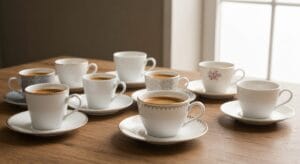
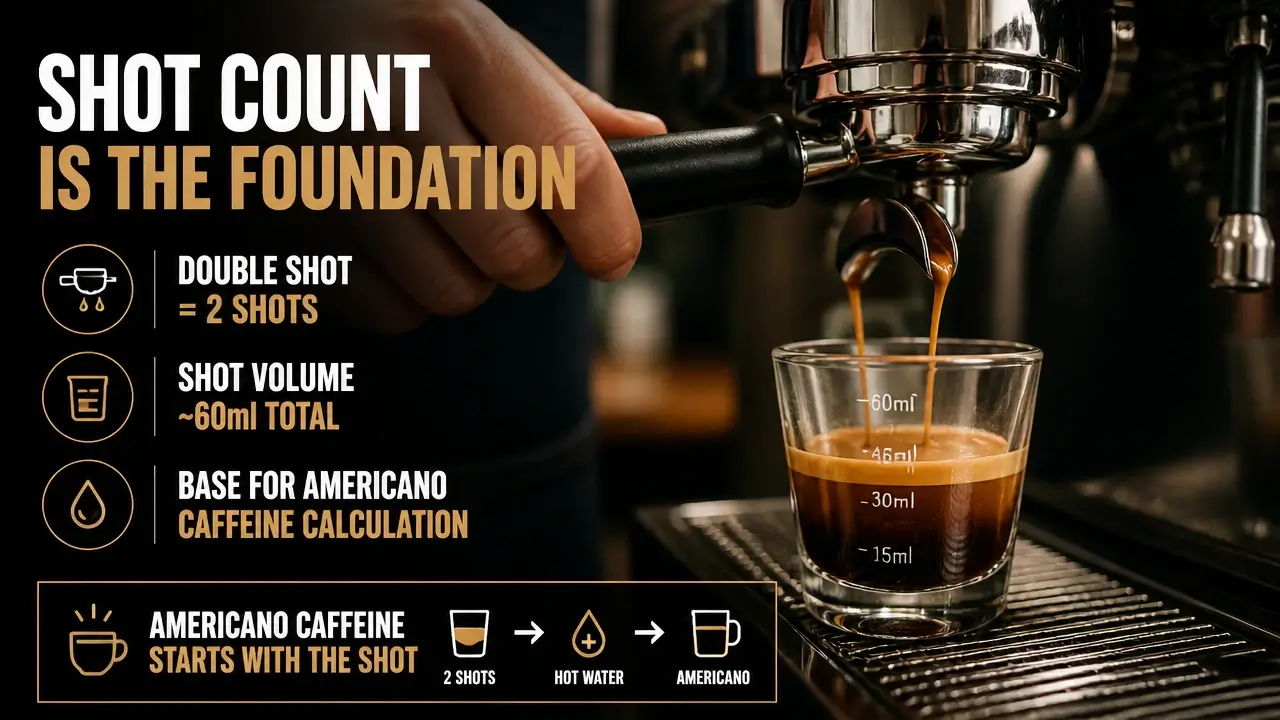
This photo shows what a standard two-shot Americano pull looks like before water is added – it’s a useful visual anchor for understanding what “shot count” actually means in the cup.
Sprudge Editorial Staff, a leading global coffee journalism network, captures the size ambiguity well:
“An Americano is, in Australia, a ‘Long Black,’ made with four ounces of water and two-ish ounces of espresso… typical Americano, which is typically at least six ounces, and often more like eight ounces or 12 ounces.”
Shot count is useless without a reliable milligrams-per-shot value to pair it with – and that value swings more than most people expect based on roast and extraction. That’s where we go next.
Cracking the Caffeine‑per‑Shot Code
Espresso caffeine variability is the variable most guides treat as a settled constant, and that’s exactly why most caffeine estimates are wrong. The per-shot number isn’t one number – it’s a range shaped by three levers: the bean’s original caffeine density, the roast level, and the extraction efficiency of the machine and recipe. Get a handle on each of those, and you can pick the right value for your specific drink instead of defaulting to a generic average that may be off by 50%.
Roast and Bean Density Drive Espresso Caffeine
Roast level and bean density interact in a way that surprises most people: lighter roasts – blonde, cinnamon, light city – are physically denser because they’ve lost less mass during the roasting process. A given gram of blonde beans contains more of the original caffeine load than the same gram of dark-roast beans. Pull those beans through a properly calibrated machine, and that density advantage shows up directly in the cup. A blonde espresso shot can carry 8–15% more caffeine than a dark-roast shot from the same origin farm.
The industry reference window for a single shot is 60–80 mg (generic average), with a double shot hovering around 120 mg. Treat those as starting points, not universal constants. Arabica-dominant blends sit toward the lower end of that range; Robusta or Robusta-blended beans push it higher, sometimes dramatically so.
The most critical variable that almost no mainstream caffeine guide mentions is the barista’s default roast policy. At Starbucks, when you order an “Americano” without specifying a roast, the machine pulls Pike Place – the house medium blend – not blonde. A Grande Americano with Pike Place shots delivers 225 mg. The same drink with blonde espresso shots carries 255 mg. That 30 mg gap is invisible on the menu board and absent from most third-party caffeine databases. It only shows up when you dig into the chain’s own app data and cross-reference it with the roast the barista actually loaded.
The theoretical backing for the roast-density-caffeine link connects to Total Dissolved Solids (TDS) in espresso: blonde beans lose less mass during roasting, so a given puck weight contains more of the original caffeine load. A properly extracted shot expresses that as a higher TDS percentage, directly elevating the caffeine dose per shot.
Nick Brown, Editor of Daily Coffee News by Roast Magazine, captures the roast-extraction interaction precisely:
“Lighter roasts generally had more caffeine in the brewed coffee, but this depended on the extraction yield, i.e. how much coffee compound is dissolved in water. Darker roasts showed a higher caffeine concentration per unit of extracted coffee but lower overall extraction yields, resulting in less caffeine in the final cup.”
That last clause is the part most guides miss. Dark roast can have higher caffeine per unit of dissolved solids – but because it extracts less efficiently overall, the total caffeine in the final shot ends up lower. Roast level and extraction yield are two separate levers, and they pull in opposite directions.
Extraction Variables and Trusted Data Sources
Extraction variables – pressure, shot time, grind size – determine where a particular shot lands within that 60–80 mg range. A home machine operating at 7 bars rather than the commercial standard of 9 bars will typically extract less caffeine from the same beans. A coarser grind shortens contact time and reduces extraction yield; a finer grind does the opposite. These aren’t large swings in isolation, but stack them up and you can easily shift a shot by 10–15 mg.
For sourcing per-shot values, the priority order is: (1) your specific roaster’s published caffeine specs, (2) the chain’s official app nutrition data, (3) USDA database values as a last resort. Many specialty roasters now publish exact caffeine figures on their product pages – favor that data over any generic USDA value, which is derived from averaged samples that may not match your beans or your machine’s extraction profile.
The Simple Formula: Multiply and You’re Done
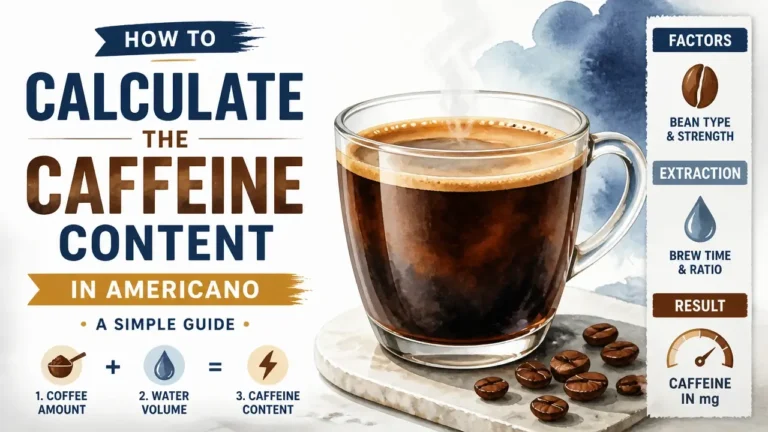
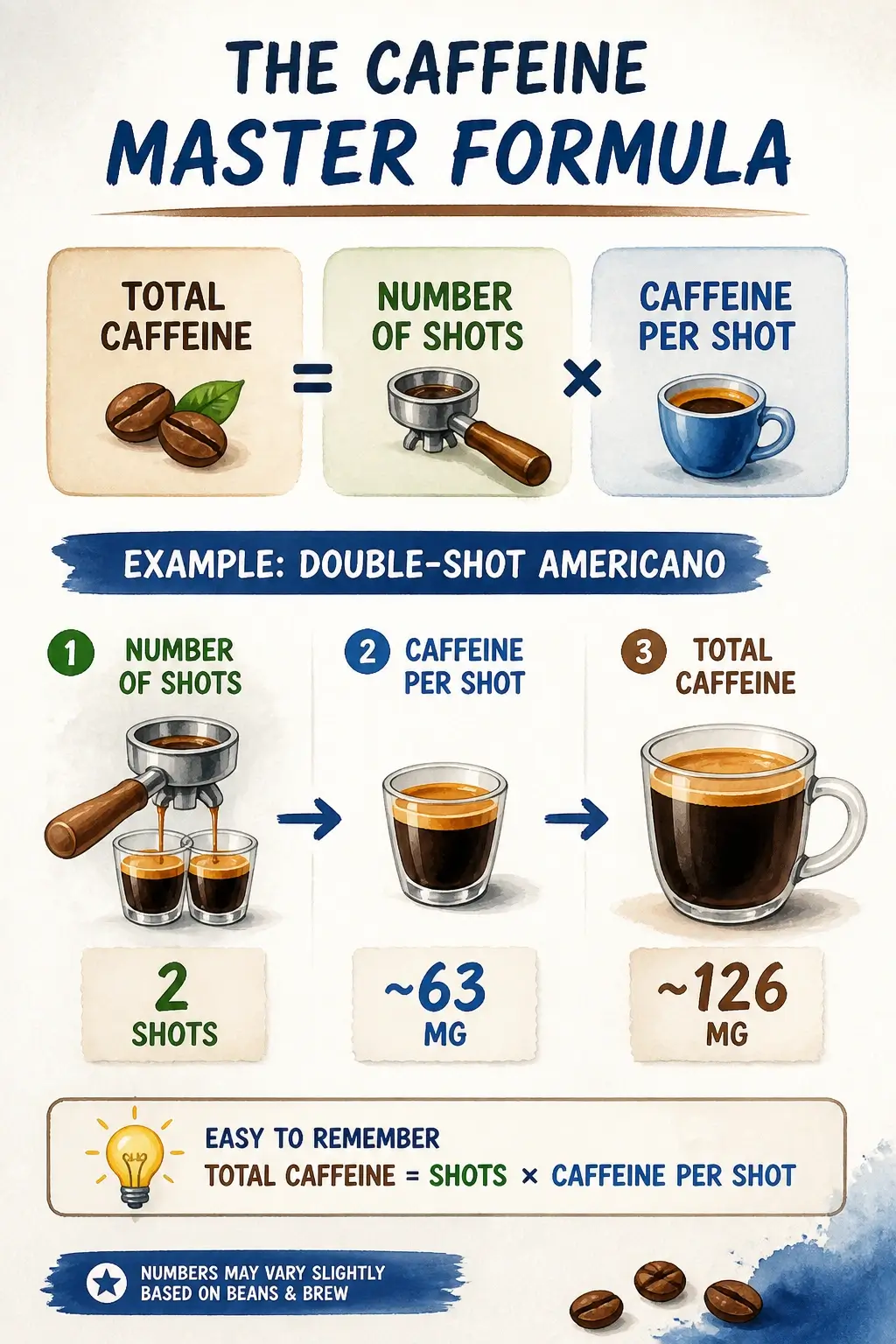
The Americano caffeine formula reduces to one line: Total Caffeine (mg) = Number of Shots × Caffeine per Shot (mg). Cup volume never enters the equation. The only number that multiplies is the shot count.
Walk through two examples to make this concrete.
At home: A double-shot Americano using a conservative single-shot estimate of 65 mg – a reasonable middle-ground for a medium-roast Arabica on a home machine – gives you 2 × 65 = 130 mg total caffeine. If your roaster publishes a higher figure, substitute it directly.
At Starbucks: A Tall Blonde Americano carries 2 shots. Starbucks’ official app lists a Grande Blonde Americano (also 2 shots) at 255 mg, which works out to approximately 127.5 mg per shot. So: 2 × 127.5 = 255 mg. That per-shot value is inferred from the chain’s own published total – not estimated from a generic chart. That distinction matters enormously, as you’ll see in the troubleshooting section.
For those who want to go one level deeper, there’s an optional concentration step: Concentration (mg/ml) = Total Caffeine ÷ Total Drink Volume (ml). A 255 mg Americano in a 360 ml (12 oz) cup runs about 0.71 mg/ml. Useful for comparing drinks side-by-side on a per-sip basis, but completely unnecessary for daily intake tracking. The total is the only number your body cares about.
Here’s a visual summary of the formula and how the inputs connect:
The peer-reviewed literature reinforces why precision in those inputs matters. Food Chemistry and Journal of Food Composition and Analysis note in their research on consumer caffeine exposure:
“The amount of caffeine obtained from the first shot ranged from 88 to 116 mg… [when assessing overall exposure] individual or population based quantification of caffeine intake… is prone to large errors because of early lower estimates of caffeine dose.”
The math is trivial. The challenge – and the real skill – is knowing what numbers to feed the formula when you’re standing at the counter.
Café Ordering Cheat Sheet: Translate the Menu to Milligrams
A café ordering cheat sheet only works if it’s built on primary-source data, not blog averages. The official app is your fastest path to an accurate number – and the two questions you ask the barista when there’s no app are just as important as the formula itself. Get both of these right, and you’ll never walk away from a counter with a wrong caffeine estimate again.
Using Official App Data and Chain-Specific Tables
Official app data from Starbucks, Peet’s, or Dutch Bros is the most reliable per-drink source available to a consumer – far more precise than any third-party nutrition database. Open the app, navigate to the drink’s nutrition information page, and read the caffeine figure directly. Don’t estimate from the category; read the specific drink with the specific roast selected.
For a chain Americano, the process runs like this:
- Step A: Find the drink in the app and check the ingredient details or standard build for shot count.
- Step B: Read the listed caffeine total directly from the nutrition panel.
- Step C: If you’re customizing – adding a shot, switching from signature espresso to blonde – make that change in the app and watch the caffeine figure update in real time before you order.
Here’s what that looks like with Starbucks’ own numbers:
| Drink | Shots | Caffeine (mg) | Notes |
|---|---|---|---|
| Tall Blonde Americano | 2 | 255 mg | Same caffeine as Grande – different water only |
| Grande Blonde Americano | 2 | 255 mg | Confirmed via Starbucks app |
| Venti Blonde Americano | 3 | ~382.5 mg | Derived: 255 mg ÷ 2 × 3 |
| Grande Americano (Pike Place) | 2 | 225 mg | Default roast when blonde not specified |
The Tall-Grande parity is the most counterintuitive entry on that table – same shot count, more water, identical caffeine. The app confirms it. Anyone relying on cup size as a caffeine proxy will be wrong every time.
The chain-specific figures also expose a critical flaw in generic advice. A commonly cited number – “an espresso shot has about 63 mg” – completely falls apart at Starbucks, where a standard “shot” is actually a double ristretto pull. Their blonde espresso contributes roughly 127.5 mg per shot. Rely on the generic figure and you’re underestimating by nearly 50%.
Sprudge Coffee, covering the ‘Which?’ UK Coffee Chain Study, shows just how much chain-to-chain variation exists:
“When comparing caffeine content in coffee drinks at the most popular chains in the UK… a medium cappuccino at Costa-made with three shots of espresso-was the most caffeinated… coming in at a whopping 325mg… Starbucks, on the other hand, was only showed to have 66mg.”
Chain policy drives those numbers as much as the coffee itself. Always use the chain’s own data.
Navigating Non‑Chain Cafés and the Barista Interaction Script
When there’s no app and no published nutrition data, a reliable barista interaction script gets you 90% of the way there. Ask two questions: “How many shots are in this size Americano?” and “What roast are you pulling those shots with?” Then plug the shot count into the formula using these safe middle-ground per-shot estimates:
- Medium roast: 65–75 mg per shot
- Light roast: 70–85 mg per shot
Those ranges account for typical commercial machine extraction at standard pressure. They’re conservative enough to avoid overestimating and close enough to reality to be useful for daily tracking.
At the counter, the most effective order script is specific: “I’d like a Tall Americano with blonde espresso, please.” The word “espresso” is load-bearing. Saying “blonde Americano” without it triggers a common barista default that most customers never know about – and that silent swap will cost you 30 mg without a single indication on your cup.
After 11 a.m. at Starbucks, the store stops brewing blonde drip coffee. When a customer orders a “blonde Americano” at that point, many baristas default to Pike Place for the espresso shots – because that’s what’s in the hopper – unless the customer explicitly requests “blonde espresso shots.” The drink looks identical. The cup reads “Blonde Americano.” But the caffeine drops from 255 mg to 225 mg. The workaround is two words: “blonde espresso.” Say those, and the barista knows to switch the grinder hopper or pull from the blonde espresso bean supply, not the drip coffee setup.
Troubleshooting: Three Calculation Errors Worth Knowing
Common calculation errors in Americano caffeine math don’t come from bad arithmetic – they come from wrong inputs. The formula is clean; the inputs are where analytical brewers consistently get tripped up. Three errors account for the vast majority of miscalculations, and each one has a specific fix.
The Brewed‑Coffee Myth and the Hidden Roast Default
Error #1: Assuming brewed coffee always has more caffeine. This myth survives on a half-truth. In a straight comparison of an 8-ounce dark-roast drip versus an 8-ounce Americano, drip might win. But the moment shot count or roast changes, the math flips. A Grande Blonde Americano at 255 mg can exceed a Tall brewed Pike Place (approximately 155–180 mg depending on the source). A Triple Blonde Americano – 3 shots × 127.5 mg – delivers 382.5 mg, which dwarfs a standard 12-ounce brewed coffee at 155–200 mg. The myth persists because generic caffeine tables ignore chain-specific shot counts and the oversized espresso pulls that large chains use as their standard. The fix: never rely on broad category claims. Use specific drink-by-drink data from the chain’s app or roaster’s site.
Error #2: Forgetting the barista’s hidden roast default. The default espresso roast at Starbucks is Pike Place – the medium house blend – not blonde. If you order “an Americano” without specifying a roast, you get Pike Place shots and 225 mg. If you order “an Americano with blonde espresso,” you get 255 mg. That 30 mg difference is silent, invisible, and consistent. It never shows up on the cup label.
The operational root cause: after 11 a.m., only Pike Place is brewed for drip, and baristas use that roast for espresso-based drinks by default unless the customer overrides it. Most popular caffeine guides have never documented this. It’s the single most impactful piece of chain-specific knowledge an analytical brewer can carry.
Jon Frech, award-winning specialty roaster and Co-founder of Black Oak Coffee Roasters, puts the brewed-coffee assumption in its proper place:
“Assuming we are comparing a double shot of espresso to a 12-ounce serving of drip coffee… drip coffee [has more caffeine]… Is this always true? No, absolutely not. A cup of watery coffee may only be brewed with 10-12 grams of coffee, meaning that a double shot of espresso may be 50% stronger or more.”
The variables that actually determine caffeine – bean weight, grind, extraction – are invisible to the customer ordering by cup size. Which is exactly why the formula needs verified inputs, not category assumptions.
Miscounting Shots and the Final Quality‑Check Checklist
Error #3: Assuming a linear shot scale across sizes. A Venti Americano at Starbucks gets 3 shots, not 4. If you treat it as a scaled-up Grande and assume 4 shots, your estimate overshoots by 127.5 mg. If you treat it as 2 shots because the Grande was 2, you undershooting by 127.5 mg. The only way to get this right is to check the app for the exact shot count of the exact size you’re ordering – not to extrapolate from a smaller size.
The arithmetic makes the stakes concrete: Venti Blonde Americano at 3 shots = 3 × 127.5 = 382.5 mg. A mistaken 2-shot calculation gives you 255 mg – a 127.5 mg error that could meaningfully affect your caffeine tracking if you’re managing intake for performance, health, or sleep.
Before you finalize any Americano caffeine number, run this four-point check:
- Did I confirm the shot count for this specific size from a primary source?
- Did I verify the roast and explicitly request the espresso roast I want at the counter?
- Did I pull the mg/shot value from the chain’s app or roaster’s site – not a forum average?
- Did I ignore cup volume entirely?
When all four pass, the calculated number is accurate enough for nutrition tracking, performance optimization, and any conversation where real data matters more than guesswork.
Key Takeaways on Calculating Americano Caffeine Content
- Calculating Americano caffeine content requires only two inputs: shot count and milligrams per shot – water volume never enters the formula.
- Adding hot water to espresso changes concentration but never alters the total caffeine dose you consume.
- A Tall and Grande Americano at Starbucks carry the same caffeine because both get two shots, not because of volume.
- Blonde espresso contributes roughly 127.5 mg per shot at Starbucks – nearly double the generic single-shot estimate of 63 mg.
- Ordering “blonde Americano” after 11 a.m. without saying “blonde espresso” silently drops your caffeine from 255 mg to 225 mg.
- Always source per-shot values from the chain’s official app or your roaster’s published specs, never a third-party blog average.
Frequently Asked Questions About Calculating Americano Caffeine Content
How much caffeine is in a 12 oz Americano?
It depends entirely on shot count and roast, not the 12-ounce volume. A 12 oz Americano with two standard blonde espresso shots at Starbucks carries 255 mg – the same as their 16 oz Grande, because both drinks use two shots.
Does a larger Americano always mean more caffeine?
No, and this is the most common mistake in café ordering. A Tall and Grande Americano at Starbucks are identical in caffeine because they both get two shots – the extra fluid in the Grande is water, which adds zero milligrams.
How do I calculate caffeine for a homemade Americano without a roaster spec sheet?
Use a conservative range of 60–75 mg per shot for a medium-roast Arabica pulled on a home machine at standard pressure, then multiply by your shot count. If your machine runs below 9 bars, lean toward the lower end of that range.
Why does the USDA caffeine value for espresso differ so much from Starbucks’ app data?
USDA values are averaged across many samples and don’t account for chain-specific extraction policies. Starbucks pulls a double ristretto as their standard “shot,” which concentrates significantly more caffeine than a textbook single shot. Always prioritize the chain’s own published data.
Is it safe to use caffeine calculators or third-party apps for tracking Americano intake?
Most third-party apps use generic per-shot averages that can underestimate by 40–50% for chain drinks with oversized espresso pulls. Use them as a rough guide only – for precision tracking, pull the number directly from the official chain app and enter it manually.
Does the order of water and espresso in an Americano affect the caffeine content?
No. Whether you pour water over shots (Americano) or shots over water (Long Black), the total caffeine is identical. The pour order affects crema and flavor perception, not milligrams.
What if my café uses Robusta beans in their espresso blend?
Robusta carries roughly twice the caffeine of Arabica by weight, so a Robusta-blended shot can push well above the 80 mg upper end of the standard range. Ask your barista about the blend composition, or check the roaster’s website – this is the one scenario where generic per-shot estimates break down most severely.
Can I trust the caffeine number on a café’s printed menu board?
Menu boards typically show a single figure for a drink category without accounting for roast variation or size-specific shot counts. The chain’s app or website nutrition page – where you can filter by size and roast – is always the more accurate source.
References
- Caffeine Content in Espresso – MDPI Foods Journal (Peer-Reviewed Spanish Market Study)
- The Americano Problem – Sprudge.com (Cole Torode)
- The Americano Problem – Sprudge.com (Editorial Staff)
- Caffeine Levels in Espresso Vary Widely – Daily Coffee News by Roast Magazine (Nick Brown)
- Espresso vs. Drip Coffee: Which Has More Caffeine – Black Oak Coffee Roasters (Jon Frech)
- Scientific Studies on Consumer Caffeine Exposure – Food Chemistry and Journal of Food Composition and Analysis
- Which Coffee Chain Has the Most Caffeine – Sprudge.com (covering the ‘Which?’ UK Coffee Chain Study)