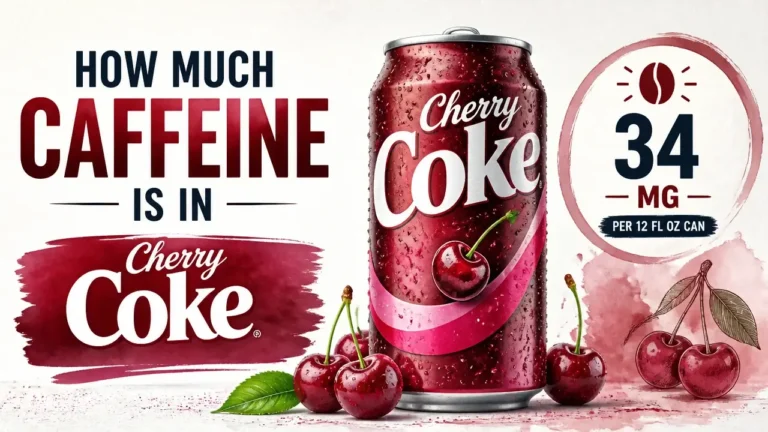

Cherry Coke caffeine sits at a modest 34 mg per 12-oz can – quiet enough to fly under the radar, significant enough to matter when your teenager is on their second bottle of the day. Most people assume the zero-sugar version is the safer pick, but the caffeine is factory-identical across every variant in the line.
What actually changes between a mini can and a 20-oz bottle isn’t just volume. It’s nearly triple the caffeine, a bigger sugar load, and a body that rarely notices the difference until the crash hits. This is the full picture – numbers, comparisons, and the biology behind the buzz.
The Exact Cherry Coke Caffeine Numbers by Size
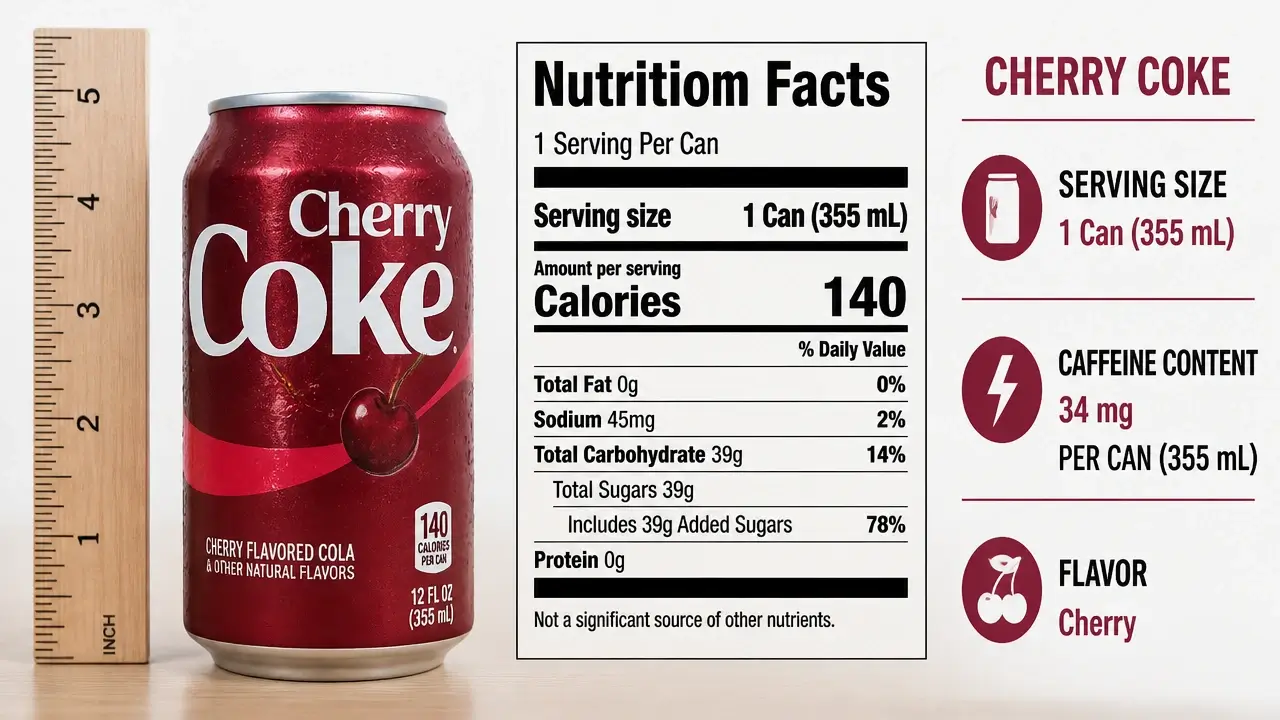
Cherry Coke caffeine in a standard 12-oz can measures exactly 34 mg – the same concentration Coca-Cola reports across its entire cherry cola line, at roughly 2.83 mg per fluid ounce. That number sounds fixed, but it scales quickly the moment you pick up a larger bottle.
Here’s how the math works across every common size:
- Mini Can (7.5 fl oz / 222 mL): 21 mg
- 12 oz Can (355 mL): 34 mg
- 16.9 oz Bottle (500 mL): 48 mg
- 20 oz Bottle (591 mL): 57 mg
Going from a mini can to a 20-oz bottle nearly triples your caffeine intake – and most people don’t think twice about grabbing the bigger size. The jump from 21 mg to 57 mg happens before you’ve finished a single drink.
The sugar picture moves in the same direction. A 12-oz can delivers about 42 g of sugar and 150 calories. Step up to the 16.9-oz bottle and you’re looking at roughly 58 g of sugar and 210 calories. That’s not a small can of soda anymore – that’s most of a day’s added sugar in one sitting, according to the American Heart Association’s daily limit for women (25 g) and a meaningful chunk of the men’s limit (36 g).
One thing worth knowing: every Cherry-flavored cola in the Coca-Cola family – original Cherry Coke, Cherry Coke Zero Sugar, and Diet Coke Cherry – shares the same caffeine concentration per fluid ounce. So the size of the container is the only real variable you’re managing when it comes to stimulant load.
That said, these figures come entirely from Coca-Cola’s own reported data. No independent lab testing or manufacturing tolerance information is publicly available. A modest batch-to-batch variance of even 10% could shift a 34-mg can by about 3.4 mg in either direction – an edge that never shows up on any ingredient panel. The numbers above are the most reliable good-faith estimates available. They’re just not verified to the milligram.
Here’s a closer look at what’s actually on the label versus what most people assume they’re getting:
Diet vs. Zero: Does Cutting Sugar Cut the Caffeine?
Zero-sugar Cherry Coke contains exactly the same caffeine per serving as the original – 34 mg per 12-oz can, 48 mg per 16.9-oz bottle, proportional across every other size. The caffeine is not reduced, reformulated, or removed. What changes is only the sweetener system.
Regular Cherry Coke uses high-fructose corn syrup to hit its sweetness. The zero-sugar versions replace that with a blend of aspartame, acesulfame-potassium, and sometimes sucralose – synthetic sweeteners that deliver no calories but replicate the taste. If you’re handing a Zero Sugar to your kid thinking you’ve eliminated the stimulant, that assumption needs a correction.
The calorie swap is real and meaningful. Regular Cherry Coke at 12 oz carries 150 kcal. Zero Sugar sits at zero calories – no contest if weight management or blood sugar is the concern. For most people, that trade is the whole point of the switch.
But “zero calories” isn’t the same as “metabolically neutral,” and that distinction matters more than the marketing suggests. Research published in PLOS One found that low-dose aspartame consumption in diet-induced obese rats reduced caloric intake and body weight – but also elevated fasting glucose levels and impaired insulin-stimulated glucose disposal. Fecal analysis showed increased Enterobacteriaceae and Clostridium leptum, while serum metabolomics detected higher propionate, a short-chain fatty acid that fuels gluconeogenesis. In plain terms: the sweetener altered gut bacteria and blood sugar regulation in ways that don’t show up on a calorie label.
The marketing framing – “full flavour, zero sugar, enjoy anytime” – skips over this entirely. Someone switching to Zero Sugar to improve their metabolic health may be trading a sugar-driven calorie load for a different set of pressures they never knew to look for, while still getting the same caffeine hit they started with.
There’s one more label detail worth flagging for families: every zero-sugar Cherry Coke carries a phenylalanine warning. Aspartame breaks down into phenylalanine during digestion, which is harmless for most people but a genuine dietary restriction for anyone with PKU (phenylketonuria). If that condition runs in your family, the zero-sugar label is not a free pass.
Cherry Coke vs. Coffee and Energy Drinks: The Real Scale
Cherry Coke’s relative caffeine strength becomes a lot less scary the moment you put it next to what most adults already drink every morning. At 34 mg per 12 oz, it sits at roughly the same level as a standard Coca-Cola – and nowhere near the territory of brewed coffee or the energy drinks showing up in middle school backpacks.
Brewed coffee typically delivers 100–140 mg of caffeine per 12 oz, depending on the roast and brew method. That makes Cherry Coke three to four times weaker, cup for cup. A standard 8.4-oz energy drink runs around 80 mg. A 16-oz energy can can reach 160 mg or higher. Against either of those, a 12-oz Cherry Coke looks mild.
The comparison that probably surprises most people: a 12-oz Cherry Coke is roughly equivalent to a single cup of black tea, which averages around 34 mg per 8 oz. You’re not getting a coffee-level jolt. You’re getting a tea-level nudge, wrapped in 42 g of sugar.
One exception worth knowing: Cherry Coke Energy is a different product entirely. At 114 mg per 12 oz, it’s more than three times stronger than standard Cherry Coke and sits firmly in energy drink territory. The name sounds like a slight upgrade. The caffeine is a category jump.
Here’s the full side-by-side so you can see where Cherry Coke actually lands:
| Beverage | Serving Size | Caffeine (mg) |
|---|---|---|
| Cherry Coke (standard) | 12 oz | 34 mg |
| Regular Coca-Cola | 12 oz | 34 mg |
| Black Tea | 12 oz | ~51 mg |
| Cherry Coke Energy | 12 oz | 114 mg |
| Standard Energy Drink | 8.4 oz | ~80 mg |
| Large Energy Can | 16 oz | ~160 mg |
| Brewed Coffee | 12 oz | 100–140 mg |
The takeaway is simple: standard Cherry Coke is a low-caffeine soda. The risk isn’t that a single can hits hard. The risk is the cumulative math when kids drink two or three in a day – which is exactly where the next question lives.
Is Your Kid Already Over the Limit?
Pediatric caffeine guidelines draw a much tighter line than the adult benchmark most people know. The FDA’s 400 mg/day figure applies to healthy adults. For children under 12, the American Academy of Pediatrics recommends avoiding caffeine entirely. For adolescents, most health authorities cap safe intake at no more than 100 mg per day.
Now run the math on a typical school day.
A 12-year-old grabs a 16.9-oz Cherry Coke with lunch – that’s 48 mg. After school, they crack open a 12-oz can – another 34 mg. Total: 82 mg before dinner, leaving less than 20 mg of headroom before hitting the adolescent ceiling. One more small soda and they’re over.
The 20-oz bottle makes this even more precarious. At 57 mg, a single large bottle already accounts for more than half the teen daily limit – and no label anywhere flags that in kid-specific terms. The nutrition panel shows milligrams. It doesn’t say “this is 57% of what your teenager should have today.”
Sensitivity adds another layer of complexity. Body weight, personal tolerance, concurrent medications, and even sleep deprivation all affect how a given dose of caffeine lands. The 100 mg ceiling is a population-level safety rail, not a guarantee that every adolescent will be fine right up to that number.
The most dangerous assumption in this whole conversation is the most common one: Cherry Coke is a soda, not a coffee, so parents and teens mentally file it under “non-caffeinated treat.” That framing is exactly backwards. It contains caffeine. It’s consumed casually and repeatedly. And the information architecture around it gives families nothing to act on.
Nawrot et al., the Health Canada guideline authors whose work underpins adult caffeine safety standards, put it plainly:
“The most widely cited of these values is from Health Canada (Nawrot et al., 2003), in which the agency authors conducted a comprehensive (but not systematic) literature search and concluded in a peer-reviewed publication that an intake dose of up to 400 mg caffeine/day was not associated with adverse effects in healthy adults.”
The operative phrase is healthy adults. The 400 mg figure was never designed to cascade down to a 90-pound seventh grader. According to CDC data on adolescent caffeine consumption, a significant share of teens aged 12–18 already exceed the recommended 100 mg daily threshold – and flavored sodas are a primary contributor to that number. The gap between what the label tells you and what a parent actually needs to know is the most actionable problem in this entire space.
The Sugar Mirage That Makes Cherry Coke Feel Stronger
The energy hit from Cherry Coke feels bigger than 34 mg of caffeine should produce – and there’s a specific biological reason for that. The sugar-caffeine energy cycle running inside a 12-oz can involves two separate systems working in sequence, and understanding how they interact explains both the buzz and the crash that follows.
The first system is sugar. The 42 g of fast-absorbing sucrose in a standard can hits the bloodstream quickly, triggering a rapid blood glucose spike. That spike comes with a dopamine hitch – a brief reward signal that registers as an immediate lift in mood and alertness. It feels like energy. It’s actually your body mobilizing glucose faster than it can use it.
Caffeine steps in right behind it. By blocking adenosine – the neurotransmitter that accumulates throughout the day and signals tiredness – caffeine delays the natural “I’m getting tired” signal your brain would otherwise receive. The sugar high now feels cleaner and longer than it actually is, because the biological feedback loop telling you to slow down has been temporarily muted.
Then both systems reverse at the same time. Insulin surges to clear the elevated blood glucose, pulling it down sharply. The caffeine wears off and adenosine floods back in, hitting harder than it would have without the blockade. The combined result is a deeper energy trough than either substance would produce alone – and it arrives faster than most people expect.
That trough is where the behavioral loop starts. The body registers the drop, interprets it as a need for more quick energy, and the pull toward another soda is less a craving than a physiological prompt. In teenagers whose days already run on quick-sugar snacks and irregular meals, this cycle can repeat several times before anyone notices the pattern.
Cherry Coke Zero Sugar changes the first half of this equation but not the second. Without the sugar spike, the perceived energy lift is subtler and the insulin surge is absent – but the caffeine still blocks adenosine, and the sweet taste still triggers a reward signal. The cravings loop can still run on sweetness alone, which is exactly where the metabolic uncertainty around aspartame and acesulfame-potassium (covered earlier) becomes a practical daily concern rather than a theoretical one.
The caffeine content is only part of the story. The 34 mg doesn’t fully explain how Cherry Coke feels. The rollercoaster does.
Key Takeaways on Cherry Coke Caffeine
- Cherry Coke caffeine measures 34 mg per 12-oz can, scaling to 57 mg in a 20-oz bottle – nearly triple a mini can’s 21 mg.
- Zero Sugar and Diet Cherry Coke contain identical caffeine to the original; only the sweetener system changes, not the stimulant load.
- Brewed coffee delivers three to four times more caffeine per 12 oz than standard Cherry Coke; Cherry Coke Energy is a separate, much stronger product at 114 mg per 12 oz.
- Two servings in a school day can push a teenager to 82 mg – within 20 mg of the recommended 100 mg adolescent daily ceiling.
- Sugar and caffeine amplify each other’s effects, making Cherry Coke feel more energizing than its milligram count suggests and setting up a sharper crash.
- All caffeine figures come from Coca-Cola’s self-reported data; no independent lab verification is publicly available, so treat the numbers as reliable estimates, not exact doses.
Frequently Asked Questions About Cherry Coke Caffeine
Does Cherry Coke have more caffeine than regular Coke?
No – both sit at exactly 34 mg per 12-oz can, running at the same 2.83 mg per fluid ounce concentration. The cherry flavoring changes the taste profile, not the caffeine level.
How does Cherry Coke caffeine affect someone who is pregnant?
Most health authorities recommend pregnant women stay under 200 mg of caffeine per day, so a single 12-oz Cherry Coke at 34 mg uses up about 17% of that budget. The concern isn’t one can – it’s cumulative intake from coffee, tea, chocolate, and other sodas consumed in the same day.
Can Cherry Coke trigger caffeine sensitivity symptoms even at 34 mg?
Yes, absolutely. People with low caffeine tolerance, anxiety disorders, heart arrhythmias, or certain medication interactions can feel jitteriness, elevated heart rate, or disrupted sleep from doses well below 100 mg. Body weight, genetics, and metabolic rate all play a role in how 34 mg actually lands.
Is Cherry Coke caffeine-free if you buy it in certain markets?
Not by default. Caffeine-free Cherry Coke exists as a specific product variant, but it’s not the standard version. If the label doesn’t explicitly say “caffeine free,” assume the standard 34 mg per 12 oz is present.
Does Cherry Coke Zero Sugar affect blood sugar even without real sugar?
The research suggests it might, indirectly. The PLOS One rat study on aspartame found impaired insulin-stimulated glucose disposal and shifts in gut microbiota composition at low doses – meaning zero calories doesn’t guarantee zero metabolic effect, especially with regular consumption.
Why does Cherry Coke make me feel more awake than a cup of tea with the same caffeine?
The sugar load is doing a lot of the heavy lifting. The 42 g of fast-absorbing sugar in a regular Cherry Coke spikes blood glucose and triggers a dopamine response that stacks on top of the caffeine’s adenosine-blocking effect. A plain cup of tea delivers similar caffeine without that glucose hit, so the perceived energy is noticeably different.
What’s the difference between Cherry Coke and Cherry Coke Energy in terms of caffeine?
It’s a major jump. Standard Cherry Coke has 34 mg per 12 oz. Cherry Coke Energy has 114 mg per 12 oz – more than three times the caffeine, putting it firmly in energy drink territory rather than soda territory. The name sounds like a minor variation; the formulation is not.
Should teens avoid Cherry Coke entirely because of the caffeine?
The American Academy of Pediatrics recommends children under 12 avoid caffeine entirely. For teens, the general guidance caps daily intake at 100 mg – which means two standard servings in a day already pushes close to the limit. One Cherry Coke isn’t a crisis, but two or three in a day, combined with other caffeine sources, can push an adolescent over the recommended ceiling without anyone realizing it.
References
- Low-Dose Aspartame Consumption Differentially Affects Gut Microbiota-Host Metabolic Interactions in the Diet-Induced Obese Rat – journals.plos.org
- Health Canada Caffeine Safety Review (Nawrot et al.) via Food and Chemical Toxicology – sciencedirect.com
- CDC Adolescent Caffeine Consumption Data – stacks.cdc.gov