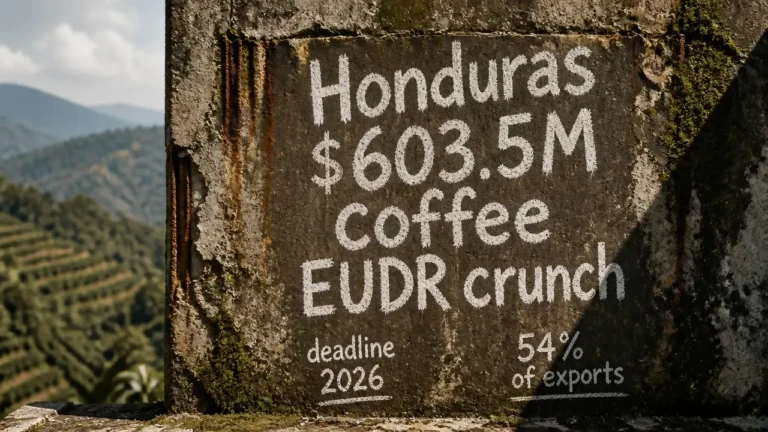
Honduras, one of Central America’s largest arabica producers, is racing to keep its coffee flowing into the European Union as new anti‑deforestation rules threaten access to a market that buys more than half of its exports and generated
$603.5 million in 2024 alone. With EU Deforestation Regulation (EUDR) deadlines now set for late 2026 and mid‑2027, officials and exporters warn that most small farmers still lack the traceability tools they need to comply.According to
Mongabay, about half of Honduras’ coffee goes to the EU, while data from
DevelopmentAid show that 54% of the country’s coffee exports headed to the bloc in 2024, with coffee accounting for 62% of all Honduran exports to the EU by value. A study cited in a report from the London School of Economics (
LSE) estimates that 20% of Honduras’s total exports and 7% of its foreign exchange earnings are at risk if the country fails to meet EUDR requirements for deforestation‑free supply chains.The stakes are especially high for smallholders. Research summarized by the LSE report indicates that 90% of Honduran coffee production comes from smallholders and family farms, and that coffee supports more than 1 million direct and indirect jobs, according to figures compiled by
DevelopmentAid. An analysis highlighted by a coalition of organizations in an
EurekAlert! release warns that without effective traceability tools, 85% of Honduran coffee farmers could lose access to the EU market, and notes that 85% of Honduras’s coffee output is conventional arabica outside certified supply chains.Readiness on the ground remains uneven. A study seen by
Mongabay found that only 44% of Honduran coffee farmers are aware of the EUDR and that just one in three has completed a related training course. The same article, citing the Association of Honduran Coffee Exporters (ADECAFEH), reported that only 44% of the 44,200 farms belonging to ADECAFEH had been georeferenced, a core step for proving compliance with the EUDR’s cut‑off date of 31 December 2020 for deforestation.Government and industry initiatives have begun to close those gaps but still cover a minority of the sector. The LSE report notes that a system introduced by Honduran authorities for EUDR compliance covered only about 3% of total production as of July 2025. In an interview with
El Heraldo, Subsecretary of Caficulture Carlos Murillo of the Ministry of Agriculture (SAG) stated that Honduras has continued advancing in certifying productive units, mapping coffee land use and establishing certification and verification mechanisms. The same article reported that 58% of productive units were ready for EUDR compliance ahead of the latest deadline extension, and that 72,000 of 97,250 producers registered for the 2023‑2024 harvest could use the compliance scheme developed by the national coffee institute IHCAFE.Exporters say buyers are already nervous. “Our clients are worried that Honduras won’t deliver enough coffee,” Basilio Fuschich, president of ADECAFEH, told
Mongabay, adding that some exporters will comply while others “are not interested and prefer to sell to Asia and the U.S. without all this paperwork.” His earlier comments to
El Heraldo framed the EU’s decision to delay enforcement until 30 December 2026 for large and medium operators, and 30 June 2027 for micro and small enterprises, as giving the country “one more year” to ensure that all coffee entering the EU meets zero‑deforestation rules.For farmers, the cost and control of data are central concerns. A representative of sustainability group Solidaridad identified as Flores told
Mongabay that georeferencing a 7‑hectare farm costs about $22.50, and noted that “not everyone is willing to bear the costs and is looking for the cheapest solution.” Independent producer Fredy Pastrana, quoted in the same article, said some private actors “own your data” when they offer georeferencing services and argued that information “must be handled by a public institution.”Alongside those tensions, a new open‑source approach is emerging. In May 2025, a coalition coordinated by the Alliance of Bioversity International and CIAT, technology firm Permarobotics, trader Neumann Kaffee Gruppe and other partners shipped Honduras’s first container of EUDR‑compliant coffee—20.7 tonnes from the departments of Lempira and Santa Bárbara—using an open‑source traceability platform, according to an
EurekAlert! announcement. The same release quoted Neumann’s head of group sustainability Carolin Ehrensperger as saying that mapping 12.5 million coffee farms globally is a key challenge and cost driver, and that the Honduran pilot serves as proof‑of‑concept that open‑source software can significantly reduce costs while maintaining data quality, privacy and farmer ownership.Alliance of Bioversity/CIAT senior manager Brian King stated in the
EurekAlert! report that the collaborative model used in Honduras helped resolve bottlenecks around interoperability and the agency and privacy of farmers. Senior research associate William Ricardo Igeler added that, in the long term, alignment with deforestation‑free standards may open opportunities for recognition, traceability‑linked premiums and more resilient trade relationships for participating producers.Even with new tools, sector leaders emphasize that work on compliance must continue. IHCAFE president Pedro Mendoza told
El Heraldo that institutions have been “making every effort to comply” with the EU regulation and that all actors from producers to exporters have to be responsible, while independent producer Fredy Pastrana said in the same outlet that there are still challenges but that coffee growers remain willing to do their part to meet the EUDR.

 By | May 22, 2026