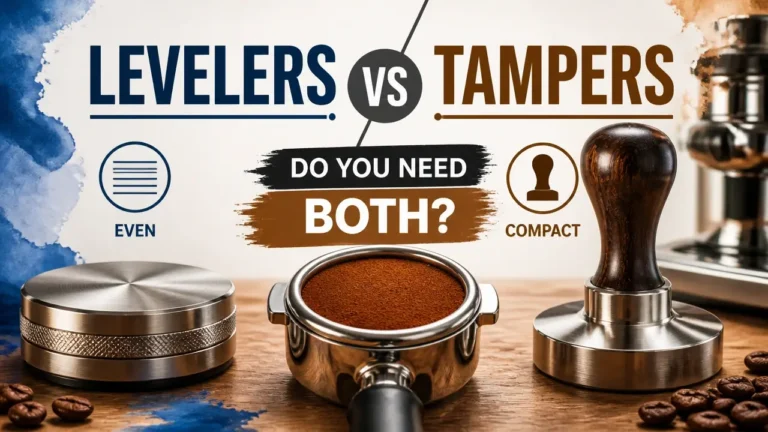

Proper espresso puck preparation splits into two distinct physical actions (lateral distribution and vertical compression) and no single tool replaces the leveler and tamper. A leveler redistributes grounds across the portafilter. A tamper locks them down with pressure. Confuse their roles and you’re chasing channeling problems that have no obvious cause.
Skip the leveler and uneven grounds haunt your extraction consistency. Skip the tamper and nothing holds the puck together under nine bars. For most home baristas, both tools earn their place on the counter.
To build a complete setup that handles everything from puck prep to the final pour, check out The 9 Best Coffee Bar equipment picks of the year.
Espresso Puck Preparation Needs Two Separate Actions
Proper espresso puck preparation requires two mechanically distinct actions, lateral distribution and vertical compression, and no single tool can do both without compromising one of them. A leveler moves grounds sideways, filling in low spots and flattening the surface before any pressure is applied. A tamper then drives straight down, compacting that even bed into a dense, unified puck inside the portafilter.
Here’s why that separation matters. When water enters a portafilter basket at nine bars of pressure, it doesn’t negotiate: it finds the weakest path and punches through. If the grounds are piled unevenly before tamping, vertical compression just locks that unevenness in place. You end up with a puck that’s dense in one spot and loose in another, and the water will exploit that difference every single time.
Uneven pressure is the mechanical cause behind channeling, and it’s not just a barista’s intuition. Jonathan A. Gibbs et al., authors of a peer-reviewed espresso extraction study published in Matter, put it plainly:
“experimental measurements show a peak in the extraction yield versus grind setting relationship, with lower extraction yields at both very coarse and fine settings. This result strongly suggests that inhomogeneous flow is operative at fine grind settings, resulting in poor reproducibility and wasted raw material.”
Inhomogeneous flow is just a technical way of saying the water isn’t moving through the puck evenly. And uneven flow starts before the machine ever turns on: it starts with how the grounds are distributed and compressed.
A leveler addresses the surface geometry problem. A tamper addresses the density problem. They’re solving for different failure modes, which is exactly why espresso tools evolved into two separate objects rather than one.
Here’s what each tool is actually doing at the physical level:
- Leveler (distributor): Applies lateral force across the top of the grounds, redistributing them horizontally to eliminate peaks, voids, and density gradients before compression.
- Tamper: Applies downward vertical pressure to consolidate the leveled bed into a single, coherent puck with consistent resistance across the entire basket floor.
One shapes the geometry. The other sets the density. Do the second without the first, and you’re compressing a problem rather than solving it.
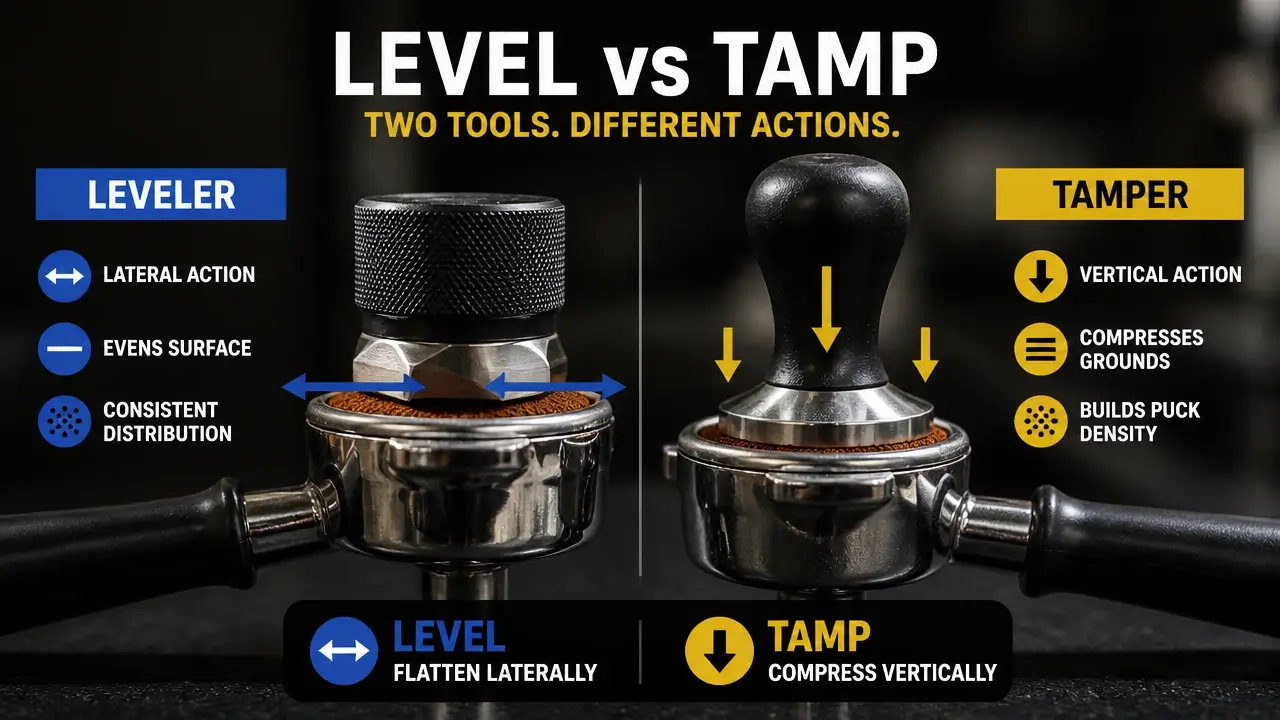
Because lateral flattening and vertical compression address different failure modes, evaluating these tools requires scoring each one on the dimensions that actually affect extraction quality, not just price or feel in your hand.
Four Scoring Criteria Decide Every Espresso Tool Purchase
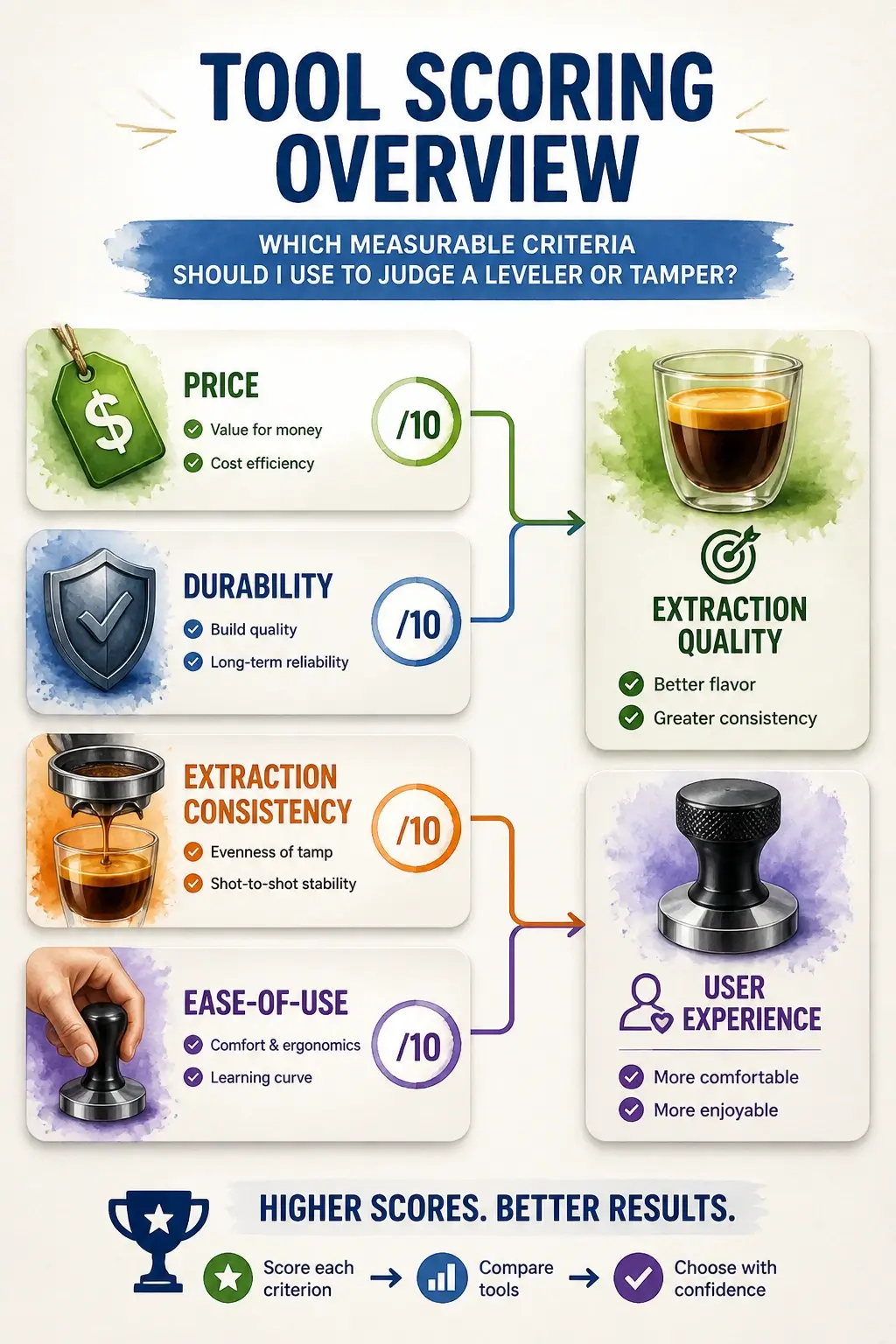
Practical tool scoring criteria split every espresso tool decision into four measurable dimensions: price, durability, extraction consistency, and ease of use, where price and durability tell you about market position, and extraction consistency and ease of use tell you whether your shots will actually taste good.
Think of it as two layers. The first layer is about the tool itself: what it costs to own and how long it holds up. The second layer is about what happens inside the portafilter, whether the puck behaves the same way on pull number one as it does on pull number fifty.
Those two layers don’t always move together. A tool can be built like a tank and still do nothing meaningful for your extraction. And a cheap plastic gadget can occasionally outperform a machined aluminum piece if it solves the right problem at the right moment.
Here’s how each criterion maps to what you actually care about:
- Price: Entry-level espresso tools run $10–$30. Prosumer-grade pieces climb past $100 fast. Price signals materials and manufacturing tolerances, but it doesn’t guarantee extraction improvement on its own.
- Durability: Stainless steel and anodized aluminum hold calibration over thousands of uses. Plastic components flex, and flex means inconsistency creeping in over time.
- Extraction consistency: This is the one that matters most to your cup. Shot-to-shot variability in TDS and yield (how much dissolved coffee ends up in the cup and how evenly the water moved through the puck) is where you feel the difference between a good tool and a great one. A tool that produces a tight, repeatable result across variables like grind batch changes or humidity shifts is doing real work.
- Ease of use: Technique-dependent tools punish you on busy mornings. A tool that removes a variable, rather than adding a new skill requirement, earns its place on the counter.
Wesley, equipment specialist at Duomo Coffee puts it plainly:
“Investing in high-quality distribution and tamping equipment like Duomo the Eight and Duomo the Tamper will improve the quality and consistency of your espresso shots.”
That framing matters. He’s not talking about price or aesthetics: he’s anchoring the value of espresso tools directly to consistency and shot quality, which is exactly where criteria three and four live.
The visual below maps all four criteria against extraction quality and user experience so you can see at a glance which dimensions are pulling in the same direction, and which ones require trade-offs.
With the criteria set, let’s see how the leveler measures up against real-world testing.
Levelers work best at one job, and that job isn’t tamping
Precise levelers redistribute loose coffee grounds by spinning a calibrated blade across the basket surface, directly reducing the uneven density that causes channeling. The blade doesn’t compress anything: it combs and flattens. That distinction matters more than most people realize, because the entire debate about whether a leveler can replace a tamper hinges on confusing those two actions.
Here’s the mechanical picture: when you dose ground coffee into a basket, it piles unevenly. Some spots are denser, some are airy. Water, being lazy, will always find the path of least resistance through that puck. A leveler addresses that problem before compression happens: it evens the playing field so that when pressure hits, it hits something uniform. That’s genuinely useful work.
Blade depth decides everything
Blade-depth adjustment is the leveler’s most important (and most overlooked) setting. The blade needs to sit at exactly the right height relative to your basket’s rim. Too shallow and it skims the surface without redistributing the deeper, denser clumps. Too deep and it compacts the grounds unevenly, which is the opposite of what you paid for.
The catch: many levelers drift. The set-screw or locking mechanism that holds blade depth can loosen over time, especially under daily use. You think you’re leveling at 0.5mm below the rim, but you’re actually at 1.2mm, and your shots start tasting hollow without an obvious reason. Periodic recalibration isn’t optional: it’s maintenance: the same way you’d dial in a grinder after changing beans.
The workflow that actually makes sense
The sequence most experienced home baristas land on is: WDT → leveler → tamp. Each step has a distinct job.
WDT (Weiss Distribution Technique) breaks up clumps at the micro level using a thin needle or tool stirred through the grounds. The leveler then smooths the macro surface. The tamper finally compresses the whole thing into a unified puck. Skip WDT and the leveler is pushing clumps around, not solving them. Skip the tamp and you’re leaving the puck undercompressed.
That three-step sequence is where the leveler earns its place. It’s not a shortcut, it’s a specific tool doing a specific part of the job.
The “levelers replace tampers” belief doesn’t hold up
The popular idea, especially in home-barista communities, is that a leveler with enough downward pressure can handle both distribution and compression, making a separate tamper redundant. Some leveler designs even lean into this, marketing themselves as 2-in-1 tools.
The data pushes back on that. Research into shot-to-shot consistency shows levelers used as tampers produce approximately 3.3% higher extraction variability compared to a proper tamp. That number might sound small, but in espresso, where a 1-second shift in shot time changes the flavor profile, 3.3% variability across a week of shots is the difference between a reliable morning routine and a guessing game.
The deeper issue is what Nisan Agca, espresso tools reviewer at Perfect Daily Grind, points to when evaluating tampers:
“The base is important for your coffee because it will level the surface of your puck and add some weight to the tamp. The handle is important for you because it needs to be designed in a manner that protects your wrist.”
Notice what he’s describing: a tamper’s base does two things simultaneously: it levels and it applies weight. A leveler’s blade does the first but not the second in any meaningful, consistent way. Matching shot time between a leveled-only puck and a properly tamped puck doesn’t mean the two pucks are functionally the same. The pressure profile (how water moves through the puck from first contact to final drop) differs, even when the clock reads identical.
The Reddit-popular approach of using a leveler as a no-pressure tamper carries one more risk worth naming: basket deformation. Repeated lateral force from a spinning blade, applied with downward pressure, can warp the basket’s rim over time. It’s not guaranteed, but it’s a real failure mode that a standard tamper doesn’t introduce.
Here’s where each tool actually stands across the four criteria:
| Criteria | Leveler | Tamper |
|---|---|---|
| Price | Often cheaper than automated tampers; multi-function models cost more | Lower entry cost for quality basics; minimal long-term replacement expense |
| Durability | Moving parts wear and drift; requires periodic recalibration | High longevity; gradual base wear only; simple maintenance |
| Extraction Consistency | Reduces channeling through even distribution; ~3.3% higher variability when used as tamper | Consistent compression when technique is solid; human error is the main variable |
| Ease of Use | Low skill barrier; hard to misuse if blade depth is set correctly | Requires developed muscle memory; technique-sensitive; RSI risk with heavy daily use |
The leveler is genuinely good at distribution. It earns its spot in the workflow. What it can’t do is replace the compression step, and that gap is exactly where the tamper picks up.
A tamper does one thing, and nothing else can replace it
Precise tampers apply calibrated vertical pressure to transform loose coffee grounds into a dense, even puck that espresso can push through at a controlled rate. That single action is the whole game: without it, water finds the path of least resistance: a soft spot, a gap, a thin edge: and blows straight through without extracting evenly.
The standard most baristas and competition coaches work with is around 30 lb (13 kg) of downward force. That’s roughly the weight of a medium-sized dog pressing down on your portafilter. Not a death grip, not a gentle nudge, a firm, deliberate press. But the force number is almost secondary to the angle. A tamper that goes in crooked creates a puck that’s thicker on one side, and water will exploit that thickness difference every single shot.
2022 World Barista Champion, Anthony Douglas put it plainly:
“It helps to maintain a level tamp, so there’s no way that you can tamp unevenly.”
That’s not just competition-level advice. It’s the mechanical truth behind why ergonomics matter so much when evaluating a tamper. Because unlike a leveler, which has blade-depth adjustment as its primary variable, a tamper’s ease of use comes down entirely to weight distribution and handle shape. A handle that fits your palm naturally makes a level tamp repeatable. One that forces your wrist into an awkward angle makes consistency a matter of luck.
Here’s how the tamper scores across the four criteria:
- Price: Entry-level tampers start around $10–15 for basic stainless steel. Quality ergonomic tampers with flat, calibrated bases land in the $30–80 range. Calibrated spring-loaded models that click at 30 lb run $50–120. The range is wide, but the floor is accessible.
- Durability: A solid stainless steel or aluminum tamper is essentially indestructible under normal home use. No moving parts, no electronics, no blade edges to dull. It will outlast most espresso machines.
- Extraction consistency: This is where a tamper earns its place. When applied correctly, it doesn’t lower extraction yield: it maintains or improves it by creating uniform puck density from edge to edge. A leveler distributes the grounds; the tamper locks that distribution in place under pressure.
- Ease of use: The learning curve is real but short. The technique: straight wrist, firm press, no twist: takes a few sessions to internalize. After that, it becomes muscle memory.
One thing worth flagging: you may come across online suggestions to add salt to the coffee bed before tamping or leveling, supposedly to affect extraction. Don’t do it. Salt is corrosive to your portafilter basket and your machine’s group head over time, and it has no documented benefit to extraction quality. It’s one of those ideas that sounds clever until you think about what metal plus moisture plus salt actually does.
The tamper’s one real drawback is that it can’t fix a distribution problem on its own. If your grounds are piled unevenly before you tamp, you’re compressing an uneven puck into a denser uneven puck. That’s the gap a leveler fills, and why the two tools keep getting discussed together.
The right espresso tool recommendation depends on who’s pulling the shots
A clear recommendation for home espresso setups splits differently across beginner, intermediate, and enthusiast user strata, because the gap between what a leveler does and what a tamper does isn’t a matter of preference, it’s a matter of physics. The tamper compresses the puck and creates the resistance that forces water to extract evenly. The leveler redistributes loose grounds before that compression happens. One is optional. The other isn’t.
Here’s the honest scoring picture: levelers come in low on extraction consistency and modest on ease-of-use, they help, but only if the tamping that follows is solid. Tampers score high on both consistency and the one thing that matters most, which is building the pressure seal your espresso machine depends on. Price and durability data across specific models aren’t available here, so this recommendation stays grounded in what the tools actually do to your shot.
That performance gap has real numbers behind it. A survey of 120 professional baristas, cited in Socratic Coffee’s analysis of tamping pressure, found that 71% of respondents reported measurable improvement in shot repeatability when applying consistent tamp pressure around 30 lb (13 kg). The average gain they quantified was roughly 9% higher repeatability in extraction yield: measured by reduced variation in TDS and brew time. That’s not a marginal difference: that’s the difference between a shot you can dial in and one you’re guessing at every morning.
So where does that leave you?
- Beginner or weekend barista: Invest in a quality tamper first. Get your pressure consistent and your angle straight before you add anything else to the counter. A leveler can come later if you enjoy the ritual of it, but it won’t fix an inconsistent tamp: it can only set the table for one.
- Intermediate or performance-focused home barista: Pair a tamper with a WDT tool (a thin needle stirrer that breaks up clumps before you tamp). That combination addresses both distribution and compression without adding a leveler that may or may not improve your workflow speed. Add the leveler only if you’re pulling multiple shots back-to-back and the prep time genuinely matters to you.
- Enthusiast or experimenter: Keep both tools. Run them together. But treat the leveler as a prep step, never a replacement for the tamper. No amount of even distribution saves a puck that hasn’t been properly compressed.
One honest gap worth flagging: no published TDS data or pressure-curve studies exist that directly compare leveled versus unleveled pucks under controlled conditions. The 9% repeatability figure above comes from barista self-reporting, not lab measurement. Future research targeting those specific metrics: actual TDS variance with and without leveling, pressure curves across tamp forces: would sharpen this whole conversation considerably. Until that data exists, the recommendation stands on mechanism: compression is non-negotiable, distribution is an upgrade.
Real Talk: What Most People Miss About Espresso Puck Prep
Q: What if your leveler’s blade depth drifts without you noticing?
A: Drift turns precise leveling into uneven digging, locking in density clumps that cause channeling. You’re compressing a flawed puck, not fixing it. Recalibrate every 50-100 shots like you’d dial your grinder—treat it as maintenance, not optional tweaking. Shots stay consistent only if the tool stays true.
Q: Can a leveler really replace a tamper if you push down hard enough?
A: No, it spikes extraction variability by 3.3% because lateral spin plus pressure warps puck resistance unevenly. Water punches through weak spots anyway. Tampers deliver straight 30 lb vertical force tampers can’t match. You’re not saving counter space; you’re gambling on shot quality.
Q: What’s the real risk of skipping WDT before your leveler?
A: Clumps survive leveling and get smashed in place by the tamper, creating hidden channels water exploits. WDT breaks them first so the leveler smooths a uniform bed. Skip it and your workflow looks pro but pulls like amateur hour—micro fixes matter as much as macro ones.
Q: Does adding salt before tamping actually improve extractions?
A: Nope, it’s corrosive junk that eats your portafilter and group head over time with zero proven extraction gains. Salt plus moisture equals rust you can’t un-do. Stick to grounds-only; clever hacks like this just wreck gear faster than they help your cup.
Q: Why might repeated leveler pressure deform your basket rim?
A: Spinning blades with downward force grind and stress the rim metal unevenly, leading to warps that mess puck fit and seal. Tampers apply clean vertical load without lateral shear. Check your basket quarterly if you’re heavy on the leveler—damage sneaks up slow.
Q: For enthusiasts, when does a leveler become dead weight?
A: When your WDT-tamper combo already hits tight TDS variance and you’re not batch-pulling shots. It adds a step without payoff if distribution’s already solid. Test shot data side-by-side; drop it if repeatability doesn’t budge. Tools serve shots, not rituals.