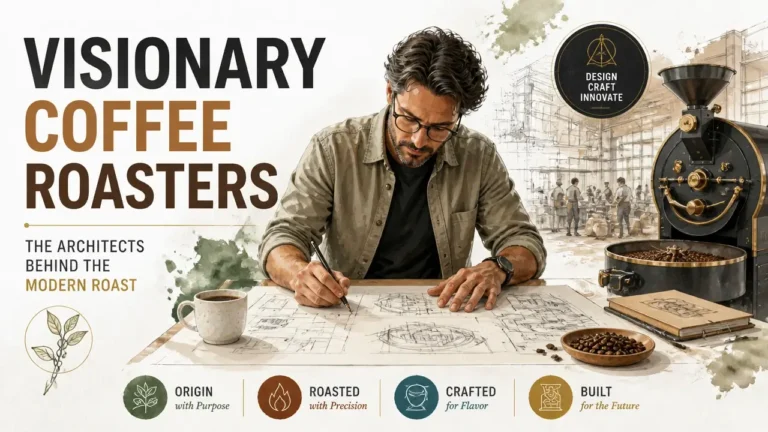

Famous coffee roasters didn’t just refine a craft, they rewired how the world thinks about a cup. From Alfred Peet’s dense, dark philosophy that quietly shaped Starbucks’ founders to Tim Wendelboe’s Nordic light roast redefining what clarity even tastes like, these figures built systems, not just products.
Intelligentsia, Counter Culture, Onyx, The Barn: each name carries a sourcing philosophy, a roast signature, a training culture. This is the story of how roasting stopped being a commodity process and became something closer to architecture.
Long before these modern roasting empires took shape, the roots of the entire industry were forever altered during the francisco de melo palheta journey that smuggled coffee seeds into Brazil.
Long before these modern sourcing philosophies took shape, the baba budan legend laid the very foundation of global coffee smuggling and cultivation.
To truly understand how this meticulous approach to roasting evolved, one must look back at the ancient yemen coffee history that laid the very foundation for the global coffee trade.
While modern pioneers transformed sourcing and craft, you can uncover the darker industry truths by reading Blood Beans amp Billions The.
What Makes a Visionary Coffee Roaster?
A truly visionary coffee roaster earns that title through lasting structural impact: on sourcing philosophy, roast profile innovation, education and community, or a business model that permanently shifted how the industry operates. That’s a different standard than popularity. High ratings and a strong Instagram following can make a roaster famous. They can’t make a roaster foundational.
This distinction matters more than it sounds. The specialty world today is full of excellent roasters producing genuinely beautiful coffee. But excellent isn’t the same as pioneering: when we talk about the architects of the modern roast, we’re asking a specific question: What did this person change that the industry couldn’t walk back?
That question filters the list down fast.
The professionals who source, buy, and evaluate coffee for a living, tend to apply four dimensions when separating architects from the crowd:
- Sourcing philosophy: Did they build direct, transparent relationships with farmers, or are they buying through conventional channels with a specialty label on the bag?
- Roast profile innovation: Did they introduce a technique or approach that others then adopted as a new baseline?
- Education and community impact: Did they invest in raising the knowledge floor for consumers, baristas, or other roasters?
- Brand influence on consumer perception: Did they change what people expect coffee to be, not just what it tastes like?
A roaster who moves all four of those needles is an architect. A roaster who moves one is impressive. A roaster who moves none but has 200,000 followers and a beautiful bag design is a product of the movement, not a builder of it.
There’s a real trap here worth naming: the overhyped roaster trap. High scores on review platforms and online buzz can create a reputation that outpaces the actual contribution. Consumer satisfaction is real (but it measures the product, not the impact). Some of the most hyped roasters today are delivering genuinely excellent coffee while standing entirely on foundations that someone else poured decades ago.
The compensation gap tells part of that story. Roasters who built true direct trade relationships (where they negotiate directly with farmers, visit farms, and pay based on quality rather than commodity pricing) helped push farmer earnings to somewhere between top-tier specialty coffee pricing data, compared to the Fair Trade floor of roughly $1.80 plus a $0.20 premium. That gap didn’t exist by accident. Specific roasters built the model that made it possible, and the industry followed.
Michael Cleland of Assembly Coffee, co-founder of Assembly Coffee in London, frames the underlying pressure precisely:
“Innovation matters because taste alone is too fragile a differentiator.”
That’s the core of it. A roaster competing purely on flavor is one bad harvest away from losing their edge. The visionary roasters on this list competed on systems: sourcing systems, education systems, transparency systems, that made their influence structural rather than seasonal.
What follows isn’t a ranking: it’s a lineage, a chain of cause and effect running from the 1960s to today, where each roaster either built something new or pushed an existing foundation further than anyone thought it could go. Understanding that arc is what lets you see the modern specialty world clearly, instead of just seeing a crowded shelf of beautiful bags.
Alfred Peet Planted the Specialty Coffee Seed
Dutch-trained Alfred Peet opened Peet’s Coffee & Tea in Berkeley, California in 1966, and the dark-roast philosophy he brought from Europe immediately exposed how bad American coffee had gotten. Post-war America was running on canned, commodity-grade beans: thin, stale, and roasted as lightly as possible to stretch volume. Peet did the opposite.
He sourced high-quality arabica beans and roasted them dark (not burnt, but deep and complex, the way European roasters had been doing for generations). The difference wasn’t subtle. Where commodity coffee tasted like warm brown water, Peet’s tasted like something. Locals noticed. They lined up. And that line answered a question the industry hadn’t thought to ask: would American consumers pay more for better coffee?
The answer was yes, and that economic proof mattered as much as the coffee itself. Peet didn’t just raise the bar on flavor. He demonstrated that quality could carry a price premium in a market that had been treating coffee like a utility.
His influence didn’t stay in Berkeley. The founders of Starbucks (Jerry Baldwin, Zev Siegl, and Gordon Bowker) were direct students of Peet’s philosophy. He mentored them personally, and when they opened their first store in Seattle in 1971, they modeled it on what they’d learned from him, even sourcing their initial beans from Peet’s. The chain of influence from that relationship is difficult to overstate: Starbucks eventually scaled to a global brand, and the specialty movement that grew alongside and in reaction to it traces its DNA directly back to one roaster in Berkeley.
That’s why Alfred Peet carries the title “grandfather of specialty coffee”: he didn’t build an empire. He built a standard, and then handed it to people who spread it across the country. The direct trade sourcing, the roast transparency, the barista craft that came decades later: all of it was built on the foundation he laid: quality is worth paying for, and the roaster is responsible for delivering it.
How Stumptown Transformed Sourcing Into Partnership
Stumptown Coffee Roasters, founded by Duane Sorenson in 1999 in Portland, Oregon, built its identity around a single disruptive premise: the people growing the coffee deserved a seat at the table, not just a check. That idea (which Stumptown called Direct Trade) wasn’t a certification program or a marketing badge. It was a sourcing philosophy that replaced the commodity chain with something closer to a working relationship.
Here’s what that actually meant in practice. Under the conventional model, coffee moved through layers of exporters, importers, and brokers before it ever reached a roaster. Each layer took a cut, and the farmer at the bottom of that chain had almost no visibility into where their coffee ended up or what it was worth to the people drinking it. Fair Trade certification improved the floor: it set a minimum price and required some social standards, but it still operated through that same layered structure. The farmer was still a supplier, not a partner.
Stumptown cut through those layers. Sorenson and his team traveled directly to origin, built relationships with specific farms, paid premiums above market rates, and came back season after season. That consistency mattered as much as the money. A farmer who knows a buyer is returning next harvest has a reason to invest in quality. The relationship itself became an incentive structure.
The financial difference was real. According to industry analyses of Direct Trade pricing, farmers in Direct Trade relationships often earn 20%–50% more per pound than under Fair Trade minimums. Where the Fair Trade floor sits around $1.80 per pound plus a $0.20 premium, top-tier specialty coffees in Direct Trade arrangements have reached $3.25–$7.00 per pound. That gap doesn’t just improve farm economics: it funds the kind of careful processing and selective harvesting that actually produces better coffee. Quality and compensation moved together.
On the roasting side, Stumptown operationalized freshness in a way the industry hadn’t seen at scale. Small-batch roasting, date-stamped bags, and direct consumer education on brew methods weren’t just quality-control measures: they were a statement that coffee was a perishable product with a peak window, not a shelf-stable commodity. Every bag with a roast date on it was an implicit argument: this coffee was made for right now, not for indefinite storage.
The downstream effect on the third wave was significant. What Stumptown proved: that a roaster could build a viable business on transparency, relationships, and quality over volume, gave the next generation of specialty roasters a working model to follow. Direct Trade went from being Stumptown’s differentiator to an industry expectation. Roasters who couldn’t explain where their coffee came from or who grew it started looking like they were behind. The bar moved, and it didn’t move back.
Intelligentsia Turned Baristas Into Craftspeople
Intelligentsia Coffee, founded in 1995 in Chicago by Doug Zell and Emily Mange, built its reputation by treating every touchpoint between farm and cup as a craft decision, and that included the person standing behind the bar. Where most coffee shops of that era treated the barista role as interchangeable, Intelligentsia made it the centerpiece of the entire experience.
The shift was deliberate. Intelligentsia didn’t just hire people to pull shots, they built the Intelligentsia Training Lab, a dedicated infrastructure for barista certification protocols that turned “making coffee” into a discipline with real standards. Baristas learned to dial in each coffee individually, to read extraction, to work with seasonal offerings that changed the variables under their hands. The consumer standing at the counter felt that difference, even if they couldn’t name it.
That’s what the “coffee bar” experience actually meant. It wasn’t about aesthetics or atmosphere: it was about making the preparation visible and intentional. Single-cup pour-overs, seasonal menus, and a quiet theater of technique turned the counter into a stage where the coffee’s origin story could be told through the hands of someone who actually understood it.
Geoff Watts of Intelligentsia, Vice President and green coffee buyer at Intelligentsia, put it plainly:
“Our baristas work to dial in our coffees every single morning. They train to work with nuance as part of their job, to become acutely aware of the small details that separate an exquisite brew from a merely good one.”
That sentence describes a fundamentally different job description than what existed before Intelligentsia. Nuance as a job requirement. Dialing in as a daily ritual, not a setup task you do once and forget.
Their Direct Trade program reinforced the same logic at the source. Where Stumptown pioneered the relationship-based sourcing model, Intelligentsia layered in a focus on producer development: working with farmers not just to pay more, but to improve quality over time through ongoing partnership. The barista in Chicago and the farmer in Ethiopia were, in this model, working toward the same outcome.
What Intelligentsia proved is that specialty coffee lives or dies at the human layer. Great sourcing gets the coffee to the roastery. Great roasting gets it into the bag. But without a barista who understands what they’re working with, all of that upstream investment dissolves in a poorly extracted cup. Intelligentsia made the human layer non-negotiable, and the industry eventually followed.
What the model still left open was accountability at the roaster level itself. Consumers could trust the barista’s skill, but they had no window into how sourcing decisions were made or whether the quality claims held up year over year. That transparency gap was the next frontier.
Counter Culture’s Radical Transparency Standard
Durham-based Counter Culture Coffee built its industry identity on two interlocking commitments: public accountability through its annual Transparency Report and free, open-access education through a nationwide Training Center network. Founded in 1995 in Durham, North Carolina, it arrived at a moment when most roasters still treated sourcing as proprietary information, something you kept close to the chest. Counter Culture went the opposite direction.
The annual Transparency Report is the clearest expression of that philosophy. It doesn’t just say Counter Culture pays fair prices: it shows you the numbers. Specific farms, specific prices paid, specific challenges encountered that year. That level of detail was almost unheard of in specialty coffee, and it raised an uncomfortable question for every other roaster in the industry: if you’re not publishing this, what are you hiding? Accountability, when one player makes it visible, becomes a quiet pressure on everyone else.
But transparency about sourcing only matters if the people buying and brewing the coffee understand what they’re looking at. That’s where the Training Centers come in. Counter Culture built a network of these spaces across the US: not as revenue centers, but as genuine educational infrastructure. Free public cuppings, professional brewing courses, open to anyone who walks in. The idea was straightforward: if coffee is a culinary product worthy of the same serious attention as wine or cheese, then the people drinking it deserve to understand what they’re tasting and why.
That culinary framing was the real shift. Coffee as a commodity gets roasted to spec and sold on price. Coffee as an artisanal ingredient gets traced, discussed, and taught: the same way a sommelier talks about a vineyard or a cheesemonger explains a specific aging cave. Counter Culture was pushing the industry toward that second model, and the Training Centers were the physical proof of the commitment.
Kim Elena Ionescu, Sustainability Manager at Counter Culture Coffee, described the sourcing relationship in direct terms:
“This year, I brought to Cenfrocafe the idea of paying a premium to any of their members in these communities who agree to a set of farming practices that we believe will lead to better cup quality.”
That’s not charity: it’s a feedback loop. Better farming practices, better cup scores, higher premiums paid, better farming practices next season. The Transparency Report makes that loop visible to anyone who reads it, which means customers, competitors, and the farms themselves can all see how the system is working.
By the time the American third wave had fully taken shape, Counter Culture had established that a roaster’s job doesn’t end at the roast. It extends into education, accountability, and the long-term health of the supply chain. That standard is now baked into what serious specialty roasters are expected to do.
What it didn’t settle was the question of the coffee itself: specifically, how much roasting was actually getting in the way of what the bean had to say. A Scandinavian roaster was about to make that argument in a way the industry couldn’t ignore.
How Tim Wendelboe Redefined Origin Character
Tim Wendelboe, the 2004 World Barista Champion turned Oslo roaster, proved that stopping the roast just past first crack: what the world now calls the Nordic light roast: reveals more about a coffee’s origin than any amount of additional heat ever could. Before he made this argument stick, even serious specialty roasters were pushing beans darker than we’d recognize today. Darkness was the default signal for quality. Wendelboe flipped that logic entirely.
The mechanism behind his approach is straightforward once you see it. Roast long enough and the heat-driven compounds take over: caramelization, carbon, and char start masking whatever the soil, altitude, and processing left behind. Pull the roast earlier, and you preserve the acids, sugars, and aromatic compounds that are native to the bean itself. Wendelboe wasn’t just chasing brightness for its own sake. He was arguing that the terroir: the actual fingerprint of where and how a coffee was grown: is the most interesting thing in the cup, and that the roaster’s job is to get out of its way.
That philosophy only works if the raw material is exceptional to begin with, which is why his sourcing model is inseparable from his roasting one.
His partnership with Finca Tamana in Colombia is the clearest example of how far he takes this. He didn’t just buy their coffee at a premium: he asked to farm a plot himself. Tim Wendelboe regarding experimental farming, speaking about those early days at the farm, described the terms he set with the producer:
“I asked to rent some land to experiment on and he agreed. My first week there, I told him that he needed to change almost everything on the farm. In order to support the changes, I agreed to buy all the coffee at $3.50 per pound, no matter the result.”
That number ($3.50 per pound with a guaranteed floor regardless of outcome) is the part most people gloss over. He absorbed the producer’s risk entirely. That’s not a sourcing strategy: that’s a co-investment in quality, and it’s what gives him the standing to influence agronomic decisions at origin rather than just showing up at harvest to cup and cherry-pick.
The result is a feedback loop that most roasters can’t replicate: better farming practices produce better raw coffee, which a lighter roast can actually showcase, which justifies paying more for it, which funds further improvements at the farm. Each element depends on the others.
His influence on the broader industry is harder to quantify but impossible to miss. The Nordic approach became the reference point for what serious specialty coffee is supposed to taste like: bright, clean, fruit-forward, traceable. A generation of roasters who came up in the 2010s calibrated their palates against that standard. Light roasting went from fringe to default in specialty circles, and Wendelboe is the single figure most responsible for that shift.
Video: Roasting coffee with Tim Wendelboe – live workshop
There’s one more signal worth paying attention to: scarcity: Wendelboe’s production is small by design, and his reputation has outgrown his output by a significant margin. Buyers in Europe (people who source specialty coffee professionally) describe getting allocation as notoriously difficult. That gap between demand and supply isn’t a marketing problem he’s failed to solve. It’s evidence that what he’s built can’t be easily scaled without compromising the thing that makes it worth having. Among the famous coffee roasters who shaped the modern industry, that kind of cult status: that kind of cult status is usually the most honest validation there is.
Sey Coffee’s Radical Sourcing Philosophy
Sey Coffee, the Brooklyn-based roaster founded in 2017 by Lance Schnorenberg and Tobin Polk, built its entire identity around two commitments that most roasters treat as aspirations: buying micro-lots from single producers, and telling you exactly what they paid for them. Not a vague “we pay above Fair Trade” disclaimer: actual data. Farm name, variety, process, price per pound. Published. Every lot.
That level of data disclosure changes the dynamic between roaster and consumer in a way that’s hard to overstate. When you can see the full chain: who grew it, how it was processed, what Sey paid, you’re not just buying coffee. You’re reading a sourcing audit. That’s the experience Schnorenberg and Polk designed from day one, and it shows in how the space itself was built.
“Coffee’s hard, because trying to get consumers connected to a product that’s grown far away can be pretty difficult. But transparency is a main factor behind what we do—having glass here will make the experience as integrated as possible.”
The glass walls aren’t aesthetic: they’re an argument. Watch the roast happen. See the beans. Understand where they came from. The cafe is designed to close the distance between a farm in Ethiopia and a cup in Bushwick.
The roasting philosophy follows the same logic: Sey’s ultra-light roast style takes the Nordic approach: already considered extreme by American standards, and pushes it further. The goal isn’t to develop flavor: it’s to stay out of the way of the flavor that’s already there. Every degree of roast you add is a degree of origin character you’re trading away. Sey treats that trade as a loss, not a technique.
That position is polarizing. Customers used to medium or dark roasts often find ultra-light coffees sour, thin, or unfinished. Purists call it the most honest cup you can brew. Both reactions are understandable: because what Sey is serving is essentially raw material made drinkable. The coffee itself carries the entire argument.
Among professionals who source for a living, the verdict is unusually direct. The kind of peer-to-peer endorsement that carries real weight in buying circles: not an award, not a press mention, is someone who evaluates coffee for a living saying, “Best sourcing of any roaster I know of.” That’s the category Sey occupies in the specialty trade.
The minimalist branding reinforces all of it. No origin story marketing, no lifestyle imagery, no seasonal latte menu. The bag design is spare. The cafe is spare. The message is spare: the coffee is the story, and the story is complete.
What Sey represents in the broader arc of specialty coffee is the logical endpoint of a direction the industry has been moving for two decades: toward the producer, toward the origin, toward less intervention at every step. They didn’t invent that direction. They followed it to its current limit.
Onyx Coffee Lab’s Competitive Edge and Brand Reach
Onyx Coffee Lab, founded in 2012 in Rogers, Arkansas by Jon and Andrea Allen, built its reputation on a rare pairing: competition-proven quality backed by a brand that actually invites people in rather than gatekeeping them out. Their record at the US Barista Championships and World Brewers Cup finals isn’t just a trophy shelf: it’s third-party proof that what’s in the bag performs at the highest level of scrutiny. That matters more than most roasters let on.
Here’s why competition success functions differently than marketing. When a roaster wins or places at that level, judges are evaluating extraction consistency, flavor clarity, and sourcing decisions under controlled, blind-adjacent conditions. You can’t fake it. So when Onyx competes and places, the win is a signal to professionals: this is a reliable benchmark. For anyone studying what excellence looks like at scale, that competition record is the most honest data point available.
But what separates Onyx from other competition-circuit roasters is what happens after the trophy: most high-performing roasters stay niche. Onyx invested in sleek, modern packaging and a social media presence that communicates quality without requiring the reader to already speak specialty coffee. Their transparency reports follow the same logic: pricing breakdowns, farm relationships, and lot information are published in plain language, not buried in jargon.
The product range reflects the same thinking. They offer approachable blends alongside rare single-origin lots, which means a curious newcomer and a seasoned professional can both find a point of entry. The newcomer doesn’t feel judged for starting with a blend. The professional gets the ultra-traceable micro-lot they’re looking for. That’s not a compromise: it’s architecture.
In a market where hype regularly outpaces quality, Onyx closes that gap by making the proof visible: the competition record is objective. The transparency reports are published. The branding is honest about what it is. For roasters and buyers trying to figure out what “excellent at scale” actually looks like, Onyx is one of the clearest case studies available.
That philosophy: excellence made accessible, is distinctly American in its ambition. Across the Atlantic, a very different approach was taking root: one that rejected breadth entirely and built its identity on strict, unwavering single-origin focus.
The Barn’s Uncompromising Single-Origin Standard
Berlin-based The Barn built its identity on a single, non-negotiable rule: no blends, ever. Founded in 2010 by Ralf Rüller, it became one of the most referenced names in European specialty coffee by treating that rule not as a marketing position but as a structural commitment to how coffee should be understood.
To see why that mattered, you have to picture the European market The Barn stepped into: espresso culture here ran deep: Italian-style blends were the default, dark roasts were the norm, and the idea that a single farm’s coffee deserved to stand alone was, at best, a niche curiosity. Rüller’s position was essentially the opposite: blending obscures origin. If you want to know what a specific terroir tastes like, you have to roast it alone and get out of its way.
That philosophy pulled light roasting into the conversation almost automatically. You can’t showcase a Kenyan highland’s brightness or an Ethiopian natural’s floral complexity if you’ve roasted those characteristics into submission. The Barn adopted lighter profiles early: well before that approach had any mainstream acceptance on the continent, and in doing so, helped shift what European specialty coffee thought was possible.
The physical spaces reinforced the philosophy, rather than just selling it. The Barn’s Berlin cafes and roastery became places where curious people could sit with a single-origin pour-over, attend a cupping, or just ask questions. That community infrastructure mattered. Building a specialty culture from scratch requires more than good coffee on the shelf: it requires the conversations, the comparisons, and the shared vocabulary that help people develop a palate and a point of view.
What The Barn ultimately gave Europe wasn’t a trend: it was a reference point: a clear, consistent answer to the question of what uncompromised single-origin coffee looks like when a roaster refuses to hedge.
Proud Mary Proves Coffee Can Be Luxury
Melbourne-born Proud Mary, founded by Nolan Hirte in 2009, built the “Deluxe” coffee category: pairing obsessive sourcing of rare lots (Gesha, exotic varietals, competition-winning micro-batches) with the hospitality sensibility of fine dining. It’s the same instinct that drives a great restaurant to maintain a serious wine list: the product earns the price because the sourcing story and the cup quality are inseparable. Proud Mary didn’t just charge more. They built the infrastructure: from farm relationships to in-café experience, to justify every dollar.
The Deluxe menu is the clearest expression of that philosophy. Where most specialty menus top out at a premium single origin, Proud Mary’s list reads more like a sommelier’s selection: rare lots scored at the top of the market, priced accordingly, and presented with the context that makes the price make sense. After expanding from Melbourne to Portland and Austin, they proved that geography wasn’t the limiting factor: the ceiling on what consumers would pay was.
Nolan Hirte on luxury pricing, Owner and Director of Proud Mary Coffee, put the shift plainly:
“From the consumer side, it’s no surprise we want to change the way people think about coffee and what gets paid for it. We have been doing $12‑$15 a cup deluxe pours at the consumer level in cafes for years, and we are now at a point where highest‑end stuff outsells the basics.”
That last line is the one worth sitting with. The highest-end stuff outsells the basics: not because the market was already there, but because Proud Mary built the conditions for it to exist.
There’s a real trap here worth naming. The “deluxe” label is easy to copy and hard to earn. Plenty of roasters have slapped a premium price on a mediocre lot and called it a luxury experience. What separates Proud Mary from that pattern is sourcing rigor: the rare lots on their menu are verifiable: auction winners, documented farm partnerships, traceable scores. The luxury hospitality framing works because the coffee underneath it actually delivers. Strip the sourcing quality away, and the whole thing collapses into marketing theater.
For any roaster thinking about how to position their own top lots, that’s the core lesson. The price ceiling isn’t set by your brand story: it’s set by what’s in the cup and how honestly you can account for how it got there. Proud Mary raised the industry’s floor on what “premium” has to mean, and that pressure has pushed famous coffee roasters across every market to take their top-tier offerings more seriously.
The Collective Legacy and Your Path Forward
The evolutionary arc of famous coffee roasters isn’t a timeline, it’s a layered architecture, where each visionary added load-bearing structure that the next generation built on top of. Peet proved quality had a market. Stumptown proved sourcing was a relationship, not a transaction. Intelligentsia proved the person behind the bar mattered. Counter Culture proved accountability had to be documented. Wendelboe proved that less roast reveals more truth. Sey proved transparency could go deeper still. Onyx proved excellence and reach aren’t opposites. The Barn proved European identity could anchor around single-origin purity. Proud Mary proved that rare coffee could command fine-dining prices, and find buyers willing to pay them.
Every standard you now take for granted: direct trade, transparency reports, barista training programs, light roast profiling, was someone’s radically bet: today’s professional stands on those bets without always knowing whose shoulders they’re standing on.
Knowing the architects is only half the battle. The real skill is choosing which lessons apply to your context.
A Decision Framework Built on Values
- If sourcing transparency is your priority: Sey Coffee is your benchmark: their public sourcing documentation sets the current ceiling for what “knowing your farmer” actually looks like in practice. Study how they communicate provenance: not just the country, but the lot, the processing method, the relationship.
- If you want to master light roasting: Tim Wendelboe is your technical reference: his approach treats the roast as a subtraction process: remove heat interference so origin character can speak. His writing and course materials are as instructive as his coffee.
- If barista craft and in-store experience are your focus: Intelligentsia built the playbook for turning a coffee bar into a skills-forward environment. Their training infrastructure and competition investment show how human capital compounds over time.
- If brand-building alongside quality is your goal: Onyx Coffee Lab demonstrates that competition credibility and modern visual identity aren’t in tension: they reinforce each other. Their growth model is worth studying as carefully as their roast profiles.
- If accountability and education are what you want to build into your business: Counter Culture’s annual transparency reports aren’t just PR: they’re an operational discipline that forces internal clarity before it ever reaches the public.
- If you’re building a European-style single-origin program: The Barn’s seasonal rotation and community hub model show how to make scarcity feel intentional rather than limiting.
- If premiumization is your direction: Proud Mary’s “Deluxe” category gives you a pricing and curation framework: rare scores, limited availability, fine-dining presentation. The lesson isn’t “charge more.” It’s “earn the right to charge more, then communicate why.”
Treat Their Coffees as a Curriculum
No book about roast profiles will teach you what a side-by-side tasting of a Wendelboe filter and a Peet’s dark roast will. The gap between those two cups is the history of the specialty movement, made physical and drinkable.
If you’re serious about developing your palate or your roasting philosophy, build a tasting curriculum around these roasters. Order a bag from each one you can access. Brew them the same way. Let the differences do the teaching. You’ll understand light roast philosophy faster through that exercise, than through any amount of reading, including this one.
Reference Table
| Roaster | Year Founded | Core Innovation | Typical Roast Profile | Geographic Influence | Notable Recognition |
|---|---|---|---|---|---|
| Alfred Peet | 1966 | Dark Roast Rebellion | Dark, bold | USA (West Coast) | Father of specialty coffee |
| Stumptown | 1999 | Direct Trade | Light-medium | USA (Portland) | Pioneered direct relationships |
| Intelligentsia | 1995 | Barista Training | Light, nuanced | USA (Chicago) | World Barista Champs, training prog. |
| Counter Culture | 1995 | Transparency Report | Light-medium | USA (Durham, NC) | Annual transparency reports |
| Tim Wendelboe | 2005 | Nordic Light Roast | Very light | Norway/Ethiopia | World Barista Champion 2004 |
| Sey Coffee | 2017 | Ultra-Transparency | Light, experimental | USA (Brooklyn) | Radical sourcing transparency |
| Onyx Coffee Lab | 2012 | Competition Excellence | Light, precise | USA (Arkansas) | Multiple US Barista Championships |
| The Barn | 2010 | Single-Origin Focus | Light | Germany/Belgium | Euro focus on seasonal single-origins |
| Proud Mary | 2009 | Luxury Deluxe | Light, premium | Australia/Portland | High-end single origins, awards |
The Geographic Reality of Benchmarking
One thing the table won’t tell you: access is uneven, and that matters for your planning.
Wendelboe ships internationally, but lead times and shipping costs from Oslo make him an occasional benchmark rather than a regular reference. The Barn is similarly Europe-centric: excellent for readers on that side of the Atlantic, harder to source consistently from the US. Sey and Onyx both ship domestically within the US with reasonable turnaround. Proud Mary has a Portland outpost alongside their Australian base, which helps North American access.
Don’t let scarcity frustrate your curriculum. Let it inform your sequencing: start with the roasters you can access consistently. Use the harder-to-get ones as milestone purchases: a Wendelboe bag when you’re specifically studying roast development, a Proud Mary Deluxe when you’re benchmarking premium positioning.
The Overhyped Filter
Fame and architectural impact are not the same thing. The specialty world produces plenty of roasters who are popular without being pioneering: good coffee, strong Instagram presence, no structural contribution to how the industry thinks or operates.
Go back to the criteria from the opening of this piece: innovation in sourcing, roasting, education, or lasting industry impact. Apply those four filters to any roaster you’re considering as a benchmark: if they score on at least two, they’re worth studying. If they score on one or zero, they may still make excellent coffee: but they’re not building the next layer of the architecture. They’re living in someone else’s.
This lineage isn’t a hall of fame: it’s a litmus test: use it every time someone tells you a roaster is “changing the game.” Ask which game, and how.
Key Takeaways on Famous Coffee Roasters
- A roaster’s Instagram following doesn’t equal architectural impact—look for systemic changes in sourcing, education, or transparency.
- Direct Trade isn’t a marketing label; it’s a risk-sharing model that can double what farmers earn per pound.
- Light roasting is only as good as the bean underneath—without exceptional sourcing, it just exposes flaws.
- Public transparency reports don’t just inform consumers; they force competitors to confront their own sourcing gaps.
- Treating coffee as a perishable ingredient, not a shelf-stable commodity, shifted value from volume to craftsmanship.
Frequently Asked Questions About Famous Coffee Roasters
Q: Why are some of the most respected roasters so hard to buy from?
A: Scarcity often signals intentional limits on scale to preserve quality. Roasters like Tim Wendelboe or Sey Coffee roast small batches because their sourcing model depends on micro-lots that can’t be replicated at volume. The difficulty of buying their coffee isn’t a flaw—it’s proof that what they’re building resists dilution.
Q: Is ultra-light roasting just a phase, or does it genuinely reveal more flavor?
A: Ultra-light roasting isn’t a gimmick when the raw coffee is exceptional. By stopping the roast early, you preserve volatile aromatic compounds that darker roasts destroy. The catch: if the green coffee has any defect, there’s nowhere to hide. It’s a high-stakes approach that demands elite sourcing.
Q: How much do Direct Trade premiums actually reach farmers compared to Fair Trade?
A: Direct Trade premiums can push farmer earnings to $3.25-$7.00 per pound, versus Fair Trade’s floor of $1.80 plus a $0.20 premium. That 20-50% increase isn’t charity—it funds better picking, processing, and farm investment, creating a feedback loop that improves cup quality.
Q: Why don’t all specialty roasters publish detailed transparency reports?
A: Publishing exact prices per lot can strain supplier relationships—some producers don’t want their negotiations public. It also requires rigorous internal tracking most roasters aren’t set up for. The operational discipline behind Counter Culture’s report is as impressive as the disclosure itself.
Q: Do competition-winning coffees taste the same when you buy them retail?
A: Not always. Competition lots are often tiny, hyper-selected batches that don’t represent the roaster’s everyday output. However, a consistent competition record, like Onyx Labs, signals a roasting skill that trickles down. For daily drinking, look for their approach, not the exact cup.
Q: What’s the real difference between a ‘visionary’ roaster and a popular one?
A: Visionary roasters change the industry’s operating system—they create sourcing models, roast philosophies, or training standards that others adopt. Popular roasters might excel at marketing or consistency but stand on foundations built by pioneers. The overhyped filter separates architects from tenants.
References
- What is Direct Trade Coffee? Your Complete Guide to This Coffee Movement – hamptoncoffeecompany.com
- How Can Roasters Drive Real Innovation in Specialty Coffee? – perfectdailygrind.com
- Intelligentsia Coffee’s Summer Solstice Blend with Geoff Watts – baristamagazine.com
- Counter Culture Buyers Ionescu and Hill on a Coalescing Direct Trade Philosophy – dailycoffeenews.com
- It’s a Post-Xmas Supersonic Gathering in Berkeley with Tim Wendelboe – dailycoffeenews.com
- Say Yes to Bushwick’s New Sey Coffee – sprudge.com
- Proud Mary Coffee Selling Best of Panama Winner for $150 Per Cup – dailycoffeenews.com
- Roasting coffee with Tim Wendelboe – live workshop – youtube.com