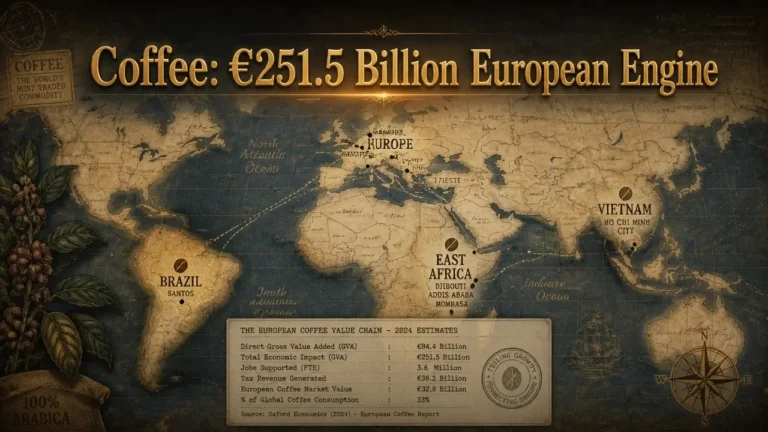

Coffee’s place in Europe’s economy is far larger than a morning habit, according to a new assessment presented on 25 June 2026 at World of Coffee in Brussels, which finds that the sector generated more than half a trillion euro in economic output and €251.5 billion in gross value added in 2025 while remaining tightly linked to producers across the globe.
The study, titled Economic Impact of Coffee in Europe and prepared by consultancy Europe Economics for the European Coffee Federation (ECF), reports that the EU27 coffee industry alone generates €191.5 billion in direct output value, €84.4 billion in direct gross value added and supports around 1.5 million direct full-time equivalent jobs, more than 87% of them in hotels, restaurants and cafés. An ECF summary cited by Comunicaffe adds that when indirect and induced effects are included, coffee supports approximately 3.8 million jobs across the EU economy.
Beyond the topline figures, the report emphasises how much value is added after coffee reaches Europe. Coverage by The Reporter Ethiopia notes that the EU27 imported 2.9 million tonnes of green and roasted coffee from non‑EU countries in 2025, equivalent to 48.3 million bags and worth €18.7 billion, with more than 97% arriving as green coffee. The report text states that “each Euro of imported green coffee is associated with around 11.20 euro of direct European output,” highlighting the scale of post‑import value creation in roasting, manufacturing, distribution, retail and hospitality.
According to the ECF’s own summary of the study, cited by Comunicaffe, each €1 of direct coffee output generates about €2.60 of total output once indirect and induced effects are counted. The federation also reports that coffee generates €65 billion in sales and labour tax revenues across the EU27. Europe’s role as a consumption hub is equally pronounced: ECF materials referenced by Comunicaffe state that Europe drinks around 28% of the world’s coffee, making it the largest single market.
Report excerpts reproduced by The Reporter Ethiopia describe this system as a shared value chain: “Although Europe grows little coffee itself, it is central to the global coffee economy. Producing countries provide the essential agricultural input. Europe then adds value through trading, warehousing, roasting, decaffeination, soluble coffee manufacture, packaging, logistics, retail and hospitality.” ECF Secretary General Eileen Gordon is quoted in the federation’s press release as saying that recognising this interdependence is “essential to supporting a resilient and sustainable future for the coffee sector.”
The assessment also quantifies how much coffee-producing countries depend on Europe. According to figures reported by The Reporter Ethiopia, an estimated 12.5 million farming households worldwide rely on coffee, with around 85% of them classed as smallholders. For some origins, coffee exports to the EU+ market make up a notable share of overall trade: The Reporter Ethiopia lists coffee exports to EU+ as a share of total merchandise exports at 13.2% for Burundi, 12.2% for Honduras, 11.8% for Ethiopia and 10.9% for Uganda.
This asymmetry extends to market shares. A summary on Europa Says reports that the top eight suppliers accounted for roughly 85% of EU coffee imports in 2025, led by Brazil at 37% and Vietnam at 18.9%, followed by Uganda at 8.9%, Colombia at 5.5%, Honduras at 4.6%, Ethiopia at 4.5%, India at 3.8% and Indonesia at 3.7%. In parallel, ECF examples cited by Comunicaffe and The Reporter Ethiopia point out that while Burundi represents just 0.2% of EU+ coffee imports, around 91% of Burundi’s coffee exports go to the EU+ market, and that Uganda supplies about 5.6% of EU+ imports while sending roughly 56% of its coffee exports to the bloc.
The report’s own summary, quoted by The Reporter Ethiopia, concludes that “these examples illustrate the strategic interdependence between Europe and coffee-producing countries,” adding that Europe depends on producers for supply while many producing countries “also depend heavily on Europe as a destination market for exports and foreign exchange earnings.”