
The Cuisinart DGB-900BC Grind & Brew solves a specific kitchen problem: freshly ground coffee every morning without two machines, two power cords, and a counter that looks like a barista station. It stacks a flat burr grinder directly above a 12-cup thermal drip brewer in one brushed stainless chassis.
Whether it earns a permanent spot on your counter comes down to three things the product page glosses over: steam chute physics, a mandatory carafe pre-warming step, and a weekly brush routine. This review covers all three with nothing softened.
Key Takeaways on Cuisinart Burr Grind & Brew DGB-900BCC Review
- Real two-year ownership cost is approximately $245-265: the $200-220 machine plus $12/year charcoal filters and $10/year descaling solution.
- The thermal carafe drops brew temperature 5-8°F unless you pre-warm it with hot tap water for 60 seconds before every cycle; this one step resolves all lukewarm complaints.
- Steam condensation inside the grinder chute requires a weekly 3-minute dry brush routine; skipping it causes coffee oil buildup that restricts dosing and strains the motor.
- Flat burrs produce meaningfully more uniform particle sizes than blade grinders, giving this machine a clear freshness advantage over standard pre-ground drip makers.
- Best match: busy households and morning commuters wanting automated fresh-ground coffee; hard mismatch for precision grind enthusiasts or buyers who resist any appliance maintenance.
The Morning Reality: Unboxing, Kitchen Footprint, and the Single-Machine Promise
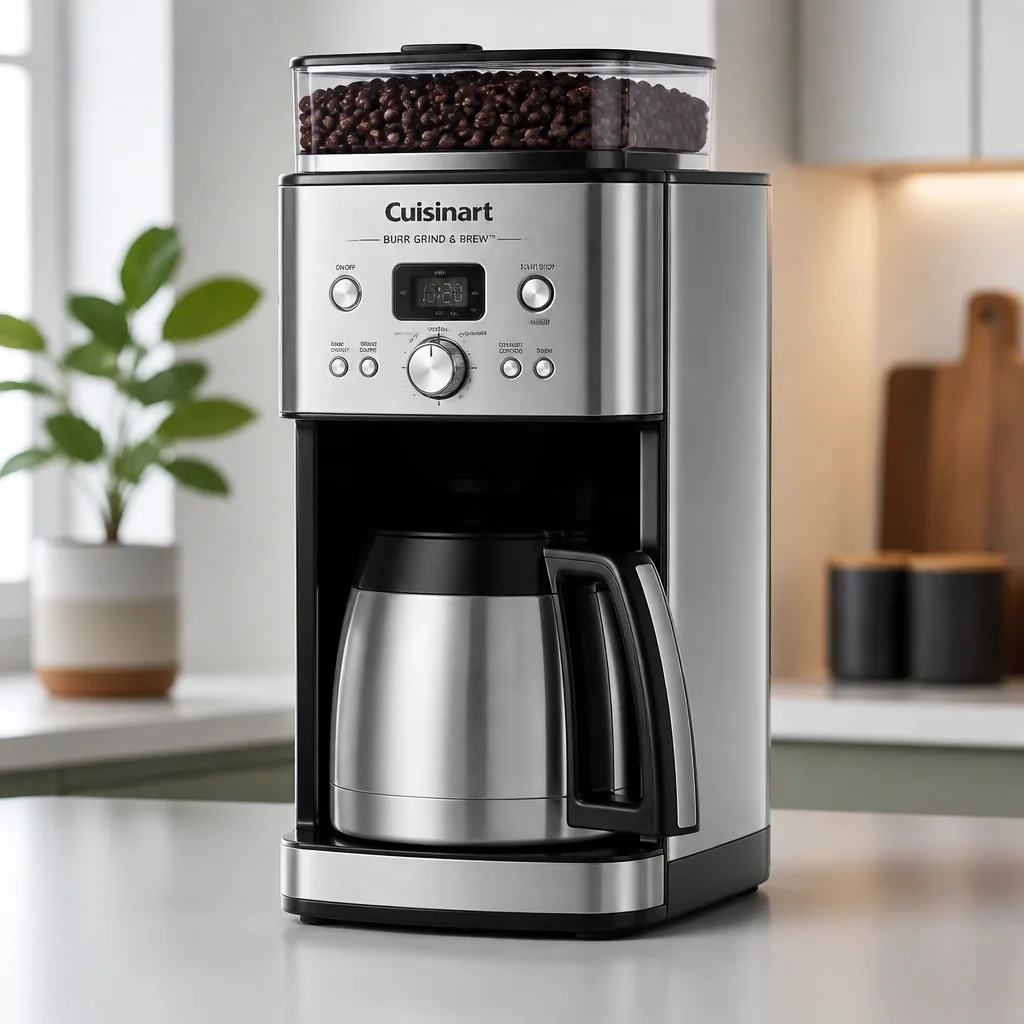
The Cuisinart DGB-900BC measures approximately 8.27 inches wide, 11.61 inches deep, and 16.34 inches tall. Those numbers matter more than they appear on a spec sheet.
Width and depth are the primary counter space wins. Replacing a standalone grinder and a separate drip brewer with this single unit typically recovers 4-6 inches of linear counter space, depending on what you owned before. That consolidation is the machine’s central value argument, and it holds up.
Height is where you need to think. Standard upper kitchen cabinets sit 18 inches above the counter surface. The DGB-900BC clears that comfortably in place. The problem is the bean hopper on top. Filling it requires opening the hopper lid, which needs additional clearance above 16.3 inches. In a typical fixed-cabinet layout, that means sliding the unit to the counter edge before refilling. It takes ten seconds and is easy on smooth surfaces; it is mildly annoying on textured or grouted counters. Buyers planning a permanent under-cabinet installation should measure this before ordering.
Once in place, the machine’s 8-ounce sealed hopper holds roughly half a standard 12-ounce bag of beans. That covers approximately one week of brewing for a two-person household at 2-4 cups per day. The seal is adequate for short-term freshness protection, though serious coffee people will want to keep the remainder of their bag in an airtight container away from heat.
The build quality is honest mid-range. Nothing flexes, rattles, or feels cheap. The LCD panel, cup-count buttons, and strength selector are laid out logically enough that the machine is operable without reading the manual. The carafe handle has a solid grip and the brew-through lid seals cleanly. This is not a premium appliance, but it is built to last several years of daily use without drama.
Under the Hood: The Integrated Burr Grinder and the Steam Chute Physics
The grinder uses a flat burr assembly. Burr grinding works by crushing coffee between two abrasive rotating plates set at a fixed gap. The result is a particle size distribution that is narrow and consistent. Blade grinders, by contrast, chop randomly, producing a mix of fine powder and large unbroken fragments that extract at different rates inside the same brew cycle. That inconsistency is what causes the muddy, bitter, or sour notes that define cheap grocery store drip coffee. A flat burr grinder in a $200 all-in-one is a meaningful engineering commitment.
The DGB-900BC’s grinder offers three strength settings: Mild, Medium, and Strong. These settings adjust grind time, which controls dose weight. They do not adjust the burr gap. This is the machine’s primary grinder limitation: if a particular specialty bean requires a finer or coarser grind to extract cleanly at your altitude and water chemistry, the machine cannot accommodate that. For medium-roast grocery beans and most specialty medium-darks, the fixed calibration performs well. For light-roast single-origins with unusual density, it is a constraint worth knowing before you buy.
The more consequential engineering detail is steam chute physics. The grinder exit chute sits directly above the brew basket. During extraction, water heated to 195-205°F generates steam that rises up through the chute channel. That steam contacts the cooler plastic walls and condenses immediately, leaving a moisture film on every interior surface. Coffee dust from each grind cycle adheres to that film. Over multiple brew cycles, this accumulates into a dense, oily paste that narrows the chute’s internal diameter.
This is not a design flaw unique to Cuisinart. Every all-in-one machine that positions a grinder above a hot brew chamber shares the same thermodynamic problem. Coffee oil buildup in the chute increases resistance to falling grounds, eventually causing bridging where grounds compact across the chute opening instead of dropping into the filter basket. The outcome is under-dosed coffee and, in neglected machines, a stalled grinder motor. A weekly dry brush routine prevents this entirely. The relevant question is whether you will actually do it consistently.
The Thermal Carafe Truth: Heat Retention Without Burned Coffee
The DGB-900BC uses a 12-cup double-walled insulated stainless steel thermal carafe with a brew-through lid and no electric hot plate. This is the correct design choice, and the chemistry explains why with precision.
Electric hot plates on glass-carafe drip makers maintain temperature by applying continuous heat to already-brewed coffee. At temperatures above 175°F, chlorogenic acids in coffee degrade into quinic acid and other off-flavor compounds. The familiar “burned” taste of office coffee left on a warming plate all morning is this degradation process in action. It is irreversible. The thermal carafe avoids it entirely by using vacuum insulation to hold temperature passively, without any ongoing chemical cooking.
Coffee in a properly sealed thermal vessel holds at serving temperature for 3-plus hours and retains its aromatic pyrazines significantly longer than coffee maintained on an electric element.
The catch is what engineers call the heat sink effect. Cold stainless steel walls absorb heat energy from the first pour of hot coffee, pulling approximately 5-8°F out of the brew during the initial fill. For a full 12-cup cycle, this is noticeable in the final cup temperature if you brew and pour immediately without any preparation.
The fix is a carafe pre-warming protocol that Cuisinart mentions in the manual without giving it the prominence it deserves. Before starting the brew cycle, fill the empty carafe with hot tap water and let it stand for 60 seconds. Dump the water and start the brew immediately. The steel walls are now at or near brew temperature, the heat sink effect disappears, and the coffee comes out properly hot. Every review complaint about “lukewarm coffee” from DGB-900BC owners traces back to skipping this step. Pre-warming is not optional; it is the operating protocol.
To check live pricing and current availability before purchasing, here is the listing:
This post contains affiliate links, meaning I may earn a commission if you make a purchase through these links, at no additional cost to you. As an Amazon Associate, I earn from qualifying purchases. I only recommend products I genuinely believe will add value.

Cuisinart DGB-900BCC DGB-900BC Grind & Brew Thermal 12-Cup Automatic Coffeemaker
- 24-Hour fully programmable coffeemaker with auto shutoff, Brew-pause feature, and grind off function. Cord len…
The 5-Step Logic Loop: Brew Quality, Controls, and the Real Price Tag
The controls: The digital panel manages 2-12 cup volume dosing, three flavor strength settings, a 24-hour programmable advance timer, and a Grind-Off bypass button for pre-ground coffee. The auto-calibration matches water volume to grind time automatically, so selecting 4 cups produces a proportionally dosed batch rather than a weak half-pot. The 24-hour timer allows loading the hopper at night and waking to a kitchen that smells like freshly ground coffee before you have looked at your phone.
The cup: Coffee from the DGB-900BC is noticeably fresher and more aromatic than the same beans pre-ground and brewed in a standard drip maker. Grinding immediately before brewing preserves volatile coffee oils that begin oxidizing within 15 minutes of exposure to air. The cup profile is medium-bodied, clean, and fuller than pre-ground drip. It is not at the level of a pour-over dialed in on a precision grinder with a gooseneck kettle. That is not the comparison being made; the relevant comparison is against other all-in-one machines and against standard drip makers using canned grounds, where this machine wins clearly.
The real price tag: The machine retails at approximately $200-$220. Most reviews stop there. The recurring costs deserve equal attention. The charcoal water filter requires replacement approximately every 60 days, roughly $12 per year. Descaling solution or food-grade citric acid for the monthly cleaning cycle adds another $10 per year. The gold-tone permanent filter included in the box eliminates ongoing paper filter costs entirely. Two-year total ownership cost lands at approximately $245-$265. For a flat-burr grind-and-brew at this brew volume, that is honest value.
The ideal buyer is the morning commuter who needs a full carafe ready at 6:30 AM without standing over a grinder. For that buyer, this machine delivers exactly what it promises.
The Six-Month Maintenance Protocol: Keeping the Chute from Clogging
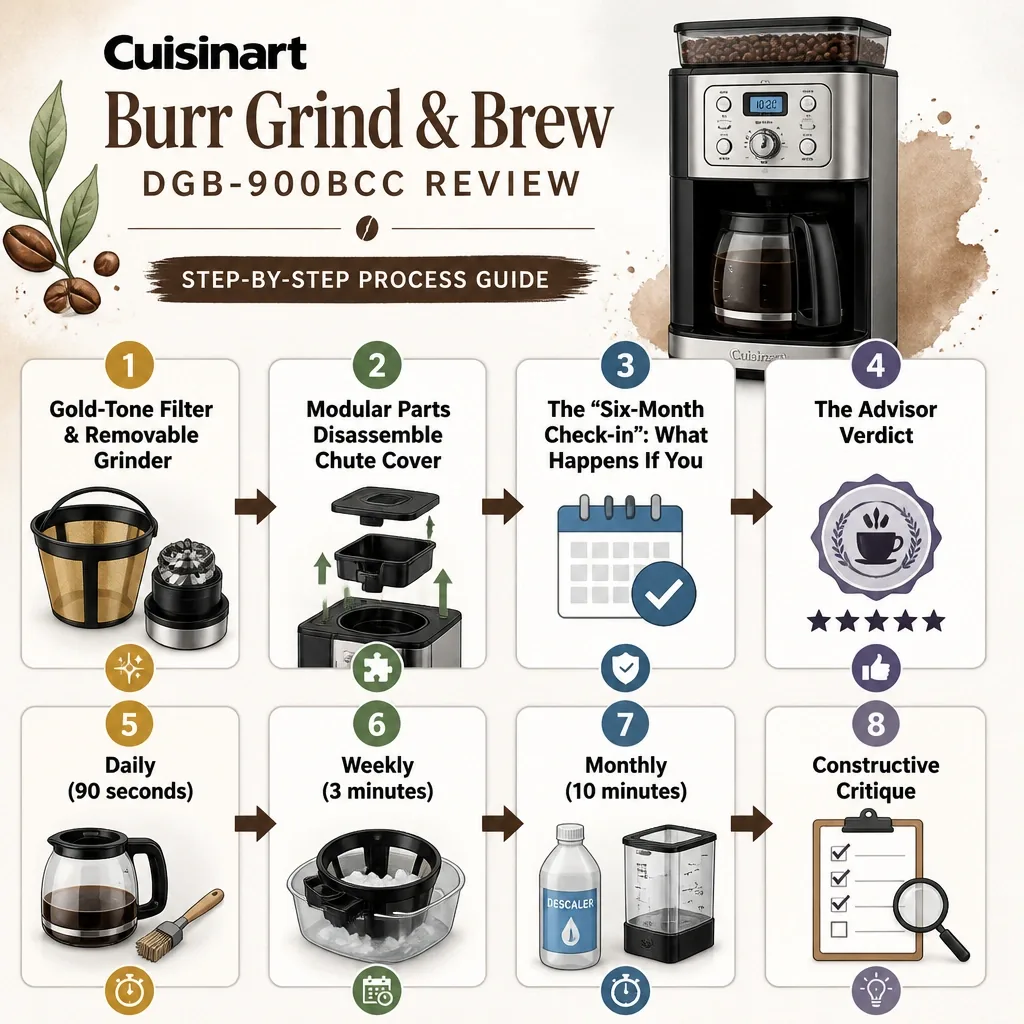
The DGB-900BC is maintenance-honest in its design. Parts are tool-free and modular. The gold-tone filter basket lifts out, the chute cover unlatches with a thumb press, and the carafe disassembles in seconds. The safety interlock switch prevents the grinder from operating when the chute cover is open, eliminating any risk of accidental contact with the burrs during cleaning.
Three intervals cover everything the machine needs to run cleanly:
Daily (90 seconds). Lift the gold-tone filter basket out of the brew position and dump the spent grounds. Rinse the basket under cold tap water. Do not use dish soap on the gold-tone mesh; detergent residue accumulates and affects coffee flavor over time. Set the basket to air dry. Wipe the exterior of the carafe if needed.
Weekly (3 minutes). Press the chute cover release tab and swing the cover open. Use the stiff-bristle burr cleaning brush included with the machine to dry-brush the interior walls of the chute channel, working the brush in and out several times to break up and dislodge compacted grounds and coffee oil buildup. Critical rule: never run water through the grinder or chute housing. Water reaching the burr motor causes rust and electrical damage. Dry brush only, every time. Reattach the cover until the latch clicks securely.
Monthly (10 minutes). Fill the reservoir with a 1:1 mixture of white vinegar and water, or a commercial citric acid descaling solution. Run a full brew cycle without beans or filter, then run two plain water cycles to flush all residue. Swap the charcoal water filter at this same interval if the filter indicator light has triggered.
The six-month check-in: Consistent weekly brushing keeps the grinder running at spec with predictable dosing. Skipping the weekly brush for a month produces a higher-pitched grinder tone (the motor straining against increased chute resistance) and visibly uneven coffee dose in the basket. The corrective session is a deeper 15-minute cleaning pass across every accessible chute surface, followed immediately by a descaling cycle.
Head-to-Head: Cuisinart DGB-900BC vs. Breville Grind Control vs. Dedicated Separates
Three options serve the same buyer, each with a different set of trade-offs.
Breville Grind Control (BDC650BSS, approx. $330): The Breville offers 6 grind size calibrations versus the Cuisinart’s fixed burr gap, plus single-cup dispensing and finer water temperature management. It costs over $100 more. Importantly, the Breville positions its integrated grinder above a hot brew chamber, so it shares the identical steam-chute condensation physics as the DGB-900BC. Paying more gets you better grind adjustability and a more refined control interface. It does not reduce the maintenance obligation.

Breville BDC650BSS Grind Control Thermal Carafe, Brushed Stainless Steel
- The Breville Grind Control coffee maker creates third wave specialty coffee by capturing freshness and essenti…
- INTEGRATED AND ADJUSTABLE GRINDER: Adjust the coffee grinder output to suit any bean from anywhere and customi…
- Receive 2 free bags of specialty coffee when you purchase and register any Breville coffee machine; T and Cs a…
- STEEP AND RELEASE TECHNOLOGY: Brew your coffee directly into a large carafe, tall cup or travel mug with equal…
- INCLUDED ACCESSORIES: Gold Tone Filter, 12 Cup Dual Wall Stainless Steel Thermal Carafe and Cleaning Brush
Dedicated Separates (Baratza Encore + Cuisinart DCC-3200P1 or Bonavita 8-cup, approx. $260-$320): A standalone Baratza Encore grinder paired with a quality drip brewer eliminates the steam-chute problem entirely because the two machines are physically separate. The Encore offers 40 grind settings with genuine particle uniformity meaningfully superior to any integrated all-in-one at this price. Component isolation means a broken grinder does not affect the brewer, and vice versa. The costs: you need counter space for two appliances, you grind manually before each brew, and there is no programmable auto-start that wakes you to fresh coffee.

Baratza Encore Coffee Grinder ZCG485BLK, Black
- Specialty Coffee Association Award Winning Grinders - Baratza grinders are preferred by coffee professionals a…
- Go-To Entry Level Grinder - Baratza’s best-selling grinder, with its small footprint, is THE choice for brewin…
- User Friendly - A convenient, front-mounted pulse button, plus a simple ON/OFF switch make it easy to grind fr…
- 40 Grind Settings - Engineered with 40mm commercial-grade conical burrs that help you explore the extensive ra…
- Warranty and Quality Parts - Hardened alloy steel burrs manufactured in Liechtenstein, Europe, plus a powerful…

Cuisinart Coffee Maker, Programmable, Stainless Steel, 14-Cup Glass Carafe
- ADJUSTABLE CARAFE TEMP: Our Cuisinart 14-Cup* Coffee Maker with adjustable carafe temp feature adjusts the war…
- BREW STRENGTH CONTROL: This coffee maker customizes your brew to perfection with regular or bold settings, cat…
- FULLY AUTOMATIC COFFEE MAKER: The coffee machine offers convenience with 24-hour programmability, 1-4 cup sett…
- 14-CUP* CAPACITY: *Cup equals approx. 5 oz. (varies by brewing technique).
- FILL WITH EASE: Enjoy precise water filling with the easy-to-view water window, while the Cuisinart coffee mak…

Bonavita 8 Cup Drip Coffee Maker Machine, One-Touch Pour Over, Auto Pause Brewing with Stainless Steel Double Wall Thermal Carafe, SCA Certified, Dishwasher Safe, BV1901TS
- 8 CUP IN 6 MINS: Brew a full 8-cup carafe in just 6 minutes with one touch. The powerful 1500-watt heater ensu…
- ONE-TOUCH FAST BREW: Start your day effortlessly with a single press, enjoying professional and fresh coffee f…
- EVEN EXTRACTION FOR FULL FLAVOR: The specially designed showerhead ensures even saturation of coffee grounds, …
- BLOOM FOR RICHER TASTE: The optional pre-infusion mode gently pre-wets coffee grounds before brewing, resultin…
- DISHWASHER-SAFE & BPA-FREE: The carafe lid, filter basket, and showerhead are dishwasher-safe and BPA-free. Th…
| Feature | Cuisinart DGB-900BC | Breville Grind Control | Separates (Encore + DCC-3200) |
|---|---|---|---|
| Price | ~$200-220 | ~$330 | ~$260-320 |
| Counter footprint | Single machine | Single machine | Two machines |
| Grind adjustability | Fixed (3 strength doses) | 6 grind settings | 40 settings |
| Auto-start timer | Yes | Yes | No |
| Steam chute cleaning | Weekly required | Weekly required | Not applicable |
| Failure isolation | No | No | Yes |
The separates setup wins on coffee quality ceiling and long-term reliability philosophy. The all-in-ones win on automation and counter consolidation. Among the all-in-one options, the Cuisinart wins the value calculation by over $100.
The Advisor Verdict: Who Should Buy It and Who Should Walk Away
The Cuisinart DGB-900BC is a workhorse that delivers automated fresh-ground coffee with genuine daily convenience. Its engineering trade-offs are real and predictable. Respecting them keeps the machine performing well for years. Ignoring them produces exactly the negative reviews you find online.
Buy this if you want the sensory upgrade of freshly ground coffee every morning with zero manual grinding steps. Buy it if you are brewing 4-12 cups for a busy household or need to fill a travel thermos before a commute. Buy it if you can commit to the 3-minute weekly chute brush on the same day each week, treated as part of the appliance’s operating cost rather than an inconvenience.
Skip this if you are a pour-over or espresso purist who needs precise grind size control. The fixed burr gap cannot accommodate specialty extraction requirements, and this machine was not designed for that audience. Skip it if the weekly maintenance requirement genuinely feels unreasonable; an uncleaned all-in-one produces worse results than a simple drip maker with pre-ground beans, and there is no shortcut past the brush routine. Skip it if your upper cabinets sit closer than 17 inches from the counter surface and the machine cannot slide forward freely for hopper refilling.
For the buyer it was designed for, this machine earns its counter space consistently.
Frequently Asked Questions About Cuisinart Burr Grind & Brew DGB-900BCC Review
Can I use pre-ground coffee in the Cuisinart DGB-900BC?
Yes. The Grind-Off button bypasses the burr grinder entirely and brews from pre-ground coffee you load directly into the filter basket. This is also useful if the grinder needs service but you still want to use the brewer.
How often do I really need to clean the grinder chute?
Every week when you brew daily. Steam condensation and coffee dust accumulate into a restrictive paste inside the chute within 5-7 brew cycles. Skipping the weekly dry brush for a month causes erratic dosing and audible motor strain.
Why is my coffee not hot enough from the thermal carafe?
The cold steel carafe walls absorb heat from the first pour, dropping brew temperature by 5-8°F. Fill the empty carafe with hot tap water, wait 60 seconds, dump it, and start the brew immediately. This pre-warming step eliminates the heat sink effect entirely.
Can I put the thermal carafe or bean hopper in the dishwasher?
The carafe body requires hand washing; the lid and brew-through stopper can go on the dishwasher’s top rack. The bean hopper should never go in the dishwasher. Moisture and detergent residue inside the hopper accelerate coffee oil rancidity and can damage the grinder mechanism.
What should I do if the grinder makes a buzzing sound or stalls mid-cycle?
A high-frequency buzz or grind stall almost always means the exit chute is partially blocked. Turn the machine off, unlatch the chute cover, and dry-brush the interior with the included stiff-bristle brush. Run a test grind after reattaching the cover. If stalling continues, confirm the chute cover is fully latched; the safety interlock will prevent grinder operation if the cover is not secured.