

Cortado vs latte is one of the most searched comparisons in specialty coffee – and one of the most incompletely answered. Both drinks start from the same double espresso shot, but the way milk is measured, textured, and poured turns them into two genuinely different sensory experiences.
The gap isn’t just about size. It’s about how much of the espresso’s character survives the milk. Get the structural logic right, and every coffee menu starts making sense on its own.
What We’re Actually Comparing in These Two Drinks
Both the cortado and the latte start from the exact same foundation: a double espresso shot and steamed milk. That’s it. Every difference you taste, feel, and see in the cup comes from how those two ingredients are combined – the proportion, the texture of the milk, and the total volume poured.
Three variables define any espresso-milk drink, and these two are no exception. First, the milk-to-espresso ratio – how much milk you add per unit of espresso. Second, the milk texture – how much air gets worked into the milk during steaming. Third, the total serving size – the physical volume of the finished drink. Change any one of these, and you change the drink’s identity.
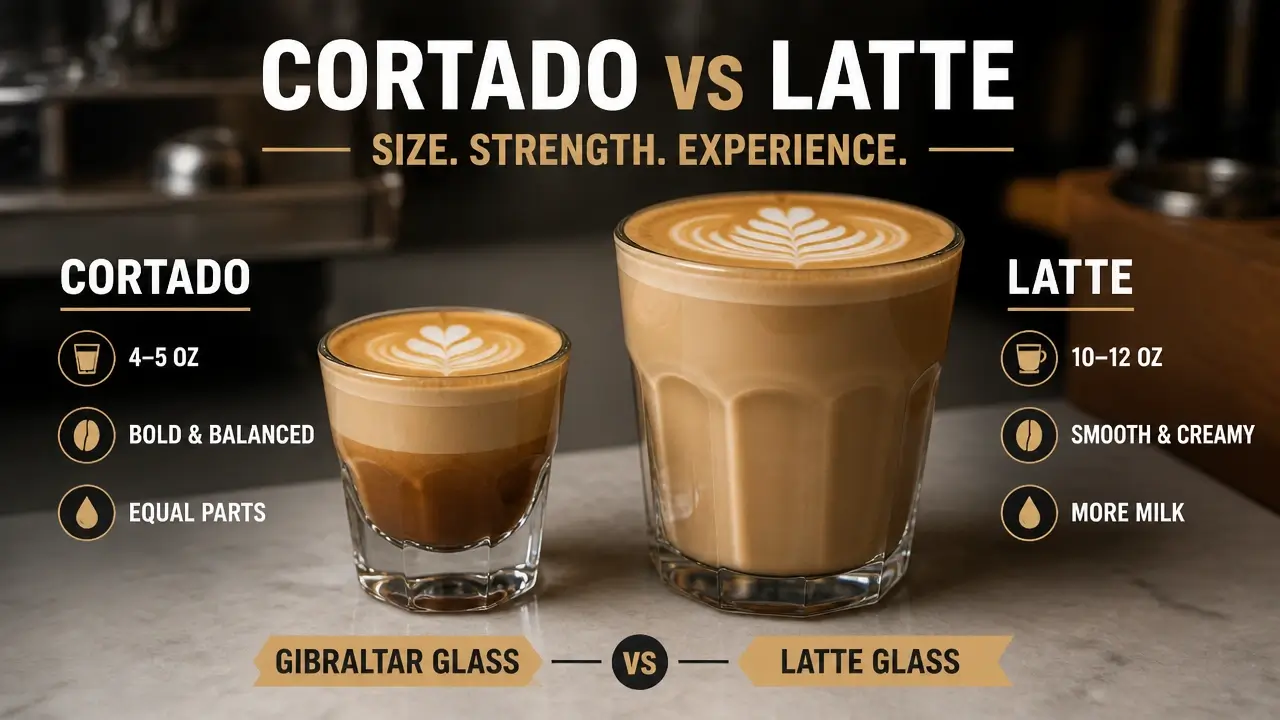
Here are the working numbers before we go any further: a cortado sits at a 1:1 ratio, roughly 4 oz total; a latte runs 1:3 to 1:5, typically 8–12 oz. Ratio is the first and loudest sorting tool, but it doesn’t work alone. Texture and size move in lockstep with it – a 1:1 ratio poured into a 10 oz mug stops being a cortado in any meaningful sense.
That said, ratio as a decision tool has a real-world problem. The coffee industry hasn’t agreed on a single name for the cortado across cafés. Walk into one shop and order a cortado; walk into another and order the same thing – you may receive drinks built on entirely different assumptions about size, milk texture, and even glassware. The specialty coffee world often treats “Gibraltar” as simply a cortado served in a specific Libbey rocks glass, while mainstream menus treat it as a distinct drink or an entirely separate category. Two cafés, two definitions, one name.
This article anchors itself to the recipe – the 1:1 ratio, minimal foam, small glass – not to whatever a café’s chalkboard says. Think of what follows as a structural blueprint, not a brand guide.
Milk Ratio and Serving Size: The Decisive Number
Milk ratio is the loudest structural difference between a cortado and a latte, and the math is straightforward. A cortado is built on a double espresso shot – typically 18–20 g of ground coffee yielding about 36–40 g of liquid espresso, or roughly 2 oz – combined with an equal 2 oz of steamed milk, for a 1:1 ratio and a total volume of approximately 4 oz. A latte uses the same double shot but stretches it with 6–10 oz of steamed milk, landing at a 1:3 to 1:5 ratio and a total volume of 8–16 oz, most commonly 8–12 oz in a standard café pour.
That ratio gap controls what your palate actually registers as “coffee.” In a cortado, the low dilution keeps the espresso’s body, brightness, and bitter-sweet character at the front of every sip. The milk is present, but it plays a supporting role – it softens sharp acidity without burying the roast. In a latte, the high milk volume coats the tongue first. The espresso is still there, acting as a backbone, but the milk’s natural sweetness and fat content take over the sensory foreground. The coffee becomes a whisper inside a creamy envelope.
Serving size connects directly to drinking tempo in a way that’s structural, not lifestyle commentary. The cortado’s 4 oz in a Gibraltar glass is consumed in minutes – it’s a focused, intentional shot of flavor. The latte’s 8–12 oz in a wide ceramic cup becomes a 15–20 minute ritual. The volume itself changes the relationship between drinker and drink.
Caffeine content is where the math gets interesting. Both drinks are built on the same double shot, so total caffeine is nearly identical – roughly 120–140 mg. But caffeine per ounce tells a different story: a 4 oz cortado delivers approximately 30–35 mg per ounce; a 10 oz latte delivers roughly 12–14 mg per ounce. You’re not getting more caffeine from a cortado, but you’re receiving it in a far more concentrated package, which changes how the hit lands.
Here’s a direct head-to-head look at the structural numbers:
| Parameter | Cortado | Latte |
|---|---|---|
| Espresso dose | ~2 oz (double shot) | ~2 oz (double shot) |
| Milk volume | ~2 oz | 6–10 oz |
| Total volume | ~4 oz | 8–16 oz (typically 8–12 oz) |
| Milk-to-espresso ratio | 1:1 | 1:3 to 1:5 |
| Total caffeine | ~120–140 mg | ~120–140 mg |
| Caffeine per ounce | ~30–35 mg/oz | ~12–14 mg/oz |
| Typical cup/glass | 4–5 oz Gibraltar glass | 8–16 oz ceramic cup |
| Drinking tempo | 3–5 minutes | 15–20 minutes |
One important caveat before treating that table as the final word: two lattes built on the exact same 1:4 ratio can taste radically different depending on how the milk was steamed. Milk fat percentage, air injection volume, pour height, and even milk temperature alter mouthfeel and the way the espresso’s bitter fractions are masked or exposed. Ratio is your baseline decision tool. Your actual sensory experience will be written by the texture layer – which is exactly where we’re going next.
Thom Huppertz, Professor of Dairy Science and Technology at Wageningen University in the Netherlands, explains that when steam contacts milk, air bubbles form almost instantly and are immediately coated by milk proteins – it’s those proteins that give the foam its structural stability. The practical consequence for your cup: the quality and density of microfoam isn’t just a technique variable, it’s a milk-chemistry variable. Change the protein content – by switching milk brands or swapping to a non-dairy alternative – and the foam structure changes even if the barista’s technique stays identical.
To preserve this precise structural equilibrium and maintain the ideal thermal mass, utilizing the correct cortado vessel size is essential.
Milk Texture and Mouthfeel: Dense Velvet vs. Silky Cloud
Steamed milk is not a single thing. The way a barista positions the steam wand – how deep, at what angle, for how long – determines whether the milk becomes a dense, liquid-smooth coat or a light, pillowy microfoam. That distinction is the hidden architect of everything you taste in a cortado versus a latte.
A cortado calls for minimal air incorporation. The steam wand tip sits just below the milk’s surface, and the goal is to heat the milk to around 130°F while keeping it almost entirely free of aeration. The result is a dense, velvety consistency – smooth without being frothy, warm without a foam cap sitting on top. Because the milk isn’t aerated, the espresso’s crema survives the pour and lingers on the surface. There’s nothing to disrupt it. Latte art isn’t possible here, and that’s by design – the cortado isn’t a canvas, it’s a lens.
A latte requires the opposite approach. The steam wand begins near the milk’s surface to deliberately pull in air during a short “stretching” phase, then submerges to spin the milk into a vortex that breaks large bubbles down into microfoam – tiny, uniform air bubbles that produce a glossy, wet-paint surface and a soft foam cap. Target temperature runs slightly higher, around 145°F. That microfoam is what makes latte art possible: the controlled pour of aerated milk over espresso is what forms a rosetta or a heart. The microfoam also softens the espresso’s entry on the palate and creates a creamy, lingering finish that a cortado simply doesn’t produce.
Temperature isn’t just a safety variable – it changes what you taste. Research published in the Journal of the Japan Society of Home Economics found that milk-added coffee prepared at 70°C (158°F) was perceived as significantly sweeter and less bitter than the same coffee prepared at 80°C or 90°C, with sensory evaluation methods confirming the effect across both taste intensity and aftertaste. The cortado’s slightly cooler milk preserves more of the espresso’s delicate volatile aromatics; the latte’s warmer pour shifts the milk’s natural lactose into a sweeter-tasting register.
A complementary study on steam frothing and microfoam characteristics found that optimal steam frothing temperature sits between 50–60°C for microfoam texture and stability, and that the aeration process itself – not just heat – is what drives organoleptic differences between milk textures. Meanwhile, research on foam stability in milk-based espresso drinks confirmed that higher steaming temperature improves foam height and perceived mouthfeel without altering the fundamental taste compounds – meaning the texture layer and the flavor layer operate on separate tracks, even as they influence each other.
Now here’s where the framework gets complicated in the real world. Everything above assumes whole dairy milk. But a significant share of café orders today are oat, almond, or soy – and these alternatives behave differently under steam in ways that directly undermine the cortado/latte distinction.
Oat milk can produce a thicker, more stable microfoam than skim dairy, which can push a latte’s texture toward something denser and drier – closer to a cappuccino than the silky cloud you ordered. Almond milk often can’t build meaningful microfoam at all, which means the latte’s signature texture collapses into a warm, thin milk-espresso mix. A cortado made with oat milk may end up carrying an unintended layer of foam, which is precisely the thing the drink is supposed to avoid.
The pour matters as much as the steam. Tilt the cup slightly, start the pour from low to integrate the milk with the espresso, then raise and slow down to lay a clean white dot or the beginning of a rosetta. The microfoam’s density is what allows the pattern to hold.
Marek Krupa, Co-Founder and CFO of Kruve, the specialty coffee glassware manufacturer, notes that professional baristas typically hold their cups by the bottom rather than the handle when pouring latte art – the tactile feedback from the cup’s base gives them more control over tilt and flow. It’s a small detail, but it illustrates how much of the latte’s technique lives in the pour, not just the steam.
One technique note that most guides skip: the same espresso extraction that works perfectly in a cortado may come across as too acidic or too bitter in a latte. The latte’s larger milk volume amplifies certain flavor fractions while dampening others – an extraction that reads as balanced and complex in 4 oz of total volume can feel sharp or one-dimensional spread across 10 oz. You may need to dial your grind slightly coarser or adjust your dose when switching between formats, not because the recipe changed, but because the milk’s sensory context changed.
The Gibraltar/cortado naming confusion introduces one more practical problem: shops that treat the Gibraltar as a distinct drink sometimes build it with slightly more milk – 4.5–5 oz total – or add a small touch of foam, deviating from the strict 1:1, no-foam cortado definition. In those cafés, ordering a “cortado” and ordering a “Gibraltar” can get you different drinks. The clearest path forward: specify ratio and foam level directly – “double shot, equal parts milk, no foam” – rather than relying on the name to do the work.
Cortado or Latte: A Decision Guide for the Intentional Drinker
Every section above has been building toward one practical question: given everything you now know, when does it actually make sense to choose one over the other?
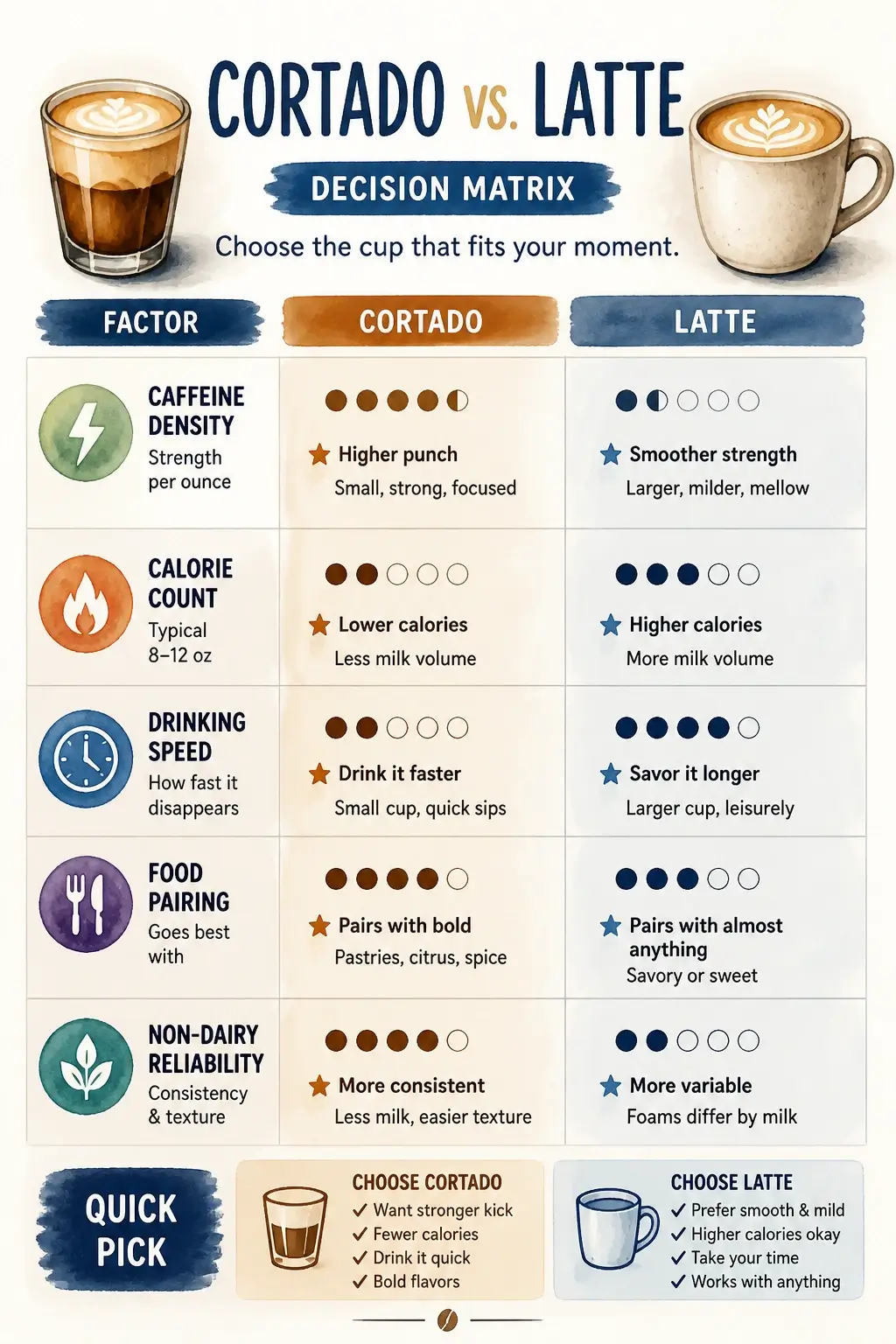
Here’s the direct framework, without mood-based hedging. Choose a cortado if you want a quick, intense coffee where the espresso’s character is the star – the bean, the roast, the origin. Choose a latte if you want a creamy, soothing cup that lasts 15–20 minutes and integrates comfortably with food or a slow morning.
The concrete trade-offs break down like this:
- Caffeine density: Both drinks carry roughly the same total caffeine (~120–140 mg from a double shot), but the cortado delivers it in 4 oz versus the latte’s 8–12 oz. The cortado hit is sharper and faster; the latte’s is extended and gentler.
- Sugar and calories: A cortado with whole milk runs approximately 2–4 g of natural sugar and 50–80 calories. A latte with whole milk sits at roughly 10–16 g of sugar and 120–200 calories. For anyone managing intake, the cortado gives you the same caffeine payload at a fraction of the caloric cost.
- Heat retention: The cortado cools faster – smaller volume, thinner glass walls. Drink it within 5 minutes or the temperature window closes. The latte stays drinkably warm for 15–20 minutes, which matters if you’re reading, working, or eating alongside it.
The per-persona breakdown is worth stating plainly:
- The espresso purist will favor the cortado for its unvarnished bean expression – every sip is the coffee, not a milk vehicle.
- The texture and art seeker who values a silky, pillowy mouthfeel and the visual craft of latte art will find the latte more rewarding.
- The calorie- or sugar-conscious drinker gets the same caffeine hit from a cortado at roughly one-third the caloric load.
- The home barista with limited steaming skills will find the cortado more forgiving – there’s no microfoam to perfect, no rosetta to nail. A quiet steam and a clean pour is all it takes.
Food pairing follows the same logic as flavor intensity. The cortado’s bold espresso character stands up to a buttery croissant or a piece of dark chocolate – the richness of the food meets the coffee as an equal. The latte’s creamy sweetness flatters a blueberry muffin or banana bread without either element overwhelming the other.
One final practical warning on ordering: the Gibraltar/cortado naming overlap and the non-dairy texture variables mean that in an unfamiliar café, the name alone won’t protect you. If you drink oat, almond, or soy milk, the cortado’s simple no-foam texture survives alternative milks better than the latte’s microfoam does – a poorly steamed oat milk latte collapses into something thin and forgettable, while an oat milk cortado, even imperfectly made, still delivers concentrated espresso flavor. When in doubt, specify: ratio, foam level, milk type.
Here’s the mental model that ties it all together: cortado vs latte is really a question of what you’re optimizing for – espresso intensity versus milk comfort, speed versus duration, restraint versus richness. Neither drink is better. They’re calibrated for different intentions.
Sarah Allen, Co-Founder and Editor of Sprudge Coffee, points out that the Gibraltar name is used more frequently on the West Coast of the United States and is tied directly to the specific Libbey rocks glass in which the drink is served – which means the same preparation can carry a different name depending entirely on geography and glassware inventory. Knowing this, the intentional drinker stops relying on the menu label and starts specifying the drink by its structure. That’s the real upgrade: from passive consumer to someone who knows exactly what they’re asking for, regardless of what the blackboard calls it.
Key Takeaways on Cortado vs Latte
- A cortado uses a 1:1 milk-to-espresso ratio at ~4 oz total; a latte runs 1:3 to 1:5 across 8–16 oz – ratio is the primary structural divider.
- Both drinks carry nearly identical total caffeine (~120–140 mg), but the cortado delivers roughly 30–35 mg per ounce versus the latte’s 12–14 mg per ounce.
- Cortado milk is steamed to ~130°F with minimal air; latte milk is steamed to ~145°F with deliberate microfoam – texture is a separate variable from ratio, not a consequence of it.
- The same espresso blend can taste bold and complex in a cortado but disappear entirely in a latte – the format changes the flavor hierarchy, not just the strength.
- A cortado with whole milk runs 50–80 calories; a latte runs 120–200 calories – for the same caffeine, the cortado is the lower-calorie format.
- Non-dairy milks disrupt both drinks differently: oat milk over-foams a latte, almond milk under-foams it, and both can add unintended texture to a cortado – always specify foam level when ordering with alternatives.
Frequently Asked Questions About Cortado vs Latte
Is a cortado actually stronger than a latte?
The total caffeine is nearly identical since both use a double shot, but the cortado is more concentrated – roughly 30–35 mg of caffeine per ounce versus the latte’s 12–14 mg per ounce. You’re not getting more caffeine, you’re getting it in a smaller, more intense package.
Is a cortado basically a flat white?
They’re close but not the same. A flat white typically runs 4–6 oz with a thin microfoam layer and a higher milk-to-espresso ratio than a cortado’s strict 1:1. The cortado deliberately avoids foam; the flat white’s microfoam is part of its identity and allows for latte art.
Which coffee has the least milk – cortado or latte?
The cortado by a significant margin. At 1:1, you’re adding roughly 2 oz of milk to a double shot. A latte adds anywhere from 6 to 10 oz to the same shot, making it three to five times more milk-heavy.
Does the type of espresso roast matter differently in each drink?
Yes, and this is one of the most under-discussed variables. A bright, fruity single-origin shot expresses beautifully in a cortado but gets lost in a latte’s milk volume. A dark, chocolatey blend can feel heavy in a cortado but anchors a latte’s flavor exactly right – match the roast to the format.
Can you make a cortado at home without a steam wand?
You can approximate it. Heat 2 oz of milk in a small saucepan to around 130°F without boiling, froth it minimally with a handheld frother for just a second or two, then pour it over a double shot. You won’t achieve the velvety texture of a properly steamed cortado, but the ratio and temperature will get you close.
Why does my oat milk latte taste so different from a dairy latte?
Oat milk’s higher starch and beta-glucan content produces a thicker, denser microfoam than whole dairy milk, which shifts the latte’s texture toward something heavier and less silky. The mouthfeel changes even when the ratio and technique stay the same.
What if a café lists both “cortado” and “Gibraltar” on the menu?
That’s a shop-specific distinction – some cafés build the Gibraltar with slightly more milk or a small foam layer, deviating from the cortado’s strict 1:1 no-foam definition. Ask the barista what differentiates them on their menu, or simply specify “double shot, equal parts milk, no foam” to get the cortado blueprint regardless of what it’s called.
Which drink is better for drinking quickly before a meeting?
The cortado, without question. At 4 oz and 130°F, it cools to a comfortable drinking temperature within a minute or two and is finished in under five minutes. A latte’s 10 oz volume takes longer to cool and longer to consume – it’s built for a slower setting.
References
- Thom Huppertz – Wageningen University Staff Profile – wur.nl
- Effect of Steam Frothing on Milk Microfoam: Chemical Composition, Texture, Stability and Organoleptic Properties – papers.ssrn.com
- The Effect of Xanthan Gum and Temperature on Foam Stability of Milk-Based Espresso Coffees – academia.edu
- Effects of Processing Conditions During Manufacture on Retronasal-Aroma Compounds from a Milk Coffee Drink – ift.onlinelibrary.wiley.com
- Marek Krupa on Kruve Imagine Glasses – kruveinc.com
- Sarah Allen on the Gibraltar – sprudge.com