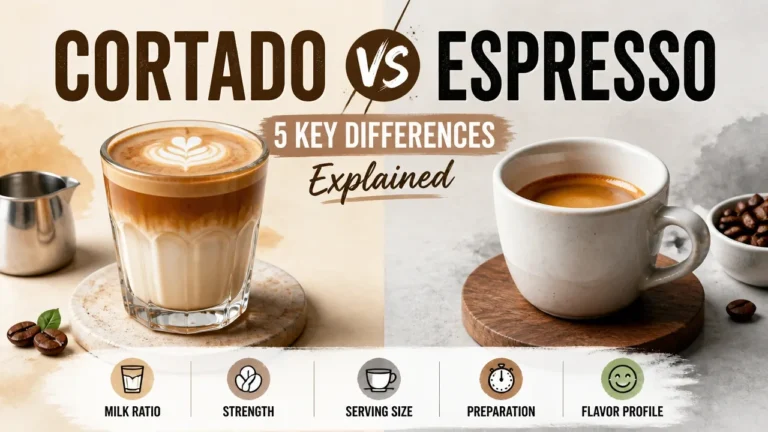

The cortado vs espresso debate looks like a volume question until you realize the real variable is milk chemistry. One drink hands you raw extraction – crema, acidity, intensity, nothing softened. The other takes that same shot and cuts it with steamed whole milk in a 1:1 ratio, changing not just the texture but the flavor architecture of everything in the cup.
Understanding where these two drinks actually diverge – and where they don’t – tells you more about your own palate than any menu description ever will.
Key Takeaways on Cortado vs Espresso
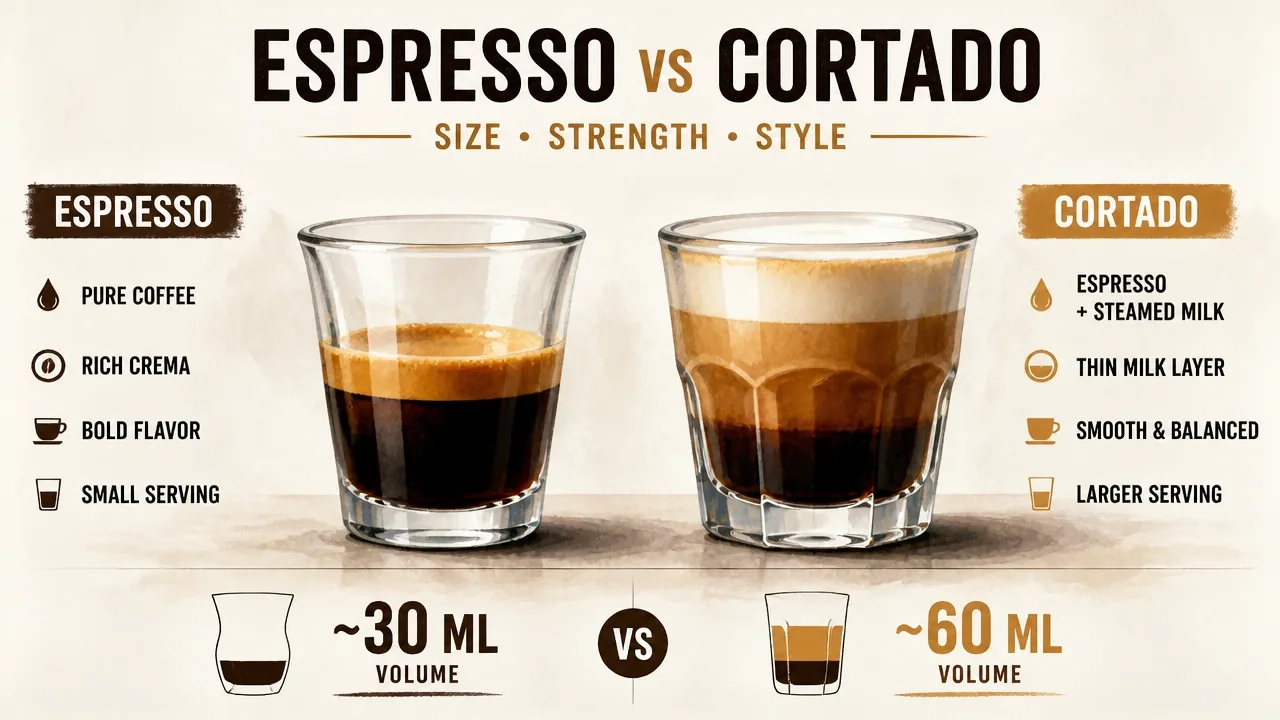
- Espresso is ~30 ml of undiluted extraction; a Spanish-style cortado is ~60 ml at a 1:1 espresso-to-steamed-milk ratio – same shot, different architecture.
- Milk proteins in a cortado chemically bind coffee’s bitter and astringent compounds, producing a measurably softer flavor profile, not just a textural one.
- Total caffeine is roughly equal in both drinks; caffeine concentration per fluid ounce is lower in the cortado because the same dose is distributed across twice the volume.
- “Cortado” is not a stable term – a solo corto, cortadito, and Gibraltar are all distinct drinks that share the name in different regions or cafés.
- Crema in espresso carries the bulk of the shot’s volatile aromatics; in a cortado, it integrates with steamed milk and its standalone impact diminishes.
- If you want pure origin character, order espresso; if you want coffee-forward flavor with a softer edge, order a cortado and specify unsweetened Spanish-style.
Decision Criteria: How to Judge Cortado vs Espresso
The Cortado vs Espresso comparison only holds up if Espresso and Cortado are defined the same way before you start. “Cortado” is regional ordering terminology that drifts depending on the country, the café, and the barista behind the bar – so anchoring the comparison to specific parameters isn’t pedantry, it’s the only way to make the verdict useful.
Comparative Beverage Definitions
Espresso, for this comparison, is the standard single or double shot: approximately 30 ml of concentrated liquid, no milk, built on a 7–9 gram dose of finely ground coffee, extracted with water at 90–92°C under 9 bars of pressure in roughly 25 seconds. It arrives in a tulip-shaped demitasse cup with a layer of crema on top. Nothing else touches it.
Cortado is the Spanish-style version: approximately 60 ml total, structured as a 1:1 ratio of espresso to lightly steamed whole milk, served unsweetened with no dense cappuccino-style foam, typically in a Gibraltar glass. The milk isn’t there to sweeten – it’s there to cut.
The problem is that “cortado” is not a stable unit across sources. Some define it as equal parts espresso and warm milk without foam. Others fold in regional Spanish variations like the solo corto from Málaga (60% coffee, 40% milk) or the Cuban cortadito, which introduces espumita – espresso whipped with demerara sugar – and may use evaporated or condensed milk instead of fresh whole milk. Then there’s café corto, which some sources treat as a ristretto (15 ml, no milk) and others define with cream or steamed milk. The same word does genuinely different work in different cities.
This article compares the Spanish-style cortado – 1:1 espresso to steamed whole milk, unsweetened, no thick foam – against a standard double espresso. Any other version needs to be ordered by name.
Scoring Dimensions and Controlled Conditions
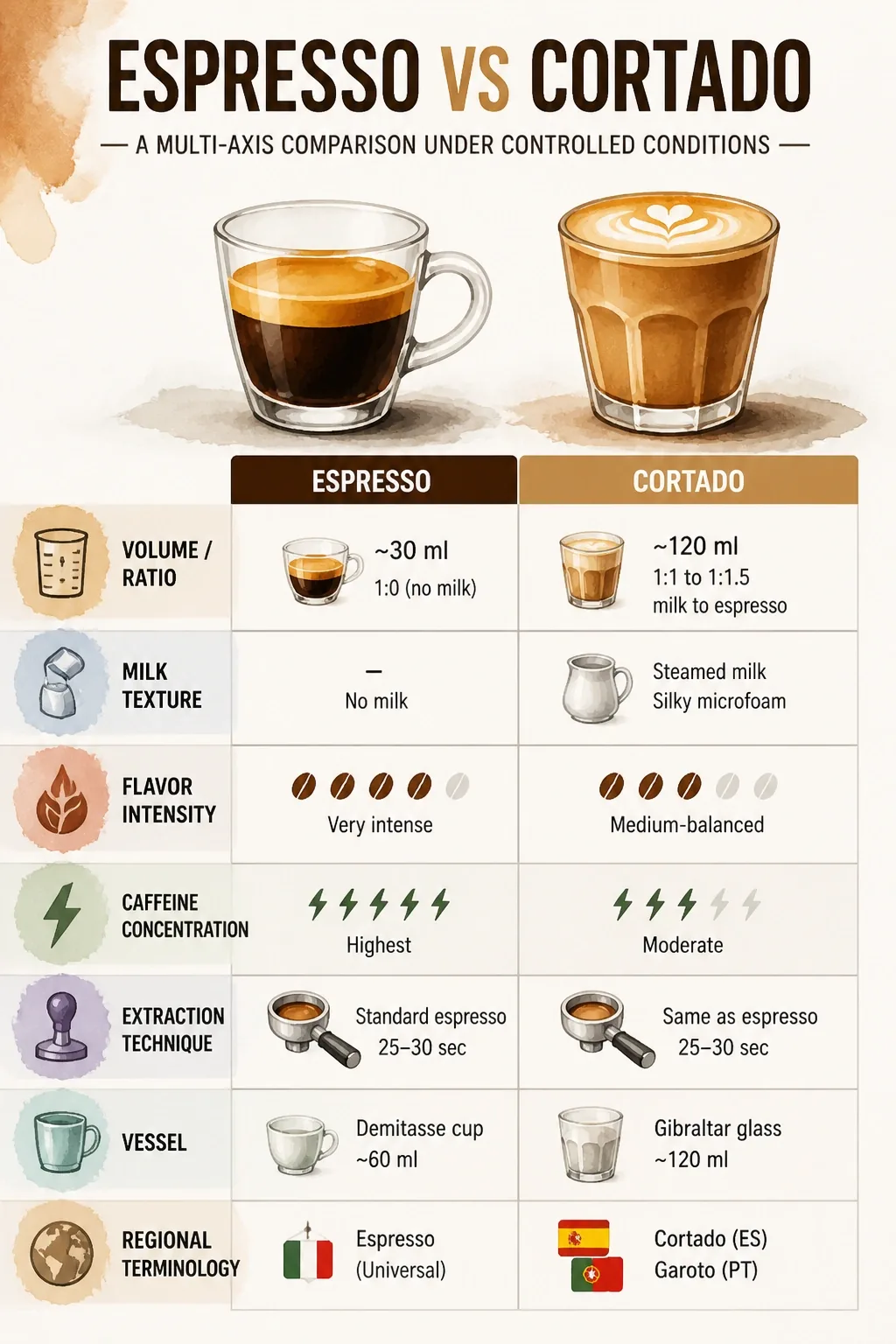
Six dimensions separate these drinks in any meaningful comparison: volume and ratio, milk presence and texture, flavor intensity and body, caffeine concentration per fluid ounce, extraction technique and barista skill required, and regional ordering terminology. Each one produces a different trade-off, and no single dimension settles the whole question.
To keep the evaluation honest, both drinks should be made under the same conditions: specialty-grade Arabica scoring 80+ on the SCA scale, beans rested 1–5 weeks post-roast (fresh-roasted CO₂ interferes with extraction), a quality burr grinder, and filtered water at 75–175 ppm TDS brewed at 195–205°F (90–96°C). Change the bean or the water and you’re comparing variables, not drinks.
Head-to-Head: The 5 Key Differences That Decide It
Once the definitions are locked and the conditions are controlled, five differences emerge – and they don’t all point in the same direction. Some favor espresso. Some favor the cortado. One creates ordering risk that has nothing to do with taste.
Volume, Ratio, and Milk Texture
Difference 1 – Volume and Ratio: Espresso is ~30 ml of undiluted extraction. A Spanish-style cortado is approximately 60 ml total – the same shot, now paired with an equal volume of steamed whole milk. That ratio is the cortado’s defining constraint. Go heavier on the milk and you’ve crossed into macchiato-or-cappuccino territory. Go lighter and you’re trending toward a solo corto. The 1:1 ratio isn’t a preference; it’s the structural boundary that makes a cortado a cortado.
“A cortado is a coffee drink that sits at the midway point between a macchiato and a cappuccino. It’s about four ounces total – a little less than two ounces of espresso topped with a little more than two ounces of steamed milk – which makes it strong but small, easy to drink quickly and milky enough to seem indulgent.” – Oliver Strand, coffee writer for The New York Times
That framing – strong but small, easy to drink quickly – captures exactly what the 1:1 ratio accomplishes. It doesn’t lengthen the drink the way a flat white or latte does; it just takes the sharp edge off the espresso without walking it into dessert territory.
Difference 2 – Milk Chemistry and Texture: Espresso’s only textural element is crema – the reddish-brown foam produced when pressurized hot water forces dissolved CO₂ and volatile compounds out of solution as the liquid exits the portafilter.
illycaffè describes this process precisely: pressurized water at around nine bars dissolves gases and volatile compounds from the grounds, and the sudden pressure drop as liquid exits the portafilter allows CO₂ to escape and form bubbles stabilized by natural surfactants in the coffee – creating a foam structure microscopically similar to the head on a well-poured beer.
That crema is delicate. It dissipates within minutes and carries a disproportionate share of the shot’s aromatics. In a cortado, crema still forms, but it integrates with the steamed milk rather than sitting as a standalone layer.
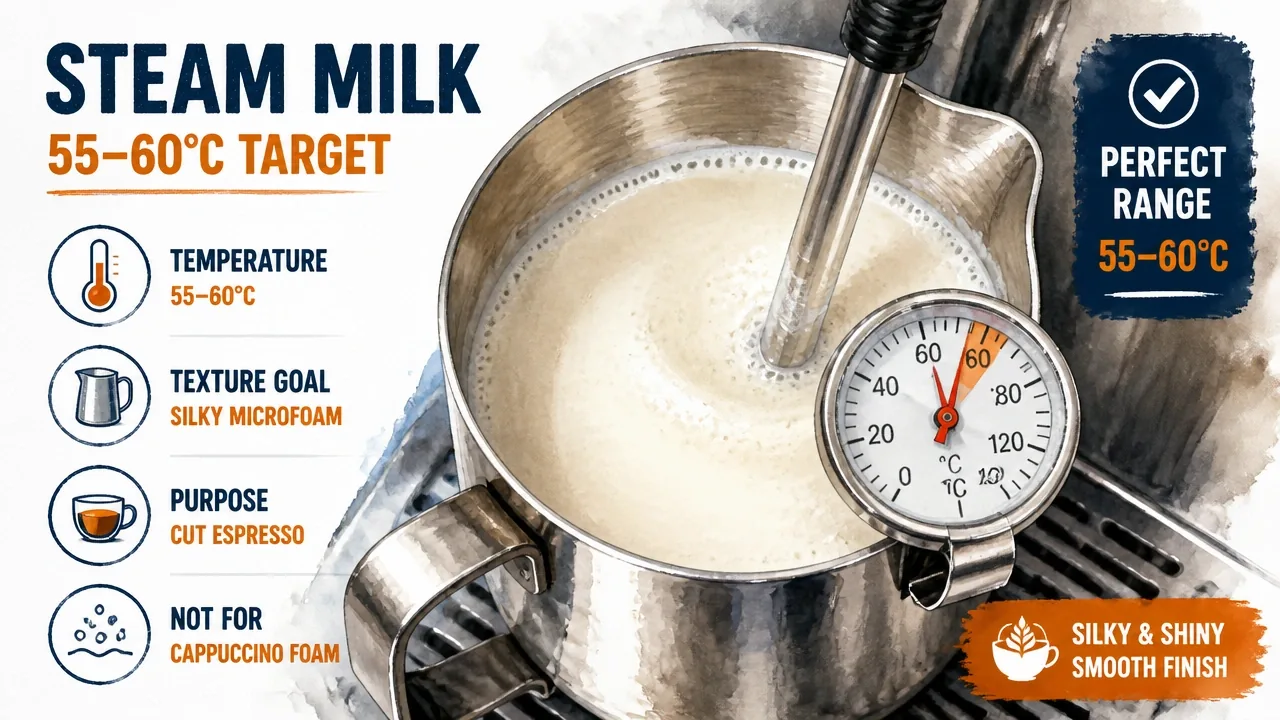
The milk in a cortado targets 130–140°F (55–60°C) during steaming – warm enough to sweeten naturally through lactose expression, cool enough to avoid scalding the proteins that give the milk its texture. This is a practitioner target range, not a universally standardized specification. The goal is a silky, pourable consistency – not the thick, spoonable microfoam of a cappuccino. Whole milk performs best here because its fat content supports stable, integrated texture.
Illycaffè’s professional preparation guide confirms that milk fat content directly governs froth consistency, recommending whole milk for hot drinks and skim or low-fat milk for cold beverages.
Achieving this precise 1:1 balance relies heavily on utilizing the ideal cortado cup dimensions to ensure proper thermal retention and mouthfeel.
Flavor Concentration, Technique, and Service Conventions
Difference 3 – Flavor, Body, and Caffeine Concentration: Espresso is the more intense drink by design. Every aromatic compound, every bitter alkaloid, every acid is concentrated into 30 ml. A well-pulled shot at the parameters David Fasman of Huckleberry Roasters describes – 18–20 gram dose, 36.5 gram output, 25–30 seconds, 9 bars, 200°F – delivers the full sensory weight of the bean with nothing to soften it.
A cortado takes that same shot and dilutes it with an equal volume of milk. The flavor shifts from concentrated and sharp to softer and rounder. The acidity drops perceptibly because the milk proteins bind with coffee’s acidic polyphenols. Research published in the Journal of Dairy Science found that as milk protein concentration increased, objective sensory attributes including bitterness and astringency decreased, and overall sensory acceptance climbed from 3.88 out of 10 for plain black coffee to 7.40 out of 10 at 90 mg/mL milk protein – a direct demonstration of how milk-protein binding restructures the flavor experience.
On caffeine: the total caffeine in a cortado and an espresso is roughly equivalent because both use the same shot. But concentration per fluid ounce is lower in the cortado because the same caffeine is now distributed across twice the volume. Anyone who says “cortado has less caffeine” is technically right about concentration; anyone who says “they’re the same” is right about total dose. Both statements are true simultaneously, which is why this particular debate generates more heat than it should.
Difference 4 – Extraction and Barista Technique: Espresso demands precision at the machine: dose, grind, tamp, yield, and time must all align. Once the shot is pulled, the drink is done.
A cortado adds a second technical layer. The barista must steam milk to the right temperature and texture, then integrate it with the shot at the right moment – before the crema degrades and while the espresso is still at serving temperature. The milk steaming step isn’t difficult, but it introduces more variables and more failure points than a straight espresso pull.
Nino Tusell, owner of Tusell Tostadores in Barcelona, frames it simply: a cortado is one shot of espresso with a little milk, at a ratio of 1:1 or sometimes even less milk than coffee – a drink that is fundamentally about restraint, not addition.
That restraint is the technique. The barista’s job is to add exactly enough milk to soften the shot without burying it.
For a closer look at the milk science behind what separates cortado texture from cappuccino foam, this training breakdown is worth the watch:
Difference 5 – Lineage, Ordering, and Vessel: Espresso is Italian in origin and broadly standardized: demitasse cup, no regional naming ambiguity, consistent expectations across specialty cafés worldwide. The cortado is Spanish, and its terminology is decidedly less stable.
In Spain, a cortado is a shot cut with a small amount of milk. In Málaga, a solo corto is 60% coffee and 40% milk – closer to a cortado than a straight espresso but named differently. A semilargo runs 80/20 in the other direction. In Cuba, the cortadito uses espumita (espresso whipped with demerara or brown sugar) and often substitutes evaporated or condensed milk for fresh whole milk, arriving in a demitasse or mini paper cup. At a modern American specialty café, “cortado” sometimes appears on a menu as a Gibraltar – the name for the small Libbey glass the drink is served in – or gets confused with a cortadito by baristas unfamiliar with the regional distinction.
The practical risk: if you order a cortado without specifying unsweetened, Spanish-style, you may receive a cortadito. The vessel – Gibraltar glass, demitasse, or paper cup – is a service convention, not a universal standard. Know what you’re asking for before you order it.
Per-Persona Verdict: Who Should Order Which?
Both drinks use the same shot. The question is what you want that shot to do to you.
Choose espresso if you want the coffee itself – uncut, unmodified, at full intensity. Espresso preserves every volatile aromatic in the crema, delivers maximum flavor concentration per sip, and gets you in and out in under two minutes. It’s the right call for anyone who wants to taste the origin character of the bean without anything standing between them and the extraction. The Origin Purist and the Time-Pressed Minimalist both land here for different reasons: one wants purity, the other wants speed, and espresso delivers both.
Choose a cortado if you want the coffee to remain the dominant flavor but with its sharpest edges rounded off. The 1:1 milk ratio doesn’t hide the espresso – it just makes it easier to drink without fighting through acidity or bitterness. The Balanced Sipper orders a cortado because they want coffee-forward flavor with enough body to feel like a complete drink. The Texture Seeker orders it because the steamed milk integration creates a mouthfeel that a straight espresso shot simply can’t replicate.
Choose a cortadito – the Cuban variant – if you want sweetness built into the structure of the drink itself. The espumita (espresso whipped with sugar before milk is added) fundamentally changes the drink’s character. This isn’t a Spanish cortado with sugar stirred in; it’s a different construction. The Sweet or Regional Explorer belongs here, not in the standard cortado category.
The trade-offs are plain:
- Milk dilution reduces perceived intensity and acidity but adds body and creaminess
- Total volume doubles in a cortado, but caffeine concentration per fluid ounce drops
- The cortado’s softer profile comes directly from milk proteins binding coffee’s bitter and astringent compounds – which is a chemical change, not just a textural one
- Ordering terminology creates real risk: “cortado” does not mean the same thing in every city or every café
Final recommendation: If you want to taste the coffee, order espresso. If you want coffee with a softer edge and a small amount of milk that doesn’t overwhelm the shot, order a cortado – and specify unsweetened, Spanish-style if that’s what you actually want in your cup.
Frequently Asked Questions About Cortado vs Espresso
Is a cortado just a watered-down espresso?
No – it’s the same espresso shot, but paired with an equal volume of steamed whole milk. The milk doesn’t dilute extraction quality; it chemically changes the flavor by binding bitter and astringent compounds.
Which drink is stronger, espresso or cortado?
Espresso is more intense per sip because nothing dilutes it. Total caffeine is similar in both since they use the same shot, but espresso delivers higher caffeine concentration per fluid ounce.
What’s the difference between a cortado and a latte?
A cortado is a 1:1 ratio of espresso to steamed milk, totaling about 60 ml. A latte uses the same espresso base but adds significantly more milk – typically 150–240 ml – making it considerably larger and milder.
Can I order a cortado at any café and expect the same drink?
Not reliably. “Cortado” means different things in Spain, Cuba, and American specialty coffee shops. Always specify unsweetened and Spanish-style if you want the standard 1:1 version without added sugar or condensed milk.
Why does a cortado taste less bitter than espresso if it uses the same shot?
Milk proteins form complexes with coffee’s polyphenols – the compounds responsible for bitterness and astringency – reducing how intensely your palate perceives those attributes. It’s a chemical interaction, not just dilution.
What is a Gibraltar, and is it the same as a cortado?
A Gibraltar is a cortado served in a specific Libbey glass of the same name. The drink inside is functionally a cortado; the name refers to the vessel, which became shorthand at some American specialty cafés.
Does the type of milk change a cortado significantly?
Yes. Whole milk produces the most stable, integrated texture at cortado steaming temperatures because of its fat content. Skim or low-fat milk creates a thinner, less cohesive result that changes both texture and mouthfeel noticeably.
What’s the difference between a cortado and a cortadito?
A cortadito is the Cuban variant – espresso whipped with demerara or brown sugar before milk is added, creating espumita. It often uses evaporated or condensed milk instead of fresh whole milk, making it a sweeter, structurally different drink from the Spanish cortado.
References
- Defining the Ever-Changing Espresso – SCA News | sca.coffee
- What Is a Cortado? – Perfect Daily Grind | perfectdailygrind.com
- Achieve Perfect Coffee Crema | blog.illy.com
- ESE Preparation Guide – illycaffè Professional | illy.com
- A Cortado Is Not a Minivan – T Magazine, The New York Times | archive.nytimes.com
- Milk Protein Modulates Antioxidant Activity and Metabolome Stability in Coffee Beverages During Thermal Processing – Europe PMC | europepmc.org