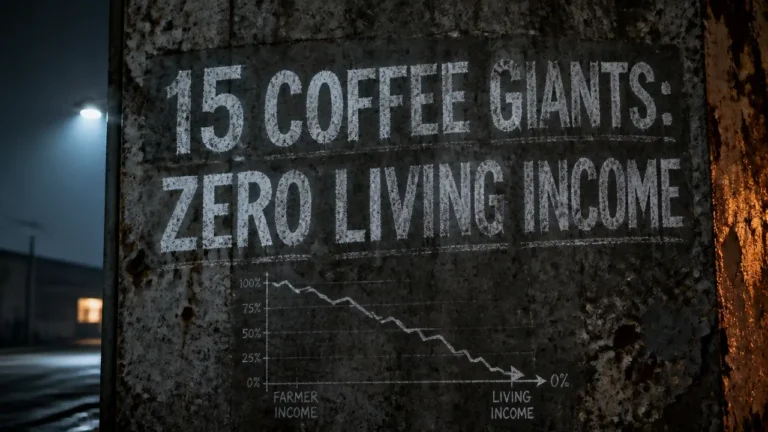

Global coffee giants are under growing pressure after the 20th anniversary Coffee Barometer 2026 reported in Milan on 11 June that none of the 15 largest roasters and traders have publicly committed to paying farmers a living income, even as the European Union prepares to make living income a legal obligation.
The new 100-page edition, released by a coalition of NGOs including Solidaridad Network, Conservation International, Ethos Agriculture and VOCAL and cited by Comunicaffe, offers a 20-year overview of the sector since the 2001‑2003 price collapse. It finds that the global coffee economy is still dominated by approximately 12.5 million farming households, most managing less than two hectares of land, while the top ten producing countries account for 85% of supply and the remaining 15% is grown by 9.6 million smallholders described as facing “extreme precarity.”
According to the Coffee Barometer 2026, ten percent of the retail cost of a pack of coffee is effectively subsidized by farmers’ families through unpaid labour, and producer incomes “still fall below living income benchmarks.” The report notes that most value continues to be captured downstream rather than in producing countries, despite two decades of sustainability rhetoric.
The authors reviewed the policies of major companies including Nestlé, Starbucks, JDE Peet’s, Olam, Louis Dreyfus, Ecom and Volcafe. The Barometer states that none of the 15 largest global roasters and traders have publicly disclosed living income commitments or aligned pricing structures designed to deliver such incomes. Instead, it concludes that “sustainability commitments have multiplied, yet systemic reform has not followed,” arguing that the coffee economy functions as “a political and economic system shaped by concentration, power, and commercial incentives that consistently produce inequitable outcomes.”
Lead author Sjoerd Panhuysen of Ethos Agriculture, quoted by Solidaridad Network, said that “two decades after the first Coffee Barometer, the structural conditions shaping the coffee sector remain largely unchanged.” He added that “in 20 years the language has shifted: worrying less about hunger in the coffee lands, and more about the cost of a daily espresso.”
The regulatory context in Europe is now changing. The report highlights the EU’s Corporate Sustainability Due Diligence Directive (CSDDD), described by GlobalBankingAndFinance as the first EU instrument to recognise living income as a binding human right. From July 2029, the directive will legally require large companies to ensure living incomes for farmers in their supply chains, with potential fines of up to 3% of global turnover for non-compliance.
In its analysis of the CSDDD, the Coffee Barometer stresses that “pricing structures, contract duration and payment terms are no longer purely commercial decisions; where they are linked to adverse human rights impacts, companies are required to change them.” The report also argues that companies currently “publish sustainability commitments, while core commercial operations continue to rely on low-cost commodity purchasing,” and that as long as this continues, “sustainability investments” will “work around the problem rather than on it.”
Fairtrade International publicly welcomed the Coffee Barometer 2026 and its assessment of structural challenges. In its formal response, Fairtrade stated that it “also agree[s] that voluntary action alone will not deliver the scale of transformation needed,” and concluded that the Barometer makes clear that “stronger regulation, greater accountability, and shared value and risk are essential to creating a more sustainable coffee sector, and we agree.”
The report’s findings come against a backdrop of sharp price movements and rising costs. A separate analysis by Pure Kopi Luwak noted that Arabica futures hit $4.41 per pound in February 2025, the highest on record, and that the International Coffee Organization composite indicator price reached $3.54 per pound that month, its highest-ever monthly average. The same article reported that the C price, which averaged $1.10–1.40 per pound between 2019 and 2021, was above $3.20 per pound in early 2026, with retail coffee prices up 40–60% across categories.
Despite these price levels, the Coffee Barometer 2026 concludes that labour in coffee production remains “poorly rewarded” and that the structural conditions underpinning farmer incomes have “largely” persisted since the early 2000s.