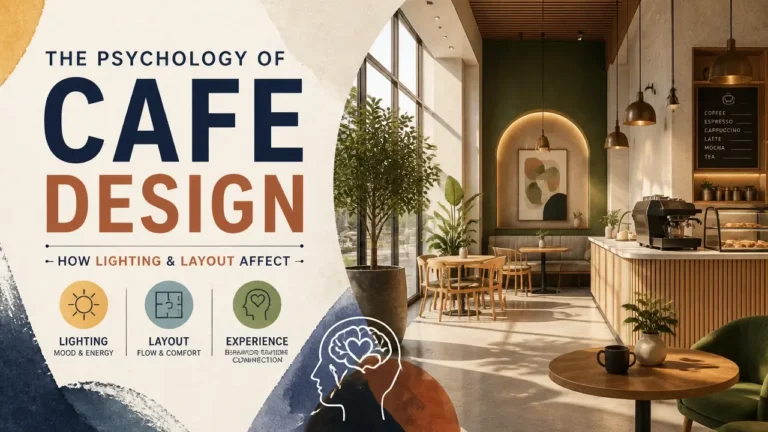

Environmental psychology doesn’t stay in lecture halls (it’s running quietly behind every great cafe you’ve never wanted to leave). Color temperature, spatial layout, and the ancient human instinct for prospect-refuge theory all converge in the room around your cup.
Warm light makes coffee taste sweeter. A well-placed seat makes you feel safe enough to stay an hour longer than you planned. Good cafe design isn’t decoration: it’s the invisible architecture of how pleasure actually works.
The Hidden Psychology of Café Spaces
Environmental psychology (the study of how physical spaces shape human thought and behavior) is the invisible architect behind every café you’ve ever enjoyed or exited quickly. It connects lighting, layout, and sensory cues directly to your mood, your spending, and how long you stay. And the part that makes it so effective? You never notice it working.
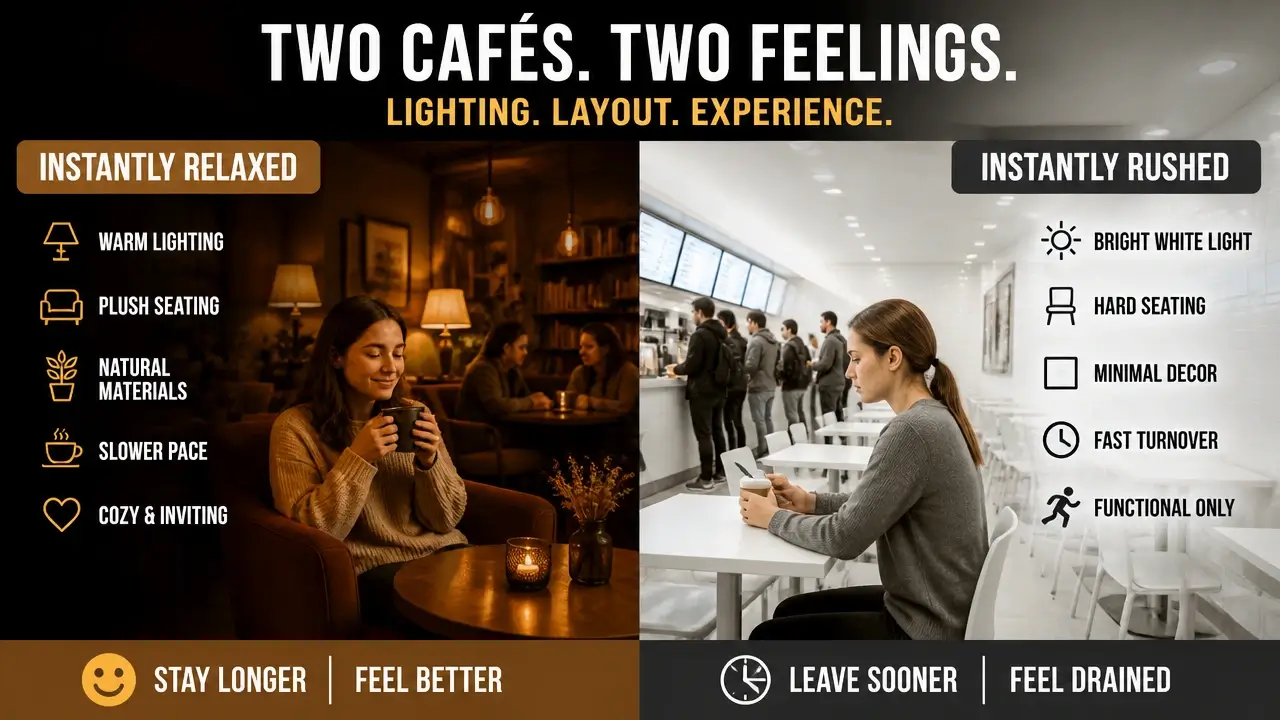
Think about the last time you walked into a café and just settled in. You ordered a second drink. Maybe a pastry. You stayed for an hour without meaning to. Now think about the opposite: a place where you drank your coffee quickly, felt vaguely restless, and walked out without looking back. The coffee might have been identical. The difference was the room.
The Third Place and Why It’s Designed
Sociologist Ray Oldenburg coined the term “third place” to describe a social environment that’s neither home nor work (a neutral ground where people decompress, connect, and simply exist without agenda). Cafés are the most common third place in modern life, and the ones that hold you longest are engineered to feel like one.
And if you’re the type to capture that atmosphere, mastering the art of taking coffee photos with just your smartphone can help you preserve that specific mood long after you’ve left.
That engineering isn’t accidental. A café that succeeds as a third place has made deliberate choices about how warm the light feels at 3pm, how far your seat is from the door, whether you can see the room without being in the middle of it. These aren’t aesthetic preferences. They’re behavioral levers.
How Surroundings Shape Customer Behavior
Environmental psychology tells us that our surroundings affect mood, behavior, and spending, even when we’re completely unaware of it. The pace at which you eat, the likelihood you’ll order a second round, whether you feel generous or guarded: all of it bends under the pressure of the physical space around you.
Two tools do most of that work: lighting and spatial layout. Lighting operates on your biology: your internal clock, your nervous system, your sensory perception. Layout operates on something even older: your primal instincts about safety, territory, and social exposure.
These behavioral levers ultimately drive global coffee consumption statistics by influencing how often people visit and how long they linger in these spaces.
As these psychological strategies continue to evolve alongside 2024 coffee market trends, modern shop owners are increasingly blending ancient behavioral design with cutting-edge consumer insights.
We’re going to pull both apart. First, we’ll look at exactly how lighting reaches inside your brain and changes not just your mood, but the way your coffee actually tastes. Then we’ll map how layout guides your feet and your decisions before you’ve consciously made any. And finally, we’ll walk through real cafés that have turned these principles into spaces people travel across cities to sit in.
Lighting: From Chronobiology to Comfort
Café lighting isn’t just atmosphere: it’s a biological lever that controls your internal clock, your appetite, and how long you stay in the seat. The mechanism runs deeper than mood. It operates at the hormonal level, and once you see how it works, you’ll recognize the hand on that lever every time you walk through a café door.
Color Temperature and Your Body Clock
Color temperature, measured in Kelvin, is the single most powerful variable in a café’s lighting toolkit. Warm light at around 2,700K sits in the amber-orange range (the same spectrum your eyes evolved to associate with sunset). Your brain reads that signal and begins winding down, nudging melatonin production upward and dropping your sense of urgency. Cool, blue-rich light at 5,000K and above mimics midday sun. Your brain reads that as “stay awake, stay sharp,” and melatonin gets suppressed accordingly.
This isn’t design folklore. The Chellappa et al. (2011) study demonstrated it directly: participants exposed to cool, blue-rich light at ~6,500K showed measurably larger drops in salivary melatonin than those under warm ~2,700K light, and they reported higher alertness and stronger cognitive performance. The warm-light group was more relaxed, physiologically, not just subjectively.
That’s the biological anchor for everything café designers do with light. The Kelvin number isn’t an aesthetic preference. It’s a dosage.
Brightness as a Pacemaker
Beyond color temperature, raw intensity acts like a tempo dial for your experience. Bright environments accelerate visual processing: your eyes take in more information faster, decisions come quicker, and the whole visit feels more transactional. That’s exactly what a café wants at 8 a.m. when twenty people are queued for lattes. High-intensity, cool-spectrum lighting keeps the line moving.
Dim, amber lighting does the opposite. It narrows your visual field, softens the edges of the room, and slows your sense of time passing. You stop calculating how long you’ve been sitting. You start thinking about whether you want another coffee, or maybe a slice of that cake in the case.
Professor of Consumer Behavior Brian Wansink, Professor of Consumer Behavior at Cornell University and Director of the Cornell Food and Brand Lab, documented exactly this pattern in restaurant settings:
People ordered healthier foods if they sat by a window or in a well-lit part of the restaurant. It seems that they ate fattier, calorie-laden food and ordered more of it if they sat at a dark table or booth. People sitting farthest from the front door ate the fewest salads and were 73 per cent more likely to order dessert.
That 73% figure isn’t about the food changing: it’s about what dim light does to your decision-making state. Lower alertness, lower inhibition, higher willingness to indulge.
The Daily Lighting Cycle
Most well-designed cafés run a deliberate lighting arc across the day. Morning hours get bright, natural-spectrum light (high intensity, cooler temperature) to match the energy of the morning rush and move customers efficiently. Then, somewhere in the mid-afternoon, the shift happens. Overhead intensity drops, warmer accent lighting takes over, and the room changes character. The same physical space starts to feel like a place to stay rather than a place to pass through.
This isn’t accidental. It’s a designed transition from throughput mode to dwell mode, timed to when the queue thins and the revenue opportunity shifts from volume to secondary purchases.
Accent Lighting and the Impulse Purchase
Strategic accent lighting is where the psychology of café design gets quietly aggressive. A spotlight aimed at the pastry case doesn’t just illuminate the croissants: it pulls your eye there involuntarily. The human visual system is wired to prioritize bright objects in a dimmer field. Cafés exploit this by placing focused, warm accent lighting on the espresso machine, the display shelf, or the seasonal special board.
You think you noticed the almond tart because it looked good. You noticed it because a 50-watt spotlight made it the brightest object in your peripheral vision at the moment you were standing in line.
The Revenue Gap Behind the Science
Here’s where honesty matters. Longer dwell time correlates with higher secondary purchases (that part is straightforward logic), and café operators have observed it consistently enough to treat it as operational truth. But the broader discipline rests on thinner ground than the confident prescriptions suggest.
Across design guides, brand frameworks, and even academic literature on environmental psychology, there’s a striking absence of hard quantitative data specific to café lighting: no published A/B dwell-time percentages, no controlled sales-lift studies, no footfall measurements tied to Kelvin shifts. The Chellappa study gives us the biological mechanism cold. What it doesn’t give us is a controlled measurement of how that mechanism translates into minutes-at-table or dollars-per-visit inside a real café.
The principles work: the chronobiology is real, the behavioral observations are consistent, and experienced designers apply them with genuine skill. But the “psychology of café design” is still a field built more on accumulated intuition than on rigorously tested metrics. Knowing that doesn’t make the lighting less effective. It just means the next time a design guide tells you warm light “increases dwell time by 20%,” you should ask where that number came from.
How Lighting Rewires Your Coffee’s Flavor
Crossmodal perception (your brain’s habit of blending signals from every sense simultaneously) is the hidden mechanism that lets a café’s lighting reach directly into your cup and change what you taste. It sounds like a magic trick, but it’s just neuroscience: your visual cortex and your gustatory cortex are in constant conversation, and one will override the other without asking your permission first.
Here’s what that looks like in practice. Sit under warm, amber light and take a sip of your latte. Your brain, already primed by a hue it associates with sunset, ripe fruit, and comfort, carries that association straight into the flavor signal. The coffee reads as rounder, sweeter, more complete. Now move to a table under harsh, cool-white fluorescents (same cup, same brew, same barista). The bitterness sharpens. The body feels thinner. Nothing in the liquid changed. Only the light did.
The mechanism isn’t mystical. Warmth, both physical and visual, is one of the oldest evolutionary cues your brain uses to signal “ripe, safe, sweet.” Amber light triggers that same circuitry. Your brain doesn’t stop to verify whether the cue is coming from a fruit or a light fixture, it just runs the association and adjusts your perception accordingly.
Experimental psychologist Charles Spence, Professor of Experimental Psychology at the University of Oxford and Head of the Crossmodal Research Laboratory, has studied this exact phenomenon across dozens of controlled experiments:
Changing the colour of the ambient lighting can even influence people’s perception of a drink when it is presented in a black tasting glass (thus ensuring that the ambient colour doesn’t affect the perceived colour of the food itself; e.g., see Oberfeld et al., 2009, Spence et al., 2014). Changes in the colour (not to mention brightness) of the ambient lighting have even been shown to affect how much people consume.
That last point is worth sitting with. It’s not just flavor that shifts, consumption volume moves too. The psychology of café design, at this level, is operating well below conscious awareness.
Specialty cafés that serve light-roast coffees (the ones with bright acidity and delicate fruit notes that can easily tip into sharp or sour territory) often lean on warm lighting precisely for this reason. The amber wash softens perceived acidity and adds a sense of richness that the roast profile alone might not deliver. Grab-and-go chains run the opposite play: cool, bright, neutral light implies freshness, alertness, and efficiency. It’s not accidental. It’s calibrated.
The honest caveat is this: lighting cannot rescue a bad cup. If the extraction is wrong or the beans are stale, no amount of amber warmth will manufacture quality. What lighting does is act as an amplifier: it turns up the volume on certain flavor notes while quietly dialing others back. In the hands of a café that already has the coffee right, that’s a genuinely powerful tool.
Spatial Layout: The Architecture of Staying
Deliberate spatial layout is the quietest player in the psychology of café design: it works entirely below your conscious radar, yet it dictates where you sit, how long you stay, and whether you order a second drink. You didn’t choose that corner booth because it was close to the counter. You chose it because your nervous system ran a threat assessment in about half a second and decided it was the safest seat in the room. That’s not a metaphor. That’s biology.
The mechanism behind it has a name.
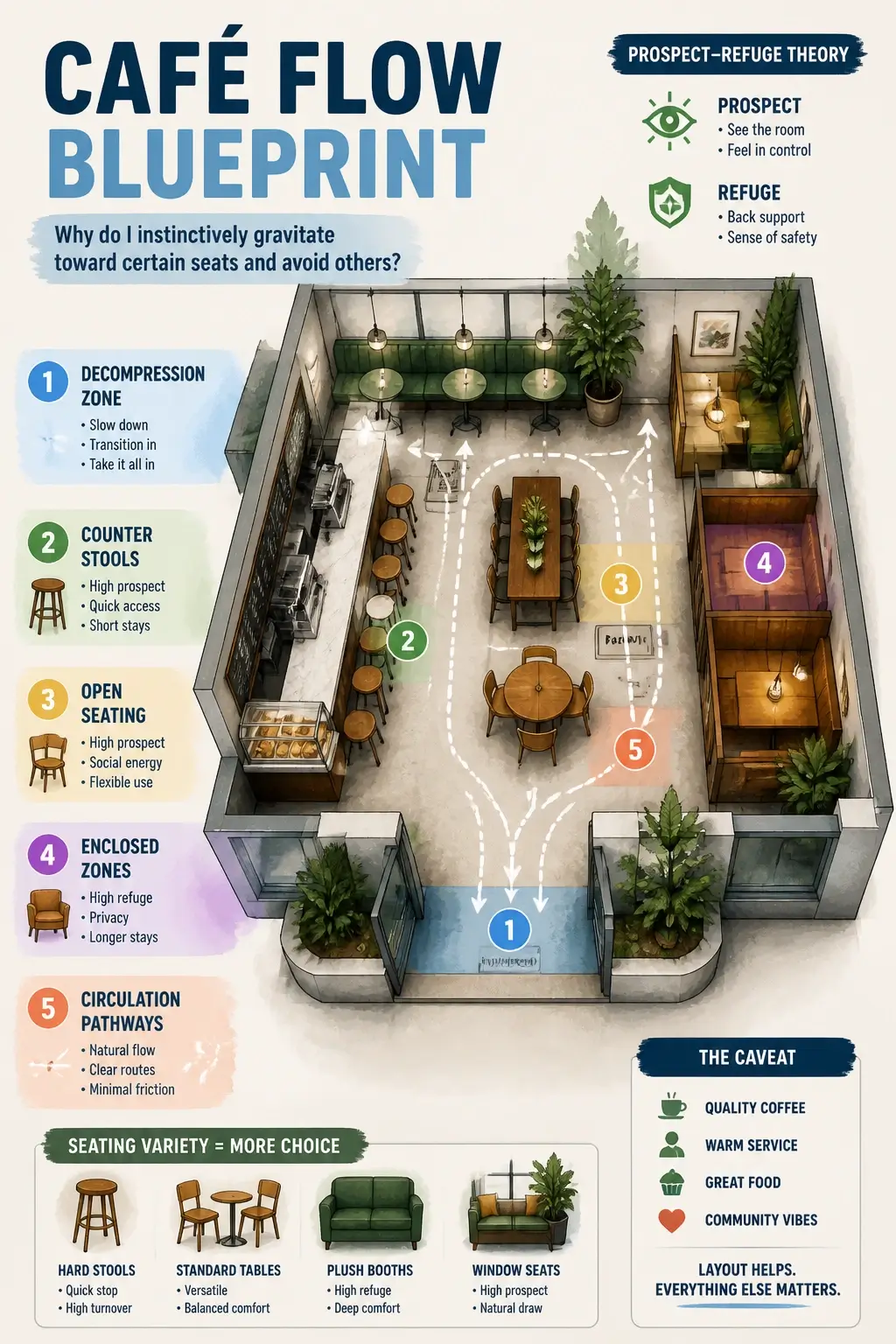
Prospect-Refuge Theory and Seat Selection
Geographer and theorist Jay Appleton, geographer and originator of prospect-refuge theory at the University of Hull, built his entire framework around a single human drive:
To see without being seen
That phrase is a complete description of your ideal café seat. You want prospect (a clear sightline to the entrance and the room, so nothing can surprise you). And you want refuge (a solid wall, a high booth back, or a structural column behind you, so nothing can approach from behind). The seat that delivers both feels immediately, inexplicably right. The seat that delivers neither (exposed in the center of the room, surrounded on all sides) creates a low-grade unease that most people can’t name but will absolutely act on. They leave sooner. They order less. They don’t come back.
Well-designed cafés don’t leave this to chance. Corner seats, banquettes against perimeter walls, and booths with high backs are placed precisely because they satisfy this wiring. The café isn’t being generous with its best seating: it’s using prospect-refuge to anchor the customers it most wants to keep.
How Seating Variety Controls Dwell Time
Not every café customer is the same, and smart spatial layout doesn’t treat them that way. Hard, backless stools at a window bar or along a high-traffic counter send a clear signal: this seat is for a quick stop. The physical discomfort isn’t accidental: it’s a turnover mechanism. Those seats serve the morning espresso crowd, the grab-and-go customer who wants to stand for ten minutes and watch the street. They free up the “anchor” seating for people who actually want to stay.
The anchors are the plush booths, the armchairs, the low sofas tucked into corners. They signal the opposite: settle in. And people do. A remote worker who drops into a comfortable armchair is far more likely to order a second coffee, a pastry, or lunch than someone perched on a stool. The seating variety isn’t about aesthetics: it’s a behavioral sorting system that matches customer type to the revenue potential of their visit.
Open Zones vs. Enclosed Nooks
The same logic extends to how zones are carved out across the floor plan. Open, communal tables in bright central areas generate social energy: they’re loud, visible, and fast. They work well for cafés that want a buzzy, high-volume atmosphere and quick table turns. Enclosed nooks, partial partitions, and lower-ceilinged alcoves do something different: they create a sense of privacy that makes intimate conversation feel possible, which lengthens stays and deepens the experience. People don’t whisper in an open room. They do in a nook.
The best layouts layer both (an open core for energy and visibility, enclosed edges for refuge) so the café serves multiple customer moods simultaneously without any single zone feeling wrong.
The Decompression Zone at the Threshold
There’s one spatial move that almost every successful café shares, and almost no customer consciously notices: the decompression zone. The area immediately inside the entrance (roughly the first six to ten feet) is intentionally kept clear of seating. No tables, no chairs, no obstacles.
This isn’t wasted space. It’s a transition buffer. When you walk in from the street, your senses are recalibrating: adjusting to the shift in light, absorbing the coffee aroma, reading the ambient noise level, scanning the room. If a table is shoved right up against the door, that recalibration gets interrupted and the space feels instantly cramped. The decompression zone gives you a beat to arrive before you commit to a seat. It makes the café feel larger than it is, and it makes the decision of where to sit feel like a choice rather than a scramble.
How Circulation Shapes the Whole Experience
Pathways matter just as much as seats. If the route from the entrance to the counter cuts through the seating area, customers in transit constantly interrupt settled guests, and that friction accumulates. A well-designed circulation path keeps movement to the perimeter or through a dedicated corridor, so the seated zones feel calm and protected. When pathways are tight and poorly placed, the café feels chaotic regardless of how good the coffee is. People sense the disorder and leave earlier than they would have otherwise.
Here’s a visual map of how these elements (decompression zone, prospect-refuge positions, circulation paths, and zone segmentation) work together on a single floor plan:
One honest caveat before we move on. Design blogs and commercial interiors guides often present these layout tactics as near-guaranteed profit levers: get the zones right, and the revenue follows. That’s an oversimplification worth calling out. No study in this domain adequately controls for the variables that actually drive café success: coffee quality, service speed, pricing, foot traffic, and the competitive density of the neighborhood. A perfectly zoned layout with textbook prospect-refuge seating will not rescue a café serving mediocre espresso with slow Wi-Fi. The correlation between thoughtful spatial layout and thriving cafés is real, but correlation is not a direct cause. The psychology of layout is one thread. A cluttered neighborhood spot with extraordinary coffee and a warm owner can outperform a design-forward space that gets every principle right and the product wrong.
Understanding that limitation is part of reading these spaces clearly, which is exactly what the next section puts to the test in three iconic cafés that have turned these principles into something you can walk into and feel for yourself.
Cafés That Mastered the Psychology
Three well-known café design case studies show exactly how lighting and layout psychology moves from theory into brick, bulb, and barstool, and once you see the pattern, you can’t unsee it.
The psychology of café design isn’t a set of abstract principles that a handful of academics debate. It’s a working toolkit that some of the world’s most visited cafés have built into their floors, ceilings, and seating arrangements: deliberately, expensively, and with measurable results. Let’s walk through three of them, each with a different philosophy, so you have real reference points the next time you walk through a door.
Blue Bottle Coffee’s Minimalist Precision
Blue Bottle built its reputation on the idea that the coffee deserves your full attention. The design enforces that.
Warm-white ambient light, typically in the 2700K–3000K range, keeps the space feeling calm without tipping into drowsy. Focused accent lighting lands on the bar, the brewing equipment, and the pastry case. There’s no decorative distraction. The light says: look here, this is what matters.
The layout does the same thing spatially. Open sightlines to the bar create prospect (you can see exactly what’s happening with your order). Smaller tables, bench edges, and wall-adjacent seats give you the refuge to settle in once you have it. The zones are clean: you know where to order, where to wait, where to sit. That clarity isn’t accidental. It removes the low-grade anxiety of not knowing what to do next, which means your brain can relax into the experience instead of mapping it.
The intended outcome is calm, premium focus. You browse the menu thoughtfully. You watch the pour. You linger, but quietly.
Understanding how minimalist precision influences consumer perception allows us to appreciate the broader Cafe style design comparison across the specialty coffee landscape.
Starbucks Reserve Roastery’s Theatrical Immersion
The Starbucks Reserve Roastery is a different animal entirely. Where Blue Bottle whispers, the Roastery performs.
The Global Design Director at Starbucks described the intent directly:
We have the lighting theatrically inspired, like the kind of lighting you would see in a music venue. There’s a chandelier made out of microphones.
That quote tells you everything about the philosophy. Warm ambient light sets the base tone, but dramatic accent lighting hits the roasting equipment, architectural features, and product displays like stage spots on a headliner. Brighter task lighting at service points keeps the operation legible inside all that atmosphere. The result is layered: you feel the warmth, but your eye keeps finding something new to land on.
The layout matches the ambition. The floor plan is large and zoned into distinct experiences: ordering, tasting, retail, seating. You move through it the way you’d move through a museum. Communal tables in the center pull you into the energy; perimeter seating gives you refuge to watch it all from a slight distance. The central circulation path is the prospect (you’re always oriented, always aware of the full spectacle around you).
The psychological target is immersion and discovery. You’re not just buying a coffee. You’re spending time in a destination, which is exactly why dwell time stretches and the average spend climbs.
The Coffee Academics’ Comfortable Productivity
The Coffee Academics lands between the two. It’s moody without being theatrical, social without being loud, and it’s built for the kind of visit where you arrive for one coffee and leave two hours later.
Warm ambient light around 2700K–3000K pairs with pendant accents and spotlights over tables and feature walls. Menu boards and displays get brighter illumination for clarity, which keeps the space from feeling so atmospheric that it becomes hard to function in. You can read. You can work. You can also just sit and feel good about being there.
The seating mix is the real design story: communal tables, two-tops, bar seating, and tucked-away corners all coexist. The zones separate socializing from solo work from quick-turnaround traffic. Edge seating provides refuge for the person who needs to focus; communal tables pull in the groups who want energy. The café doesn’t force a single mode of being: it accommodates several simultaneously.
The outcome it’s chasing is comfortable productivity: a space where you feel welcome enough to stay and mentally engaged enough to come back.
Here’s a quick synthesis of all three before you visit any of them:
| Café | Lighting Strategy | Layout Strategy | Intended Psychological Outcome |
|---|---|---|---|
| Blue Bottle Coffee | Warm-white ambient (~2700K–3000K), focused accent lighting on bar and brewing area, minimal glare | Open sightlines to bar (prospect), smaller tables and wall-adjacent seats (refuge), clear order/pickup/dwell zones | Calm, premium focus: browse thoughtfully, trust the craft, linger quietly |
| Starbucks Reserve Roastery | Warm ambient base with dramatic accent lighting on equipment and architecture, brighter task light at service points, layered lighting scenes | Large experiential layout, distinct zones for ordering/tasting/retail/seating, communal tables plus intimate perimeter nooks | Immersion and discovery: feel like a destination, stay longer, explore more, spend more |
| The Coffee Academics | Warm moody ambient (~2700K–3000K), pendant and spotlight accents over tables, brighter task light on menus and displays | Mixed seating types (communal, two-tops, bar, corners), zoned for socializing, solo work, and quick turnover | Comfortable productivity: feel welcome and engaged, support repeat visits and extended stays |
One thing worth keeping in your back pocket as you visit any of these: the design didn’t build these cafés alone. Coffee quality, brand reputation, service, and location are all doing real work alongside the psychology. What makes these spaces impressive is precisely that the design integrates with everything else rather than compensating for it. The lighting and layout are the quiet partner in a very successful collaboration.
Next time you walk into any of these, or any café at all, check the ceiling first. Find the warmest light in the room. Notice which seats fill up first. The answers will tell you exactly what the designer intended you to feel before you ever ordered a thing.
What Café Design Does to You
Café psychology works through exactly two levers, and you’ve now seen both of them clearly. Lighting acts as a biological pacemaker and a crossmodal flavor filter at the same time: color temperature sets your internal clock, and the warmth or coolness of that light quietly rewires how sweet or bitter your drink tastes before it even hits your tongue. Spatial layout works the other lever: the decompression zone slows your entry, seat selection follows the prospect-refuge instinct, and accent lighting tells your eyes what the room considers important.
That’s the whole system. Two levers, dozens of invisible effects.
Now here’s how to read a room the moment you walk into one.
A simple four-point café psychology checklist:
- Color temperature: Is the light warm amber or cool white? Warm pulls you toward lingering and sweetness. Cool pushes you toward efficiency and a faster exit.
- Decompression zone: Is there a visual exhale between the door and the counter? If the ordering queue starts two steps from the entrance, the space was designed for throughput, not comfort.
- Seat selection: Notice which seats filled up first. Corner chairs, wall-backed booths, and spots with a sightline to the door go first every time. That’s prospect-refuge playing out in real time, not personal preference.
- Accent lighting: Follow what the spotlights hit. Pastry case? They want you to add on. Art wall? They’re selling atmosphere. Menu board? They’re moving you through a decision.
This checklist takes about thirty seconds and costs you nothing except a moment of attention at the door.
The practical payoff is real. If you’re there to focus, find a wall seat under warm, localized light: low ambient noise and visual enclosure reduce distraction. If you’re meeting someone, a center table under brighter light naturally shortens the visit and keeps energy up. If you just need a quick hit of caffeine and a clear head, a bright, cool-lit counter stool near the window will do exactly what the designer intended it to do.
And the drink itself? Order something nuanced (a light roast, a honey process, anything with delicate sweetness) under warm dim light. The crossmodal effect is real enough that the same coffee genuinely tastes different depending on the room’s color temperature. You’re not imagining it.
The numbers back up how much this environment actually matters. According to Statista industry survey data, 71% of customers say warm, low-intensity lighting makes them want to stay longer, compared to just 42% who feel the same under bright, high-intensity light. And cafés aren’t just coffee stops anymore: daytime foot traffic from remote workers has grown 38% since 2020, with 45% of remote workers using a café as a third place at least once a week. Designers are building for that reality now, which is why the lighting and layout decisions in newer cafés are more deliberate than ever.
Architectural designer Seth Boor, co-founder of Boor Bridges Architecture and the designer behind Sightglass Coffee and Ritual Coffee, puts the underlying logic plainly:
We’ve learned about flow and how people, especially in the US, approach a cafe. How they line up, where they want to go after that. Most of the cafes have similar menus, espresso, and drip and all that, and the design aspect is how you move people through that menu.
That’s the confession hiding in plain sight. When the coffee itself is roughly equal across good cafés, design is the product. The light, the layout, the zones, they’re not backdrop. They’re the offer.
Here’s the thing though: knowing this doesn’t flatten the experience. It deepens it. You’re not being manipulated once you can see the mechanism: you’re a participant who understands the game. Every warm-lit corner becomes a small case study. Every decompression zone is a design decision you can appreciate. Every instinctive pull toward the window seat is the prospect-refuge instinct doing exactly what 200,000 years of human wiring built it to do.
Walk in, read the room, pick your seat with intention, then let the coffee do the rest.
Key Takeaways on Psychology of Cafe Design
- Lighting isn’t just atmosphere — it’s a biological lever that alters your hormone levels, pace, and even how sweet your coffee tastes.
- Your preference for corner seats and wall-backed booths is a 200,000-year-old survival instinct, not a personality quirk.
- Cafés run two different lighting modes in a single day: throughput mode in the morning and dwell mode in the afternoon to maximize revenue.
- The decompression zone inside the door is never wasted space — it’s a psychological buffer that prevents you from feeling cramped and leaving early.
- Warm light amplifies sweetness and suppresses bitterness through crossmodal perception, meaning the room itself changes your drink.
Frequently Asked Questions About Psychology of Cafe Design
Q: What’s the real biological reason warm light makes me linger longer than cool light?
A: Warm light around 2700K mimics sunset, which triggers your brain to nudge melatonin production upward and drop your sense of urgency. Cool blue-rich light at 5000K+ suppresses melatonin instead, keeping you alert and moving. It’s hormonal, not just a mood.
Q: How does the decompression zone at the entrance actually work on my brain?
A: It gives your senses a beat to recalibrate — adjusting to the shift in light, absorbing the coffee aroma, reading the noise level — after coming in from the street. Without it, the space feels instantly cramped and your arrival feels like a scramble rather than a choice.
Q: Why do I always choose the seat against the wall without thinking about it?
A: Your nervous system ran a threat assessment in about half a second. Prospect-refuge theory says you’re driven to see without being seen — a clear sightline to the door and a solid surface behind you. That seat delivers both and feels immediately, inexplicably right.
Q: Can lighting really trick me into thinking my coffee tastes sweeter than it actually is?
A: Yes, through crossmodal perception. Your brain blends signals from every sense, and warm amber light triggers the same circuitry that signals ripe, sweet fruit. Your brain runs that association and adjusts your flavor perception accordingly — same cup, same brew, different taste.
Q: How do cafes use accent lighting to make me spend more money without realizing it?
A: Your visual system is wired to prioritize bright objects in a dimmer field. A focused spotlight aimed at the pastry case pulls your eye there involuntarily. You think you noticed the almond tart because it looked good. You noticed it because it was the brightest object in your peripheral vision.
Q: Why do hard stools near the window feel fine for ten minutes but unbearable for an hour?
A: That physical discomfort isn’t accidental — it’s a designed turnover mechanism. Hard backless stools and high-traffic counter seats signal this is for a quick stop, freeing up the comfortable anchor seating for customers who order more and stay longer. The room is sorting you by revenue potential.
Q: Is there actually proof that cafe lighting strategies increase dwell time or is it just design folklore?
A: Honestly, no published A/B dwell-time percentages or controlled sales-lift studies exist specific to cafés. The chronobiology is real and the behavioral observations are consistent, but the field is built more on accumulated designer intuition than rigorously tested commercial metrics. Correlation isn’t direct cause.
Q: What’s the one thing I should check first when I walk into a new cafe to understand what the designer intended?
A: Look up at the ceiling first. Find the warmest light in the room and notice which seats filled up earliest. Warm light and occupied corner seats tell you the designer intended lingering and comfort. Cool light and empty center seats signal throughput and efficiency instead.
References
- Impact of Color Temperature on Melatonin and Alertness (Chellappa et al., 2011) – ncbi.nlm.nih.gov
- Brian Wansink on Restaurant Lighting and Ordering Behavior – scholar.google.com
- Charles Spence on Crossmodal Perception and Ambient Lighting – psy.ox.ac.uk
- Jay Appleton and Prospect-Refuge Theory – hull.ac.uk
- Starbucks Global Design Director on Theatrical Lighting – starbucks.com
- Seth Boor on Cafe Flow and Design Psychology – boorbridges.com
- Remote Workers and Cafes as Third Places (Statista data) – statista.com