
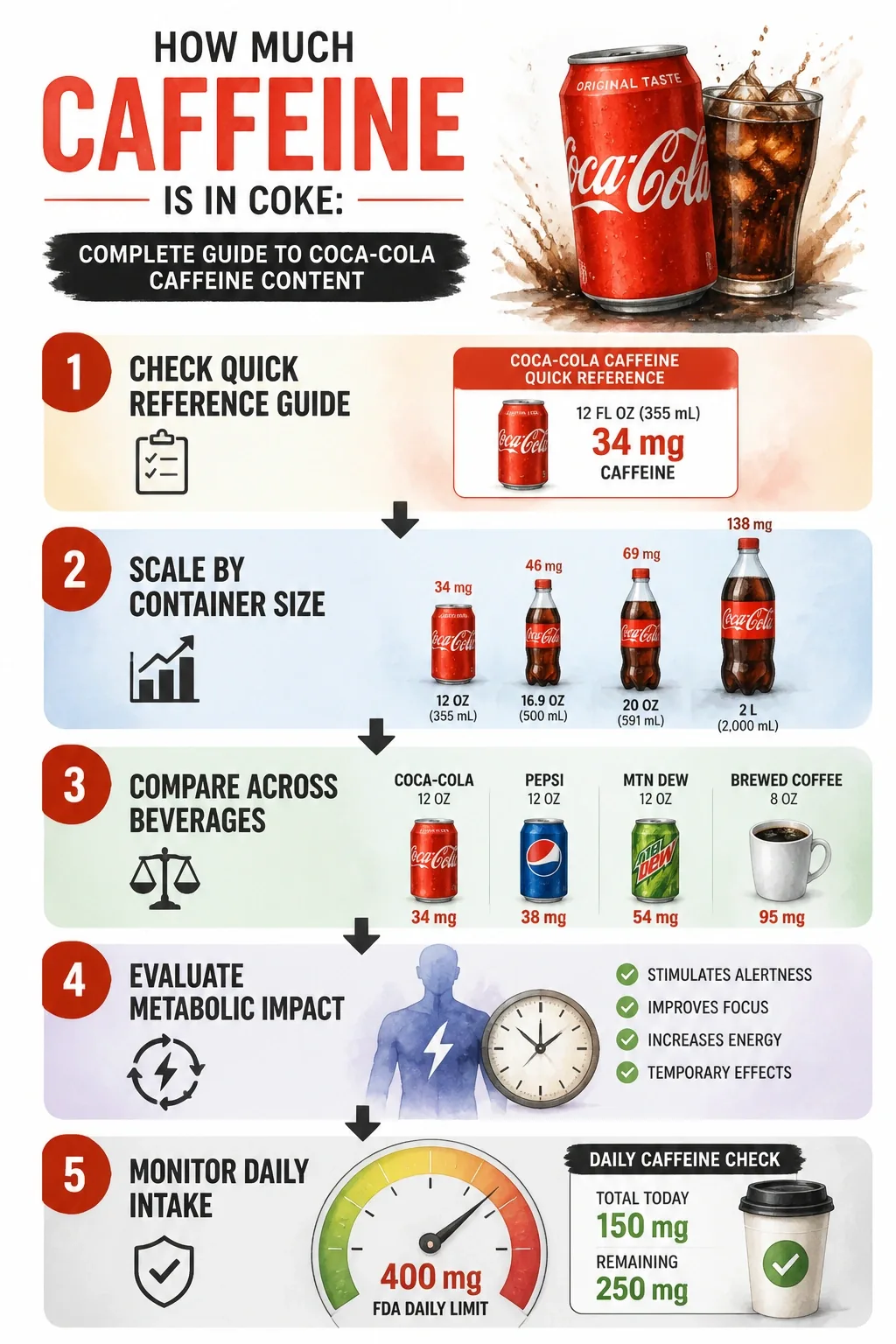
Coca-Cola Classic contains 34 milligrams of caffeine per 12 oz (355ml) can. Diet Coke contains 46mg per 12 oz, making it 35% stronger than the Classic formula. Coca-Cola Zero Sugar matches Classic at 34mg. Caffeine-Free Coca-Cola contains 0mg.
These numbers are the foundation, but they only apply to the standard 12 oz aluminum can. A 20 oz convenience bottle contains approximately 57mg. A 2-liter family bottle contains approximately 190mg. Understanding the full caffeine picture requires knowing how Coke scales across container sizes, how it compares to rival sodas and coffee, and why the real daily consumption bottleneck is sugar rather than caffeine.
Key Takeaways on how much caffeine is in coke
- Coca-Cola Classic contains exactly 34mg of caffeine per 12 oz (355ml) can; Diet Coke contains 46mg per 12 oz, making it 35% stronger than Classic because higher caffeine compensates for the absent sugar’s mouthfeel contribution.
- Caffeine scales linearly with container size: approximately 45mg in a 16 oz bottle, 57mg in a 20 oz single-serve bottle, and 190mg in a full 2-liter; always check the container size, not just the brand name.
- Mountain Dew leads mainstream sodas at 54mg per 12 oz (59% more than Classic Coke); Sprite, 7UP, Fanta, and all root beers except a few contain zero caffeine.
- A 12 oz Coke has 3-4 times less caffeine than an 8 oz cup of drip coffee (95-140mg); the “energy” from Classic Coke comes primarily from 39g of sugar triggering a glycemic spike, not from caffeine stimulation.
- The daily consumption limit for Classic Coke is set by sugar (AHA limit: 36g men / 25g women), not caffeine; a single 12 oz can already delivers 39g of sugar, exceeding the AHA daily limit for women in one serving.
Quick Answer Box: How Much Caffeine Is in a 12 oz Can of Coke?
The fastest reference across the Coca-Cola 12 oz lineup:
| Coca-Cola Variety | Caffeine per 12 oz | Calories | Sweetener |
|---|---|---|---|
| Coca-Cola Classic | 34 mg | 140 kcal | High-fructose corn syrup |
| Diet Coke | 46 mg | 0 kcal | Aspartame |
| Coca-Cola Zero Sugar | 34 mg | 0 kcal | Aspartame + acesulfame K |
| Cherry Coke | 34 mg | 150 kcal | High-fructose corn syrup |
| Cherry Coke Zero | 34 mg | 0 kcal | Aspartame + acesulfame K |
| Mexican Coke (glass bottle) | 34 mg | 150 kcal | Cane sugar (sucrose) |
| Caffeine-Free Coke (gold can) | 0 mg | 140 kcal | High-fructose corn syrup |
| Caffeine-Free Diet Coke | 0 mg | 0 kcal | Aspartame |
The 12 oz Baseline Across the Coca-Cola Lineup
Every variant of Coca-Cola Classic, Cherry Coke, and Zero Sugar contains the same 34mg baseline. This consistency reflects the Coca-Cola formula’s use of caffeine primarily as a bittering agent and flavor component rather than as a marketing-headline stimulant. The caffeine in standard Coke serves a functional flavor role: at 34mg per 12 oz (approximately 2.8mg per fluid ounce), it provides a mild bitter edge that balances the beverage’s high sugar sweetness without delivering a perceptible stimulant effect comparable to coffee.
Why Does Diet Coke Have More Caffeine Than Regular Coke?
Diet Coke contains 46mg of caffeine per 12 oz versus 34mg in Classic, a 35% difference. This is not accidental and not the result of different source cola-nut extracts. It is a deliberate sensory compensation for the absence of sugar.
The sensory role of caffeine in diet soda: sucrose and high-fructose corn syrup in regular Coke contribute three distinct sensory elements: sweetness, mouthfeel (viscosity from dissolved sugar), and a slight tactile body. Aspartame in Diet Coke replicates the sweetness but not the mouthfeel or the body. Without the physical weight and viscosity of dissolved sugar, the beverage’s carbonation sharpness and its flavor compounds register differently on the palate. The higher caffeine concentration in Diet Coke provides an additional bittering compound that sharpens the flavor perception and creates what Diet Coke drinkers describe as a “crisper bite” compared to Classic. Caffeine at 46mg versus 34mg is perceptible as a more defined, assertive flavor edge that partially compensates for the absence of sugar’s textural contribution.
Full Coca-Cola Product Line and Container Size Breakdown
| Container | Volume | Caffeine (Classic) | Caffeine (Diet Coke) | Notes |
|---|---|---|---|---|
| Standard can | 12 oz (355ml) | 34 mg | 46 mg | Universal reference baseline |
| Tall can / plastic bottle | 16 oz (473ml) | ~45 mg | ~61 mg | Common convenience store single |
| Grab-and-go bottle | 20 oz (591ml) | ~57 mg | ~77 mg | Most common gas station size |
| 1-Liter bottle | 33.8 oz (1L) | ~95 mg | ~129 mg | Mid-size take-home format |
| 2-Liter bottle | 67.6 oz (2L) | ~190 mg | ~258 mg | Full family serving size |
Scaling Caffeine Across Packaging Sizes
Coca-Cola’s caffeine concentration is fixed at 34mg per 12 oz (2.83mg per fluid ounce) for Classic and 46mg per 12 oz (3.83mg per fluid ounce) for Diet Coke. All other container sizes scale linearly from this baseline. A 20 oz bottle is not a different formula; it is simply 1.67 times the volume of a 12 oz can, producing 1.67 times the caffeine.
The 2-liter context: a single 2-liter bottle of Coca-Cola Classic contains approximately 190mg of caffeine across its 67.6 oz of volume. This is equivalent to roughly two 8 oz cups of brewed drip coffee in total caffeine. Most consumers who share a 2-liter at a meal or over a day do not consciously track this cumulative caffeine dose.
The convenience store threat: the 20 oz plastic bottle sold at gas stations and convenience stores is the format most likely to cause unintentional caffeine overconsumption. At 57mg per bottle (Classic) or 77mg (Diet Coke), a consumer who buys one at lunch and one in the afternoon has consumed 114-154mg of caffeine from soda alone before adding any coffee, tea, or other caffeinated beverages.
Mexican Coke vs American Coke: Does Cane Sugar Change Caffeine?
Mexican Coke is imported Coca-Cola manufactured in Mexico and bottled in the iconic 12 oz glass bottle. The formula uses sucrose (cane sugar) rather than high-fructose corn syrup as the sweetener. Laboratory testing of Mexican Coke consistently confirms the same 34mg caffeine content per 12 oz as American Coke Classic.
The sweetener difference does not affect caffeine: cane sugar and HFCS serve the same sweetening function; neither is a caffeine source or modifier. The caffeine in Coca-Cola comes from a separate extracted ingredient (either from tea, guarana, or synthetic caffeine depending on regional formulation) that is added regardless of which sweetener is used.
Flavor perception difference: Mexican Coke does taste different from American Coke despite identical caffeine. Sucrose is a disaccharide that hydrolyzes slowly in the mouth, producing a sweeter-rising flavor curve that peaks mid-palate and finishes cleanly. HFCS is a mixture of free fructose and free glucose that registers sweetness immediately and tends to linger longer in the finish. The perceived “cleaner” taste of Mexican Coke compared to American Coke is this difference in sweetness kinetics rather than any formula variation in caffeine, acids, or other flavor compounds.
Cross-Brand Soda Comparison: How Coke Ranks Against Rival Colas
| Soda Brand | Caffeine per 12 oz | vs Classic Coke |
|---|---|---|
| Mountain Dew | 54 mg | +59% more |
| Diet Mountain Dew | 54 mg | +59% more |
| Dr Pepper | 41 mg | +21% more |
| Pepsi | 38 mg | +12% more |
| Diet Pepsi | 35 mg | +3% more |
| Coca-Cola Classic | 34 mg | Baseline |
| RC Cola | 43 mg | +26% more |
| Sprite / 7Up / Fanta | 0 mg | Caffeine-free |
| Root Beer (standard) | 0-22 mg | Varies by brand |
The Mainstream Soda Caffeine Spectrum
Coca-Cola Classic at 34mg per 12 oz sits near the lower end of the caffeinated mainstream soda spectrum. Mountain Dew leads all non-energy mainstream sodas at 54mg per 12 oz, delivering 59% more caffeine than Classic Coke in the same serving volume. Dr Pepper and Pepsi fall between the two.
The relative modesty of Coca-Cola’s caffeine content is historically intentional. The original Coca-Cola formula (developed in the 1880s by John Pemberton) included cocaine from coca leaf extract as the primary stimulant; caffeine was a secondary ingredient. When cocaine was removed from the formula around 1903, caffeine’s role became more prominent, but the formula calibration was not significantly increased. The 34mg figure has remained consistent through most of Coca-Cola’s modern history.
Why Mountain Dew Packs Significantly More Caffeine
Mountain Dew occupies an unusual position: it is a citrus-flavored soda (lemon-lime base) in a category where all other mainstream citrus sodas (Sprite, 7UP, Fanta, Fresca) contain zero caffeine. This is not because citrus sodas require caffeine; they do not. Mountain Dew’s caffeine is a deliberate branding and formulation choice.
PepsiCo positioned Mountain Dew starting in the 1990s as an active-lifestyle, high-energy beverage targeting younger male demographics who were adopting extreme sports culture. The 54mg caffeine dose was part of this positioning: it delivered a more perceptible stimulant effect than cola beverages while staying well below energy drink territory. Mountain Dew established the “high caffeine mainstream soda” category approximately a decade before Red Bull made energy drinks mainstream.
Coke vs Coffee: Caffeine Milligrams and Metabolic Dynamics
| Beverage | Volume | Caffeine | Sugar | Glycemic Index | Alertness Duration |
|---|---|---|---|---|---|
| Drip coffee (medium roast) | 8 oz | 95-140 mg | 0g | 0 | 3-5 hours |
| Espresso (double shot) | 2 oz | 126 mg | 0g | 0 | 3-4 hours |
| Coca-Cola Classic | 12 oz | 34 mg | 39g | 63 | 1-2 hours |
| Diet Coke | 12 oz | 46 mg | 0g | 0 | 2-3 hours |
| Coca-Cola Zero Sugar | 12 oz | 34 mg | 0g | 0 | 2-3 hours |
Raw Milligram Comparison: The 3x to 4x Gap
A standard 8 oz cup of drip coffee contains 95-140mg of caffeine depending on bean origin, roast level, grind size, and brewing ratio. A 12 oz can of Coca-Cola Classic contains 34mg. You would need to drink three to four 12 oz cans of Classic Coke to approach the caffeine in a single mug of standard drip coffee.
This gap surprises many consumers who perceive Coke as a strong stimulant because of the associated sugar rush and carbonation experience. The physiological alertness of a can of Coke is not primarily from caffeine at 34mg (a dose below the perceptible threshold for most caffeine-tolerant adults). It is from the glycemic spike of 39 grams of high-fructose corn syrup.
The Glycemic Spike and Crash vs Sustained Alertness
HFCS absorption kinetics: the 39g of sugar in a 12 oz Coca-Cola Classic (consisting primarily of free fructose and free glucose from HFCS) are in solution and require minimal digestion before absorption. The liquid sugar passes through the stomach rapidly and is absorbed in the upper small intestine within 15-20 minutes of consumption. Blood glucose rises sharply, triggering a proportional insulin release from the pancreas.
The 60-90 minute sugar crash: the rapid insulin release drives blood glucose back down to or below baseline, a phenomenon called reactive hypoglycemia. As blood glucose drops 60-90 minutes after consumption, energy perception decreases, concentration falters, and the consumer feels tired or foggy. This is the Coke “crash”: a physiological consequence of the sugar metabolism, not of caffeine wearing off.
Coffee’s different pathway: brewed coffee at 0g sugar and 0 glycemic index does not trigger an insulin response. Caffeine at 95-140mg inhibits adenosine receptors in the brain (adenosine is the chemical that builds up and makes you feel sleepy). The chlorogenic acids in coffee (primarily 5-caffeoylquinic acid) slow gastric emptying and moderate the caffeine absorption rate, producing a flatter, more gradual caffeine blood-level curve that sustains alertness for 3-5 hours without a subsequent glucose crash.
Coke vs Energy Drinks: Red Bull, Monster, and Synthetic Stimulants
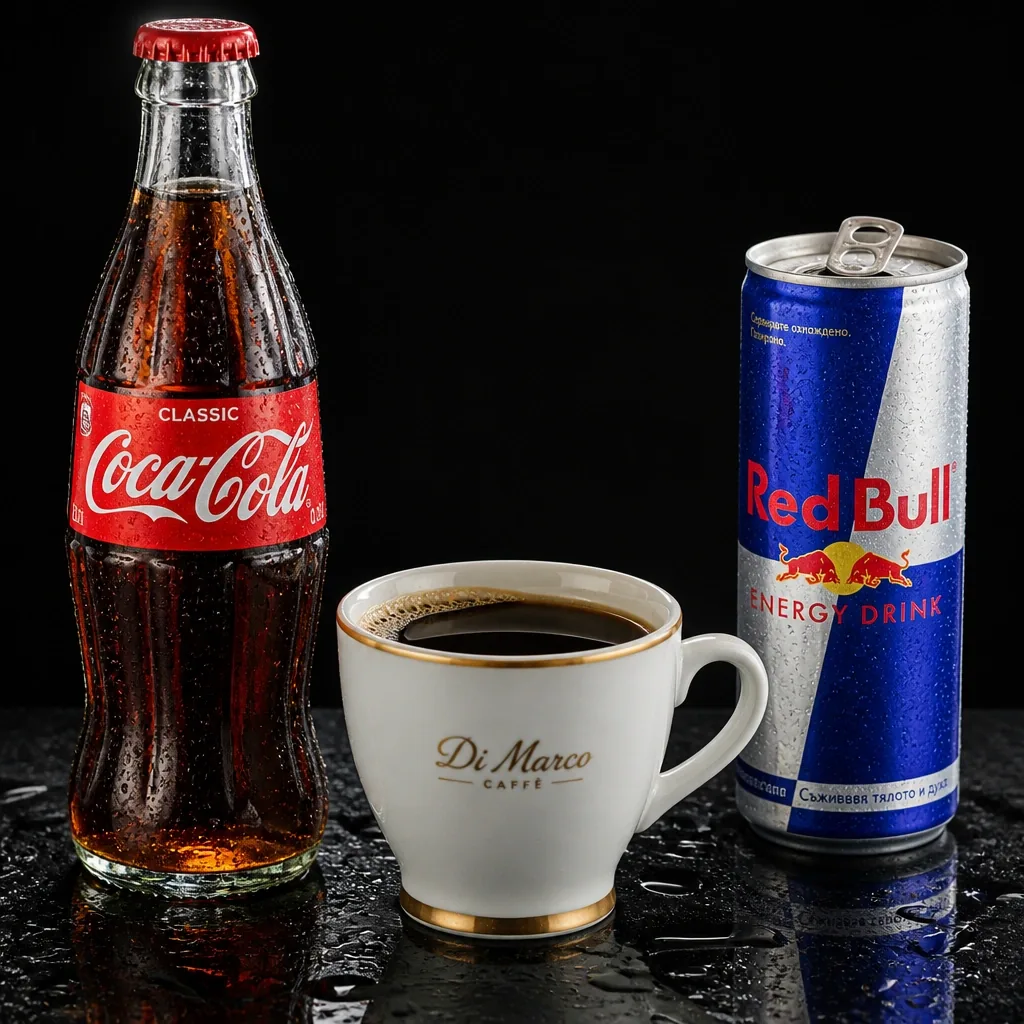
| Beverage | Volume | Caffeine | Sugar | Taurine | Primary Stimulant Mechanism |
|---|---|---|---|---|---|
| Coca-Cola Classic | 12 oz | 34 mg | 39g | 0 | Mild adenosine inhibition + glycemic spike |
| Red Bull Original | 8.4 oz | 80 mg | 27g | 1000 mg | Caffeine + taurine + sugar |
| Monster Original Green | 16 oz | 160 mg | 54g | 1000 mg | Caffeine + taurine + ginseng + sugar |
| Bang Energy | 16 oz | 300 mg | 0g | 0 | Anhydrous caffeine + BCAAs + CoQ10 |
| Spike Hardcore | 16 oz | 350 mg | 0g | 0 | Anhydrous caffeine + beta-alanine + yohimbine |
The Stimulant Differential: Coke vs Red Bull and Monster
Red Bull 8.4 oz: 80mg of caffeine in a volume smaller than a standard soda can. Per fluid ounce, Red Bull delivers 9.5mg versus Coke’s 2.8mg, a 3.4x concentration advantage. A single Red Bull delivers more than twice the caffeine of a 12 oz Classic Coke.
Monster Energy 16 oz: 160mg of caffeine, nearly 5 times the caffeine of a 12 oz Coke in a larger volume. Monster’s caffeine concentration per ounce (10mg/oz) is 3.5x that of Coke, and the drink further amplifies its stimulant effect through 1000mg of taurine, panax ginseng extract, and 54g of added sugar.
Spike Hardcore and Bang 16 oz: the extreme performance category. Spike Hardcore delivers 350mg of synthetic anhydrous caffeine per 16 oz can (21.9mg/oz), which is 10.3 times more caffeine per ounce than Classic Coke. A single can delivers 87.5% of the FDA’s safe daily adult caffeine ceiling.
The Additive Synergy: Taurine, Glucuronolactone, and B-Complex
Energy drinks do not simply add more caffeine than Coke; they add a pharmacologically designed mixture of compounds that interact with each other and with caffeine’s mechanism of action in ways that Coke’s single-ingredient approach does not attempt.
Taurine (typically 1000mg per energy drink can): an amino sulfonic acid produced naturally in the human body and found in meat, fish, and dairy. At the concentrations in energy drinks, taurine enhances calcium handling in cardiac myocytes (heart muscle cells), increasing the force of each heartbeat. Combined with caffeine’s vasoconstrictive properties, the combination produces a more intense cardiovascular effect than caffeine alone. The subjective feeling of “heart pounding” after an energy drink is partly attributable to taurine’s cardiac calcium effect.
Glucuronolactone (typically 600mg per can): a naturally occurring compound and structural component of connective tissue. Its inclusion in energy drinks is derived from older European studies suggesting cognitive enhancement effects, though modern clinical evidence for these effects at beverage doses is limited.
Coke’s minimalist stimulant design is not a deficiency: it reflects the product’s historical positioning as a beverage rather than a performance product. The 34mg caffeine dose in Coke is below the level where most caffeine-tolerant adults notice any central nervous system effect.
Daily Safe Intake Limits, Health Considerations, and The Sugar Bottleneck
| Demographic | Max Daily Caffeine | Max Daily Coke Equivalent | AHA Max Sugar | Cokes Until Sugar Limit Reached |
|---|---|---|---|---|
| Healthy adult | 400 mg | 11-12 cans (12 oz Classic) | 36g (men) / 25g (women) | Less than 1 can |
| Pregnant woman | 200 mg | 5-6 cans (12 oz Classic) | 25g (AHA recommendation) | Less than 1 can |
| Adolescent (13-17) | 100 mg (Canada guidance) | 2-3 cans (12 oz Classic) | 25g | Less than 1 can |
| Child under 12 | 0-45 mg (varies by body weight) | 0-1 cans | 25g | Less than 1 can |
The FDA 400 mg Daily Ceiling
The FDA’s safe daily caffeine limit for healthy adults is 400mg. In terms of Coke Classic, this equates to approximately 11-12 standard 12 oz cans. In terms of Diet Coke, it equates to approximately 8-9 cans. Reaching the caffeine ceiling through Coke consumption alone is physiologically possible but practically unlikely, as the corresponding sugar consumption would cause acute gastrointestinal distress long before approaching caffeine toxicity.
Pregnant women: the American College of Obstetricians and Gynecologists (ACOG) recommends limiting caffeine to 200mg per day during pregnancy. At 34mg per 12 oz, a pregnant woman can consume approximately 5-6 cans of Classic Coke daily within the caffeine limit. However, the sugar content of those 5-6 cans (195-234g of added sugar) far exceeds any reasonable dietary guideline and creates gestational blood sugar risks separate from the caffeine question.
Children: no authoritative body recommends caffeinated sodas for children under 12. Above 12, Canada’s health guidelines suggest a maximum of 2.5mg per kilogram of body weight per day. A 40kg adolescent would have a limit of 100mg, approximately 3 cans of Classic Coke.
The Added Sugar Bottleneck: The True Limiting Factor
A single 12 oz can of Coca-Cola Classic contains 39 grams of added sugar from high-fructose corn syrup. The American Heart Association (AHA) recommends a maximum of 36g of added sugar per day for men and 25g per day for women. A single can of Classic Coke exceeds the women’s daily limit by 56% and matches the men’s daily limit almost exactly.
This means the practical daily consumption ceiling for Coke is not determined by caffeine. It is determined by sugar. The maximum safe daily sugar intake is reached after approximately one can for most adults before any caffeine concern is triggered.
Metabolic risks of sustained high soda intake: clinical research consistently associates daily sugar-sweetened beverage consumption with:
- Insulin resistance and increased type 2 diabetes risk (fructose metabolism in the liver produces triglycerides at high intake levels)
- Dental enamel demineralization from carbonic acid and phosphoric acid in the beverage
- Visceral adiposity from chronic caloric surplus and fructose-driven hepatic lipogenesis
- Elevated LDL cholesterol from high-fructose intake independently of total calorie balance
Coca-Cola Zero Sugar and Diet Coke eliminate the sugar risk entirely. Their caffeine profiles are 34mg and 46mg respectively, within any reasonable daily limit, and their zero-sugar formulations remove the AHA sugar bottleneck. For regular Coke drinkers motivated by both the caffeine and the taste, switching to Zero Sugar preserves the flavor profile while eliminating the primary health risk.
Frequently Asked Questions About how much caffeine is in coke
Does Mexican Coke have more caffeine than regular Coke?
No. Mexican Coke and American Coke Classic both contain 34mg of caffeine per 12 oz serving. The only confirmed formula difference is the sweetener: Mexican Coke uses sucrose (cane sugar) rather than high-fructose corn syrup. Laboratory tests confirm identical caffeine content. The perceived taste difference is real (sucrose has a different sweetness curve than HFCS) but does not extend to any stimulant difference.
Which soda has the highest caffeine content?
Among mainstream retail sodas, Mountain Dew leads with 54mg per 12 oz. Among energy-soda hybrids and specialty products, Surge, Vault, and similar high-intensity sodas can reach 69mg per 12 oz. Among actual energy drinks marketed as beverages, Spike Hardcore reaches 350mg per 16 oz can. Mountain Dew is the highest caffeine standard soda available at most supermarkets.
How much caffeine is in a 2-liter bottle of Coke?
A 2-liter bottle of Coca-Cola Classic contains approximately 190mg of caffeine total. A 2-liter of Diet Coke contains approximately 258mg total. These figures assume the full 2-liter (67.6 oz) is consumed, which is uncommon in a single sitting but relevant for households that go through a 2-liter per day across multiple family members.
Is Coke Zero completely caffeine-free?
No. Coca-Cola Zero Sugar contains 34mg of caffeine per 12 oz, identical to Classic Coke. Only Caffeine-Free Coca-Cola (sold in a gold can) and Caffeine-Free Diet Coke contain 0mg of caffeine. The “Zero” in Coke Zero refers to zero sugar and zero calories, not zero caffeine. Consumers who need to avoid caffeine entirely must specifically purchase the Caffeine-Free labeled variants.
References
- Coca-Cola Company, Nutrition Information and Product Facts for Coca-Cola Portfolio | coca-colacompany.com
- U.S. Food and Drug Administration, Spilling the Beans: How Much Caffeine Is Too Much? | fda.gov