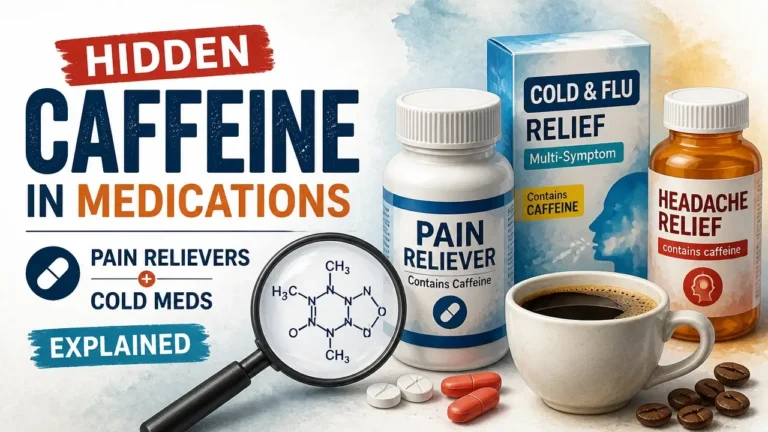

Hidden caffeine in medications catches most people completely off guard – not because drug companies are sneaking it in, but because almost nobody reads the Active Ingredients block on their pain reliever before swallowing it. Excedrin, Midol, and certain cold remedies carry real, measurable caffeine doses that interact with everything else you’ve consumed that day.
Understanding why it’s there – and exactly how much – changes how you use these products. Once you see the mechanism, the label stops being fine print and starts being a tool.
Looking beyond everyday medications, exploring your daily routine can reveal an even broader health impact when you understand how stimulants affect your overall wellness.
Understanding why it’s there—and exactly how much—changes how you use these products, especially if you ever find yourself needing flushing caffeine from the body after an accidental overdose from overlapping medications.
Knowing how your body processes this stimulant is just as important, especially when you consider how genes determine half-life and influence your overall sensitivity.
Why Is Caffeine in My Pain Reliever?
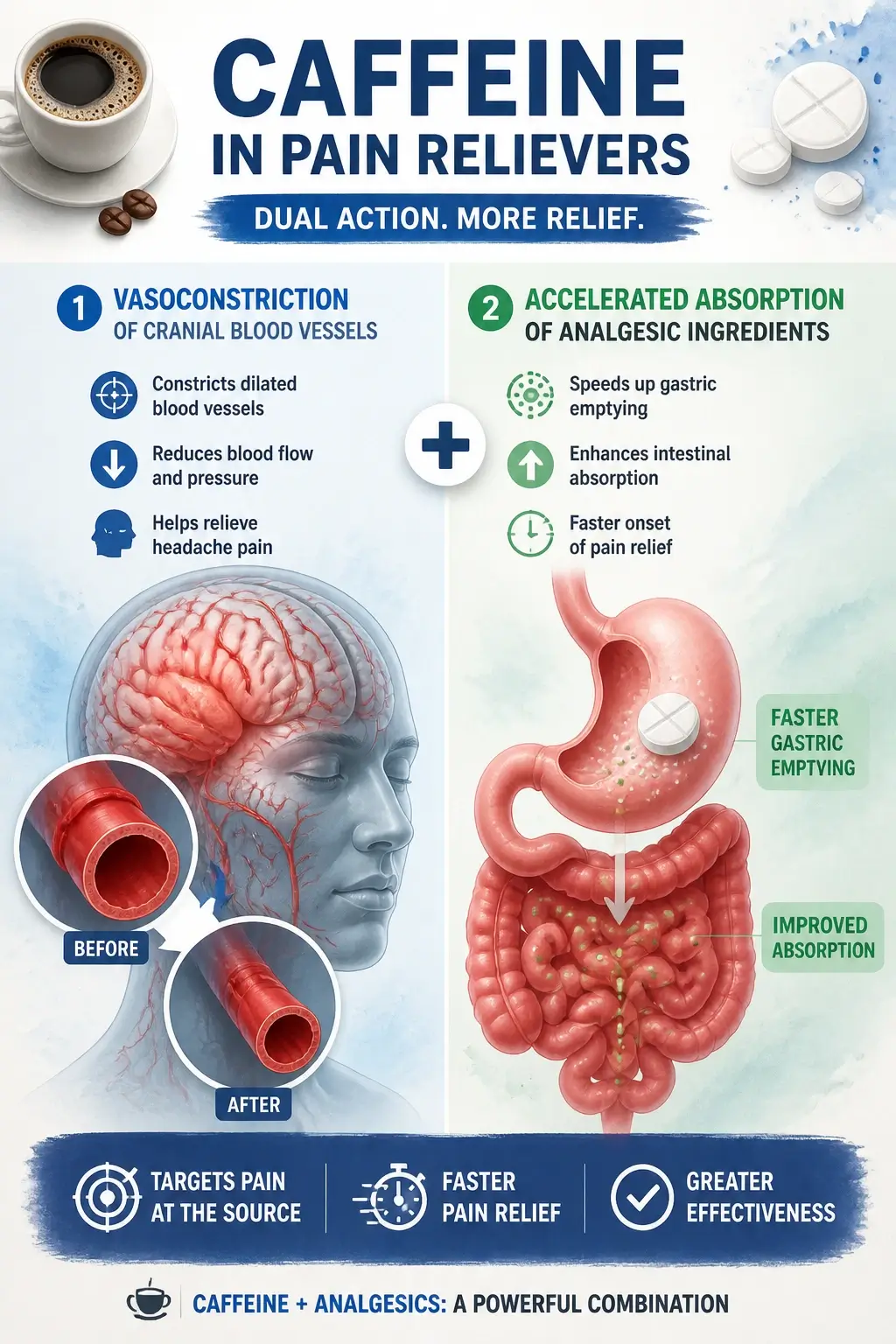
Caffeine’s role in pain relief is more than a marketing gimmick – it works through two distinct biological pathways that make your headache pill hit harder and faster. First, it acts as a mild vasoconstrictor, narrowing the swollen cranial blood vessels that generate the throbbing pain signal during a migraine or tension headache. Second, it accelerates your body’s absorption of analgesic compounds like acetaminophen and aspirin, so those ingredients reach therapeutic concentration in your bloodstream faster than they would on their own.
That second point is worth sitting with. It’s not that caffeine simply “helps” – it significantly boosts the pain-relieving effect of the drugs it’s paired with. A peer-reviewed pharmacology review put it plainly:
This is exactly why caffeine shows up in products targeting migraines and tension headaches specifically – both conditions involve vascular changes where fast relief matters most. The vasoconstriction dampens the pressure signal while the enhanced absorption gets the acetaminophen or aspirin working before the pain escalates further.
Here’s the part that trips most people up: caffeine is not a hidden additive. It’s an active ingredient with a declared purpose and an exact milligram strength listed on the Drug Facts Label of every OTC product that contains it. The law requires it. That means you’ve always had access to this information – you just may not have known to look.
Here’s a visual breakdown of how both mechanisms work together inside your body:
Which Common OTC Medications Contain Caffeine?
Caffeinated OTC medications are more widespread than most people expect, and the doses aren’t trivial. Knowing which products carry caffeine – and exactly how much – is the foundation for managing your total daily intake. The list breaks into two practical categories: pain relievers and menstrual aids on one side, and cold remedies plus alertness supplements on the other.
Excedrin and Midol: The Doses That Add Up Fast
Excedrin Extra Strength and its identical twin Excedrin Migraine each contain approximately 65 mg of caffeine per tablet. That number alone sounds manageable – until you follow the standard two-tablet dose. Two tablets deliver 130 mg of caffeine in a single sitting, which is already more than a typical 8-oz cup of coffee. Clinical pharmacology researchers Voicu et al. confirmed the formulation directly:
“…Excedrin®, a fixed combination drug containing 250 mg ASA, 250 mg PAR, and 65 mg CAF.” – Voicu et al., clinical pharmacology researchers
Midol Complete takes a similar approach. Each caplet carries approximately 60 mg of caffeine, added specifically to address two of the most common menstrual complaints: bloating and fatigue. The logic is the same as in a headache pill – caffeine pulls double duty as both a mild diuretic and an energy-boosting adjuvant. But for someone who already drinks two or three cups of coffee a day, that 60 mg per caplet is a real addition to the running total, not a negligible trace.
Here’s how these two products compare side by side:
| Product | Caffeine per Tablet/Caplet | Standard Dose | Caffeine per Dose | Key Analgesic Ingredients | Intended Use |
|---|---|---|---|---|---|
| Excedrin Extra Strength / Migraine | ~65 mg | 2 tablets | ~130 mg | Acetaminophen 250 mg, Aspirin 250 mg | Headache, migraine relief |
| Midol Complete | ~60 mg | 1 caplet | ~60 mg | Acetaminophen 500 mg, Pyrilamine maleate 15 mg | Menstrual pain, bloating, fatigue |
Cold Remedies, Alertness Pills, and Supplements with Caffeine
Daytime cold and flu remedies occupy a different corner of the caffeine-in-medications map. Certain DayQuil formulations, Theraflu varieties, and their generic equivalents add caffeine specifically to counteract the drowsiness that antihistamines produce. The amounts vary by formula and brand, which means the label check is non-negotiable – there’s no reliable shortcut for this category.
The caffeine doses in pure alertness pills are a different story entirely. NoDoz and Vivarin each contain 200 mg of caffeine per pill – the equivalent of roughly two standard cups of coffee in a single tablet. These products make no pretense about their mechanism; caffeine is the only active ingredient. But people often reach for them during a cold or a long workday when they’re already drinking coffee, creating an easy path to excess.
Weight-loss aids and “energy-boosting” supplements round out the hidden sources. Many of these products rely on caffeine or herbal stimulants rather than listing caffeine outright. Green tea extract, guarana, and kola nut are the most common botanical stand-ins – all deliver caffeine, just under a plant name that doesn’t trigger the same mental alarm as the word “caffeine” on a label.
A laboratory analysis of 63 weight-loss and multi-symptom cold products found that 33 of them – roughly 52% – listed caffeine on the label. That’s more than half the products in a single product category quietly contributing to your daily total.
All of these medication doses sit on top of whatever coffee, tea, soda, or energy drinks you’re already consuming. The math catches up with you faster than you’d expect.
The Coffee and Pill Danger Zone
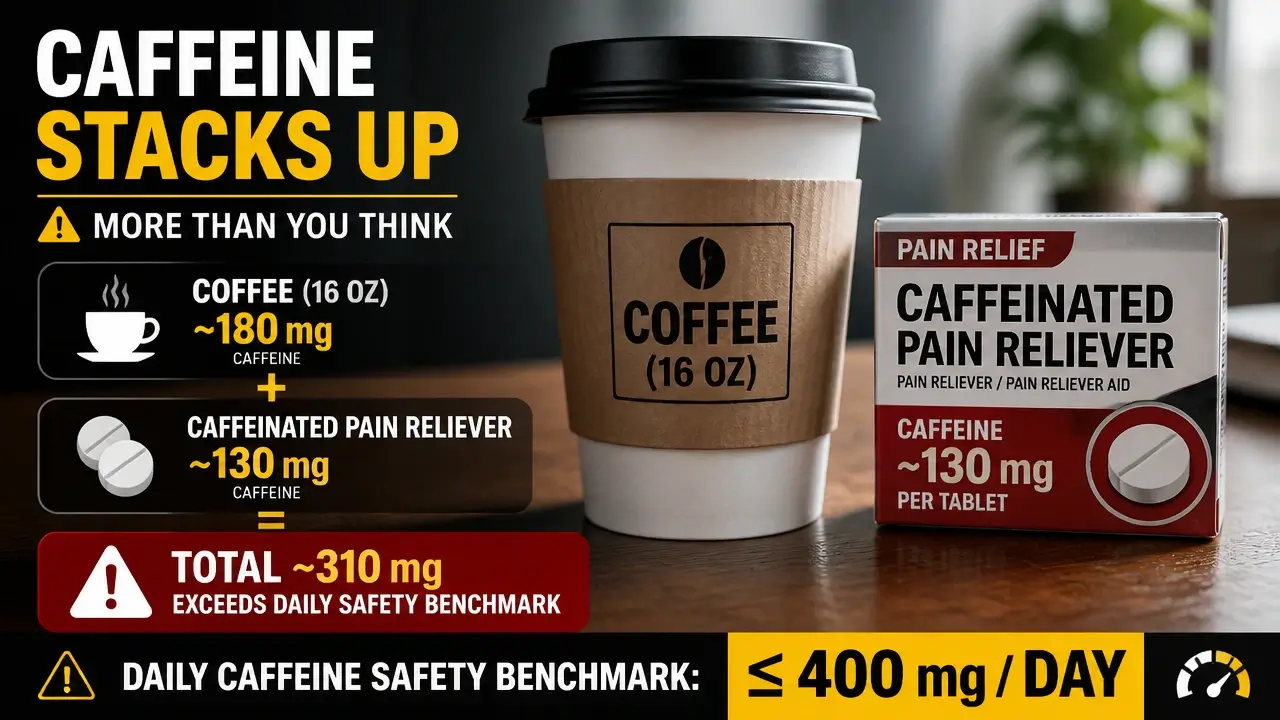
Caffeine overload doesn’t usually happen because someone made a reckless decision – it happens because the doses are invisible until you add them up. Walk through a realistic scenario: you take two Excedrin for a migraine (130 mg of caffeine), then wash them down with a large 20-oz brewed coffee (roughly 300–400 mg depending on the roast and brew method). In one sitting, before you’ve even had lunch, your caffeine total sits somewhere between 430 and 530 mg. The FDA’s widely cited guidance for healthy adults puts the daily benchmark at 400 mg:
“Healthy adults can consume up to 400 milligrams a day…” – U.S. Food and Drug Administration, U.S. federal public health regulator
You’ve already exceeded it, and the day isn’t half over.
The immediate consequences are predictable: jitteriness, a racing heartbeat, anxiety, elevated blood pressure, and difficulty falling asleep that night. None of those symptoms feel like a medication side effect – they feel like stress, or too much coffee, which is exactly why the connection goes unnoticed.
What makes the 400 mg benchmark more complicated than it looks is that it’s a population average, not a personal ceiling. Roughly 25% of people carry a gene variant that makes them slow metabolizers through the CYP1A2 liver enzyme – they clear caffeine up to four times more slowly than fast metabolizers. A dose that a friend processes and forgets in three hours can still be active in a slow metabolizer’s system eight hours later, amplifying jitteriness, insomnia, and palpitations well past the point where the pain relief has worn off.
Pregnancy adds another layer. Major health organizations recommend capping caffeine at 200 mg daily during pregnancy – half the general guideline. A single caffeinated pain reliever plus one cup of coffee can already reach that threshold before any other dietary sources are counted.
Hidden stacking sources compound the problem further. A can of cola adds about 35 mg. An energy drink can contribute anywhere from 80 to 150 mg. Even chocolate carries a small but real caffeine load. None of these feel like “caffeine intake” in the way that coffee does, but they all count.
Drug interactions add a final, underappreciated layer of risk. Certain antibiotics – ciprofloxacin is a well-documented example – inhibit the CYP1A2 enzyme, the same pathway that clears caffeine from your system. Oral contraceptives have a similar slowing effect. If you’re on either of these, the caffeine from your pain reliever lingers longer and at higher effective concentration than you’d expect from the dose alone.
The most acute combination risk involves decongestants. Pseudoephedrine, found in many daytime cold formulas, already elevates heart rate and blood pressure on its own. Stacking it with caffeinated medications – or with caffeine from any source – compounds that cardiovascular strain. Prescription stimulants used for ADHD carry the same concern. The heart is getting hit from two directions simultaneously, and the risk isn’t theoretical.
The photo below captures the everyday scenario that makes this stacking so easy to overlook:
The Rebound Headache Trap
Rebound headache is the part of the caffeinated pain reliever story that almost nobody sees coming – because it looks exactly like the problem you were trying to solve. The physiological mechanism is straightforward once you understand the vascular cycle. Caffeine constricts cranial blood vessels to relieve pain. When the caffeine clears your system, those same vessels don’t just return to baseline – they rebound, dilating rapidly. That rapid vasodilation is itself a pain trigger. The headache that returns isn’t a continuation of your original problem. It’s a withdrawal headache driven by the medication.
The trap closes here: the withdrawal headache feels identical to the tension headache or migraine that started the whole sequence. So you take another dose. The cycle repeats. Over time, this pattern solidifies into what clinicians call medication-overuse headache, or MOH.
A peer-reviewed article in Neurología (English edition) explains the deeper neurological mechanism behind this cycle. Chronic caffeine use causes adenosine receptors in the brain to up-regulate – the brain compensates for caffeine’s blocking effect by building more receptor sites. When caffeine clears abruptly, a surge of adenosine floods those now-abundant receptors, triggering rapid vasodilation and local inflammation. The same paper documents cortical hyperexcitability from serotonin depletion and central sensitization of the trigeminal pain system, which keeps the pain pathways in a pre-excited state – essentially making the brain more sensitive to pain over time, not less. The review authors describe the mechanism directly:
“…when caffeine consumption is interrupted abruptly, adenosine receptors become available, leading to vasodilation and significant increases in cerebral blood flow.” – Review article authors, peer-reviewed headache medicine review
The ICHD-3 clinical threshold for MOH diagnosis sits at just 10 days per month for combination analgesics – meaning using a caffeinated pain reliever on roughly every third day is enough to qualify. The practical limit to stay well clear of that threshold: no more than two or three days per week.
Full withdrawal, if you stop abruptly after regular use, carries its own set of symptoms. Severe throbbing headache, fatigue, irritability, and brain fog are the most common, and they can persist for several days. That symptom cluster is often misread as illness, stress, or the return of the original headache condition – which leads people right back to the pill bottle.
This pattern doesn’t exist in isolation from the stacking risk covered in the previous section. Someone who occasionally overshoots the 400 mg daily benchmark by combining Excedrin with coffee is simultaneously building the neuroplastic changes that lower their headache threshold over time. Both the acute risk and the chronic risk are running in parallel.
How to Spot Hidden Caffeine on Your Medication Labels
The Drug Facts Label is the single most reliable tool you have – and it’s sitting on every OTC package you’ve ever bought. The Active Ingredients block appears at the very top of the Drug Facts section, before dosage instructions or warnings, and it lists every active compound with its exact milligram strength and its declared purpose. For caffeine, you’ll typically see something like “Caffeine 65 mg – pain reliever aid” or “Caffeine 200 mg – alertness aid.” That declared purpose is legally required. If caffeine is in there, it has to be named and quantified.
Dietary supplements and “natural” products work differently. They’re governed by the Supplement Facts panel rather than Drug Facts, and they’re allowed to list caffeine under botanical names without flagging it as caffeine. The four names to watch for: guarana, green tea extract, yerba mate, and kola nut. All four deliver real caffeine doses. None of them trigger the same mental recognition as seeing the word “caffeine” printed plainly. The U.S. National Center for Complementary and Integrative Health makes this point directly:
“Dietary supplements can contain ingredients that are not herbs, such as vitamins, minerals, amino acids, and caffeine.” – U.S. National Center for Complementary and Integrative Health, NIH center
For prescription medications, the label check isn’t always available in the same straightforward format. Some prescription migraine drugs and certain cold formulas do include caffeine, but the packaging may not present it as prominently. The most reliable move here is a direct question to your pharmacist – not a general “does this have caffeine?” but a specific “does this medication contain caffeine, and does it interact with caffeine from other sources?” Pharmacists can also flag interactions with CYP1A2-inhibiting drugs like ciprofloxacin or oral contraceptives that would slow your clearance.
The simplest habit to build: a running milligram tally. Add the caffeine from every pill you take, then add your coffee, tea, and soda intake for the same window of time. The total is what matters, not any individual source. Most people who discover they’ve been overshooting the 400 mg benchmark aren’t doing anything dramatic – they’re just adding up numbers they’d never bothered to combine before.
One more thing worth mentioning that rarely comes up: caffeine can distort certain lab test results, potentially producing false values and triggering unnecessary follow-up investigations. If you’re scheduled for a blood draw, tell your healthcare provider about any caffeine-containing medications you’ve taken – not just what you ate or drank. It’s a small step that can prevent a misread result from sending you down an unnecessary diagnostic path.
Key Takeaways on Caffeine in Medications
- Caffeine in pain relievers works through two mechanisms: vasoconstriction of cranial blood vessels and accelerated absorption of analgesic ingredients like acetaminophen and aspirin.
- A standard two-tablet dose of Excedrin delivers 130 mg of caffeine – more than a typical cup of coffee – before any other sources are counted.
- Stacking a large brewed coffee with a caffeinated pain reliever can push a single sitting’s total past 430 mg, exceeding the FDA’s 400 mg daily benchmark in one go.
- Slow CYP1A2 metabolizers – roughly 25% of the population – clear caffeine up to four times more slowly, making the same dose significantly riskier for them.
- Using caffeinated pain relievers more than two or three days per week can trigger medication-overuse headache, a withdrawal-driven cycle that mimics the original pain.
- The Drug Facts Label always lists caffeine by name and milligram strength; for supplements, watch for guarana, green tea extract, yerba mate, and kola nut as botanical caffeine sources.
Frequently Asked Questions About Caffeine in Medications
What common products contain caffeine that most people don’t expect?
Beyond coffee and energy drinks, caffeine shows up in Excedrin, Midol Complete, certain DayQuil and Theraflu formulations, NoDoz, Vivarin, and a wide range of weight-loss supplements and “natural” energy boosters that list it under names like guarana or green tea extract. A lab analysis of 63 weight-loss and cold products found roughly 52% contained caffeine on the label.
Which medications should you never combine with caffeine from coffee or other sources?
The highest-risk combinations involve decongestants like pseudoephedrine, prescription ADHD stimulants, and antibiotics like ciprofloxacin – ciprofloxacin slows caffeine clearance through the CYP1A2 enzyme, meaning the caffeine from your pain reliever stays active far longer than the label dose would suggest.
Can caffeine in medications affect blood test results?
Yes – caffeine can distort certain lab values, potentially producing false readings and triggering unnecessary follow-up tests. If you’ve taken any caffeinated medication before a blood draw, tell your healthcare provider explicitly, not just what you ate or drank that morning.
Does caffeine in pain relievers cause dependency the same way daily coffee does?
Functionally, yes. Frequent use of caffeinated analgesics produces adenosine receptor up-regulation – the same neuroplastic change that makes daily coffee drinkers feel foggy without their morning cup. The ICHD-3 threshold for medication-overuse headache sits at just 10 days per month for combination analgesics.
Is the 400 mg daily caffeine limit safe for everyone?
It’s a population average for healthy, non-pregnant adults – not a personal ceiling. Slow CYP1A2 metabolizers process caffeine up to four times more slowly, and pregnant individuals are generally advised to stay under 200 mg daily. Your actual safe limit depends on your genetics, medications, and life stage.
Can I take caffeinated pain relievers if I’m on oral contraceptives?
You can, but you should be aware that oral contraceptives inhibit the CYP1A2 enzyme and slow caffeine metabolism, so the caffeine from your medication will remain active in your system longer than it would otherwise. Keeping your total daily caffeine lower on days you take caffeinated pain relievers is a practical way to manage that.
Does caffeine in Lexapro or other antidepressants interact with caffeine from medications?
Lexapro (escitalopram) doesn’t contain caffeine, but caffeine can worsen anxiety and interfere with sleep quality – two areas where SSRIs like Lexapro are already working to establish stability. High caffeine intake from medications or beverages can undercut the drug’s effectiveness in managing anxiety symptoms, so it’s worth discussing your total caffeine load with your prescriber.
What’s the difference between caffeine withdrawal headache and a regular tension headache?
The timing is the clearest tell – withdrawal headache tends to appear predictably 12 to 24 hours after your last caffeine dose and is often accompanied by fatigue, irritability, and difficulty concentrating. A tension headache typically builds in response to stress, posture, or muscle tension without that predictable caffeine-timed pattern.
References
- Caffeine as an Analgesic Adjuvant – ScienceDirect (Pharmacology Review)
- Excedrin Fixed Combination Drug Study – Frontiers in Pharmacology (Voicu et al.)
- Laboratory Analysis of Caffeine in Weight-Loss and Cold Products – USDA ARS
- FDA Consumer Update: How Much Caffeine Is Too Much – FDA.gov
- Caffeine and Headache: Specific Remarks (Neurología, English Edition) – ScienceDirect
- Dietary Supplements and Herbal Medicines – NCCIH (NIH)