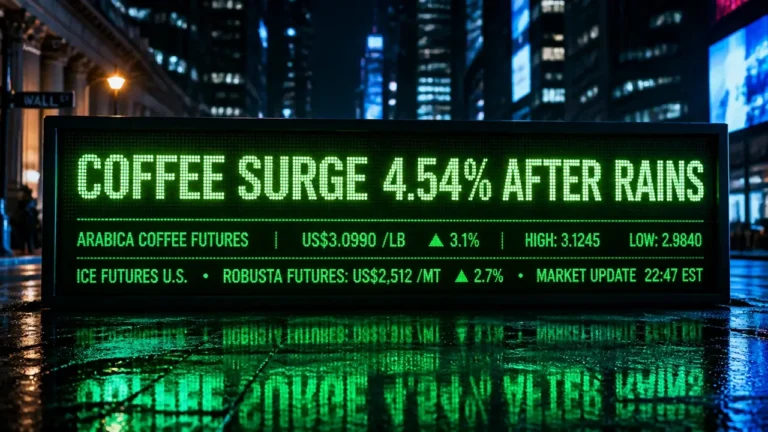

Arabica and robusta futures surged on 1 July as heavy, out-of-season rains in Brazil slowed the main harvest, raised quality concerns and led many producers to withhold top-grade coffee from the domestic market.
According to Globo Rural, September 2026 arabica on the New York exchange closed up 4.54% at US$ 3.0990 per pound, after touching an intraday high of US$ 3.1640 per pound, the highest level since 3 February. Reuters, via Portal do Holanda, reported that robusta futures in London rose 3.1% to US$ 3,771 per tonne on the same day.
The price spike came as field reports showed Brazil’s harvest running behind last year. Cooxupé data cited by Globo Rural indicated that only 24.9% of its area had been harvested by 28 June 2026, the lowest level for that date since 2018 and well below 31.4% in 2025. In the Cerrado Mineiro region, the cooperative Expocacer told Notícias Agrícolas that 27% of its area had been harvested by 26 June, versus 35% a year earlier.
Brazil’s Center for Advanced Studies in Applied Economics (Cepea) reported, through Globo Rural, that atypical June rains in key arabica regions have complicated post-harvest drying and favored mold development on cherries both on the ground and on the trees, heightening worries about cup quality. Analyst Gil Barabach of Safras & Mercado told Diário do Estado that excess moisture is affecting arabica-growing areas in Minas Gerais, São Paulo and Paraná, “elevando a preocupação com a qualidade dos grãos e reduzindo a oferta imediata”.
Expocacer informed Notícias Agrícolas that about 25% of coffee fruits had been knocked to the ground by the rains in its area of operation, with average processing yields of 550 to 570 liters per 60 kg bag and 12% of volume already processed. The cooperative also warned that abundant moisture had triggered an undesired early flowering in Cerrado Mineiro, which it said could affect the 2027 crop.
On the supply side of the physical market, multiple actors described a sharp pullback in sales of high-quality lots. Senior broker Tomás Araújo of StoneX told Reuters, via Portal do Holanda, that “várias fontes do setor confirmaram que as ofertas de café de alta qualidade nos mercados internos (do Brasil) foram retiradas, com os produtores optando por reter a oferta” after the rains. In the same report, agronomist Jonas Leme Ferraresso observed that producers “já não estavam vendendo muito mesmo antes das chuvas, e agora estão ainda mais reticentes”.
Ferraresso also told Reuters that collecting coffee knocked to the ground in mechanized areas requires hiring extra manual labor, which can make harvesting uneconomic for some growers; in his words, “algumas pessoas podem decidir simplesmente não colher”. Notícias Agrícolas reported that, despite an increase in overall trading volume, many producers are now choosing to delay new sales while waiting for clearer price signals.
The tightening nearby balance has been reflected in exchange stocks. Broker Escritório Carvalhaes, cited by Notícias Agrícolas, noted that certified arabica inventories on ICE fell by 3,069 bags on the latest reading to 377,465 bags. Over 12 months, those stocks are down 463,708 bags, compared with 841,173 bags a year earlier, after cumulative declines of 63,853 bags in May and 58,191 bags in April. Safras & Mercado, via Diário do Estado, estimated that Brazil’s total 2026 harvest had reached 44% of the crop by 24 June, below 51% at the same time in 2025 and a five-year average of 47%.
While the physical squeeze and weather problems have driven immediate prices higher, some analysts still see comfortable volumes ahead. In its global outlook report, StoneX projected Brazilian 2026/27 coffee production at around [UNVERIFIED] 75.30 million bags, up 6.51% from its previous estimate, with world demand between October 2026 and September 2027 at [UNVERIFIED] 172.5 million bags and global output at [UNVERIFIED] 182.5 million bags. The firm calculated a [UNVERIFIED] surplus of roughly 10 million bags and stated that global stocks were rebuilding to above [UNVERIFIED] 48 million bags, describing 2026 as a transition year in which small shocks might quickly translate into volatility.
Investment flows have amplified the latest move: Diário do Estado reported that investment funds increased their net long positions in coffee futures amid climate uncertainty and expectations of lower quality. Globo Rural added that market analyst Haroldo Bonfá of Pharos Consultoria believes the price surge has opened a window for Brazilian producers with delayed forward sales to lock in higher levels.