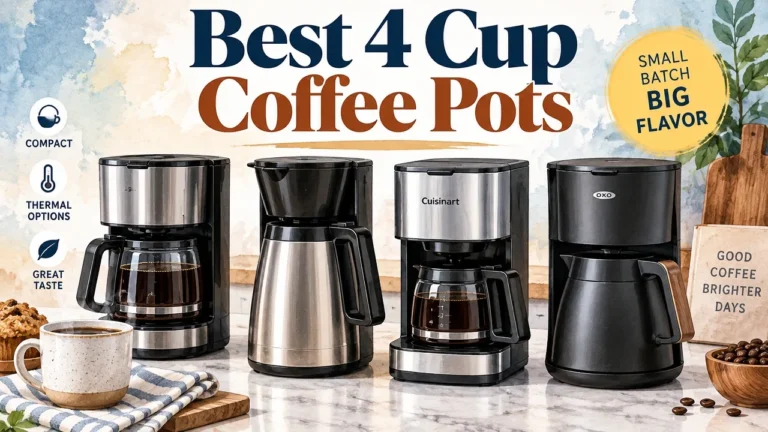

The best 4-cup coffee pots solve a problem most buyers don’t know they have: brewing a small batch correctly is harder than brewing a large one. The Bonavita 5-Cup One-Touch, the Zojirushi EC-DAC50 Zutto, and the Farberware FCP240 each attack that problem from a different angle – temperature, geometry, and heat retention – and only one of them is the right answer for your specific kitchen.
Understanding which one that is starts with a number nobody prints on the box: your “4-cup” pot makes 16 to 20 ounces of coffee, not 32. Once that lands, every other decision in this guide makes itself.
Key Takeaways on Best 4-Cup Coffee Pots
- A “4-cup” coffee maker yields 16–20 oz total – one large travel mug or two modest cups, not four kitchen mugs.
- Brewing a small batch in a 12-cup machine creates a shallow coffee bed that channels water unevenly, producing thin, under-extracted coffee regardless of machine quality.
- A warming plate scorches volatile aromatics within 15–20 minutes; a thermal carafe is the only way to preserve sweetness and acidity beyond that window.
- Pre-infusion and a wide showerhead are the two design features that most directly solve shallow-bed channeling in compact brewers.
- Reliability in compact brewers depends more on monthly citric-acid descaling than on any feature the machine ships with – narrow boiler tubing scales fast.
- The best machine is use-case conditional: heat retention, cabinet clearance, counter footprint, and morning labor tolerance each point to a different winner.
What “4 Cups” Really Means (and the 6 Tests Every Compact Brewer Must Pass)
The Capacity Math – and Why Small Batches Fight You
Before you spend a dollar, fix the number in your head. In coffee-maker standards, “1 cup” equals 4 to 5 fluid ounces (roughly 120–150 ml) – not the 8-oz measuring cup sitting in your drawer. A 4-cup pot therefore yields 16 to 20 oz total. In practical morning terms, a 4-cup capacity gives you one large travel mug or two modest mugs. It is not four mugs of coffee.
| “Cup” Label | Actual Yield (fl oz) | Real-World Equivalent |
|---|---|---|
| 4-cup pot | 16–20 oz | 1 large travel mug or 2 modest cups |
| 2-cup pot | 8–10 oz | 1 standard mug |
| 12-cup pot | 48–60 oz | 6–7 standard mugs |
That math matters because it exposes the most common small-batch mistake: brewing a 4-cup dose in a 12-cup machine. It isn’t the machine—it’s capacity mathematics. A full 12-cup basket is designed for a deep coffee bed. Pour the same grounds into that basket at 20 oz and you get a shallow bed, maybe an inch deep. Water finds the path of least resistance, punches straight through the weakest point, and exits the basket in seconds. Contact time collapses. The result is thin, pale, under-extracted coffee – not because you did something wrong, but because the bed was too shallow to slow the water down.
A peer-reviewed fluid dynamics study published in PLOS ONE modeled flow patterns through packed coffee beds and found that non-uniform extraction stems directly from inhomogeneous flow – dead zones, fine-particle agglomeration, and the preferential channels that form when bed geometry is compromised. The paper specifically identified extraction yields below 18% as under-extracted, and linked shallow or poorly distributed beds to exactly that outcome.
The temperature standard that governs this entire guide is the SCA window of 195°F–205°F, paired with a 1:15–1:17 coffee-to-water ratio. Those numbers come from commercial batch-brewing references, and nearly every compact-brewer review on the web applies them without asking whether a small machine can actually hold that temperature across a 16-to-20-oz cycle. This guide asks that question for each machine.
The other dispersion factor to check – and you can do it yourself for free – is the showerhead. Budget compact brewers often deliver a single narrow stream that drills one spot in a small bed, leaving dry pockets on either side. After your next brew, pull the spent grounds out of the basket and look at the surface. Dry patches mean uneven extraction. An even, saturated bed means the water hit everything.
“Best results in uniformity of extraction are obtained with coffee bed depths between 2.5 and 5.0 cm, but these dimensions are not a requirement for the certification.” – Specialty Coffee Association, SCA Certified Home Brewer Program Requirements
The SCA’s own language makes the point plainly: bed depth isn’t a certification requirement, but it is the variable that determines whether your 195°F water does any useful work once it lands.
Thermal Strategy, Descaling, and the Six Criteria This Guide Uses
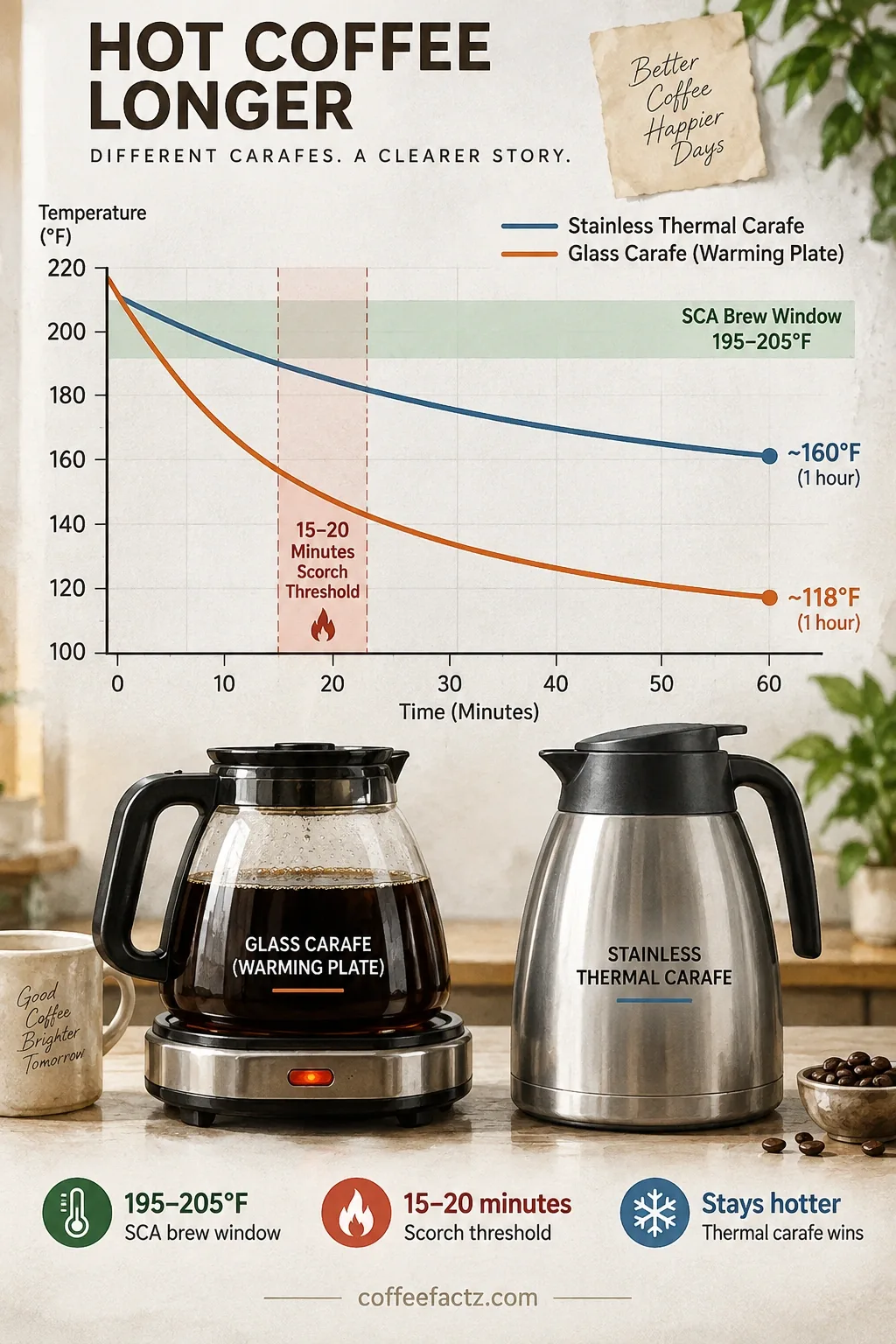
The second silent killer in small-batch brewing isn’t extraction – it’s what happens after the brew ends. A glass carafe on a warming plate begins scorching volatile aromatics within 15 to 20 minutes. The heat doesn’t keep coffee warm so much as it slowly cooks it, flattening sweetness and acidity into a flat, bitter baseline. The operational rule is simple: drink within 20 minutes of brew completion, or buy a machine with an insulated thermal carafe. There is no third option on a plate.
Here’s a visual breakdown of how thermal retention compares between glass carafes on warming plates and stainless steel insulated carafes:
Maintenance is the other longevity variable most buyers ignore until month four. Compact brewers have narrow boiler tubing that scales up with calcium deposits faster than full-size machines, simply because the surface-area-to-volume ratio is less forgiving. The monthly descaling protocol that works for normal tap water: dissolve food-grade citric acid per the package ratio into a full reservoir, run a complete brew cycle, then flush with two clean-water cycles. If you’re in a hard-water area, do this monthly. Normal water, every 60 to 90 days. Miss it consistently and the boiler restriction climbs until brew temperature drops – and you’ll blame the coffee.
The six criteria every machine in this guide is evaluated against:
- Brew-temperature accuracy – does it hold 195°F–205°F across a full small-batch cycle?
- Dispersion and bed saturation – showerhead width and water delivery pattern
- Carafe heat retention – thermal carafe vs. warming plate, and how long before flavor drift
- Footprint and lid-open clearance – measure the gap with the lid open, not closed
- Repairability and parts availability – simple mechanics and accessible components outlast software-heavy machines
- Filter type – permanent mesh vs. paper cone, and what each does to cup clarity
One practical note on clearance: several compact brewers need more vertical room than their closed height suggests, because the lid swings up or lifts off to accept water. Measure the gap between your counter and the cabinet above it with the lid in the open position before you order anything.
Elite Gourmet EHC4128: The Budget Compact Drip That Earns Its Counter Space
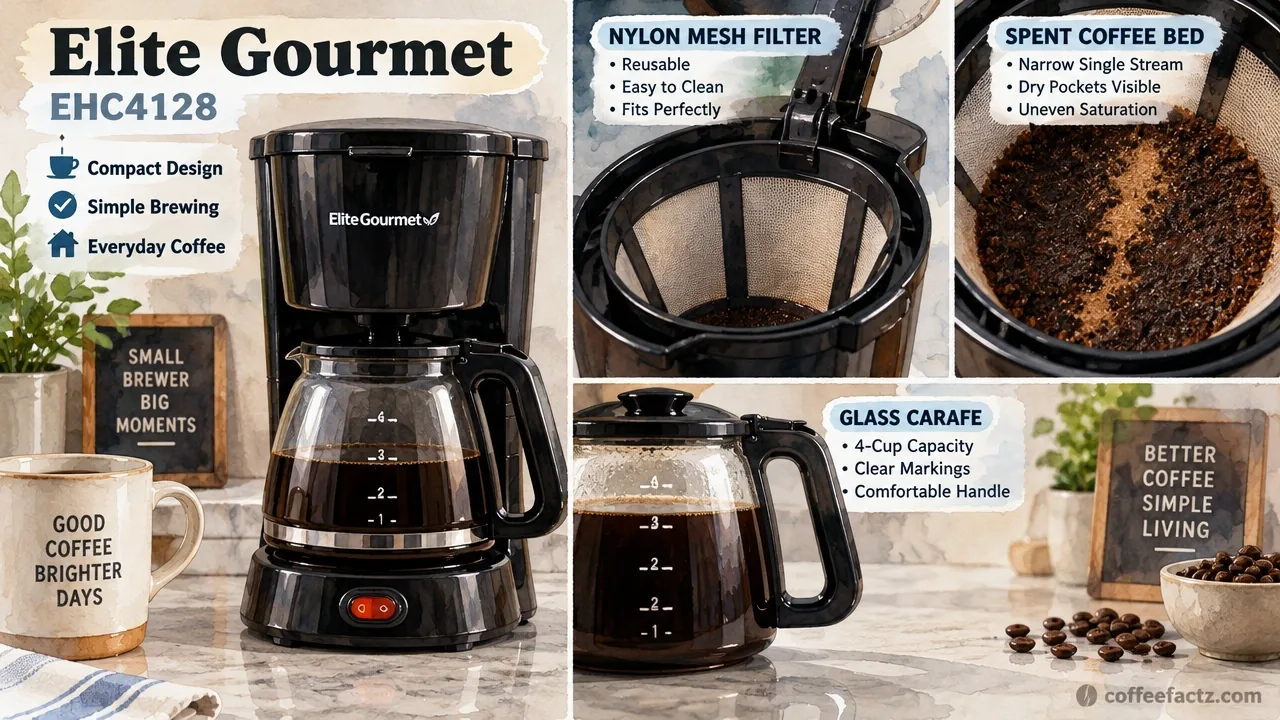
For “what’s the cheapest one that actually works?”, the Elite Gourmet EHC4128 is the honest budget compact drip brewer.” It’s an entry-level 4-cup drip brewer with a glass carafe, a warming plate, no programmable timer, and a footprint small enough to disappear into a dorm shelf or RV galley. No learning curve. No app. Plug it in, add coffee and water, press the button.
The Pause ‘n Serve mechanism deserves an honest explanation, because the name oversells it slightly. What it actually does is close a valve at the base of the filter basket when you pull the carafe out mid-brew, temporarily stopping the drip so you can pour a cup without flooding the basket. The practical pour window is short – lift the carafe, pour quickly, return it promptly. If the carafe stays out too long, the basket fills and overflows. Pause ‘n Serve is a convenience feature for an impatient moment, not a “walk away and come back” feature.
On filter choice: the included reusable nylon mesh filter eliminates the recurring cost of paper cones and lets coffee oils pass through, producing a fuller-bodied, slightly heavier cup. The trade-off is more sediment in the bottom of your mug and a slight tendency to go muddy if your grind is too fine – a coarser setting and a rinse after each use keeps it honest. Paper #2 cones give you a cleaner, brighter cup with no sediment, at roughly a few cents per brew. If you like a bold, rich cup, keep the mesh. If you want clarity and brightness, go paper.
The warming plate keeps coffee at a serviceable temperature for roughly 15 to 20 minutes before flavor drift becomes noticeable – exactly the scorch threshold established in the criteria section. After that, the aromatics that make a fresh cup interesting start cooking off. The honest habit this machine asks for: brew what you’ll drink now. It’s not a criticism; it’s just the physics of a glass carafe on a plate.
The one extraction caveat worth noting is the water delivery. I observed a fairly narrow single-stream pattern, which in a small coffee bed means the center gets saturated while the edges can stay relatively dry. Check your spent grounds after a brew. Dry patches at the perimeter are a signal to either adjust your grounds distribution before brewing or accept that a slightly coarser, even spread will help the water do its job more uniformly.
Affiliate Disclosure
This post contains affiliate links, meaning I may earn a commission if you make a purchase through these links, at no additional cost to you. As an Amazon Associate, I earn from qualifying purchases. I only recommend products I genuinely believe will add value.
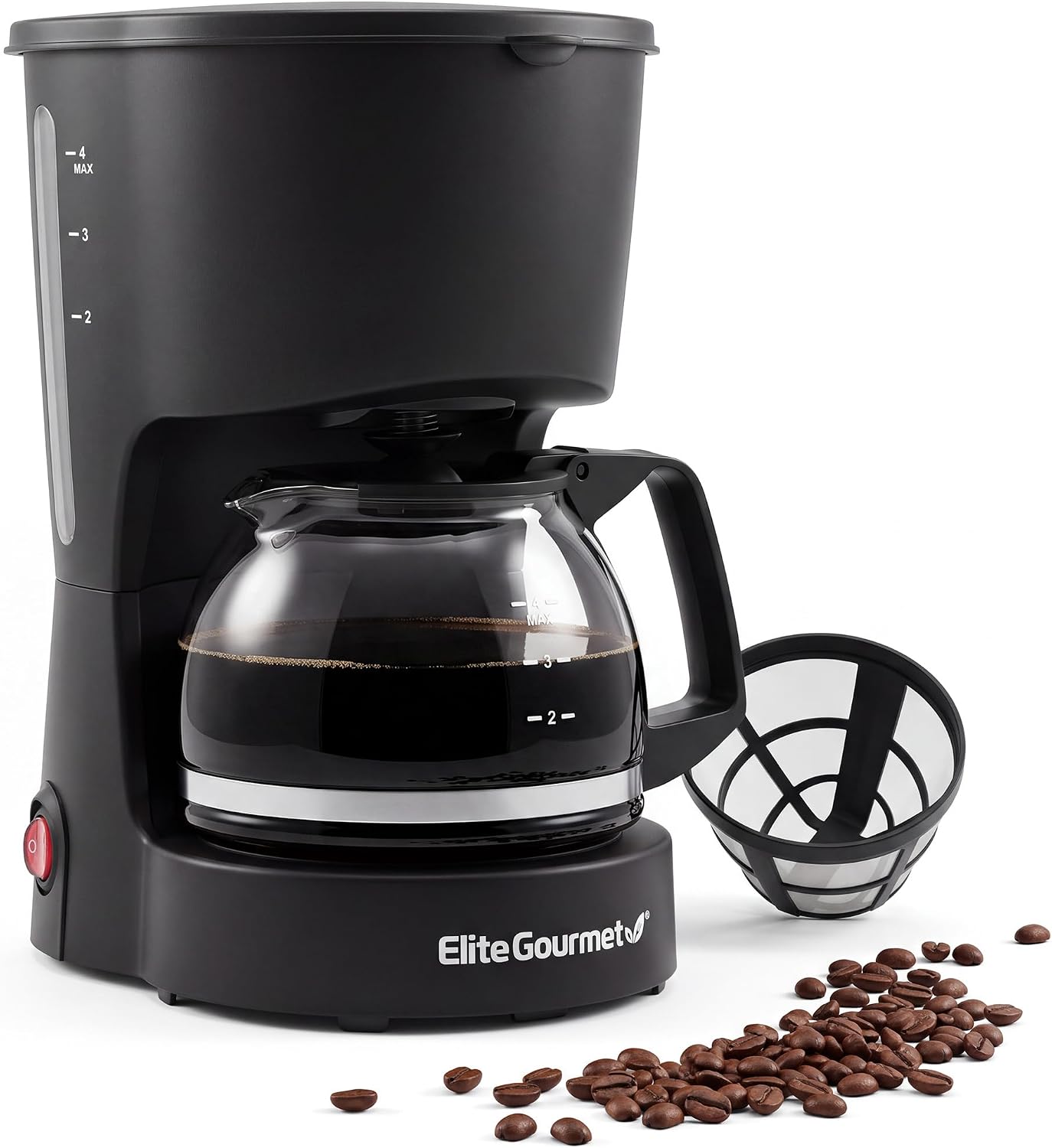
Elite Gourmet EHC4128 Automatic 4-Cup Drip Coffee Maker, Black
- SEMI-TRANSPARENT WATER RESERVOIR holds up to 4 cups of water capacity with a level indicator to always ensure …
- 4 CUP GLASS CARAFE for brewing the perfect quantity of hot fresh coffee for an individual or a small group of …
- PAUSE 'N SERVE allows a quick pour of fresh coffee in the middle of the brewing cycle if you're running low on…
- KEEP WARM FUNCTION automatically turns on when brewing to keep your coffee hot & fresh.
- RE-USABLE FILTER with removable filter basket is easy to clean and better for the environment by reducing the …
Who this is genuinely for: solo drinkers, dorm and RV residents, and small-kitchen owners who want low energy draw, zero complexity, and no learning curve. If your morning routine is “make coffee, drink coffee, leave,” this machine handles that without complaint.
Where it runs out of road: no temperature control, no timer, and a single-stream delivery that benefits from attentive grounds distribution. Readers who want coffee still hot an hour later should look at a thermal-carafe brewer. The overlooked workaround for those who want to keep this machine and solve the heat problem: brew into the EHC4128’s glass carafe, then transfer immediately into a separate 64-oz insulated carafe. It avoids plate scorching entirely, eliminates the glass-breakage risk, and costs less than upgrading to a thermal-carafe machine – but it does add one transfer step and depends on you being there within 30 minutes of brew completion. That’s a real cost, not a free fix.
Farberware FCP240: The Percolator That Pours Piping Hot, Old-School Coffee
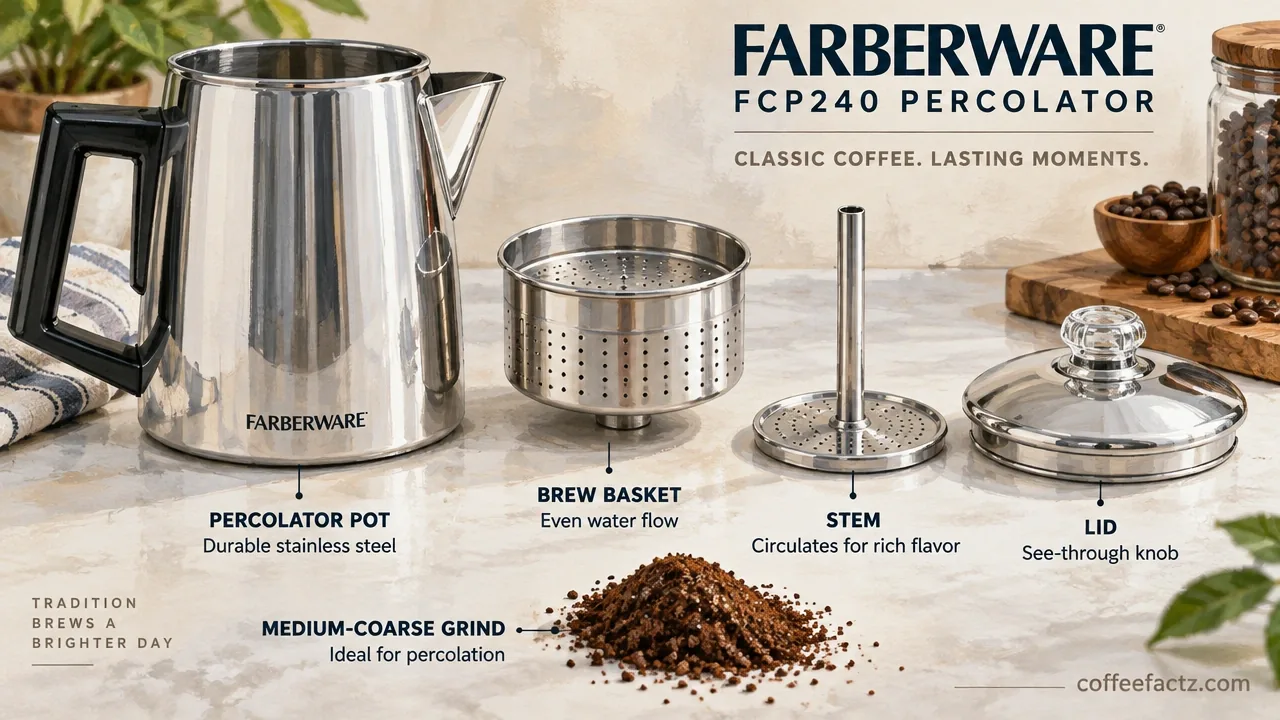
The Farberware FCP240 is a traditional electric percolator built from food-grade stainless steel – no glass carafe, no paper filter, no electronics beyond a heating element and a thermostat. It’s the simplest machine in this guide and also the most thermally aggressive.
The extraction mechanism works differently from drip brewing. Water heats in the base chamber, rises through a hollow stem under pressure, and sprays over the grounds in the basket repeatedly – cycling through at roughly one cup per minute. The result is a strong, robust, old-school cup that tastes nothing like a pour-over and isn’t trying to. If you’ve been microwaving yesterday’s coffee because your drip machine couldn’t keep up, this machine is the direct answer to that complaint. The stainless body holds heat far past what a glass carafe on a warming plate can manage, and there’s no plate to scorch the coffee in the first place – the body itself is the vessel.
The trade-offs are real and worth stating plainly. Percolation is not a precision process. You won’t be dialing in a specific extraction percentage or chasing SCA certification windows. If the coffee cycles too long past the brew completion – either because you forgot it or because you’re intentionally keeping it warm by leaving it on heat – the flavor turns harsher, with bitter edges that weren’t there in the first cup. The protocol that protects you: fill to the marked level, use a medium-coarse grind, let the cycle finish naturally, and serve promptly if flavor is your priority. If you just need it hot and strong, this machine will hold that longer than anything else in this lineup.
Cleanup is multi-piece: basket, stem, and lid all disassemble for washing. Nothing complicated, but it’s more components than a drip machine with a basket and a carafe. Worth knowing before you buy.

Farberware 4-Cup Stainless Steel Coffee Percolator, Automatic Keep Warm
- Too coarse a grind, too little coffee, or insufficiently tamping the grounds before brewing can all lead to in…
- It is important to note that the amount of espresso extracted will vary depending on the grind size and amount…
- Durable stainless steel construction and maintains consistent brew speed: 1-cup p/min
- Automatic keep warm mode. Volts -120V, 60Hz
- Cool-touch handle and lid knob with rolled edges for safe and easy handling
Who this serves best: cold-climate mornings, RV and tiny-home setups where heat and durability outrank extraction precision, and drinkers who grew up on percolator coffee and find pour-over-adjacent clarity too delicate for their taste. It also sidesteps an entire failure class that plagues combination machines – no bean reservoir means no water migrating into a grinder chamber, no clogging, no software to confuse the cleaning cycle. The FCP240 has no software. That’s not a limitation; it’s a design decision that ages well.
One honest positioning note: percolator coffee is a flavor choice, not a universal default. Recommend it for heat and robustness, not as the all-round winner. If your priority is a bright, nuanced cup at a precise temperature, this is not your machine.
Bialetti Moka Express 4-Cup: Stovetop Pressure Without Countertop Clutter
The Bialetti Moka Express 4-Cup takes a fundamentally different approach to the counter-space problem: it eliminates the counter footprint entirely. Water goes in the base chamber, ground coffee fills the funnel basket, heat from your stovetop drives steam pressure upward through the grounds, and an intense, rich, espresso-style concentrate collects in the top chamber. No electricity required. No counter real estate consumed.
Before you order one, decode the Moka cup geometry. A “4-cup” Moka describes four small espresso-style servings – roughly 1.5 to 2 oz each – not four 4-to-5 oz drip cups. The total yield is closer to 6 to 8 oz of concentrate. That’s a different beverage from a 20-oz drip batch, not a smaller version of it. It’s the right tool for one or two people who want an intense base for milk drinks, iced coffee, or small, strong cups – not a substitute for a mug of morning drip.
Technique is what separates a good Moka cup from a bitter one, and most guides skip the details. Use a medium-fine grind – finer than drip, coarser than espresso. Fill the basket level and never tamp it; packing the grounds restricts flow and produces over-extracted, acrid results. Preheat the water before assembling the pot to reduce the time the grounds spend under low heat before extraction begins. Then remove from the stovetop at the first gurgle – that sound signals the pressure has dropped and the remaining liquid in the chamber is mostly steam, not water. Let it go past that point and you’re scorching the last ounces of coffee directly on the metal.
Confirm stovetop compatibility before purchasing. The Moka Express works on gas and electric coil burners. Induction requires a dedicated induction-compatible model – the standard aluminum Moka Express will not work.
Cleanup is four components: base, gasket, filter plate, and top chamber. Rinse with warm water, no soap (it strips the seasoning that builds up over time), dry thoroughly, and reassemble. It takes maybe three minutes once you have the habit. The honest morning math, though, is: assemble, fill, heat, watch, remove, pour, disassemble, rinse, dry. That’s a ritual. Some people love it. Others find it too much before their first cup of coffee.

Bialetti Moka Express Export Espresso Maker, 4 Tassen,0.19 liters, Silver
- With Patented safety valve
- Suitable for all types of cookers (except induction)
- Material: aluminum
This video walks through the complete Moka technique, including the preheat step and the gurgle cue that most buyers miss:
Who this is for: studio apartments, tiny kitchens, stovetop-equipped RV and camp setups, and anyone who genuinely enjoys a hands-on morning routine. It’s the right machine for weekend brewers, space-constrained households, and ritual-friendly drinkers.
Who should skip it: if you leave for work nine minutes after waking up, route yourself back to the drip options. The Moka is a tool for people who have time to attend to it, not an automated drip replacement with a smaller footprint.
Zojirushi EC-DAC50 Zutto: Precision Compact Drip for Low Cabinets and Small Sinks
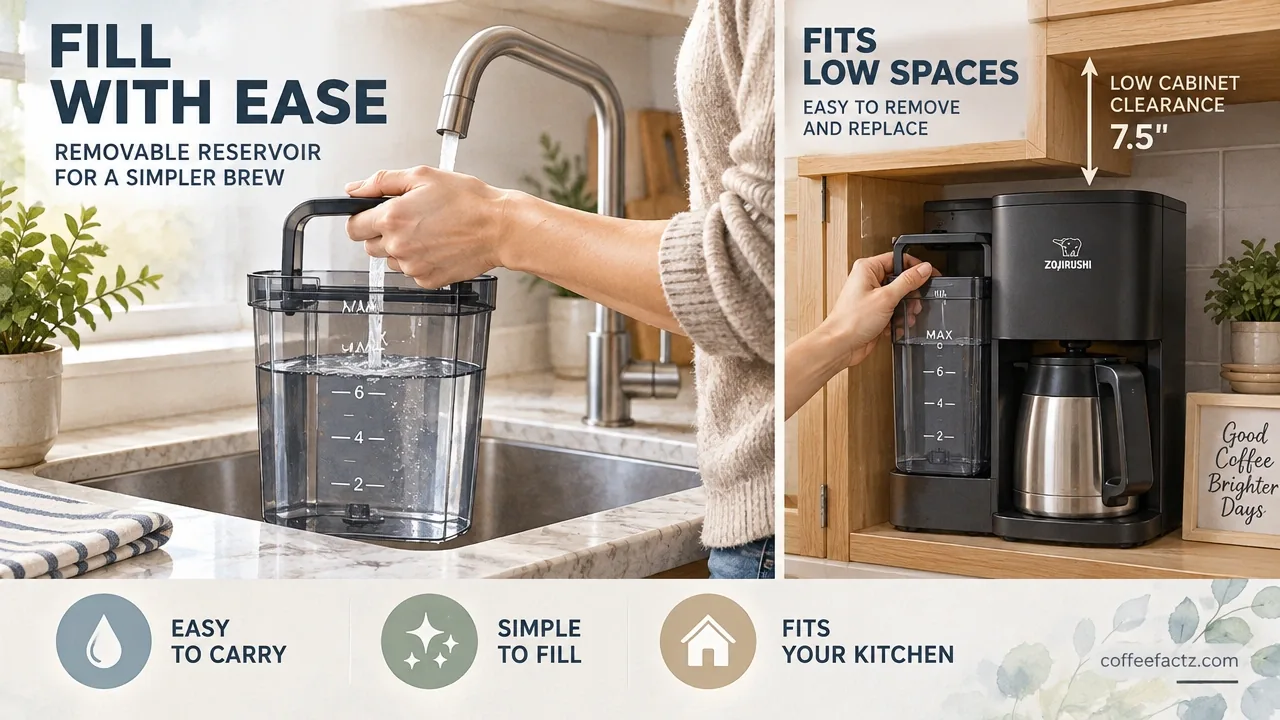
The Zojirushi EC-DAC50 Zutto solves two problems that most compact brewers pretend don’t exist: low overhead clearance and difficult sink access. Neither solution is cosmetic – both are functional design decisions that make a genuine difference in a small kitchen every single morning.
The removable water reservoir is the more immediately useful of the two. Instead of carrying a full kettle or awkwardly tipping a pitcher into a corner-mounted machine, you detach the reservoir, carry it to the sink, fill it, and snap it back in. If your kitchen sink is small, your counter is tight, or your brewer lives in a corner, this feature removes a daily frustration that you’d otherwise adapt around and quietly resent.
The cabinet clearance design is the subtler one. The Zutto houses its cone filter basket inside the carafe rather than in a swing-out door above the machine, which keeps the vertical profile low when you need to access the brewing chamber. Here’s the measurement that matters: don’t measure your cabinet gap with the machine’s lid closed. Measure it with the lid fully open, because that’s the position the machine needs to be in every time you brew. The practical minimum headroom to check for is roughly 2 to 3 inches above the machine’s closed height – the exact figure varies by installation, so measure your specific gap before ordering.
The charcoal water filter inside the reservoir is a maintenance item, not a permanent fixture. The manufacturer publishes a service-life recommendation, but that number assumes average water conditions. If your tap water is hard or heavily chlorinated, you’ll notice flavor changes before the recommended interval – trust your palate over the calendar, and cross-reference with your local water hardness report if you want a more precise schedule.
Brew performance is clean and even. The cone filter basket geometry distributes water more consistently than a flat-bottomed basket at small volumes, and the cup clarity reflects that. The one handling note: because the filter basket lives inside the carafe, you’re managing a slightly more careful pour – the basket is seated inside the vessel you’re pouring from. It’s not difficult, just different from a standard drip machine, and worth a couple of practice pours before you commit to pouring over a white shirt.
On the programmable timer: owner reports on reference-class compact brewers – including machines that complete a full brew cycle in about five minutes – consistently describe the timer as the feature they use least. A machine that’s done before you’ve finished your shower doesn’t need a 24-hour scheduling window. If you’re determined to have a timer, a smart plug can add that function to any brewer – but run any coffee maker unattended at your own risk, and treat that workaround as a caution rather than a recommendation. The better investment, on a machine like the Zutto, is the removable reservoir and the clearance design – the two features you’ll use every day, not once a week.

Zojirushi EC-DAC50SZ ZUTTO Coffee Maker 5 Cups, Silver, PFAS-free
- Convenient 5-cup size with removable water tanks makes filling easy and is fully washable.
- Automatic keep warm.
- Compct Design, ideal for small spaces.
- Free of PFAS (including PTFE and PFOA) and BPA-Free on all areas that come into contact with food or beverages…
- Coffee scoop included, Automatic keep warm
Who this is for: small-kitchen owners with low overhead cabinets, RV and dorm residents who fill from a compact sink, and anyone whose current brewer requires a pitcher-pour acrobatics routine every morning.
Bonavita 5-Cup One-Touch: The Golden-Cup Small-Batch Standard
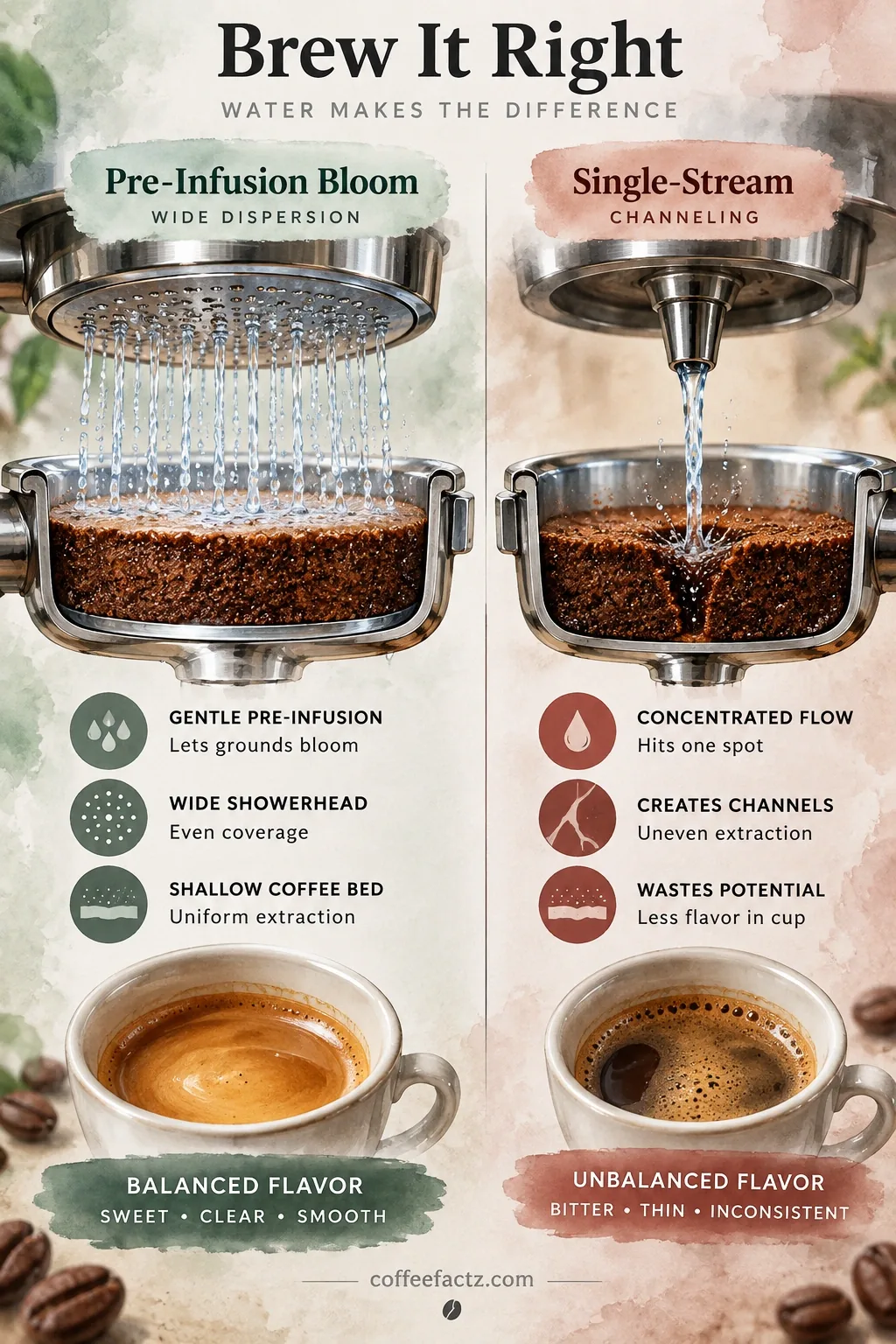
The Bonavita 5-Cup One-Touch is where the extraction physics from the criteria section get answered directly. Pre-infusion, a wide showerhead, and a stainless steel thermal carafe – those three design choices address, in order, the CO₂ problem, the channeling problem, and the scorch problem that the other machines in this guide manage with varying success.
Pre-infusion matters specifically at small volumes. When hot water first contacts fresh ground coffee, the grounds release CO₂ in a bloom that, if not managed, creates a gas barrier between the water and the coffee. In a shallow bed, that barrier is proportionally more disruptive – the water has less depth to work through and finds channels more readily. The Bonavita’s pre-infusion cycle delivers a short pre-wet that lets the bed bloom and off-gas before the main pour begins. The water that follows penetrates an already-opened bed rather than forcing its way through CO₂ resistance, which means more even contact across the full volume of grounds.
The wide showerhead handles the spatial version of the same problem. A narrow single stream saturates the center of a small coffee bed and leaves the perimeter dry. A wide showerhead spreads water across the full diameter of the basket so every gram of coffee sees water. Check the spent grounds after your first brew: an evenly dark, uniformly wet bed is the confirmation you want.
The thermal carafe eliminates plate scorching entirely. No warming plate means no aromatic loss after the 15-to-20-minute threshold. The carafe does start losing heat immediately after brewing – that’s physics, not a flaw – so rinse it with hot water before brewing to pre-warm the walls and buy yourself more time before the temperature drops noticeably.
On SCA certification and temperature accuracy: the Bonavita brand holds SCA credentials, but those certifications are awarded per model, not per brand. The 5-cup One-Touch should be verified against the spec sheet for that specific model before you assume it carries the same certification as the brand’s larger machines. Confirm the brew temperature claim on the 5-cup spec sheet directly. The 195°F–205°F window is what you’re looking for.
Reliability reports on this machine are genuinely split, and presenting them as split is the honest thing to do. Some long-term owners report close to a decade of daily use without issue. Others report being on their third unit inside five years. That spread is wide enough that placing the Bonavita in a “buy it for life” tier would be misleading. The practical advice: buy it for flavor and temperature performance, register the warranty immediately, keep the receipt, and treat the monthly citric-acid descaling protocol from the criteria section as mandatory rather than optional. Narrow boiler tubing and hard water are a slow-motion reliability problem that descaling directly addresses – more so than any feature the machine ships with.

Bonavita 5 Cup Drip Coffee Maker Machine, One-Touch Pour Over, Auto Pause Brewing with Stainless Steel Double Wall Thermal Carafe, SCA Certified, Dishwasher Safe, BV1500TS
- 5 CUPS IN 5 MINS: Brew a full 5-cup carafe in just 5 minutes with one touch. The 1100-watt heater ensures an o…
- ONE-TOUCH FAST BREW: Start your day effortlessly with a single press, enjoying professional and fresh coffee f…
- EVEN EXTRACTION FOR FULL FLAVOR: The specially designed showerhead ensures even saturation of coffee grounds, …
- BLOOM FOR RICHER TASTE:The optional pre-infusion mode gently pre-wets coffee grounds before brewing, resulting…
- DISHWASHER-SAFE & BPA-FREE: The carafe lid, filter basket, and showerhead are dishwasher-safe and BPA-free. Th…
Who this is for: small-batch coffee enthusiasts and two-person households who want drip-batch convenience with pour-over-adjacent clarity, and who have noticed – or will notice – the difference a scorched plate makes to the last half of a carafe.
The Verdict: Which 4-Cup Coffee Pot Should You Buy?
Let’s close the loop on the four questions buyers actually search for.
Which drip maker brews 4 cups? The Elite Gourmet EHC4128 and the Zojirushi EC-DAC50 Zutto are both compact drip brewers designed around the 16-to-20-oz batch. The Bonavita is technically rated at 5 cups, but its small-batch engineering makes it the right choice for the same audience.
Which brand is “best”? There is no single best – the answer is use-case conditional, and any guide that names one brand as universally superior is selling you a shortcut. The right machine depends on your cabinet height, your sink, your tolerance for morning labor, and whether you care more about heat, clarity, or convenience.
Which keeps coffee hot the longest? Thermal-carafe units and the percolator. Never a glass carafe on a warming plate past the 20-minute mark.
Here’s the one-line decision rule per persona:
- Absolute-lowest-cost solo drinker, dorm or RV user: Elite Gourmet EHC4128 – pair it with an external insulated carafe if you won’t drink it immediately.
- Cold mornings, old-school robust flavor, no-fuss heat retention: Farberware FCP240 percolator – the most thermally capable machine in this lineup.
- Zero counter space, stovetop available, hands-on morning routine: Bialetti Moka Express 4-Cup – concentrate for one or two, not a drip substitute.
- Low overhead cabinets and a tiny sink: Zojirushi EC-DAC50 Zutto – the removable reservoir and clearance design solve the daily friction other machines ignore.
- Best-tasting small batch at temperature: Bonavita 5-Cup One-Touch – pre-infusion, wide showerhead, thermal carafe; buy it for flavor, register the warranty, descale monthly.
The cross-machine truth this entire guide has been building toward: at 16 to 20 oz, extraction evenness and heat retention decide the cup quality, not price or feature count. A $40 machine with a thermal carafe will out-drink a $90 machine with a warming plate, every time, after the 20-minute mark.
Three things not to buy: any compact brewer whose only sizing information is the “4-cup” label on the box; any glass-carafe unit you plan to leave on a plate for an hour; and any combination machine with a built-in bean reservoir or grinder you’ll rarely clean – water migration into the bean chamber is a clogging failure class that simple, single-purpose machines sidestep entirely.
Whatever machine you choose, the maintenance non-negotiable is the same: monthly food-grade citric-acid descaling, plus filtered water. Narrow compact boiler tubing is the number one longevity killer in small brewers, and no feature on the box protects against calcium buildup the way a consistent cleaning routine does.
One final correction to carry out of this guide: your 4-cup pot makes one large travel mug or two modest cups. If you need more than that, buy a bigger pot. Brewing a shallow batch in a large machine to squeeze out more volume is the one move that costs you on every dimension – extraction, temperature, and flavor – simultaneously.
Frequently Asked Questions About Best 4-Cup Coffee Pots
Why does my 4-cup coffee maker produce weak coffee even with a full scoop?
The most likely cause is channeling – water finding a fast path through a shallow coffee bed rather than saturating it evenly. Try a slightly coarser grind, distribute the grounds level across the basket, and inspect the spent bed for dry patches after brewing.
Can I use a 4-cup coffee maker to brew just one or two cups?
Yes, but scale the coffee dose proportionally to the water – maintain a 1:15 to 1:17 coffee-to-water ratio regardless of batch size. Brewing two cups of water through a full 4-cup dose of grounds will over-extract and taste bitter.
How often should I descale a compact 4-cup coffee maker?
Every 60 to 90 days with normal tap water, and monthly if you’re in a hard-water area. Use food-grade citric acid dissolved per package instructions, run a full brew cycle, then flush with two clean-water cycles.
Is a reusable mesh filter as good as a paper cone filter?
Neither is objectively better – they produce different cups. Mesh lets coffee oils through for a fuller, heavier body but adds sediment. Paper traps oils for a cleaner, brighter cup at a small recurring cost. Choose based on how you like your coffee to taste.
Does the Bialetti Moka Express work on induction cooktops?
The standard aluminum Moka Express does not work on induction. Bialetti makes a dedicated induction-compatible version – confirm the model designation before purchasing if you have an induction range.
What’s the real benefit of a removable water reservoir?
It lets you carry the reservoir to the sink for filling rather than pouring water into a corner-mounted machine with a pitcher. For small sinks, tight counters, or brewers tucked under low cabinets, it removes a daily friction point that sounds minor until you’re doing it every morning.
If the Bonavita has SCA-linked credentials, why isn’t it automatically the best pick?
SCA certifications are awarded per model, not per brand. The 5-cup One-Touch should be verified on its own spec sheet. Beyond that, reliability reports are genuinely split – some owners report years of trouble-free use, others report multiple replacements. It’s the flavor-and-temperature winner in this lineup, not the longevity winner.
Is a programmable timer worth paying extra for on a compact brewer?
Probably not. A full compact brew cycle takes roughly five minutes, so the scheduling window solves a problem that barely exists. If you want timed brewing, a smart plug can add that function to any machine – but never run a coffee maker unattended without understanding the electrical and fire risk involved.
References
- Analysing extraction uniformity from porous coffee beds using mathematical modelling and computational fluid dynamics approaches | journals.plos.org