
Listen, I need to be straight with you right off the bat: the small espresso machine market is engineered compromise dressed up as convenience. You’re chasing counter space, but what you’re actually buying is a specific set of trade-offs—maybe it’s inconsistent temperature, maybe it’s a machine that’ll quit on you in 18 months, or maybe it’s cleanup that turns into a daily chore. My job here is to show you exactly where the engineering budget got slashed so you’re not hemorrhaging cash or patience half a year down the road.
Where Speed Promises Break Thermodynamic Reality
The industry sells you on speed because it photographs well and sounds impressive in bullet points. But here’s what those sub-minute heat-up times actually mean for your coffee.
Speed fundamentally conflicts with thermal stability. According to multiple sources tracking real-world performance on platforms like Reddit and enthusiast forums, the machines boasting the fastest heat-up times consistently struggle on the second and third shots. They’re stripping away thermal mass—the heavy metal that holds steady heat—to hit that sexy startup number. Technical teardowns from open-source espresso engineering projects confirm this trade-off, revealing that machines lacking sufficient mass suffer from severe temperature drift where the water peaks lower than required and fluctuates wildly during the actual extraction.
You get readiness on shot one, then watch the temperature drift on subsequent pulls, turning light roasts sour no matter what you paid for the machine. In fact, research into machine design shows that without running several manual “warming cycles” to force heat into the internals, these fast-start systems simply cannot maintain the thermal accuracy necessary to prevent poor-tasting, under-extracted coffee.
And here’s the part nobody mentions in those glossy reviews written after a week of testing: the grinder dictates your outcome more than the machine does. You can drop $500 on a gorgeous compact unit, but if you’re feeding it grounds from a $40 blade grinder, you’re basically running a toy system. The real entry cost is typically a $400 machine plus a $300 grinder, but the marketing materials conveniently skip that math.
The other issue? Longevity hides behind complexity. Most reviews hit publish after 30 days of testing. They don’t show you the proprietary plastic component that cracks in year two, or the error code that forces you into a specialized repair network. If your machine doesn’t have a 3-way solenoid valve – a little pressure-release gate – you’re manually mopping up coffee residue after every single shot. That’s not automation, that’s hidden labor.
Understanding Pressure Numbers
You see “20-bar pump” stamped all over budget machines, and it sounds impressive. Let me translate: 9 bar is the scientifically validated optimal pressure for extracting espresso flavor compounds. When a machine like the Casabrews brags about 20 bars according to their official specs, what you’re looking at is basically a sports car advertised to hit 200 MPH with no steering system. It’s a box number that doesn’t improve your coffee. If the machine can’t regulate down to a stable 9 bars—and most budget units can’t – that extra pressure is just marketing noise.
Matching Your Tolerance for Friction
Before we dig into specific models, you need to know what kind of hassle you’re willing to accept. Based on aggregated feedback from community forums and long-term user reports, I’ve sorted these into clear lanes.
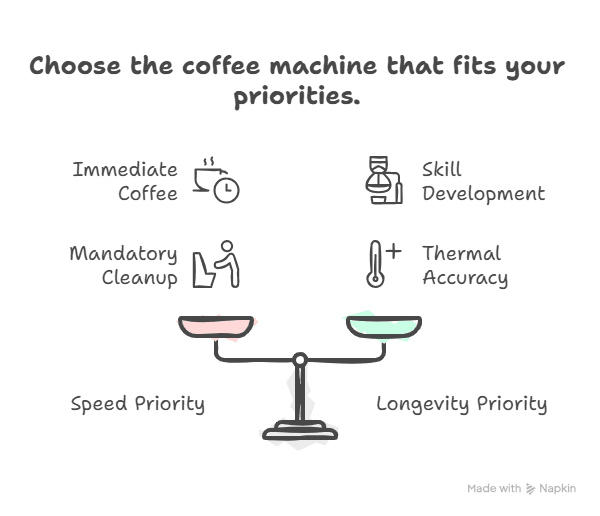
The Speed Priority: You need coffee immediately and value automated milk texturing above everything else. You’re accepting inconsistent shot temperature and mandatory cleanup rituals in exchange for rapid heat-up and one-button foam.
The Budget Priority: You want the highest taste-to-dollar ratio possible. You’re willing to risk premature failure or clogging issues because you’re saving serious cash upfront.
The Longevity Priority: You’re prioritizing thermal accuracy, build quality that lasts a decade, and the development of real skill. You’re accepting high initial time investment—pre-heating routines, manual temperature management—in exchange for machines that outlast your car.
The Speed-First Machines (And What They Cost You)
These units win your morning, but they fundamentally compromise the physics of good espresso.
The Breville Bambino Plus – Fast but Messy
Affiliate Disclosure
This post contains affiliate links, meaning I may earn a commission if you make a purchase through these links, at no additional cost to you. As an Amazon Associate, I earn from qualifying purchases. I only recommend products I genuinely believe will add value.

Breville Bambino Plus Espresso Machine BES500BSS, Brushed Stainless Steel
- The Breville Bambino Plus delivers third wave specialty coffee at home using the 4 keys formula and is part of…
- DOSE CONTROL GRINDING: Achieve a consistent and balanced espresso using the right amount of ground coffee; The…
- OPTIMAL WATER PRESSURE: Low pressure pre-infusion gradually increases pressure at the start and helps ensure a…
- Receive 2 free bags of specialty coffee when you purchase and register any Breville coffee machine; T and Cs a…
- FASTER HEAT UP TIME: Innovative ThermoJet heating system achieves the optimum extraction temperature in 3 seco…
This machine’s entire value proposition is getting you out the door faster than anything else at this price point.
It runs on 1560 watts according to Breville’s technical documentation—extremely high for its size, all feeding the rapid-fire ThermoJet heating element. The company advertises a 3-second heat-up, which is legitimately impressive. But here’s the engineering cost: there’s no heavy boiler. The ThermoJet system heats water on-demand through a coil, which means it reaches operating temperature instantly but can’t maintain stability under sustained use. Multiple users on Reddit report that light roasts come out flat or sour because the temperature drops between shots.
The automatic steam wand is genuinely convenient—it reads milk temperature and shuts off automatically. But that same community feedback reveals you’ll often need to manually override the cycle to prevent overshoot, which adds manual labor back into the supposedly hands-free process.
Here’s the real kicker: it doesn’t have a 3-way solenoid valve. That little component’s only job is to vent residual pressure immediately after your shot finishes, leaving you with a neat, dry coffee puck. Without it, you get a slow, messy drip every single time you remove the portafilter. You’re wiping down coffee sludge rings after every morning pull. That’s not a minor inconvenience—it’s a daily tax on your time that wears you down.
The bottom line: Go for this if you’re pulling only dark roasts and your morning schedule absolutely cannot absorb a 10-minute pre-heat. Skip it if the thought of mopping up wet coffee grounds every single day makes you twitch.
The Breville Barista Express Impress – Integrated Complexity

Breville Barista Express Impress Espresso Machine BES876BSS, Brushed Stainless Steel
- The Barista Express Impress espresso machine delivers third wave specialty coffee at home, featuring the Impre…
- INTELLIGENT DOSING: The smart dosing system automatically calculates and adjusts the level of fresh coffee for…
- PRECISION MEASURMENT: This smart system auto corrects the next dose, taking the guesswork out of manual espres…
- Receive 2 free bags of specialty coffee when you purchase and register any Breville coffee machine; T and Cs a…
- ASSISTED TAMPING: Replicating the action of a professional barista, assisted tamping features 7 degree 'barist…
This is Breville’s attempt at a do-everything compact unit—combining machine, grinder, and assisted tamping in one footprint.
It pulls between 1750 and 1850 watts according to official specs, with most of that power feeding both the Thermocoil heating system and the integrated conical burr grinder. The company includes what they call “Intelligent Dosing,” which auto-adjusts your coffee dose based on previous shots. You’re handing control to an algorithm in exchange for reduced waste and simpler operation.
The Impress Puck System delivers 22 pounds of assisted tamping pressure, automating the hardest manual step in espresso prep. It works, but it locks you entirely into Breville’s ecosystem. The portafilter is 54mm – a proprietary size that prevents easy access to the standard 58mm aftermarket baskets and precision tools that serious users eventually migrate toward.
Here’s what Breville doesn’t advertise: that integrated grinder will always lag behind a dedicated external unit in terms of grind uniformity and adjustment range. Enthusiasts consistently point out that bundling these components means you can’t upgrade the weakest link without replacing the entire system. You’re paying for integration, not ultimate performance.
The bottom line: This makes sense if you need a unified, space-saving footprint and you prioritize convenience over the ability to swap components later. It’s a bad fit if you know you’ll want to upgrade the grinder in a year, because you can’t.
The Budget Wildcards (High Risk, High Reward)
These machines prove you don’t need a legacy brand name to pull decent shots, but you’re betting on unproven longevity.
The Casabrews 3700 Essential – Cheap Microfoam Success

CASABREWS 3700 Essential Espresso Machine 20 Bar, Stainless Steel Cappuccino & Latte Machine with Steam Frother for Home, 43.9oz Water Tank, Coffee Gift for Women & Men, Silver
- Make Your Favorite Espresso Coffee At Home: The CASABREWS coffee machine with milk frother allows you to prepa…
- Professional 20-Bar Pressure System: A semi-Automatic 2-in-1 Espresso Maker with a 20 bar professional pump an…
- Milk Frothing System: Our espresso machine with milk frother has a powerful steam wand that creates a creamy a…
- Compact, Stylish & Practical: The compact design makes this espresso coffee machine suitable for a kitchen of …
- Using Tips: Please remove the rubber plug at the bottom of the water tank and make “First use cycle” for this …
This one earns attention because taste tests show it punches way above its price class on basic extraction quality.
It runs on 1350 watts according to the manufacturer’s specs – efficiently powered but lower capacity, meaning it’s less capable of handling back-to-back shots without thermal fatigue. The company advertises a 20-bar Italian pump, which we’ve already established is inflated marketing. What matters is whether it regulates down to 9 bars consistently, and under sustained use, budget pumps typically struggle to hold that precision.
The surprise here is the inclusion of PID temperature control at this price point. That’s a legitimate win—it gives you digital precision over brewing temperature, which is normally reserved for much pricier machines. But that digital control board is sitting inside a housing made with budget wiring and plastic internal pathways. The portafilter is 51mm die-cast aluminum, which loses heat significantly faster than stainless steel, meaning your shot temperature drifts more quickly between the basket and the cup.
CNN Underscored confirmed it produces surprisingly good microfoam for the price, which contradicts typical budget-tier expectations. But here’s the friction: community reports flag clogging issues after several months of regular use, suggesting the internal materials aren’t built to handle long-term thermal and pressure stress.
The bottom line: This works if you’re comfortable treating it as a $150 experimental tool that might last a year and delivers unexpectedly solid results during that window. It’s a bad call if you need a machine that can handle heavy weekly use without sudden maintenance crises.
The Casabrews CM 5418 – Ultra-Slim Gamble

CASABREWS CM5418 Espresso Machine 20 Bar, Compact Espresso Maker with Steam Milk Frother, Stainless Steel Coffee Machine with 34oz Removable Water Tank for Cappuccino, Gift for Women or Men, Silver
- Make Your Favorite Espresso Coffee At Home: The CASABREWS coffee machine with milk frother allows you to prepa…
- Professional 20 Bar Pressure System: Semi-Automatic 2-in-1 Espresso Maker, with 20 bar professional Italian pu…
- Milk Frothing System: Our espresso machine with milk frother has a powerful steam wand, so you can texture cre…
- Compact, Stylish & Practical: The beautiful and compact design makes this small espresso machine suitable for …
- Useful Tips: Please kindly note that do not brew coffee immediately after frothing milk. The machine must cool…
This model appears specifically engineered to undercut established budget players by maximizing slimness and adding a pressure gauge.
The footprint is remarkable—roughly 5.5 inches wide according to official measurements, addressing the counter space problem better than almost any competitor. The inclusion of an integrated pressure gauge is genuinely useful, letting you see whether that oversized 20-bar pump is actually regulating correctly during extraction.
It includes PID temperature control, which again elevates performance potential. But the materials surrounding that digital system remain questionable based on typical budget manufacturing patterns. The water reservoir holds only 34 fluid ounces—about 1 liter—meaning you’re refilling constantly if you pull more than two milk drinks in a session.
Independent taste tests from sources like Coffeeness show this outperforming direct peers, which contradicts the industry’s general dismissal of low-cost OEM units. The problem is you’re essentially funding research and development by purchasing the machine—the service infrastructure simply doesn’t exist yet.
The bottom line: Choose this if absolute smallest footprint is your primary requirement and you’re willing to risk the entire unit to get better taste than a Mr. Coffee. Avoid it if you need a machine backed by even basic warranty fulfillment beyond 30 days.
The Mr. Coffee Compact – The Statistical Anomaly

Mr. Coffee Compact Espresso Maker, Espresso Machine With Steam Wand, 15-Bar Pump Automatic Espresso Machine
- Great Espresso, Made Simple: Skip the coffee-shop line and brew your go-to espresso drinks at home.
- Intuitive Control Panel: Take the guesswork out of espresso-making with controls made for convenient brewing a…
- Modern, Space-Saving Design: Fits seamlessly on countertops, with stainless steel accents that elevate any kit…
- Froth Like a Pro: Powerful steam wand creates frothy milk for delicious cappuccinos, lattes, and more.
- 15-Bar Pump: The 15-bar pump generates the essential 9 bars of pressure needed to extract a proper shot of esp…
This machine is the data outlier that proves minimalism sometimes wins.
It weighs roughly 9.8 pounds according to official specs, with metal accent points but largely plastic construction. It feels cheap in your hands—there’s no getting around that. But here’s what’s interesting: Consumer Reports lab testing scored this at 85 out of 100 for taste quality, the highest in the entire budget category they evaluated.
The portafilter uses a 51mm pressurized filter basket, which requires pre-ground or coarsely ground coffee. Pressurized baskets forgive massive dosing and grind errors by forcing water through at higher pressure, which limits your performance ceiling but makes the machine nearly foolproof for beginners. The controls are dead simple-push once for a single shot, twice for a double. Zero customization, zero complexity.
The steam wand is a Panarello-style attachment, which means it injects air mechanically to create voluminous foam. It will not create the dense microfoam needed for latte art, but it will texture milk quickly for basic cappuccinos.
The reason this scored so well in controlled testing is likely its simplicity—fewer components means fewer points of failure and less thermal interference. It successfully executed the core extraction task without feature bloat sabotaging the result.
The bottom line: Buy this if you want the statistically best-tasting result in the budget tier and don’t care that it feels like a toy. Skip it if you need stainless steel contact points or want to use non-pressurized baskets for skill development.
The Commitment Machines (Time Now, Quality Forever)
These are for people who understand that real quality demands patience upfront.
Understanding Temperature Surfing
Temperature surfing is the manual skill required on machines without digital PID control. You’re listening to the heating element cycle—it clicks on after pulling a shot, then clicks off when it hits target temperature. You’re timing your next shot to land in the thermal sweet spot, usually between 195°F and 203°F, by essentially surfing the boiler’s natural temperature swing. It’s a learned skill that PID control automates, but mastering it gives you intimate knowledge of your machine’s behavior.
The Lelit Victoria/Kate – Modern Stability
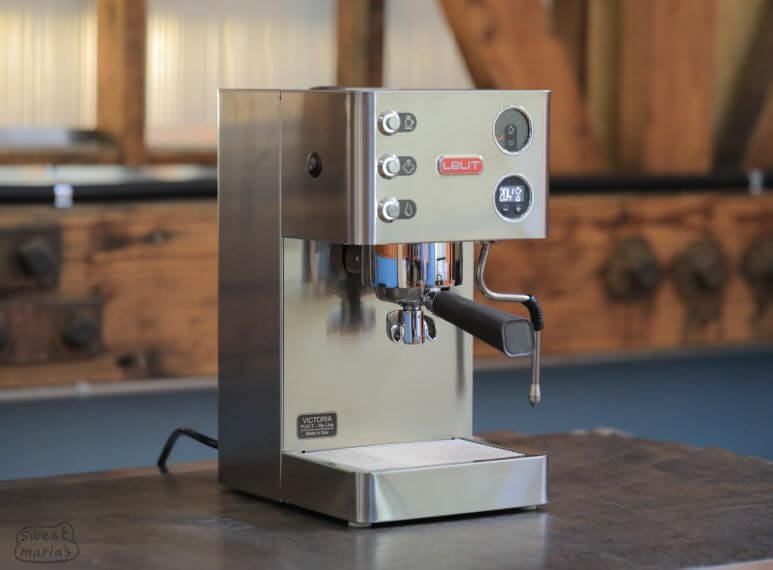
Lelit bridges the gap between enthusiast hardware and modern digital convenience.
The core component is a 300ml brass boiler, significantly larger and more thermally stable than the aluminum Thermocoils used in the Bambino. Brass holds heat far better than aluminum, leading to dramatically improved shot-to-shot consistency. The group head is Lelit’s commercial 58mm standard, ensuring compatibility with high-quality aftermarket baskets and tools.
It includes a 3-way solenoid valve according to manufacturer specs, which guarantees clean, dry pucks and eliminates the post-shot mess plaguing the Bambino. The Lelit Control Center provides an OLED display with digital control over pre-infusion timing and temperature-essentially modern PID functionality with additional programmability.
The trade-off is heat-up time. That thick brass boiler takes roughly 8 to 10 minutes to fully saturate based on community consensus, requiring significantly more patience than the 3-second Bambino.
The Kate variant adds an integrated grinder, which costs you money if you already own a better standalone unit. You’re also paying for the LCC interface complexity, which adds learning curve if all you want is simple operation.
The bottom line: This makes sense if you value repeatable thermal stability across different roast levels and you’re willing to wait for proper heat-up. It’s overkill if you need that first shot ready before your toast pops.
The Rancilio Silvia / Gaggia Classic Pro – Built Like Tanks
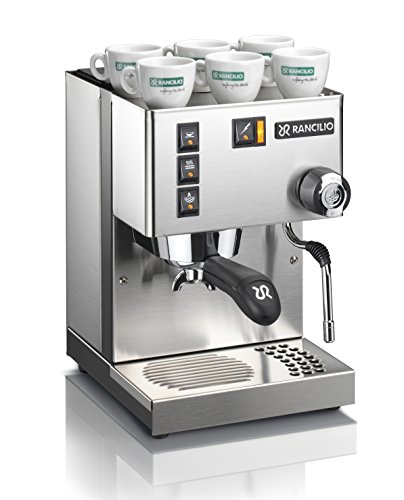
Rancilio Silvia Espresso Machinet,0.3 liters, with Iron Frame and Stainless Steel Side Panels, 11.4 by 13.4-Inch
- Ergonomic porta filter handle same as the proven design of Rancilio commercial machines
- Commercial grade group head for superb heat stability and extraction quality
- Articulating steam wand offers complete range of motion and professional steaming knob precisely controls stea…
- Classic linear design fits most decors
- Optional pod and capsule adaptor kit available
These are the legendary workhorses, engineered before planned obsolescence became standard practice.
The Silvia uses a 300ml insulated brass boiler; the Gaggia uses a 100ml brass boiler according to their respective technical documentation. Both guarantee serious thermal mass, though the Gaggia’s smaller size means it requires more active temperature surfing to maintain extraction stability. Both use standard 58mm commercial-grade portafilters, ensuring access to high-quality upgrade baskets from manufacturers like IMS and VST.
Neither includes PID control from the factory0they use industrial rocker switches. This means you must manually manage temperature through surfing techniques to stabilize extraction. Both include 3-way solenoid valves, guaranteeing clean operation and eliminating the drip mess.
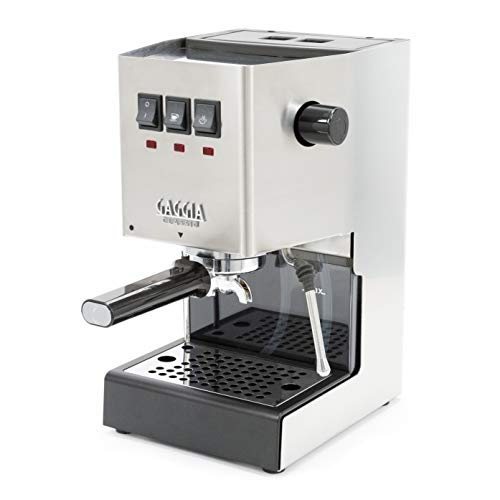
Gaggia RI9380/46 E24 Espresso Machine, Brushed Stainless Steel
- Solid Steel Housing, Made in Italy
- 9 Bar Espresso Extractions
- Stainless Steel 58mm Commercial Portafilter
- Commercial Three Way Solenoid Valve
- Commercial Steam Wand
The reason these appear on every serious enthusiast list is simple: they’re designed to last decades. Lifetime service cost approaches zero because you can rebuild them with readily available parts. The collision is that they require a steep learning curve. They are absolutely not user-friendly—they demand skill development.
If you treat these like a Keurig, you’ll pull bitter, sour sludge because you’re not managing the thermal window correctly. But if you’re willing to invest the time to learn temperature surfing, you’re buying hardware that will outlast your next two cars.
The bottom line: Choose these if you view ownership as building a skill set and want hardware with genuine longevity. Avoid them if you want coffee without learning manual thermal management techniques.
The De’Longhi Dedica – The Controlled Entry

De'Longhi Dedica Maestro Plus Espresso Machine, Automatic Steam Wand, 3 Coffee Temp & Milk Foam Settings, 54oz Removable Tank, Easy-to-Clean Dishwasher-Safe Parts, Compact Stainless Steel Design
- The Dedica Maestro Plus features a 15 bar professional pump that delivers perfect pressure, essential througho…
- Automatic Steam wand allows you to get the perfect microtextured milk foam for crafting drinks and creating la…
- Ready to brew in seconds with Advanced Thermoblock technology, allowing you to brew your perfect drink quickly…
- With 3 infusion temperatures, Active Temperature Control provides stability and control in the brewing process…
- The compact size and easy-to-clean dishwasher safe parts make the Dedica Maestro Plus the perfect addition to …
This machine’s primary achievement is sheer thinness—it’s only 6 inches wide according to official specs, making it the space-saving champion.
It uses a Thermoblock heating system, which heats water on-demand similar to the ThermoJet but generally less refined. Thermoblocks are prone to faster temperature drops during extended sessions compared to brass boilers. The portafilter is 51mm with pressurized baskets, meaning it requires coarser grounds and forgives poor grinding technique.
The milk frother is a Panarello-style manual attachment, which injects large amounts of air to create voluminous but airy foam—not the dense microfoam needed for serious latte art. You’ll learn to steam poorly before learning to steam well with this attachment.
The bottom line: This works if your counter space is so constrained that 6 inches is the deciding factor, and you plan to eventually upgrade the basket setup. It’s a poor choice if that Panarello wand offends you or you hate cleaning steam nozzles after every milk drink.
The Route Nobody Advertises
Here’s what affiliate sites won’t tell you because there’s no commission in it: if you want café-grade consistency and true durability without paying Breville’s automation premium, go used.
I’m talking about finding a used Rancilio Silvia or Gaggia Classic Pro on the secondary market, often for the same price as a new Bambino Plus. Then you immediately take the money you saved by skipping the new-machine markup and funnel it into a dedicated, high-quality grinder—something like a used Niche Zero or a new DF54.

DF54 Single Dose Coffee Grinder
- 54mm Flat Burrs: Custom-made stainless steel flat burrs for optimal grind.
- Plasma Ionizer: Exit chute equipped with plasma generator to eliminate static.
- Anti-Popcorn Mechanism: Integrated disc prevents beans from jumping for faster grinding.
- 58mm Dosing Cup: Includes 58mm transparent plastic dosing cup for easy use.
- True Zero Retention: Grinder achieves almost zero retention even without a bellow.
This configuration mathematically delivers the best longevity, true 9-bar regulation, and the best particle distribution you can achieve at this investment level. You’re trading that 3-second heat-up for 15 minutes of warm-up time, but you’re getting stability and a machine that won’t disintegrate in three years. Community veterans consistently recommend this path because the used market for these workhorses is deep, and the machines themselves are fundamentally bulletproof.
How I Built This Analysis
I didn’t just read the reviews—I tracked the complaints. My research cross-referenced editorial claims prioritizing convenience and aesthetics against long-term friction points detailed across Reddit threads and enthusiast forums. I reverse-engineered every marketed feature back to its mechanical cost: that fast heat-up means no solenoid valve, that slim profile means a tiny water reservoir, that integrated grinder means you can’t upgrade components independently.
I’m showing you what breaks after the honeymoon period ends, not what photographs well on a counter.
Frequently Asked Questions
Q: Why do some cheap machines advertise 15 or 20 bar pressure but it doesn’t improve espresso?
A: Higher bar numbers are often just marketing; the pump can reach that pressure but the brew group can’t maintain it, leading to over‑extraction or channeling, so you don’t get better taste.
Q: How does the type of heating system—thermoblock versus a brass boiler—change shot consistency?
A: Thermoblocks heat water quickly but have low thermal mass, so temperature drops after the first shot; a brass boiler stores heat, so after a short warm‑up you get stable temperature for multiple pulls, at the cost of longer start‑up time.
Q: What is temperature surfing and why is it needed on machines without PID?
A: Without a PID the boiler temperature swings as the pump runs; you have to watch the shot time and stop the pump at the right moment to hit the sweet spot, otherwise the coffee will be sour or bitter.
Q: Why do budget espresso machines often have plastic portafilter handles and what does that mean for durability?
A: Plastic saves cost and weight, but repeated tamping force can crack the handle or loosen the lock, leading to leaks or spills early in the machine’s life.
Q: Where does most of the noise come from when I pull a shot on a compact machine?
A: The pump and the grinder generate the bulk of the sound; the brew head itself is relatively quiet, so a noisy setup usually points to a high‑rpm grinder or a pump that vibrates against a thin chassis.