
The best pour over coffee maker is not the one sitting at the top of every beginner blog – it’s the one that fits where you actually are in your brewing journey. Most rankings hand you a V60 or a Chemex and call it a day, without mentioning that both devices will punish you if your grind consistency or pour technique isn’t already dialed in.
The real variable in manual percolation isn’t the logo on the dripper. It’s the system surrounding it – your grinder, your scale, your kettle, and your technique maturity. Get that hierarchy right, and the dripper choice becomes a genuine preference. Get it wrong, and no amount of beautiful glassware saves the cup.
To ensure maximum extraction and flavor clarity in your manual brewing, pairing your setup with one of the top-rated professional coffee grinders is an absolute game-changer.
While finding the right manual dripper matters, upgrading your entire brewing setup often starts by exploring the best coffee makers available on the market today.
Key Takeaways on Best Pour Over Coffee Maker
- Your grinder is a higher-order variable than your dripper – buy the burr grinder before you upgrade the brewer.
- The Hario Switch is the most honest beginner recommendation because it delivers immersion forgiveness today and percolation precision tomorrow.
- The V60 belongs in a technique-seeker tier, not a beginner tier – its sensory ceiling is real, but so is its punishment for inconsistent pours.
- The Chemex is a legitimate batch and clean-cup instrument that has been mismarketed into a beginner role it structurally doesn’t fit.
- Flat-bottom geometry (Kalita Wave, Timemore B75, Melitta-pattern) is mechanically less prone to channeling than conical geometry – peer-reviewed fluid dynamics supports this.
- Forgiveness and clarity are different products; match the dripper to the skill level you have today, not the one you plan to have eventually.
The Showdown Rubric: Why Your Grinder Outranks Your Dripper
Every pour over comparison eventually comes down to the same wrong question: which dripper matches your use case? The more honest question is which dripper performs best when the brewing equipment is well built – because without that framing, you’re comparing trophies, not tools.
Jonathan Gagné, author of The Physics of Filter Coffee and coffee science writer at Coffee ad Astra, puts it plainly: Scott Rao recommends a plastic V60 over ceramic or glass specifically because plastic retains heat better – and Gagné fully agrees with that call.
That’s the kind of detail that gets buried under brand aesthetics. A plastic dripper outperforms a premium ceramic one for a specific physical reason. Which means the scoring framework for any dripper comparison has to start with physics, not prestige.
Baseline Equipment and System Premise
Before any dripper earns an opinion, three pieces of equipment are non-negotiable. A low-fines burr grinder is the highest-order variable in the entire system – more impactful than any brewer geometry. A 0.1g digital scale with a built-in timer removes the two biggest sources of inconsistency in a single purchase. A gooseneck kettle gives you the flow control and targeted saturation that makes a bloom bloom instead of just getting the grounds wet.
The baseline protocol throughout this showdown: a 1:16 brew ratio (1g coffee to 16g water), medium-fine grind, water at 93–96°C. These aren’t arbitrary numbers – they’re the parameters that keep every dripper operating inside its designed extraction window.
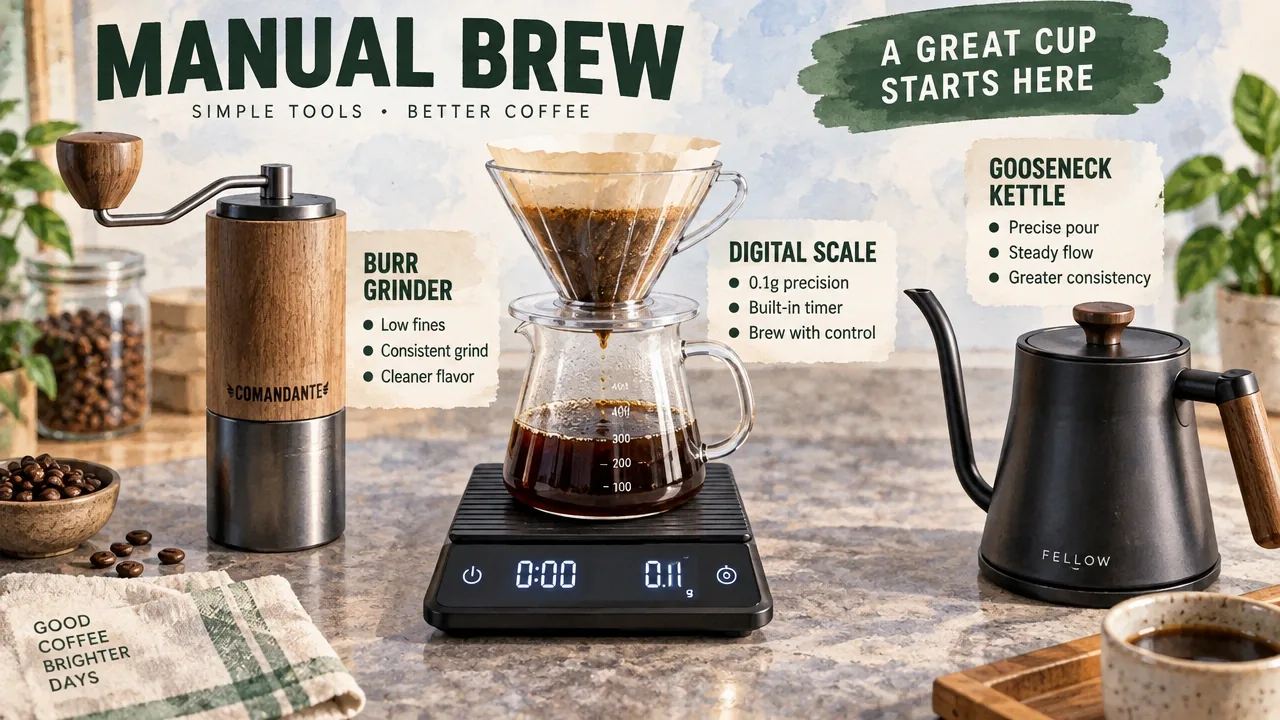
The premise of manual percolation’s signature clarity – flavor separation, delicate floral and fruit top-notes, low-lipid body – is a product of this system, not the logo on the dripper. The enthusiast community has arrived at a consensus that inverts the typical purchase order: budget for the grinder first, and the dripper’s geometry becomes a genuine preference rather than a performance limiter. That single reframe changes everything about how this showdown should be read.
Physics Scoring and Scaling Boundaries
Every brewer in this guide gets graded against the same rubric. Thermal stability across a 3-minute brew. Drawdown consistency – does the bed drain evenly, or does it channel? Bypass leakage – is water sneaking around the bed rather than through it? Filter cost and availability, because a $0.30-per-brew filter changes the economics fast. Carafe ergonomics for practical daily use. And batch capacity, which splits cleanly into single-cup focused (150–250ml) and large-format (600–1000ml).
Two physics axes run underneath everything else. Geometry and flow restrictors: a 60° conical body with a single wide aperture produces fast, unimpeded drawdown; a flat-bed with a three-hole restrictor slows flow and equalizes water depth; a trapezoid sits between them. Thermal mass and material: thick ceramic acts as a heat sink and demands aggressive pre-heating; thin plastic or glass retains heat differently and forgives a lighter pre-heat. Filter medium: bonded lab paper strips oils and sediment for a tea-like cup; thin crepe paper preserves acidity and lets more volatile aromatics through.
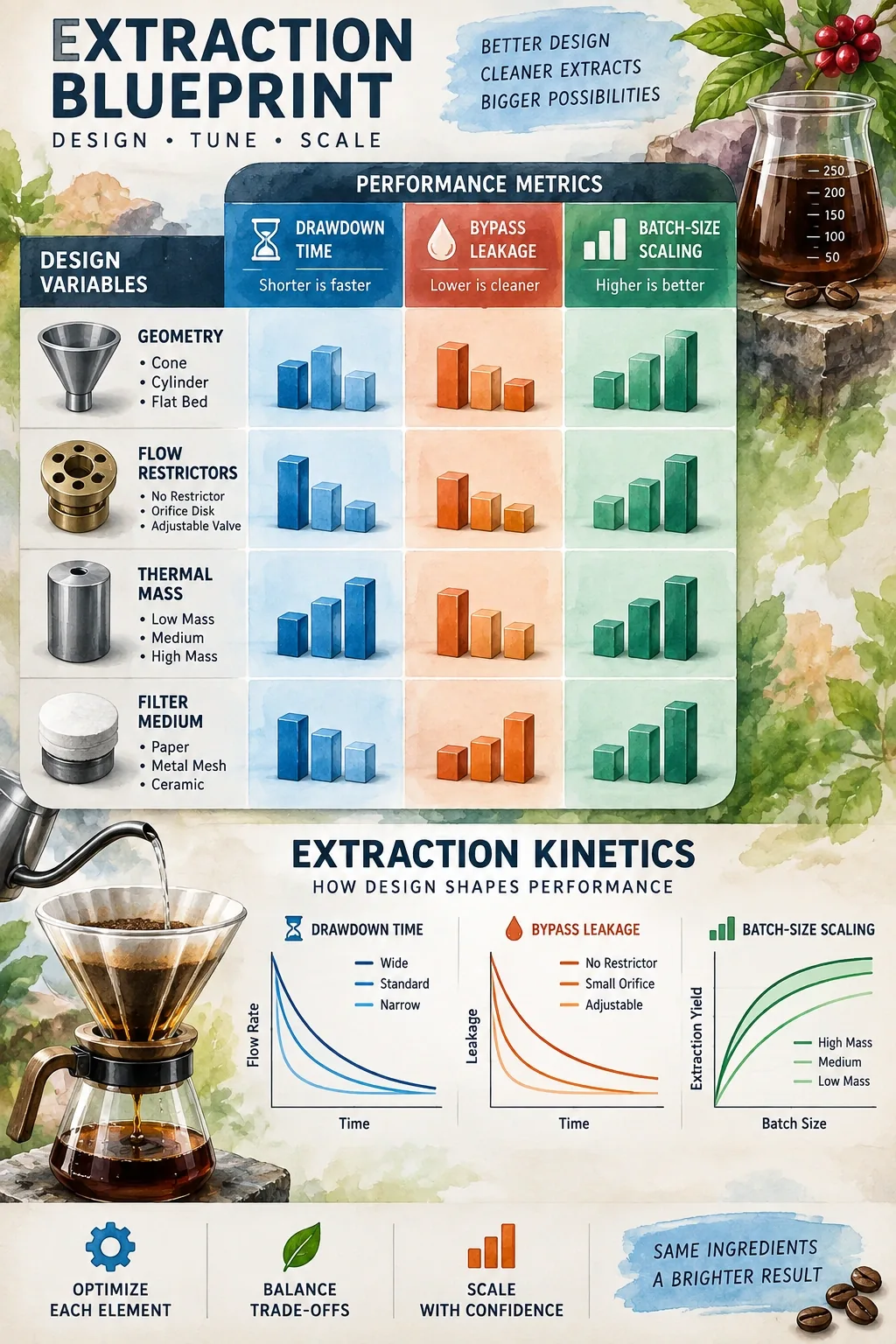
There’s also a scaling law that most guides ignore. As bed depth and hydrostatic pressure increase – moving from a single-cup dripper to a large-format carafe – extraction kinetics shift. A grind that’s perfect for a 200ml V60 brew will behave differently in a Chemex pulling 800ml. Troubleshooting follows directly from this: a sour, thin cup means the water moved too fast or the grind was too coarse; a bitter, heavy cup means the grind was too fine or the bed stalled.
One scope boundary: this showdown covers manual percolation drippers and their hybrid valve relatives only. Aeropress (immersion + pressure) and electric auto-drippers are different product categories with different physics – they’re out.
Hario Switch: The Hybrid That Rewards Every Skill Level
The Hario Switch answers a question that most beginner guides refuse to ask honestly: is there a brewer that won’t punish inconsistent pour technique today, but won’t cap your ceiling when your technique improves? The answer is yes, and the mechanism is a single valve.
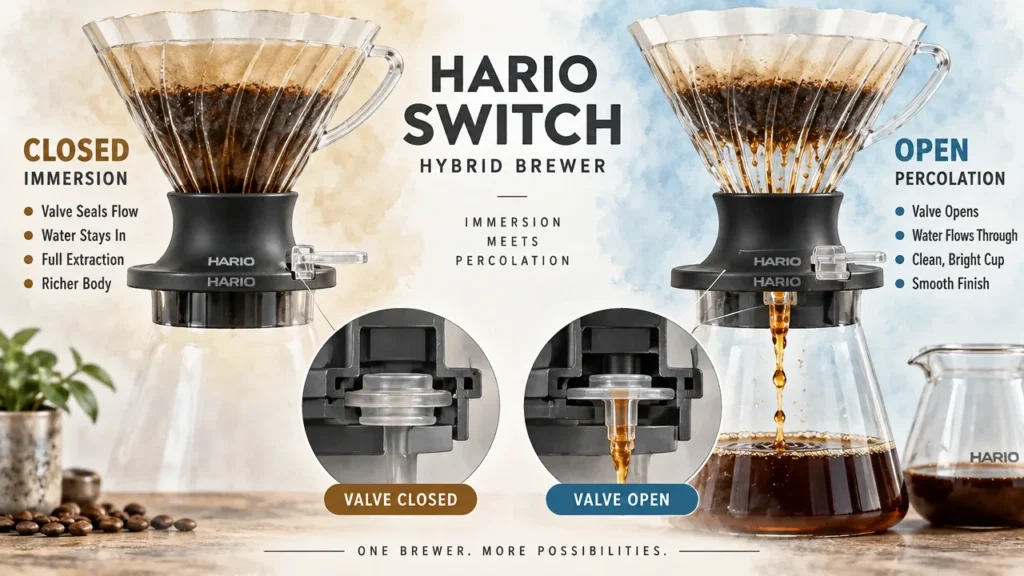
The Switch sits in a V60-shaped body with a spring-loaded valve at the base. Close the valve, and you have full-immersion steeping – the coffee bed saturates evenly, contact time is controlled by a timer rather than pour technique, and the margin for error expands dramatically. Open the valve, and the Switch drains exactly like a standard V60, giving you percolation mode with all the technique sensitivity that implies.
That two-mode design is the core value proposition. Immersion mode protects a beginner from the most punishing aspect of manual pour over – the fact that inconsistent pouring creates uneven saturation, which creates channeling, which creates a sour-bitter split in the cup. When the bed is fully submerged, pour inconsistency stops mattering. Percolation mode preserves a genuine growth path: as technique matures, the valve stays open more, and the brewer becomes an unforgiving skill-check device – the same one the V60 is, but reached gradually rather than thrown into on day one.
Its closest sibling in the immersion category is the Clever Dripper, a trapezoid-bodied device with a similar valve concept. The Switch’s differentiator is its V60-shape footprint and filter compatibility – it uses standard V60 paper, which is among the cheapest and most widely available filters in the category. The Clever Dripper uses its own proprietary paper, which narrows your sourcing options.
Capacity sits in the single-cup focused range (150–250ml), so it’s not a batch solution. The body is Arita-yaki porcelain – the same regional ceramic lineage as the flagship V60 – which means it carries real thermal mass and rewards a proper pre-heat rinse before brewing. Skip the pre-heat and the first 30 seconds of your brew are fighting a cold dripper instead of extracting coffee.
The enthusiast community’s strongest signal on the Switch is that it earns the label “two brewers in one.” Buy a forgiving immersion trainer today; convert it into a demanding percolation device as technique matures. And because it uses V60 filters, it carries the lowest ongoing filter cost of any brewer in this showdown.
Affiliate Disclosure
This post contains affiliate links, meaning I may earn a commission if you make a purchase through these links, at no additional cost to you. As an Amazon Associate, I earn from qualifying purchases. I only recommend products I genuinely believe will add value.

Hario "Switch" Immersion Dripper, Size 02
- This product comes with an 02 SWITCH dripper and a 40-pack of 02 size V60 filters.
- This dripper is designed to be a hybrid that allows your to brew like a standard pourover and an immersion bre…
- Plastic switch activates a stainless steel ball valve that open and closes the dripper allowing coffee to flow…
- This dripper is compatible with 02 size V60 filters.
- Glass V60 cone is made of Hario's signature heatpoof glass.
Hario V60: The Conical Skill Check Nobody Should Start On
The Hario V60 has accumulated a reputation as the default pour over recommendation – the answer blogs reach for when someone asks where to start. That reputation is only half-deserved. The V60 is genuinely exceptional. It is also genuinely unforgiving, and those two facts are inseparable.
The geometry explains both. A 60° conical body with a single large aperture at the base and spiral ribs running the length of the cone – the ribs create an air channel between the paper and the dripper wall, preventing suction and allowing the filter to drain freely. The result is fast, unimpeded drawdown. Nothing slows the water except the grind and the pour. That means grind consistency, pour rate, agitation level, and water temperature all feed directly into the extraction result with no mechanical buffer between them.
When technique is dialed, the payoff is real. The unimpeded flow and cone shape produce unmatched flavor separation and clarity – the floral and fruit top-notes that define great light-roast pour over emerge most distinctly through a V60. The community doesn’t oversell this; it’s a genuine sensory ceiling that other geometries approach but rarely match.
The flagship material is Arita-yaki porcelain, a regional ceramic from Saga Prefecture in Japan with real thermal mass. That mass absorbs heat aggressively during the first pour, which means a thorough pre-heat rinse isn’t optional – it’s the difference between a controlled 93°C brew and one that drops 8–10°C in the first 30 seconds. The companion filter is thin crepe paper (Hario’s own, or Cafec Abaca for a brighter cup), which preserves acidity and lets volatile aromatics pass through rather than stripping them.
The practitioner community has a phrase for this device: the 1-iron of coffee drippers. Magic when mastered, infuriating when not. Blogs rank it as standard, runner-up, or tournament winner – but the enthusiast consensus places it in a technique-seeker tier, not a beginner tier. It is a deliberate skill-check device. The internet treats it as the default first purchase; experienced brewers know it belongs as the third or fourth, after technique has been built on something more forgiving.

Hario V60 Ceramic Pour Over Coffee Set, Size 02, White
- Everything you need for a professional, pour-over cup of Coffee at home or work; just add Coffee and water!
- Kit includes: Hario V60 Coffee dripper, Hario V60 Coffee server, Hario Coffee scoop and Hario V60 Disposable p…
- Heatproof borosilicate glass server with BPA-free handle, lid and measuring spoon
- V60 Size 02 makes 1-4 cups
- Made in Japan
Kalita Wave: The Flat-Bottom Forgiveness Engine
The Kalita Wave earns its forgiveness reputation through geometry, not marketing. The mechanism is specific: a flat-bottom bed combined with a three-hole drainage restrictor at the base. Where the V60’s single aperture lets water exit freely and unevenly, the Wave’s three small holes slow drainage and equalize water depth across the entire bed. Water pressure distributes more uniformly. The coffee bed extracts more uniformly. Channeling – the pour-over failure mode where fast water finds a path of least resistance through the bed – has less opportunity to form.
A peer-reviewed CFD modeling study published in PLOS ONE examined extraction uniformity in conical versus cylindrical packed beds and found exactly what the geometry predicts: in a truncated conical bed, flow velocity increases as the cross-section narrows toward the bottom, creating shorter contact times and significant variation in local extraction level. The cylindrical case produced essentially one-dimensional, uniform flow with a linear pressure profile – extraction variation was limited mainly to the axial direction. The Kalita Wave’s flat-bottom geometry maps directly onto that cylindrical behavior: more uniform resistance, more predictable extraction.
The PLOS ONE study’s conical CFD results showed pressure and velocity varying in both axial and radial directions, while the cylindrical case behaved as a uniform 1-D flow – supporting flatter geometry as structurally less prone to non-uniform extraction than conical beds. – From the study “Analysing extraction uniformity from porous coffee beds using mathematical modelling and computational fluid dynamics approaches“
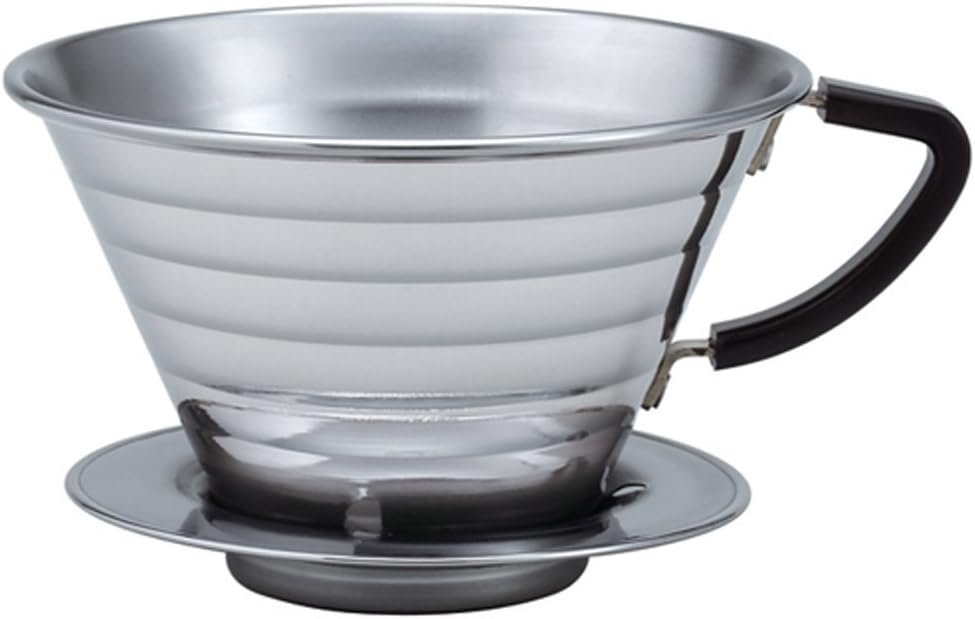
That physical advantage makes the Wave a strong flat-bed reference for any enthusiast who values repeatability and wants to understand how geometry affects their cup. It’s available in three materials: glass, ceramic, and Tsubame stainless steel – the metal variant carrying the precision manufacturing lineage of Tsubame-Sanjo, Japan’s metalworking region. The companion filter is the flat-wave crepe paper, a corrugated design that creates an air gap between the filter and the dripper wall, similar in intent to the V60’s spiral ribs.
One honest caveat worth naming: the Tsubame stainless variant is sometimes positioned as the beginner default, but that recommendation rests on thin evidence. Metal’s thermal behavior differs from ceramic or glass – it heats faster but also loses heat differently – and a newcomer who buys the metal Wave based on borrowed talking points may find themselves troubleshooting a thermal variable they didn’t know existed. Know the material before you buy the prestige.
Kalita Wave 185 Drippers
- PULLS THE PERFECT CUP: The pantented wave design reduces contact between the brewing space and the filter itse…
- TOP CHOICE OF COFFEE PROFESSIONALS: You'll find the Kalita Wave pour over coffee dripper in the world's top sp…
- PREMIUM CONSTRUCTION: Made in Japan out of polished stainless steel, the Kalita Wave 185 is more durable than …
- FITS MOST CUPS AND CARAFES: The Kalita Wave's flat-bottomed coffee bed has a dripping area diameter of 2", whi…
- SATISFACTION GUARANTEED: Kalita is a family-owned Japanese compaany that adheres to the highest standards of m…
Chemex: The Batch Aesthetic – and the Overrated-Starter Trap
The Chemex is one of the most beautiful brewing devices ever designed. It is also one of the most frequently mispositioned. Both of those things are true at once, and untangling them is the only way to decide whether one belongs on your counter.
The format is unique: an integrated glass flask-and-funnel in a single hourglass body – no separate carafe, no separate dripper. You brew directly into the vessel you serve from. The filter is thick bonded laboratory paper, roughly 20–30% heavier than standard pour over paper, and that thickness is the cup’s defining characteristic. It strips oils, sediment, and most of the compounds that create body, producing a clean, tea-like cup with exceptional clarity. If you want to taste the origin character of a well-sourced light roast without interference, the Chemex delivers that in a way few brewers match.
The use-case is batch brewing – the Chemex’s 600–1000ml capacity is its primary advantage over single-cup drippers. Deeper beds and greater hydrostatic pressure change the required grind and pour approach: you’ll typically grind coarser than a V60 at the same ratio, and you’ll need more water per pour to maintain consistent saturation across the larger bed. This is not a beginner-friendly variable to manage.
Three pushback points deserve direct attention. First, grind sensitivity: the Chemex’s thick filter slows drawdown, which means a slightly-too-fine grind stalls the bed and over-extracts bitterness in a way faster drippers self-correct. Second, proprietary filter cost and lock-in: Chemex filters are thicker and larger than standard Hario-pattern papers, and they cost more per brew. For context, Hario-pattern filters run roughly 300 sheets for $12 – the Chemex equivalent is meaningfully more expensive per cup. Third, the nominal 3-cup capacity is a genuine consumer trap: three “cups” in Chemex sizing equals roughly one large mug by modern standards. Many buyers discover this after the purchase.
The honest position: the Chemex is a valid batch and clean-cup instrument that has been marketed into a beginner role it does not fit. Buy it for the right reasons – batch hosting, visual centerpiece, oil-free clarity – and it earns every inch of counter space. Buy it because a lifestyle blog said it’s where to start, and you’ll be troubleshooting a device that’s punishing you for variables you haven’t learned to control yet.
When shifting from high-clarity paper-filtered aesthetics to heavy-bodied, high-capacity extraction for large groups, mastering immersion physics requires consulting The Ultimate Guide to 12 Cup French Coffee Press Brewing.

Chemex Pour-Over Glass Coffeemaker - Classic Series - 10-Cup - Exclusive Packaging
- CHEMEX - simple, easy to use with timeless, elegant design
- All CHEMEX Coffeemakers are made of the highest quality, non-porous Borosilicate glass which will not absorb o…
- The patented CHEMEX pour-over design allows coffee to be covered and refrigerated for reheating without losing…
- All CHEMEX Coffeemakers are measured using 5 oz. as 1 cup
- Use CHEMEX Bonded Filters FP-1, FC-100, FS-100, FSU-100, Filters not included.
The Overlooked Chassis: Hidden Gems the Rankings Miss
The brewers that dominate beginner blog rankings are the ones with the largest marketing budgets and the most affiliate links. That’s not a conspiracy – it’s just how content economics work. The consequence is that several genuinely capable drippers get consistently underrepresented, despite directly answering the questions beginners and enthusiasts are actually asking.
Forgiving Wedge and Filter-Compatible Flat Alternatives
The Melitta-pattern dripper – a trapezoid or wedge-shaped flat-bottom brewer with a single restricted outlet – is probably the most underrated beginner device in the category. Its flat-bottom geometry distributes water more evenly than a cone, its restricted outlet slows drawdown for a more forgiving margin of error, and Melitta-pattern filters are available in virtually every grocery store on earth. The forgiveness profile is real. The caveat: community evidence for it as a superior beginner pick is based on limited single-user reporting, so treat it as a strong hypothesis rather than a settled verdict.

Melitta Pour-Over Coffee Brewer W/ Glass Carafe, Holds 6 - 6 Oz Cups, Black
- Quick and Easy Handcrafted Brewing: This 36 ounce pour-over coffee maker with carafe is the perfect way to mak…
- Smart, Convenient Design: This pour-over's design allows you to monitor your pour and avoid overfilling
- The Best Way to Brew: Aficionados agree that pour-over brewing makes the best coffee; Just place a paper filte…
- Pour Your Own Coffee: Your perfect cup of coffee awaits right at home when you brew with our pour over coffee …
- Join the Pursuit for Better Coffee: Melitta is dedicated to providing the Ultimate Coffee Experience with our …
The UFO dripper occupies a similar space – a forgiving geometry that uses standard V60 filters, making it the logical pick for anyone who already has a stock of V60 paper and wants a more forgiving brew experience without buying into a proprietary filter system. Same caveat applies: experimental recommendation on single-user evidence.

Disposable Coffee Filter Paper, Ease Use UFO Design Filter Paper Convenient for Drip Coffee Makers (UFO Blue, 26Pcs)
- QUANTITY: the disposable coffee filters contains 26 pcs
- QUALITY: Our coffee filters filters is single-use,made of 100% paper pulp,can reduce the damage to the origina…
- DESIGN: our unbleached coffee filters with UFO-shaped design, suitable for coffee filter pour over cone coffee…
- SIZE: this coffee filters is 4.33*4.33 inch,capacity is 1-4 cups,very sturdy and firm to prevent coffee ground…
- STYLE: Simple and fashionable
The Timemore B75 is a different proposition. It’s a fast flat-bottom dripper with Kalita-pattern filter compatibility – designed for speed-focused extraction with the uniformity benefits of a flat bed. For an enthusiast who wants a flat-bed reference that pulls faster than the Kalita Wave, the B75 is the less-discussed answer. It also lands at a price point that makes it a serious budget alternative to the Wave.

B75 Wave Coffee Dripper PCTG 1-2 Cups Coffee Maker Increase Uniformity Transparent
- Brand new and high quality
- Type: Coffee Clever Dripper
All three of these brewers are largely absent from beginner blog rankings despite directly addressing forgiveness, filter compatibility, and speed – the three variables most frequently cited as purchase drivers by new brewers. The reward for scrolling past the obvious picks is finding options that actually fit the use case.
Dual-Filter and Conical Precision Platforms
The Origami dripper and its travel-oriented sibling, the Origami Air S, occupy a genuinely unusual position in the category: they accept both cone-shaped and flat-bottom filters, giving the brewer two distinct extraction profiles from a single device. Swap to a V60-style cone filter and you get fast, high-clarity drawdown. Swap to a flat filter and you get the slower, more uniform extraction of a flat bed. For an enthusiast building a rotation, the Origami is the format-flexibility argument.

Ceramic Coffee Dripper Pour Over Coffee Maker with Wood Stand Elegant Flower Shape Filter
- Made of ceramic for superior heat stability and durability
- Carved out of porcelain with a floral shape. The unique coffee dripper makes you brew coffee looks very elegan…
- The dripper is designed a large single hole which can change coffee taste by the speed of pouring hot water, a…
- Includes wooden stand with 4.78-inch outer diameter to fit most cups and mugs
The home version is available in Mino porcelain – a Japanese ceramic tradition from Gifu Prefecture with fine thermal properties. The Origami Air S is AS resin (a food-safe acrylic-styrene plastic), which makes it genuinely travel-durable and the most overlooked travel dripper in the category. Most travel dripper conversations default to collapsible silicone; the Air S is rigid, precise, and doesn’t carry the thermal compromise of metal travel drippers.

Kalita DACHI MI 155 Coffee Dripper, Mino Ware, High Heat Retention, Porcelain, For 1-2 People, Dachi MI 155 Dripper, Gloss Brown, #01113 Wave Series, Made in Japan, Drip Equipment, For 1 Person, 2
- Size (approx.): 3.9 x 4.7 x 2.8 inches (100 x 12
- Material: Ceramic (Mino ware Tamachi)
- Country of Manufacture: Japan
- For 1 to 2 people
- Dishwasher: Not used
The Kono Meimon is the precision pick for enthusiasts who want the V60’s conical geometry with a different extraction profile. Kono’s rib geometry is shorter than the V60’s – ribs run only along the bottom third of the cone, creating suction between the upper filter and the dripper wall that slows drawdown and extends contact time. It’s a conical brewer that leans toward body rather than brightness, sitting in the Japanese precision lineage for enthusiasts who find the V60 too fast for their preferred roast profile.

Kalita - 2001 Kalita 102 Ceramic Dripper Coffee Dipper, white
- Base: 4in diameter
- Requires 102 Filters
- used to make 8oz of liquid beverage
- Model number : 02001
The Verdict: Which Brewer Actually Earns the Counter
Every dripper in this guide solves a specific problem. The only wrong answer is buying for the wrong problem.
Here’s the use-case matching matrix, without decoration:
| Your Situation | The Brewer |
|---|---|
| Overwhelmed newbie, wants forgiveness | Switch, Clever Dripper, Kalita Wave, Melitta-pattern |
| Technique-seeker, wants a skill-check | V60 |
| Flat-bed reference, values repeatability | Kalita Wave, Timemore B75 |
| Batch brewing and clean-cup clarity | Chemex |
| Travel durability | Origami Air S, UFO |
| Budget-first purchase | Plastic V60, Timemore B75, Melitta-pattern |
| Filter-cost-sensitive | V60 (Hario paper), Switch (same filter) |
Two overrated defaults deserve an explicit correction. The V60 is not a beginner default – it is a technique-rewarding instrument that punishes inconsistency with a sour-bitter split and no mechanical safety net. Hand it to a new brewer and you’re not setting them up for success; you’re giving them a test they haven’t studied for. The Chemex is not a beginner default either – it is a valid batch and clean-cup instrument, and a beautiful one, but its grind sensitivity, proprietary filter cost, and misleading capacity labeling make it a poor first purchase.
The system principle stands regardless of which dripper you choose: grinder first, then dripper. A $200 grinder and a $15 plastic V60 will produce a better cup than a $15 grinder and a $60 ceramic dripper. That’s not an opinion – it’s the extraction physics. Grind consistency determines whether every particle in the bed extracts at the same rate. No dripper geometry compensates for a grind that produces a wide distribution of fine and coarse particles simultaneously.
The closing arbitration comes down to four signals the community has consistently produced: the Switch and Clever earn the “training wheels that scale” label; the V60 earns the “skill-check” label; the Chemex earns “not newbie-friendly” as a structural truth, not an insult; and “grinder outranks brewer” is the axiom that makes all four labels make sense. The flat-bottom and Melitta-pattern family is the more forgiving geometry for repeatability – the CFD data supports this, not just community intuition.
The final principle: forgiveness and clarity are different products. The Switch and Kalita Wave deliver forgiveness – consistent, repeatable cups while technique is developing. The V60 delivers clarity – the highest sensory ceiling in the category, earned through dialed technique. Buy for the one you actually need on the counter today. The dripper that earns the counter is the one that expresses the system you’ve built, not the one that promises to replace it.
Matching your morning routine to the right manual dripper solves hot filtration, but transitioning to chilled, low-acidity extractions calls for investing in the best cold brew coffee maker suited for effortless multi-batch preparation.
Frequently Asked Questions About Best Pour Over Coffee Maker
Which pour over coffee maker is best rated overall?
The Hario V60 consistently tops community and competition rankings for its sensory ceiling, but “best rated” conflates technique ceiling with beginner suitability. For most people, the Hario Switch or Kalita Wave earns higher marks in daily use.
What is the disadvantage of pour over coffee?
The main disadvantage is technique dependency – pour rate, grind consistency, water temperature, and bloom timing all affect the cup, and there’s no automation to compensate for an off day. It also requires more equipment investment upfront than a basic drip machine.
Are pour over coffee makers actually worth it?
Yes, for flavor separation and origin clarity that automatic drip machines can’t replicate – but only if the grinder investment comes first. A pour over brewed through a blade grinder produces a worse cup than a well-designed auto-drip machine using a burr grinder.
Is pour over really better than drip coffee?
It’s more expressive, not categorically better. Pour over lets you manipulate every extraction variable manually, which produces higher highs and lower lows than auto-drip. A well-dialed pour over outperforms most auto-drip machines on clarity and aroma; a poorly-executed one underperforms them.
Why does pre-heating the dripper matter so much?
Ceramic and porcelain drippers absorb heat from your brew water rapidly. Without a pre-heat rinse, the first 20–30 seconds of your brew can drop 8–10°C below target temperature, which compresses extraction and flattens the cup. Plastic and thin glass drippers are more forgiving here, which is one reason Jonathan Gagné endorses the plastic V60 for heat retention.
Can I use any filter in any pour over dripper?
No – filter shape must match dripper geometry. Cone filters (V60-style) don’t seat correctly in flat-bottom drippers, and flat filters don’t create the right bed depth in conical bodies. The Origami dripper is the notable exception, designed to accept both cone and flat filters.
How does grind size affect pour over extraction?
Grind size controls flow resistance through the bed. A finer grind slows water, extending contact time and risking over-extraction (bitterness). A coarser grind speeds flow, shortening contact time and risking under-extraction (sourness). The correct grind size depends on both your target brew time and your specific dripper’s geometry and flow restriction.
What’s the real capacity of a Chemex “3-cup” model?
By modern mug standards, roughly one large serving. Chemex uses a pre-metric cup measurement of approximately 5 oz, so a “3-cup” Chemex holds about 15 oz – which fills one standard 16 oz travel mug with almost nothing to spare. The 6-cup or 8-cup models are the practical batch formats.
References
- Brewing Better Coffee – Jonathan Gagné | coffeeadastra.com
- Analysing extraction uniformity from porous coffee beds using mathematical modelling and computational fluid dynamics approaches | journals.plos.org