
Starbucks caffeine amounts follow a specific architecture most drinkers never see: shot counts, pump formulas, and brew methods that vary by drink family before cup size even enters the picture. A Tall brewed coffee can carry more caffeine than a Grande Frappuccino. A Venti Hot latte and a Grande latte can land on the same number. And a “Crème” Frappuccino isn’t always caffeine-free.
This guide maps every variable, from the standard espresso shot ladder to Frap Roast pump math, bottled RTD formulations, milk absorption kinetics, and decaf residuals, so you can calculate any drink on the menu before you order it.
Key Takeaways on Starbucks Caffeine Amounts
- A Grande and Venti Hot latte both carry ~150 mg because both use 2 espresso shots; Venti Iced jumps to ~225 mg with its third shot.
- Nitro Cold Brew Grande at ~280 mg is the highest standard caffeine item on the Starbucks menu, beating every espresso drink by size.
- Frappuccino caffeine is driven by Frap Roast pump count: 2 pumps for Tall (~65 mg), 3 for Grande (~95–105 mg), 4 for Venti (~125–140 mg).
- “Crème” Frappuccino does not mean caffeine-free; Matcha Crème carries ~70 mg and Chai Crème carries ~40 mg.
- Bottled Frappuccinos use brewed coffee extract, not in-store Frap Roast, so in-store pump math does not apply to the glass bottle.
- Starbucks decaf espresso retains 3–15 mg of residual caffeine per shot; a full decaf order is low-caffeine, not zero-caffeine.
Size Codes and Shot Rules: The Architecture Behind Every Starbucks Caffeine Number
Starbucks caffeine amounts don’t scale evenly with cup size, and that’s the detail most people miss. The short answer to why a Grande and a Venti Hot latte can share the same caffeine number while a Venti Iced jumps well above both comes down to one thing: shot count, not ounces.
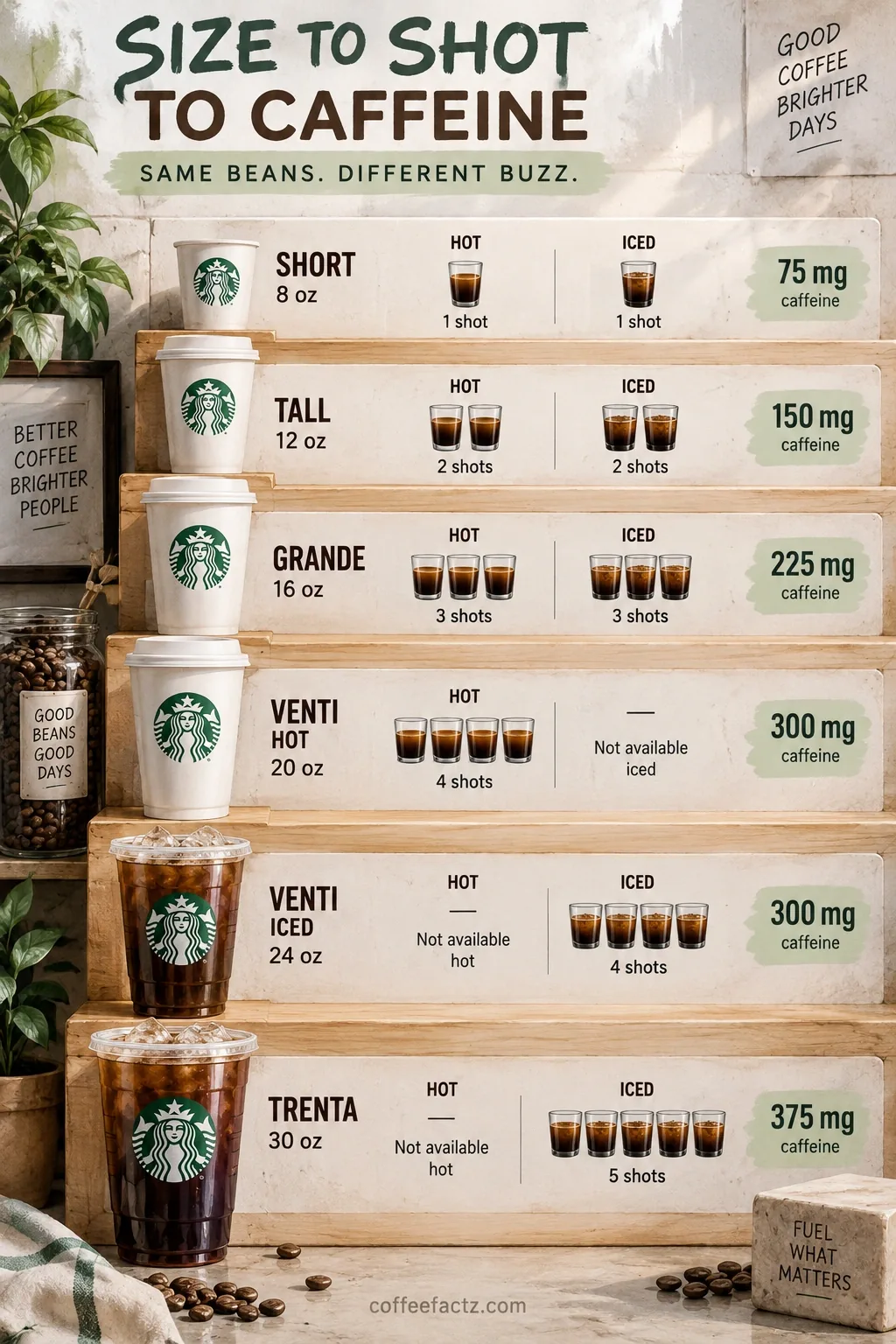
Before anything else, you need the size vocabulary. Starbucks runs six cup sizes. Short is 8 oz. Tall is 12 oz. Grande is 16 oz. Venti Hot is 20 oz. Venti Iced is 24 oz. And Trenta is 31 oz, available only for cold drinks. Those six containers hold different volumes, but for espresso-based drinks, the caffeine inside them is determined by a shot-count rule, not by the fluid ounces.
Here’s that rule, spelled out flat:
| Size | Espresso Shots | Approximate Caffeine |
|---|---|---|
| Short (8 oz) | 1 shot | ~75 mg |
| Tall (12 oz) | 1 shot | ~75 mg |
| Grande (16 oz) | 2 shots | ~150 mg |
| Venti Hot (20 oz) | 2 shots | ~150 mg |
| Venti Iced (24 oz) | 3 shots | ~225 mg |
Notice what happens between Tall and Grande: the cup grows by 4 oz, but the caffeine doubles because the shot count doubles. Then notice what happens between Grande and Venti Hot: the cup grows by another 4 oz, but the caffeine stays flat. Same two shots. That’s the plateau people hit when they upgrade a latte expecting more of a kick.
Venti Iced breaks the plateau because the larger cup gets a third shot. So when you see someone claim a Starbucks drink delivers “225 mg from a double shot,” that’s a misread. A standard doppio is two shots at roughly 150 mg. The 225 mg number belongs to Venti Iced’s three-shot total.
One more boundary to draw now, before we go further: this shot architecture applies to espresso drinks only. Brewed coffee, cold brew, Nitro Cold Brew, and Frappuccinos each follow their own caffeine logic. The size-to-shot ladder is the foundation, but it’s only one room in the building.
The 2026 Master Caffeine Chart: Brewed, Espresso, Cold Brew and Signature Brews
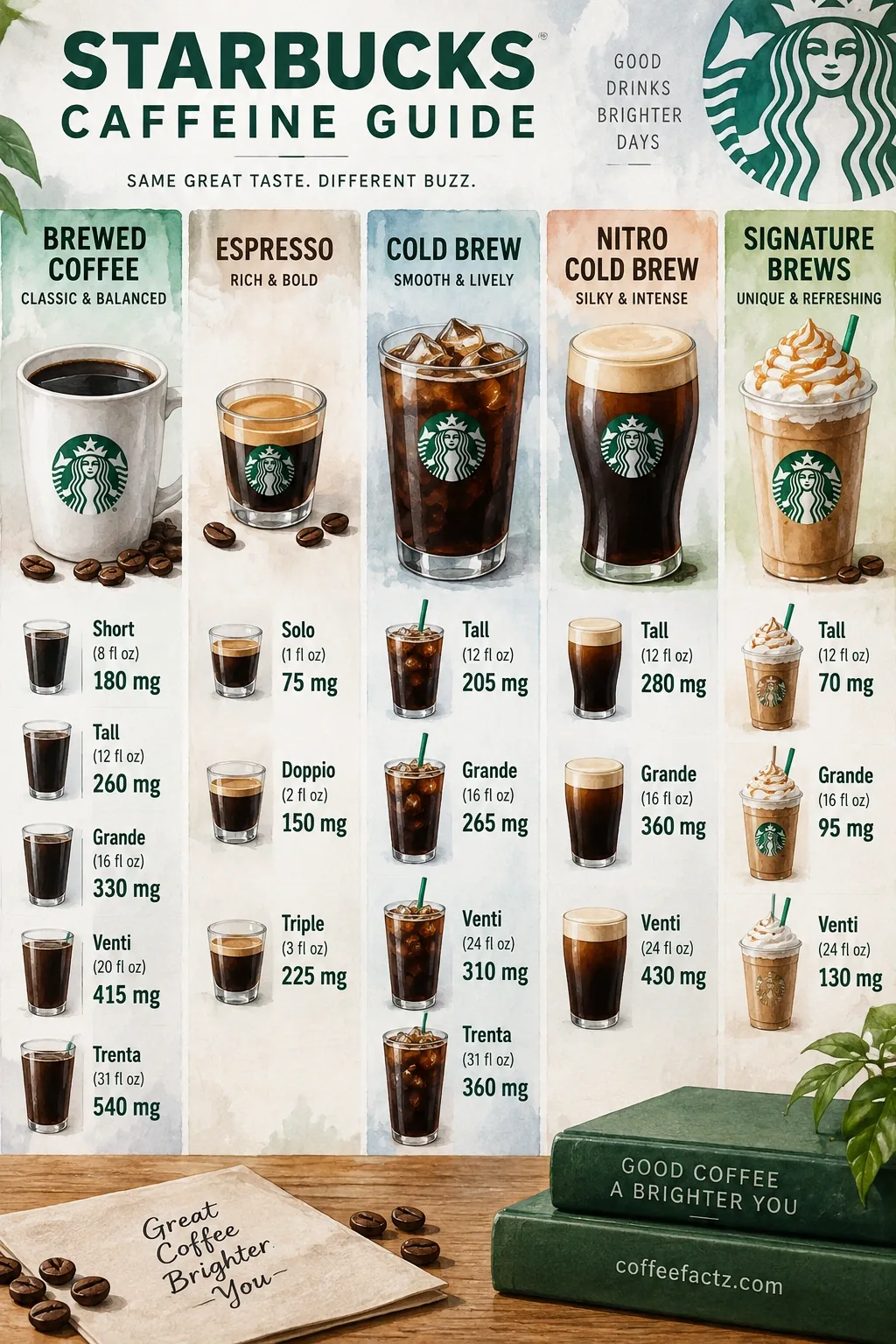
Starbucks caffeine amounts shift dramatically once you cross drink families, and the highest caffeine on the menu doesn’t come from espresso. It comes from cold brew. A Grande Nitro Cold Brew sits at approximately 280 mg, which beats a Venti Iced latte’s 225 mg without adding a single espresso shot. That’s the ceiling you need to anchor the chart.
Below is the full picture by drink family and size.
Brewed Coffee
| Drink | Short | Tall | Grande | Venti |
|---|---|---|---|---|
| Pike Place Roast | ~180 mg | ~260 mg | ~330 mg | ~410 mg |
| Dark Roast | ~130 mg | ~195 mg | ~260 mg | ~340 mg |
| Clover Brewed Reserve | Varies by bean | Varies by bean | Varies by bean | Varies by bean |
Brewed coffee caffeine is a function of roast, brew method, and serving size, not shot count. A Tall Pike Place at ~260 mg already outpaces most people’s mental model of “a cup of coffee.” Clover Brewed Reserve coffees don’t carry a universal number because the caffeine depends on the specific bean and roast dialed in that day. Never assume a fixed figure for Clover; ask or check the in-store nutrition board.
One thing worth clearing up: darker roast doesn’t reliably mean more caffeine. Roasting burns off some caffeine by mass, so a lighter roast can carry more per gram. What drives the brewed coffee number is how much ground coffee goes into the brew, not how dark it is.
Espresso Drinks
| Drink | Short | Tall | Grande | Venti Hot | Venti Iced |
|---|---|---|---|---|---|
| Latte / Cappuccino / Americano | ~75 mg | ~75 mg | ~150 mg | ~150 mg | ~225 mg |
| Flat White | ~130 mg | ~130 mg | ~195 mg | ~195 mg | N/A |
The Flat White uses ristretto shots, which pull a shorter, more concentrated extraction. Starbucks describes ristretto as a restricted shot made with the same espresso roast but less hot water pushed through the grounds, producing a smaller, sweeter, richer result. Because the Flat White also uses more shots per size than a standard latte, its caffeine runs higher even though the individual shot is shorter.
Cold Brew and Nitro
| Drink | Tall | Grande | Venti | Trenta |
|---|---|---|---|---|
| Cold Brew | ~155 mg | ~205 mg | ~310 mg | ~360 mg |
| Nitro Cold Brew | ~215 mg | ~280 mg | N/A | N/A |
Nitro Cold Brew is served only in Tall and Grande because the nitrogen charge and texture break down at larger volumes. Grande at 280 mg is the practical ceiling for a single standard Nitro order.
Protein Blended Cold Brew
This is an edge item, not a standard menu entry. The Cacao and Almond varieties are listed at approximately 180 mg and come only in Grande. They don’t scale by size, so the Tall/Venti caffeine math doesn’t apply here.
Frappuccinos (Overview)
The Frappuccino caffeine range of roughly 40 to 155 mg for coffee-based versions is real, but it’s not useful on its own. The next section breaks down the pump formula that actually explains where each number comes from.
One comparison worth making now: a Tall brewed coffee at ~260 mg can more than double a Tall Caramel Frappuccino at roughly 90 mg. Drink family matters far more than the word “Frappuccino” on the cup.
Frappuccino Formula: How Frap Roast Pumps Translate to Caffeine
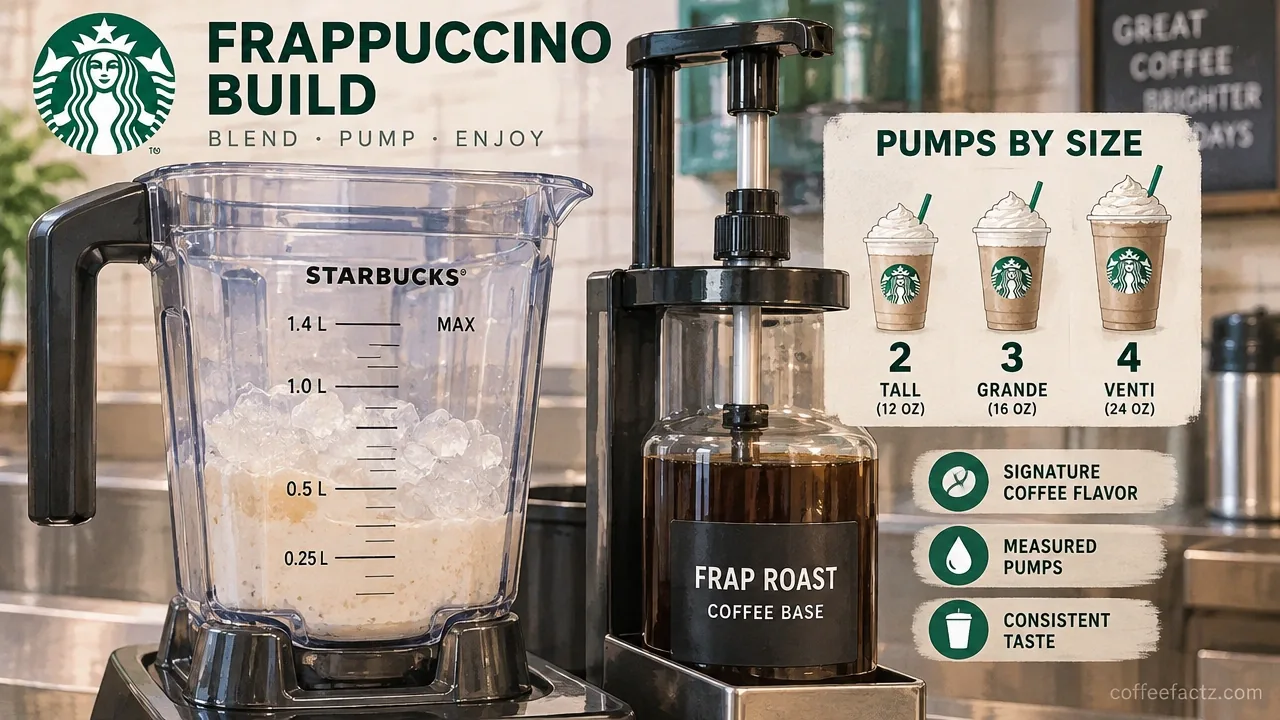
Frappuccino caffeine isn’t a mystery once you understand what’s actually going into the blender. Coffee-based Frappuccinos don’t use pulled espresso shots as their caffeine source. They use Frap Roast, a concentrated liquid coffee that baristas add by pump. The pump count scales with cup size, and that’s where the caffeine number comes from.
The formula:
| Size | Frap Roast Pumps | Approximate Caffeine |
|---|---|---|
| Tall | 2 pumps | ~65 mg |
| Grande | 3 pumps | ~95–105 mg |
| Venti | 4 pumps | ~125–140 mg |
Ice, milk, syrup, and whipped cream add zero caffeine. The only variables that change the caffeine in a Frappuccino are the Frap Roast pump count and any extra espresso shots a customer adds as a customization.
Here’s how the most common coffee-based Frappuccinos map against that pump ladder:
| Frappuccino | Approximate Caffeine (Grande) |
|---|---|
| Espresso Frappuccino | ~155 mg |
| Java Chip Frappuccino | ~105 mg |
| Mocha Frappuccino | ~100 mg |
| Coffee Frappuccino | ~95 mg |
| Caramel Frappuccino | ~90 mg |
The Espresso Frappuccino is the outlier here. At ~155 mg, it sits well above the standard 3-pump Grande range because it includes pulled espresso shots on top of the Frap Roast base, not instead of it. It doesn’t fit the pump ladder because it’s using a different caffeine delivery mechanism entirely.
According to the Nestlé Coffee Partners Starbucks Beverage Resource Manual, blended beverages must be poured into the cup within 10 seconds of blending, with pump dispensers fully depressed and released each time to ensure consistent flavor and texture delivery.
That last point matters more than it sounds. Inconsistent pump technique changes the actual volume of Frap Roast per pump, which means the caffeine in your Grande Coffee Frappuccino could vary slightly between visits if the pump stroke isn’t complete. The standard is a full depression and full release, every time.
Crème vs Coffee-Based Frappuccino Safety: Zero-Caffeine vs Hidden Caffeine
Crème Frappuccinos look caffeine-free by name, but “Crème” only tells you the drink skips the Frap Roast pump and uses a non-coffee base. It says nothing about the other ingredients in that base.
Two Crème options are genuinely zero caffeine: Vanilla Bean Crème and Strawberry Crème. Those are safe for children and anyone avoiding caffeine entirely. Everything else in the Crème category needs a closer look.
| Crème Frappuccino | Approximate Caffeine |
|---|---|
| Vanilla Bean Crème | 0 mg |
| Strawberry Crème | 0 mg |
| Double Chocolaty Chip Crème | ~15 mg |
| Chai Crème | ~40 mg |
| Matcha Crème | ~70 mg |
A Matcha Crème Frappuccino at ~70 mg carries more caffeine than some people realize they’re consuming. Matcha is ground green tea leaf, and green tea leaf contains caffeine by default. Chai concentrate contains caffeine from black tea. Chocolate contributes a smaller but real amount from theobromine and trace caffeine. None of those sources disappear because the drink is called “Crème.”
For parents ordering for children, or for anyone who is caffeine-sensitive: ask specifically for Vanilla Bean or Strawberry Crème. Don’t order by color or visual appearance, and don’t trust “Crème” as a caffeine-free guarantee.
For pregnant women, the stakes are higher. A peer-reviewed narrative review published in BMJ Evidence-Based Medicine synthesized 48 observational studies and meta-analyses on maternal caffeine consumption, finding that the substantial majority of evidence links caffeine intake to negative pregnancy outcomes including miscarriage, stillbirth, and low birth weight, with frequent dose-response associations and no clearly established safe threshold below which risk disappears. The review identified caffeine sources across coffee, tea, chai, matcha, chocolate, and cola, noting that all sources must be counted together to avoid underestimating total daily intake.
A commonly referenced practical ceiling is 200 mg per day for pregnant women, though the BMJ review’s findings suggest even that figure deserves scrutiny. A single Matcha Crème Frappuccino at ~70 mg can consume more than a third of that budget before a person realizes they’ve had any caffeine at all.
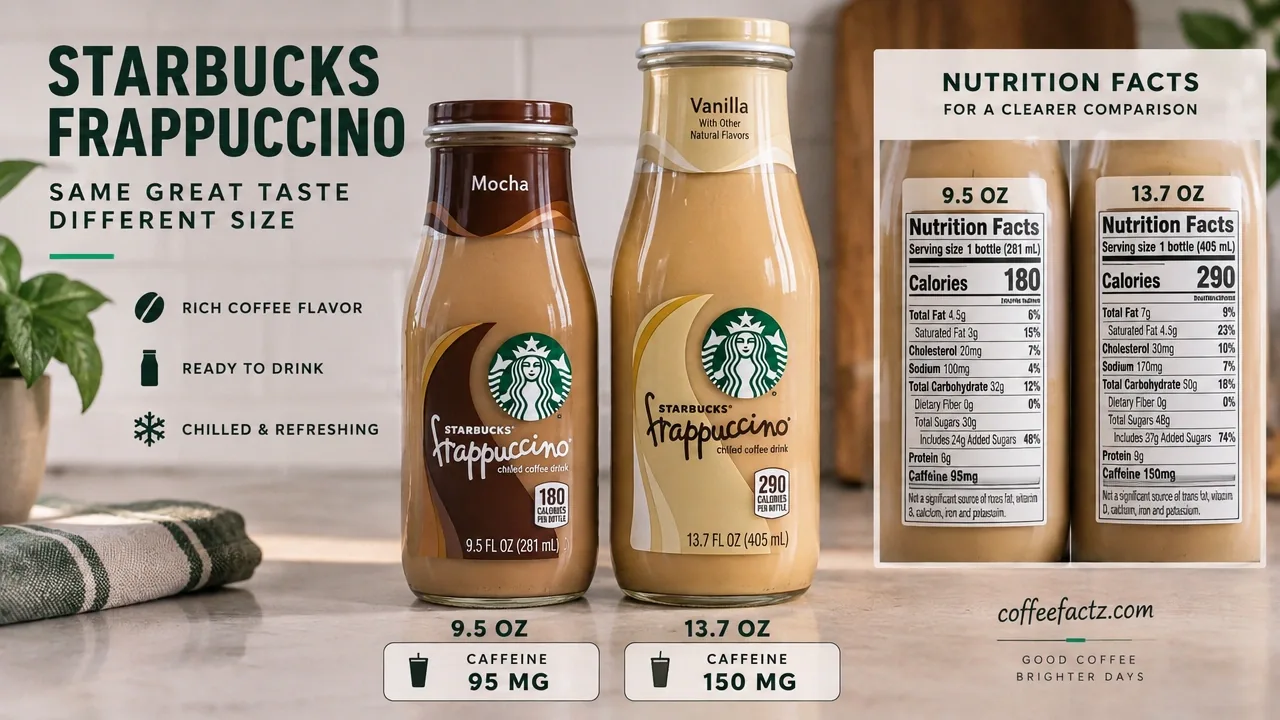
Bottled and Ready-to-Drink Frappuccino: Why the Glass Bottle Doesn’t Match the Blender
Bottled Frappuccino products and in-store blended Frappuccinos share a name and a general flavor profile. The caffeine formulation behind each is completely different.
In-store Frappuccinos are built on Frap Roast pumps and sometimes pulled espresso shots, freshly added to order. Bottled and ready-to-drink Frappuccinos use brewed coffee extract in a shelf-stable formulation designed for retail distribution. That extract doesn’t map to the pump chart. You can’t apply Tall/Grande/Venti pump math to a glass bottle because the caffeine source isn’t the same ingredient.
The actual numbers by package size:
| Bottle Size | Caffeine Range |
|---|---|
| 9.5 oz bottle | ~45–90 mg |
| 13.7 oz bottle | ~45–130 mg |
That’s a wide range within a single bottle size, and it’s driven by flavor. A Mocha flavor will land differently than a Vanilla or a Coffee flavor even in the same 9.5 oz bottle. A 13.7 oz bottle at 130 mg can exceed what a Tall in-store coffee Frappuccino delivers at ~65 mg, while a 9.5 oz bottle of a lighter flavor can come in as low as 45 mg.
The rule here is simple: read the label on every bottled product. The name on the front doesn’t tell you which end of that range you’re on. The nutrition panel on the back does.
Milk, Fat and Absorption Kinetics: Why Your Milk Choice Changes the Caffeine Curve
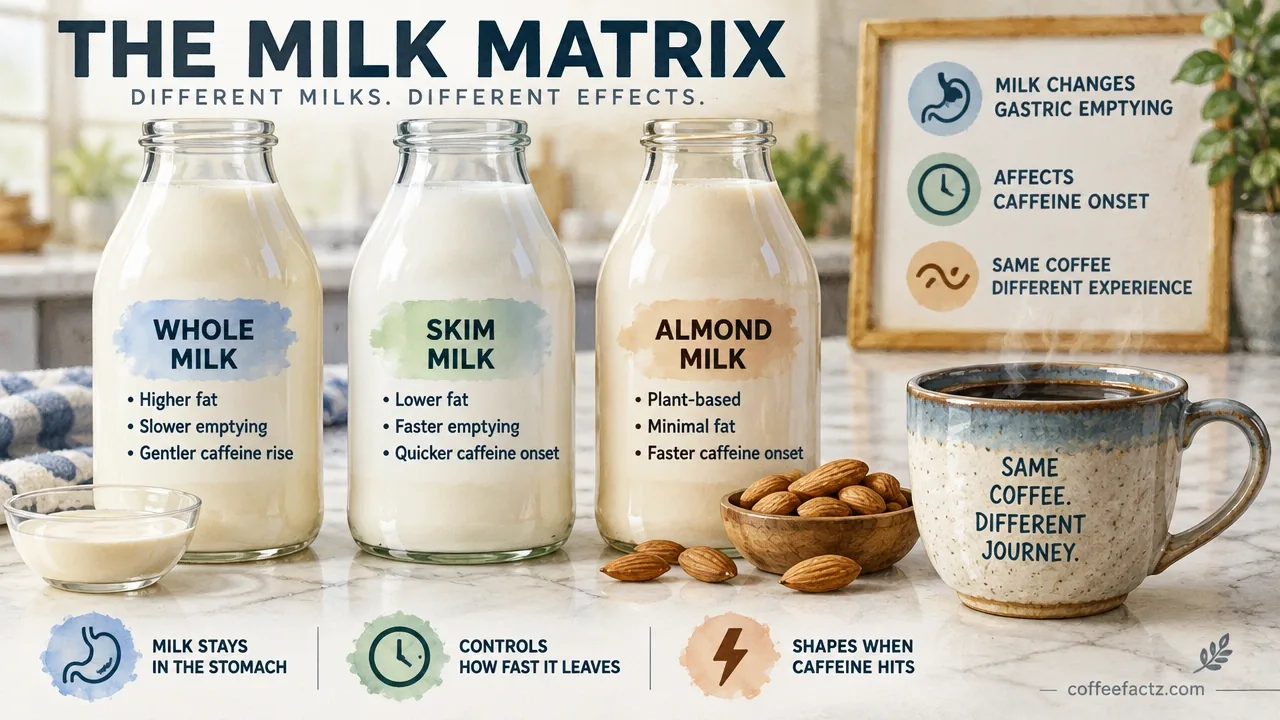
Milk choice does not change the caffeine milligrams listed for your drink. A Grande latte with whole milk and a Grande latte with almond milk both carry ~150 mg of caffeine. What changes is how fast that caffeine leaves your stomach and enters your bloodstream.
Fat slows gastric emptying. Whole milk, with its higher fat content, creates a slower release curve. The caffeine is absorbed over a longer window, which can smooth the onset and reduce the sharpness of the peak. Skim milk and almond milk, being lower in fat, allow faster gastric emptying. The caffeine moves through your stomach more quickly and hits your system sooner and sometimes harder, even though the total dose is identical.
This is the difference between perceived intensity and actual dose. The chart number doesn’t change. The milk matrix controls the timing of the curve.
Three practical takeaways from this:
- Don’t drink coffee on an empty stomach if you’re sensitive to caffeine’s effects. An empty stomach accelerates absorption and amplifies the peak regardless of milk type.
- Pair coffee with protein to stabilize the energy curve. Protein slows gastric emptying independently of fat content.
- Stop caffeine 4 to 6 hours before bedtime. Caffeine’s half-life in most adults runs 5 to 6 hours. A 3 pm Grande at 150 mg still has roughly 75 mg active in your system at 8 or 9 pm.
Moderate coffee consumption of 3 to 4 cups daily fits within a healthful pattern for most adults, but timing and stomach state matter as much as the caffeine number itself.
Customization Matrix and Decaf Reality Check: Affogato, Solo, Doppio, Half-Caf and Residual Caffeine
Starbucks customizations can add, subtract, or partially replace caffeine in any drink, and the math is straightforward once you know the base numbers. This is where you move from reading the chart to calculating your own drink.
Add-On and Low-Stimulant Shot Adjustments
The standard modifications and what they do to your total:
| Customization | What It Does | Caffeine Impact |
|---|---|---|
| Affogato-style shot | Espresso shot poured over the top | +~75 mg per shot |
| Solo add-on | One extra espresso shot | +~75 mg |
| Doppio add-on | Two extra espresso shots | +~150 mg |
| Half-caf swap | One regular shot replaced with one decaf shot | Saves ~60–72 mg per swap |
| Full decaf swap | All shots replaced with decaf | Reduces to ~3–15 mg per shot |
Decaf espresso at Starbucks is not zero caffeine. The decaffeination process removes most but not all caffeine, leaving approximately 3 to 15 mg per shot of residual caffeine. A four-shot decaf Venti could still carry 12 to 60 mg depending on the specific batch. That’s not nothing, particularly for people with high caffeine sensitivity or those tracking intake during pregnancy.
Most caffeine guides treat decaf as zero. It isn’t. The 3 to 15 mg per shot range is the correction.
According to the official Starbucks UK allergen and nutrition guide published by Starbucks Coffee Company, a Blonde Roast Decaf Espresso in a Grande contains approximately 5.4 mg of caffeine, with a Venti reaching 7.2 mg. Those figures confirm that residual caffeine in decaf espresso is real and measurable, even at the smaller end of the range.
Final Drink Estimation Protocol
You now have every variable. Here’s how to combine them into a single calculation for any drink on the menu.
Grande latte, standard: 2 shots = ~150 mg
Grande latte + affogato shot: 2 shots + 1 affogato shot = 3 shots = ~225 mg
Grande latte, half-caf: 1 regular shot (~75 mg) + 1 decaf shot (~3–15 mg) = ~78–90 mg
Venti Iced latte, half-caf: 2 regular shots + 1 decaf shot = ~150 mg + ~3–15 mg = ~153–165 mg
Grande Coffee Frappuccino + 1 added shot: 3 Frap Roast pumps (~95 mg) + 1 espresso shot (~75 mg) = ~170 mg
For limited-time or seasonal drinks, the pump math and shot rules still apply to the base recipe, but always verify with the official Starbucks nutrition data for that specific item. Seasonal drinks sometimes use different syrups, bases, or shot configurations that don’t follow the standard ladder.
The core principle: the drink’s name tells you almost nothing about its caffeine. The final number depends on shot count, pump count, base type, and any swaps you or the barista make. Once you know those four variables for your order, the calculation takes about ten seconds.
Frequently Asked Questions About Starbucks Caffeine Amounts
What’s the highest caffeine drink at Starbucks?
A Grande Nitro Cold Brew at approximately 280 mg holds the top spot for standard menu items. If you add extra espresso shots to any drink, that total climbs further, but the base menu ceiling is Nitro Cold Brew.
Why does a Tall brewed coffee have more caffeine than a Grande Frappuccino?
Brewed coffee caffeine scales with how much ground coffee is used per serving. A Tall Pike Place Roast at ~260 mg uses far more coffee by weight than the 3 pumps of Frap Roast in a Grande Frappuccino at ~95–105 mg. Drink family matters more than cup size.
Is 200 mg of caffeine a lot?
For most healthy adults, 200 mg sits comfortably within a moderate daily intake. The FDA’s general guidance places the upper limit for most adults at 400 mg per day. For pregnant women, 200 mg is frequently cited as a practical ceiling, though the evidence suggests even that threshold carries some risk.
Does ordering a larger size always mean more caffeine?
Not for hot espresso drinks. Grande and Venti Hot lattes both use 2 shots and land at the same ~150 mg. Upgrading from Grande to Venti Hot adds milk volume, not caffeine. Venti Iced is the exception, with a third shot at ~225 mg.
What is the 4-minute rule at Starbucks?
The 4-minute rule refers to Starbucks’ internal standard that espresso shots should be used within 4 minutes of pulling. After that window, the shot is considered stale and should be discarded. It’s a quality control protocol, not a caffeine rule, but it affects the flavor and consistency of your drink.
How do I order the lowest caffeine espresso drink at Starbucks?
Order a Short or Tall drink with a half-caf or full decaf swap. A Short decaf latte carries roughly 3–15 mg from a single decaf shot. If you want zero caffeine, stick to Vanilla Bean or Strawberry Crème Frappuccinos, or any herbal tea.
Does the type of espresso roast affect caffeine?
At Starbucks, the standard espresso roast and Blonde Roast espresso deliver slightly different caffeine levels. Blonde Roast espresso is a lighter roast and generally carries marginally more caffeine per shot than the darker Signature Espresso Roast because lighter roasting preserves slightly more caffeine by mass.
Can I calculate the caffeine in a custom drink I built on the app?
Yes. Start with the base drink’s shot count or pump count for your size, add ~75 mg per extra espresso shot, subtract ~60–72 mg for each regular shot swapped to decaf, and add the Frap Roast pump caffeine if it’s a Frappuccino. For seasonal or limited items, verify with the official Starbucks nutrition tool before assuming the standard formula applies.
References
- Espresso Explained | about.starbucks.com
- Starbucks UK Allergen and Nutrition Guide (WIN26 Core Beverage) | starbucks.co.uk
- Nestlé Coffee Partners Starbucks Beverage Resource Manual | nestlecoffeepartnerssl.com
- Maternal caffeine consumption and pregnancy outcomes: a narrative review with implications for advice to mothers and mothers-to-be | ebm.bmj.com