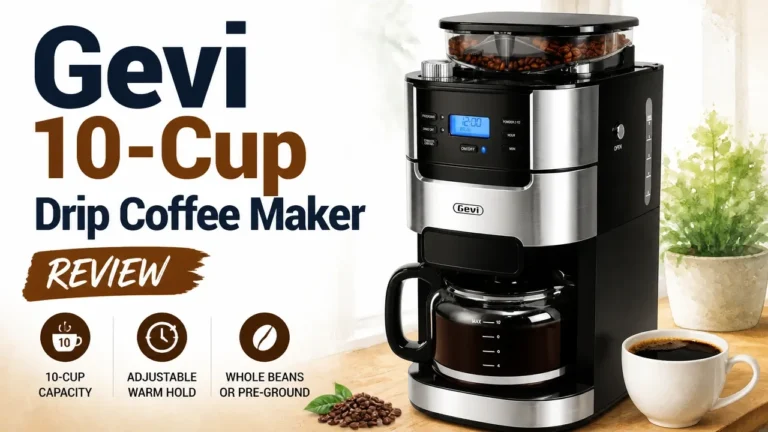

The Gevi 10-Cup Drip Coffee Maker occupies a genuinely useful niche: a sub-$200 grind-and-brew machine that collapses your morning routine into a single countertop appliance. For the right person, it’s a quietly competent daily driver. For the wrong one, it’s an expensive lesson in why all-in-one convenience has a floor.
Understanding which camp you fall into comes down to one honest question-not “is this a good coffee maker?” but “good for whom?” The answer shapes everything that follows.
If a 10-cup capacity feels a bit too restrictive for your household’s daily caffeine consumption, you might want to explore alternatives like large capacity 14 cup makers instead.
This Coffee Maker Is Not for Coffee Snobs (And That’s Exactly the Point)
The Gevi 10-Cup Drip Coffee Maker has a split personality problem-and the internet makes it impossible to ignore. On Amazon, it holds a 4.2-star rating across 1,239 reviews, with over 900 units sold in a single month. On the manufacturer’s own site, a curated 4.8 out of 5 from 207 reviews. Meanwhile, at least one professional reviewer landed here, brewed a pot, and described the result as tasting like “the stuff they put in cleaning products to deter kids from drinking it.”
So which version is true? Both, actually-and that’s the point.
The gap between those verdicts isn’t a mystery. It’s a signal. It tells you exactly what kind of drinker this machine was built for, and exactly what kind of drinker will leave a furious one-star review after two weeks. The expert’s “vile” verdict came from someone applying specialty-coffee standards to a budget convenience machine. The 4.2-star army is made up of people who wanted hot, fresh-ground drip coffee waiting for them when they stumbled into the kitchen at 6 a.m.-and got it.
Here’s what the manufacturer itself says, buried in the product FAQ: “We recommend avoiding dark roast beans. Their oils tend to clog the grinder.” A brand voluntarily warning you away from an entire roast category is not a red flag-it’s a rare moment of product honesty. Pay attention to it.
One Amazon reviewer captured the machine’s real-world quirk with the kind of specificity that only comes from daily use: the grinder “has to be babysat because the beans don’t always move down. I have to take the lid off and move them myself.” That’s not a dealbreaker for someone who makes coffee at home in pajamas. It’s an absolute dealbreaker for someone who expects a set-it-and-forget-it appliance.
The Gevi is a budget-friendly, all-in-one convenience machine built for casual drinkers who prioritize simplicity over specialty-grade extraction. It will frustrate anyone who demands precision, speed, or light-roast clarity. Read that sentence twice before scrolling further.
Freshly Ground Coffee on Autopilot: Why Casual Drinkers Love This Machine
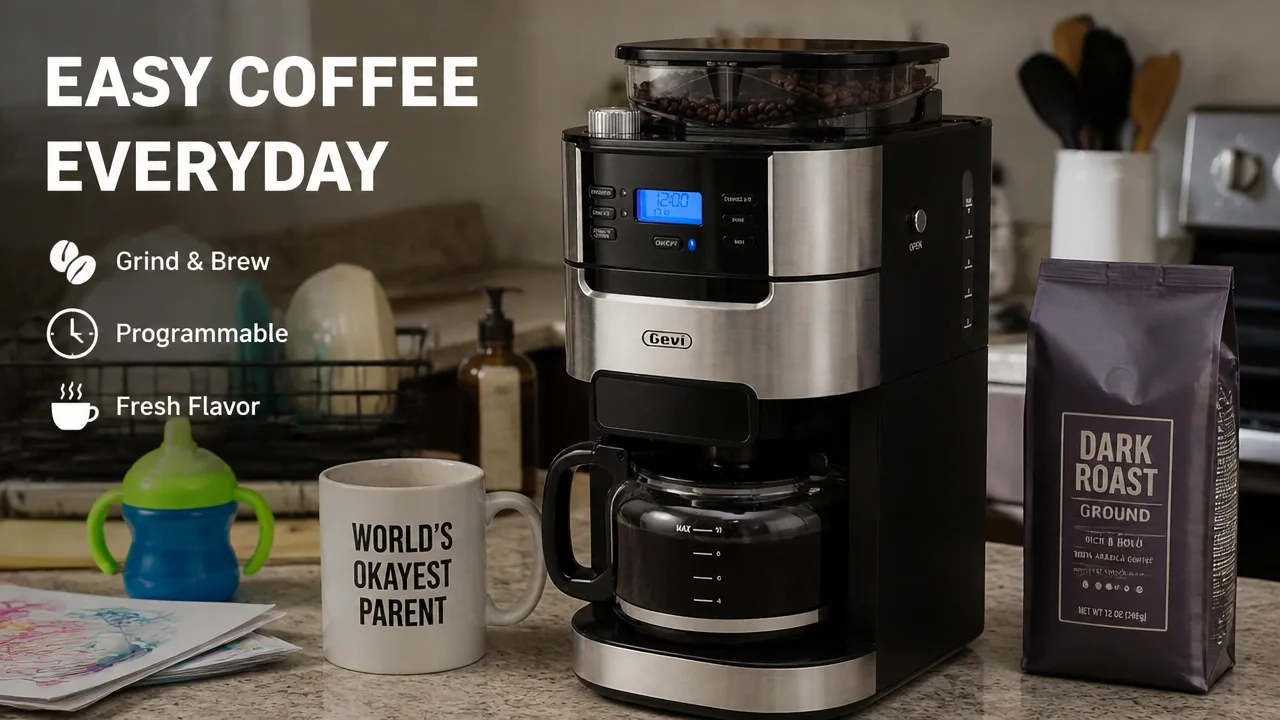
For the budget-conscious, convenience-first coffee drinker, the Gevi delivers exactly what it promises. One appliance. Whole beans in the top. Hot coffee in the carafe. No separate grinder, no paper filters to run out of, no scooping and measuring before your eyes are fully open.
The feature set is legitimately practical for this use case. The machine brews anywhere from 2 to 10 cups, automatically adjusting the water-to-coffee ratio based on your selection-a small detail that matters when you’re making two cups on a Tuesday and a full pot on Sunday morning. You get 3 strength levels and 8 grind settings, which is more granularity than most casual drinkers will ever use, but the headroom is there if you want to dial things in over time. A 24-hour programmable timer means you can load it the night before and wake up to a machine that’s already done the work. There’s also a “GRIND OFF” mode for days when you want to run pre-ground coffee through it instead.
The reusable permanent filter is a genuinely underrated inclusion at this price point. No paper filter subscription, no last-minute grocery runs. Just rinse and reload.
User feedback on the core experience is consistently warm. “It is fully customizable, easy to clean, grinds and brews perfectly. No measuring and scooping. It’s all self contained,” one Amazon buyer wrote-and that sentence reads like a mission statement for the machine’s target audience. Another noted: “Makes great coffee. The grind and boldness selectors let you vary the strength of the brew.” After some setting experimentation, Quora users with similar grind-and-brew machines report landing on “very good and consistent coffee” once they’ve found their preferred configuration.
Gevi’s “pre-brew technology”-a brief saturation phase before full extraction begins-is listed as a flavor-enhancing feature. In practice, it’s the machine’s way of mimicking the bloom step that manual brewers do intentionally, letting CO₂ escape from fresh grounds before the main pour. Whether it makes a perceptible difference at this price tier is debatable, but the mechanism is real coffee science applied to a convenience format.
The current price sits at $139.98 (marked down 22% from $179.99), which positions it as a low-risk entry for someone who wants the grind-and-brew experience without committing to a premium system. The trade-off is real: the all-in-one design forces compromises in grinder consistency and noise output. For the casual drinker, those are acceptable costs. For anyone else, they’re the beginning of the problem.
Here’s a closer look at how the machine performs in real kitchen conditions:
Those prioritizing automated morning routines frequently weigh these traditional grind-and-brew appliances against smart WiFi coffee makers for remote scheduling capabilities.
Specs, Costs, and the Nitty-Gritty: Everything You Need to Know
Every number and detail you need to make a clear-eyed decision, in one place.
| Spec | Detail |
|---|---|
| Dimensions | 12.36″D × 8.37″W × 16.93″H |
| Weight | 9.9 lbs |
| Wattage | 900 W, 120 V / 60 Hz |
| Capacity | 10 cups (1.5 L) |
| Body Material | Plastic with stainless steel accents |
| Carafe | Glass (with warming plate) |
| Brew Temperature | ~75°C (167°F) fresh; warming plate ~73°C (163.4°F) |
| Brew Time | ~16 minutes (measured by independent reviewer) |
| Grinder Type | 8-level conical burr |
| Hopper | Non-airtight |
| Strength Settings | 3 levels (Regular, Strong, Bold) |
| Programmability | 24-hour timer |
| Included Components | Coffee maker, glass carafe, scoop, permanent filter, manual |
| Replacement Carafe | $24.99 |
| Replacement Ground Filter | $19.99 |
| Replacement Bean Hopper | $22.99 |
| Warranty | 1-year limited; optional extended 2–3 years ($9.99–$18.99) |
| Amazon Rating | 4.2 / 5 (1,239 reviews) |
| Best Seller Rank | #40 in Coffee Machines |
The non-airtight hopper is the spec that matters most for bean freshness. Whole beans exposed to air, light, and heat oxidize faster than sealed storage allows. If you’re buying fresh-roasted beans and storing them in the hopper for days, you’re accelerating staling. The practical workaround: load only what you’ll use in the next day or two.
On maintenance, the grinder cleaning process requires tilting the machine and brushing out the grounds compartment through a steel baffle-weekly, per manufacturer guidance. The flashing-lights error (both PROGRAM and ON/OFF lights blinking simultaneously) has appeared in multiple user reports; the fix is simply unplugging the unit and restarting. Not catastrophic, but worth knowing before it happens at 7 a.m.
For live pricing and availability, check the current Amazon listing directly:
This post contains affiliate links, meaning I may earn a commission if you make a purchase through these links, at no additional cost to you. As an Amazon Associate, I earn from qualifying purchases. I only recommend products I genuinely believe will add value.
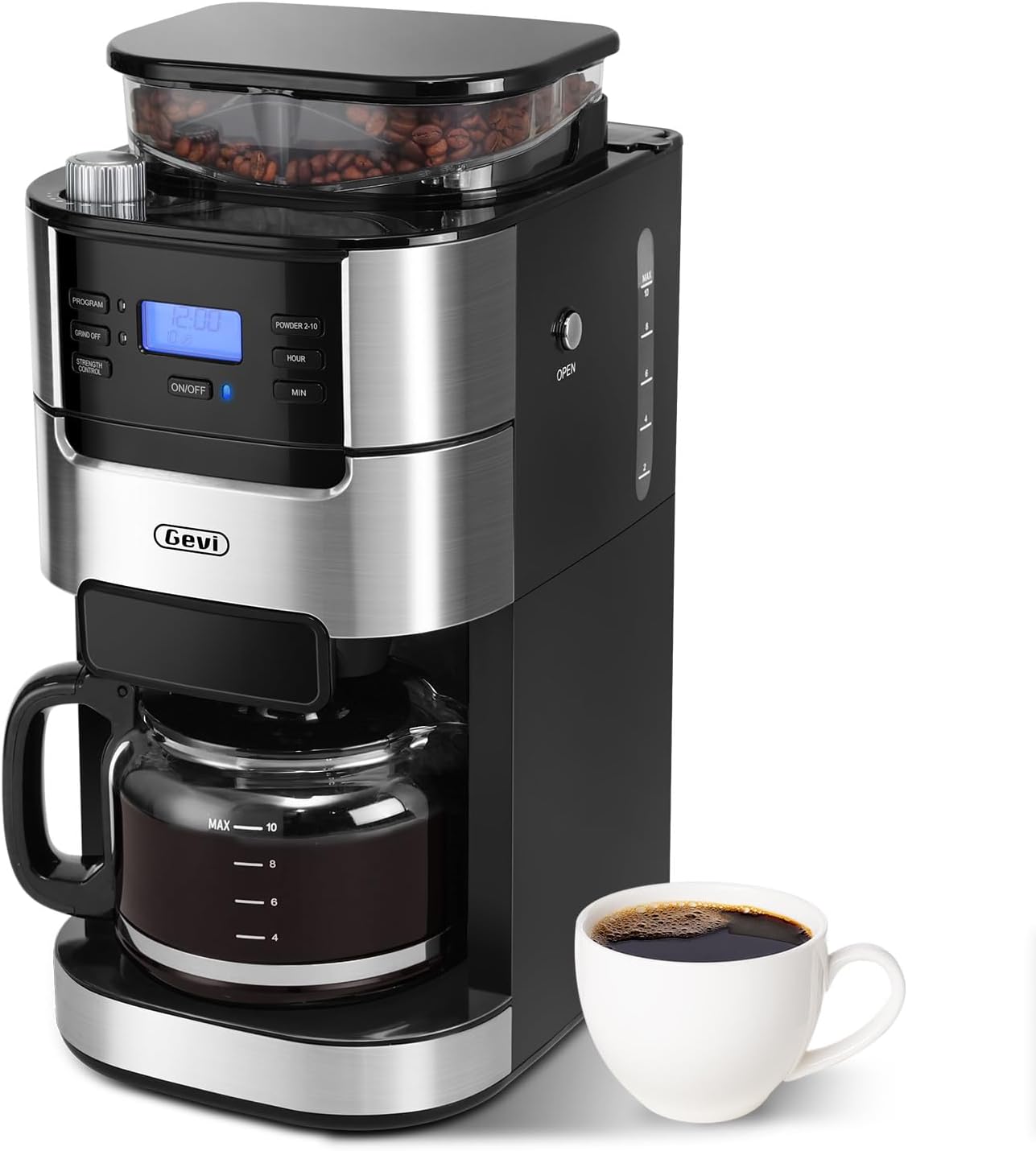
Gevi 10-Cup Grind-And-Brew Drip Coffee Maker with Built-In Burr Grinder
- 【𝟐-𝟏𝟎 𝐂𝐮𝐩 𝐕𝐞𝐫𝐬𝐚𝐭𝐢𝐥𝐢𝐭𝐲】Enjoy the perfect amount of coffee every time with this drip coffee maker and built-in g…
- 【𝐅𝐮𝐥𝐥𝐲 𝐂𝐮𝐬𝐭𝐨𝐦𝐢𝐳𝐚𝐛𝐥𝐞 𝐁𝐫𝐞𝐰𝐢𝐧𝐠】Take control of your coffee experience. Choose from 3 strength levels and 8 grind …
- 【𝐂𝐡𝐞𝐜𝐤 𝐘𝐨𝐮𝐫 𝐂𝐚𝐛𝐢𝐧𝐞𝐭 𝐂𝐥𝐞𝐚𝐫𝐚𝐧𝐜𝐞】Before you buy, be sure to measure your space. With dimensions of 12.36"D x 8.38…
- 【𝐄𝐜𝐨-𝐅𝐫𝐢𝐞𝐧𝐝𝐥𝐲 𝐑𝐞𝐮𝐬𝐚𝐛𝐥𝐞 𝐅𝐢𝐥𝐭𝐞𝐫】Say goodbye to paper filters. This coffee machine includes a durable, reusable f…
- 【𝐏𝐫𝐞𝐜𝐢𝐬𝐢𝐨𝐧 𝐏𝐫𝐞-𝐁𝐫𝐞𝐰 𝐓𝐞𝐜𝐡𝐧𝐨𝐥𝐨𝐠𝐲】Unlock richer aroma and deeper flavor with pre-brew technology. By gently satur…
Where the Gevi Fits in the Coffee Maker Jungle
The Gevi 10-Cup Drip Coffee Maker occupies a specific and genuinely underserved market slot: a sub-$200 drip machine with an integrated burr grinder. That combination is rarer than it sounds. Most machines in this price tier force you to choose between convenience and freshness. The Gevi attempts both.
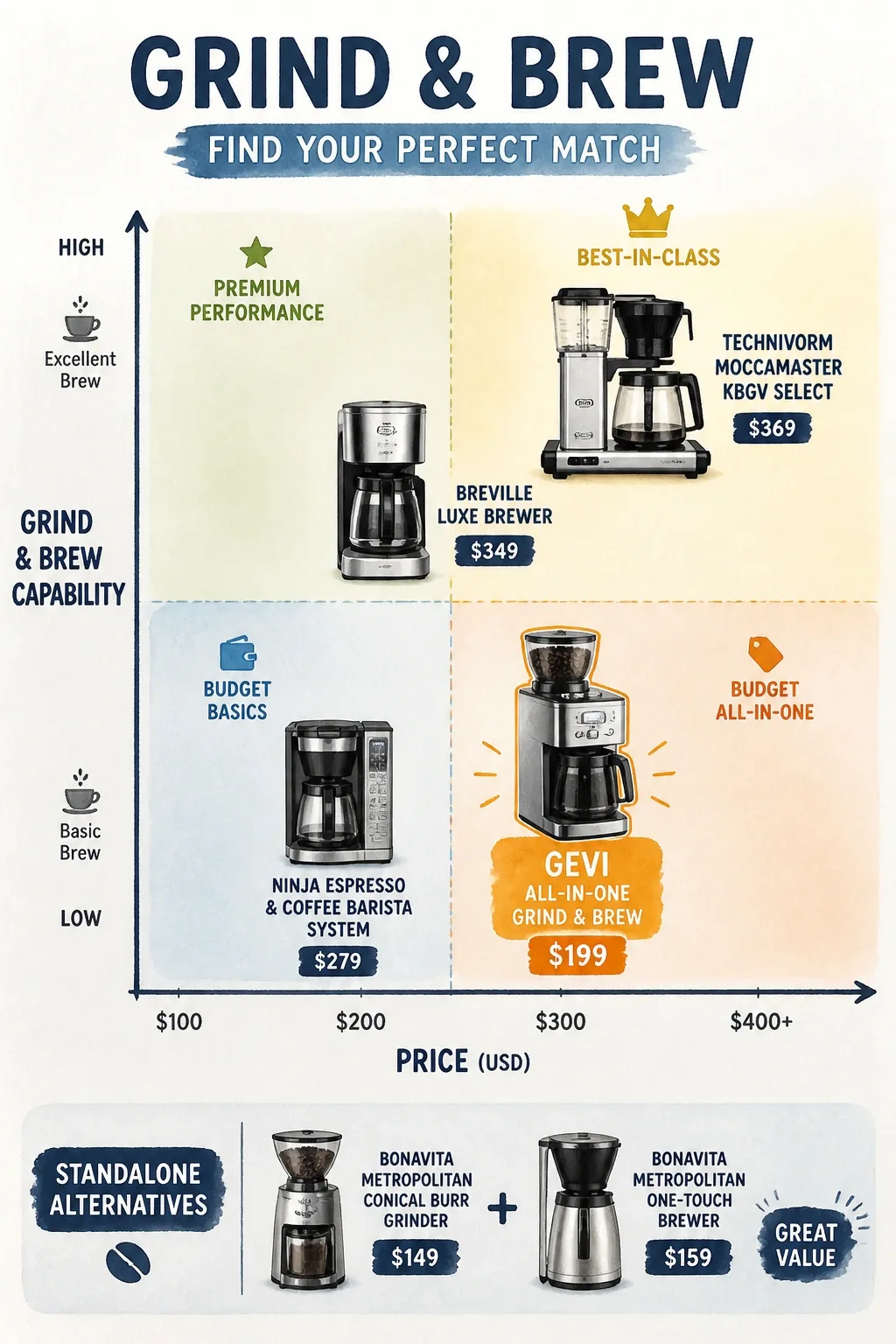
Here’s how it sits relative to the alternatives actually worth comparing:
| Machine | Price | Grinder | Carafe Type | Best For |
|---|---|---|---|---|
| Gevi 10-Cup Grind & Brew | ~$140 | Built-in burr (8 settings) | Glass + warming plate | Budget grind-and-brew convenience |
| Ninja Espresso & Coffee Barista System | ~$279 | Separate required | Thermal + glass options | Multi-format brewing, more versatility |
| Breville Precision Brewer Luxe | ~$349 | Separate required | Thermal | SCA-certified, precision temperature control |
| Technivorm Moccamaster KBGV Select | ~$369 | Separate required | Thermal | Premium drip, longevity, serviceability |
| Bonavita Metropolitan | ~$100–$130 | Separate required | Thermal | Budget SCA-certified brewing |
The more interesting comparison is against the modular budget option: a Bonavita Metropolitan (~$115) paired with a dedicated entry-level burr grinder (~$50–$150). That combination costs similar money, occupies more counter space, and requires more manual steps-but it will produce meaningfully better coffee. The Gevi’s value proposition is specifically the single-appliance simplicity, not the extraction quality.
The glass carafe with warming plate (versus the thermal carafes on premium machines) is the design decision that keeps costs down but introduces a flavor trade-off: coffee sitting on a warming plate continues to cook slowly, turning bitter and flat within 30 to 45 minutes. If you’re the type who brews a full pot and nurses it over two hours, a thermal carafe is worth the upgrade investment.
Buyers seeking automated single-serve convenience without a built-in grinder might also explore alternatives like the De’Longhi True Brew maker.
Why This Machine Isn’t for Everyone (And That’s Okay)
The Gevi’s limitations aren’t design flaws-they’re design choices made to hit a price point. Understanding which choices were made, and why they matter, is what separates a satisfied buyer from a frustrated one.
The grinder is where the machine’s budget origins are most visible. An independent reviewer ran a sieve test on the grounds it produced and found that 50% of the coffee passed through an 800-micron sieve and 50% did not-a spread that indicates wildly inconsistent particle sizes. In coffee extraction, particle consistency is everything. Coarse particles under-extract (thin, sour, weak). Fine particles over-extract (bitter, harsh). When you have both in the same brew, you get both problems simultaneously, and no amount of strength-level adjustment fully compensates for it.
Barista Hustle, one of the most widely respected coffee education platforms used by professional barista trainers worldwide, has long emphasized that grind consistency is the single variable with the greatest impact on extraction quality-particularly for light roasts, where the narrow margin between under- and over-extraction demands near-uniform particle size to achieve flavor clarity.
This is the precise reason light roasts fail in the Gevi. Light-roasted beans are denser, require higher extraction temperatures, and have almost no margin for inconsistency before the cup turns either astringent or hollow. A grinder producing a bimodal particle distribution-half coarse, half fine-cannot reliably extract a light roast. The same reviewer who ran the sieve test described the resulting cup as “utterly vile … bitter nail polish” even when using pre-ground specialty coffee, suggesting the machine’s water temperature or showerhead distribution may compound the grinder’s inconsistency.
The 16-minute brew cycle is another friction point. For someone using the programmable timer, it’s irrelevant-the coffee is ready when they walk into the kitchen. For someone brewing on demand, it’s a genuine inconvenience that most competing machines at this price don’t impose.
The manufacturer’s own FAQ acknowledges that oily dark-roast beans may stick to the grinder blades and recommends light or medium roasts instead-which creates an ironic constraint: the machine performs best with the roast style it’s least equipped to extract well. Medium roasts sit in the sweet spot; they’re forgiving enough that grind inconsistency matters less, and their oils are moderate enough not to gum up the burrs.
The non-airtight hopper means beans loaded and left for several days will oxidize noticeably. It’s not a catastrophic problem, but it does undercut the “fresh-ground” promise if you’re not loading fresh beans daily.
On reliability, durability concerns appear with enough frequency in the Amazon review pool to take seriously. Multiple buyers report machines failing after two to four months of regular use. The one-year warranty provides a backstop, but the pattern is worth factoring into the total cost of ownership-especially if you’re a daily user.
For the target buyer-someone using medium roasts, running the programmable timer, and not particularly troubled by a bit of grinder noise-none of these are dealbreakers. They’re the acceptable friction costs of a $140 all-in-one appliance. For anyone else, they’re the beginning of a frustrating relationship.
The Verdict: Buy This If… Skip This If…
The Gevi 10-Cup Drip Coffee Maker earns its place on the counter for exactly one type of person. The honest job here is to tell you clearly whether that’s you.
Buy this if:
- You want a single appliance that grinds whole beans and brews drip coffee on a programmable timer
- You primarily drink medium or darker medium roasts (not dark-dark, per the manufacturer’s own warning about oily beans)
- You don’t mind a 16-minute brew cycle because you’re using the timer anyway
- You’re willing to occasionally assist stubborn beans back toward the grinder
- You want to eliminate both a separate grinder and paper filters from your counter and routine
- $139.98 is a comfortable price for a convenience upgrade, not a serious investment
Skip this if:
- You care about extraction clarity, flavor nuance, or light-roast brightness
- You want a machine that brews in under 10 minutes on demand
- You plan to run high-quality, freshly roasted beans through it and expect them to shine
- You expect zero maintenance quirks in an appliance at this price
- Durability is a primary concern-the failure reports at the 2–4 month mark are real enough to weigh
For Specialty Coffee Lovers: A Better Path
If you’re in the “skip this” column, here’s the alternative framing that actually serves you: stop trying to find one machine that does everything, and spend the same money on two machines that each do one thing well.
Scott Rao, a coffee researcher and author whose work is used as curriculum in professional barista training programs globally, has consistently argued that separating the grinding and brewing functions-using purpose-built equipment for each-is the most reliable path to extraction consistency for home brewers who want café-quality results.
The practical execution of that principle at a budget level: a Bonavita Metropolitan ($100–$130), which is SCA-certified for brew temperature and saturation, paired with a Baratza Encore grinder ($150), gives you dramatically better grind consistency and water temperature stability than any all-in-one machine under $300. Yes, it’s two appliances. Yes, it costs more. But the coffee it produces operates in a different league.
For those with more room in the budget, the Technivorm Moccamaster KBGV Select ($369) with a separate dedicated grinder is the benchmark for drip coffee done without compromise-and it’s built to last a decade.
The Gevi’s $139.98 price tag makes it a genuinely low-risk entry point for the casual drinker. For the specialty enthusiast, that same money is better allocated toward the modular path. The right tool for the right person makes all the difference-and knowing which tool you actually need is the whole point.
Key Takeaways on the Gevi 10-Cup Drip Coffee Maker
- The 4.2-star rating and one expert’s “vile” verdict are both correct-they describe the same machine from two completely different use cases.
- Grind inconsistency is the machine’s core limitation: a 50/50 split across an 800-micron sieve means light roasts will always underperform.
- The manufacturer explicitly warns against dark-roast beans; medium roasts are the sweet spot this machine was actually designed for.
- A 16-minute brew time only becomes a problem if you’re not using the 24-hour programmable timer-plan accordingly.
- The non-airtight hopper accelerates bean staling; load only what you’ll use within a day or two for the freshest result.
- For specialty coffee drinkers, a Bonavita Metropolitan plus a Baratza Encore grinder delivers far superior results for a comparable or slightly higher total investment.
Frequently Asked Questions About the Gevi 10-Cup Drip Coffee Maker
Can you use pre-ground coffee in the Gevi without running the grinder?
Yes. The “GRIND OFF” mode lets you bypass the grinder entirely and brew with pre-ground coffee, which is useful if you have a bag you’ve already opened or want to use a different grind size than the built-in burrs can produce.
Why does the Gevi recommend against dark roast beans?
Dark roasts have a higher oil content, and those oils coat and eventually gum up the burr grinder over time. The manufacturer explicitly flags this in the product FAQ. Medium roasts are the practical ceiling for this machine’s grinder longevity.
How do you fix the flashing lights error on the Gevi?
When both the PROGRAM and ON/OFF lights blink simultaneously, the fix is simple: unplug the machine, wait about 30 seconds, and plug it back in. It’s a reset loop, not a hardware failure-but it’s worth knowing before it happens mid-morning.
Is the Gevi’s brew temperature hot enough for a proper extraction?
It brews at approximately 75°C (167°F), which is below the SCA-recommended range of 90–96°C (195–205°F) for optimal extraction. This is one reason specialty beans and light roasts underperform-the water temperature isn’t high enough to fully extract their more complex compounds.
What happens to coffee left on the Gevi’s warming plate for more than an hour?
The warming plate holds coffee at around 73°C (163.4°F), which is enough to keep it warm but also enough to slowly cook it. Expect noticeable bitterness and flatness after 30 to 45 minutes. If you brew a full pot and drink it slowly, a thermal carafe machine is a better fit.
How often does the Gevi’s grinder need cleaning?
Gevi recommends weekly cleaning: tilt the machine, slide back the steel baffle in the grounds compartment, and brush out residual grounds. Skipping this-especially if you’ve accidentally used oilier beans-leads to grinding slowdowns and feeding issues.
Does the Gevi work well for small batches, like two cups?
The machine has a “POWDER 2-10” button that automatically adjusts the water-to-coffee ratio for smaller servings. User feedback on small-batch performance is generally positive, though brewing two cups in a 10-cup machine always involves some efficiency trade-off in heat retention.
What’s the actual warranty coverage, and is the extended plan worth it?
The standard warranty is one-year limited. Extended protection runs $9.99 to $18.99 for up to three years. Given the durability concerns that appear in the Amazon review pool-multiple users reporting failures at the two-to-four month mark-the extended plan is worth serious consideration if you’re a daily user.
References
- Barista Hustle – baristahustle.com
- Scott Rao – scottrao.com