
Salada Foods Jamaica Ltd has reported a sharp improvement in profitability and margins for the quarter and nine months ended June 30, 2026, as the Jamaican coffee and beverage maker continues to benefit from new products and export gains despite earlier cost pressures and weather-related setbacks.
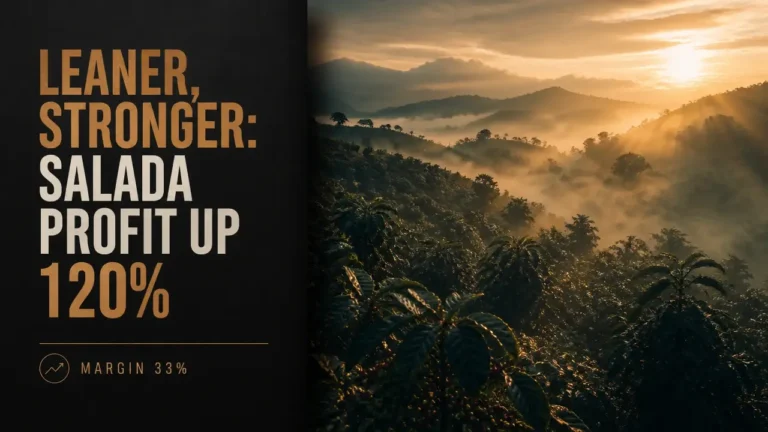
According to the Financial Gleaner, net profit for the June quarter rose to $68.3 million, more than double the $31 million earned a year earlier, a 120 per cent increase, while revenue climbed 16.1 per cent to $443.4 million from $381.9 million. Gross profit for the three months rose 29.7 per cent to $146.2 million, and the gross margin widened to 33 per cent from 29.5 per cent.
The Gleaner reported that operating profit for the quarter surged 148.6 per cent to $87.4 million from $35.1 million in the June 2025 quarter, while profit before tax more than doubled to $91 million from $41.3 million. Administrative expenses fell by 29.1 per cent to $41.7 million from $58.9 million, and selling and promotional expenses declined 8.6 per cent to $17.5 million from $19.2 million, bringing those cost lines down to 10.1 per cent and 5.0 per cent of revenue respectively, compared with 12.9 per cent and 5.2 per cent a year earlier.
On a year-to-date basis, the company’s nine-month revenue reached $1.28 billion, up 11.5 per cent, while net profit increased 40.6 per cent to $168.5 million, the Gleaner said. A separate review by Mayberry Investments cited a similar revenue figure and described a 12 per cent top-line increase versus $1.15 billion in the prior-year period, with net profit of $168.51 million representing a 41 per cent gain from $119.82 million.
Mayberry reported that nine-month gross profit increased by 16 per cent to $406.63 million compared with $349.47 million a year earlier, after cost of sales rose 9 per cent to $875.59 million. Operating profit for the nine months amounted to $215.08 million, up 51 per cent from $142.33 million in 2025, while profit before taxation climbed 41 per cent to $224.68 million. The firm said selling and promotional expenses rose 6 per cent to $63.68 million even as administrative expenses decreased 13 per cent to $129.24 million.
The stronger earnings have translated into improved cash generation. The Gleaner reported that net cash provided by operating activities swung to $148.2 million for the nine months ended June 30, 2026, from an operating cash outflow of $57.1 million in the corresponding period last year. Cash and cash equivalents closed the period at $157.4 million, more than double the $68.9 million held a year earlier, while total assets stood at approximately $1.58 billion.
In addition to the operational gains, the Gleaner noted that the company declared an interim dividend of $0.069 per stock unit, payable on June 30 to shareholders on record as at June 8. Mayberry calculated that as at August 7, 2026, Salada’s stock price of $2.54, using a twelve-month trailing earnings per share of about $0.21, implied a price-earnings ratio of roughly 11.
The latest quarter’s performance comes after a more difficult prior year, when, according to the Gleaner, the June 2025 quarter was affected by one-off redundancy costs and a 5.8 per cent decline in domestic sales that cut earnings by more than half. The Jamaica Observer previously reported that revenues for the first quarter ended December 31, 2025, fell nearly 10 per cent to $360.4 million, with net profit down 36 per cent to $32.1 million, partly reflecting the impact of Hurricane Melissa on the agricultural sector.
Since then, the Observer said, sales recovered, with gross revenue for the six months ended March 31, 2026 rising 9.2 per cent year-on-year to $838.8 million and the March quarter alone delivering a 29.4 per cent revenue increase to $478.4 million. Over that half-year, gross margin improved slightly to 31.1 per cent from 30.8 per cent, operating profit rose 19.2 per cent to $127.7 million, and net profit increased 12.8 per cent to $100.2 million.
Product development and new market channels have been central to the recent upturn. The Gleaner quoted General Manager Tamii Brown as saying, “We’re seeing the benefits of our efforts in the USA and the Caribbean. In the United States, we’re growing through some of the main supermarket chains in the South and through Amazon. In the Caribbean, we’re seeing growth primarily in Barbados. Our mainstay coffee line continues to grow in both the domestic and export markets.”
Salada’s diversification beyond core coffee lines has been underway for several years. The Observer reported that over the past five years the company has introduced about 12 new products, including ginger- and turmeric-based beverages, and that flavoured instant coffees launched in 2022 have seen strong local uptake. Brown told the Observer that the Jamaica Mountain Peak Golden Turmeric Latte remained the strongest single driver of growth as of the 2025 financial year, but that the Jamaica Mountain Peak Sorrel Hibiscus with Ginger, launched in November 2025, was already outperforming other recent launches in its first quarter.
Brown also told the Observer that the company had set a sales target for the Sorrel Hibiscus drink in the first quarter and surpassed that projection by over 30 per cent, with feedback described as “overwhelmingly positive” and no tapering off in demand. The Observer noted that the powdered instant beverage, sold under the Mountain Peak brand in 18-gram sachets, is positioned to tap into the United States instant tea market, where sorrel beverages account for an estimated US$50-million segment, and that the product uses English and Spanish packaging and has been added to the company’s online offerings through Amazon.
Even as Salada expands its product range and export reach, the Observer has highlighted ongoing pressures from elevated raw material prices and global supply chain volatility, as well as an inflationary environment that has encouraged tighter cost controls. Against that backdrop, Mayberry reported that Salada’s total assets at June 30, 2026 of $1.58 billion were up 9 per cent year-on-year, with increases in cash, property, plant and equipment, investments and inventories, while shareholders’ equity rose to $1.25 billion, equating to a book value per share of about $1.20.