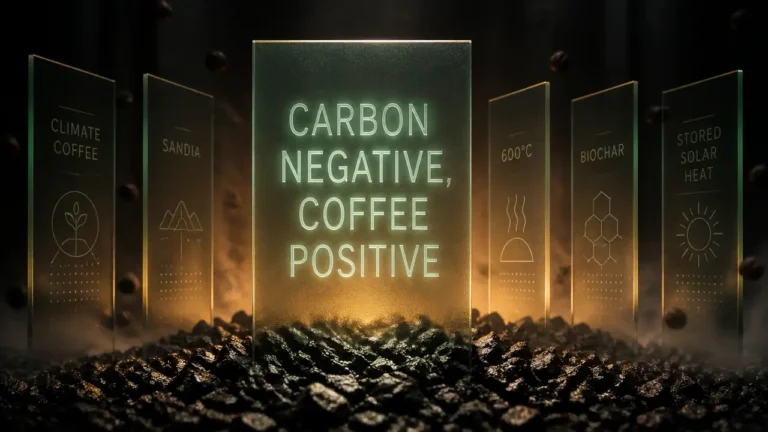

A Wyoming startup and a U.S. national laboratory are advancing very different technologies that both aim to cut fossil fuels out of coffee roasting, adding momentum to a growing wave of low‑carbon roasting experiments worldwide.
In Laramie, Wyoming, Climate Coffee, created by biochar equipment maker High Plains Biochar LLC, has developed what it describes as “the world’s first carbon-negative coffee roaster,” according to a report in the Laramie Boomerang. Founder Rowdy Yeatts told the newspaper that the system replaces a traditional propane flame with hot air generated from used coffee grounds, leaving behind carbon‑rich biochar intended for use in soils.
High Plains Biochar first outlined the concept publicly in October 2025, when a representative posting as “seanHPB” described “designing the worlds first carbon negative coffee roasting machine” on the Coffee Forums. The pilot unit was described as using a specialized version of the company’s patented RocketChar technology, burning spent coffee grounds and chaff to supply roasting heat while “simultaneously” eliminating electric or natural‑gas heat and producing biochar from the same waste streams.
According to the Laramie Boomerang, Climate Coffee currently collects used grounds from several Laramie cafés, including Starbucks Coffee Company, Turtle Rock Coffee & Cafe and Night Heron Books & Coffeehouse. The article reports that the operation is described as solar‑powered, drying and heating those grounds to create fuel for the roaster and producing a carbon‑rich char that can be returned to soil.
Yeatts told the Boomerang that this char is “a stable form of carbon that doesn’t go back into the atmosphere,” saying that instead of decomposing and releasing carbon back to the air, the material can be held in soils. He also said that while High Plains Biochar has already sold technology to a group in the Netherlands and has stoves deployed in parts of Africa, the coffee‑roaster application has helped the company find a way to expand in the United States.
The flavor and performance impacts of the new system are also framed as advantages by the company. “Where they would traditionally be using a propane flame heating the drum up, we’re pulling hot air through the process,” Yeatts told the Boomerang, claiming that indirect heat avoids scorching and creates a more even cook of the beans. The article notes that such carbon‑negative and flavor claims remain company statements without independent verification.
Alongside the Wyoming project, solar energy researchers are pursuing a different route to low‑carbon roasting. A report from specialty‑coffee publication Sprudge describes how the National Solar Thermal Test Facility at Sandia National Laboratories in Albuquerque, New Mexico, has developed a method that captures solar electricity via photovoltaic panels, then stores the heat in a “bed of rocks” used as a controllable heat source for roasting.
According to Sprudge, the Sandia system can reach temperatures of 600°C (1,100°F) and is being tested with Albuquerque roaster Michael Thomas Coffee. Owner Michael Sweeney told Sprudge that the set‑up is meant to be “not learning a new roasting machine,” but instead using a familiar roaster with “a different energy source.” In tests, he reported that dark roast times were cut by a few minutes compared with gas, and that roasting green chile showed more uniform results.
Sprudge reports that Sandia and Michael Thomas Coffee are aiming for a bolt‑on system that would allow existing gas roasters to run on stored solar energy, with enough capacity to power a roaster for days on a single charge. While no commercial launch timeline or cost details were cited, the goal outlined in the article centers on allowing roasteries to change their energy input without replacing core roasting equipment.
Both initiatives sit within a broader pattern of experiments with low‑carbon roasting energy. Sprudge’s report points to other examples, including Wonderstate Coffee’s solar‑powered facility in the U.S. state of Wisconsin, a desert solar‑roasting collaboration between coffee professional James Hoffmann and electric‑roaster maker Bellwether, and a concentrated‑sun mirror roaster developed by PuroSole in Italy.
Yeatts signaled expansion ambitions for Climate Coffee’s technology in a July 2026 LinkedIn post, writing that his team at High Plains Biochar had been working on “building the world’s first carbon-negative coffee roaster” and was “looking for partners to scale this disruptive technology world wide.” As of the latest reports, neither his project nor the Sandia stored‑solar system has publicly released independent emissions data, leaving the scale of their climate impact an open question even as low‑carbon heat sources gain visibility in coffee roasting.