

Measurable competition standards have reshaped how coffee professionals taste, buy, and build careers, but the industry’s account of that impact has a structural problem: every voice telling the story works inside the system. The World Barista Championship, the Cup of Excellence, and the SCA cupping protocol have genuinely changed professional practice. The question worth asking is which changes are documented and which are simply repeated until they feel true.
That distinction matters more now than it ever has. As specialty coffee businesses make real investment decisions around competition-grade sourcing, competition-aligned branding, and staff development through competition circuits, the gap between proven benefit and aspirational claim has direct financial consequences.
Key Takeaways on the Impact of Coffee Competitions on the Industry
- Competition parameters become professional calibration benchmarks through human diffusion: competitors become trainers, trainers become consultants, and protocols travel with them.
- The entire innovation diffusion argument in specialty coffee literature rests on one documented case; carbonic maceration is proof of concept, not proof of a pipeline.
- Cup of Excellence has distributed over $60 million to winning producers since 1999, but no published source documents what it costs producers to compete.
- Consumer preferences for acid-forward competition profiles are segmented, not universal; a significant portion of consumers respond negatively to increased sourness.
- Every published source on coffee competitions is an industry insider or advocacy organization; the unanimous praise reflects selection bias, not balanced assessment.
- The proven benefits of competition are sensory calibration, producer payment infrastructure, and professional network development; innovation diffusion and consumer relevance remain unverified claims.
The Standards Engine: How Competition Rules Shape Everyday Coffee
Competition standards don’t stay on stage. The mechanism by which World Barista Championship parameters move from a competition floor into a commercial kitchen is specific, traceable, and worth understanding before you decide whether any of it matters to your business.
Start with the numbers. The WBC requires competitors to work within defined extraction parameters: dose, yield, time, and temperature. These aren’t arbitrary constraints. They’re calibration benchmarks. When a competitor trains for months to hit a 36-gram yield from an 18-gram dose in 28 seconds at 93°C, they’re not just preparing for a performance. They’re internalizing a precision standard that they carry back into every café, roastery, and training room they enter afterward.
That’s the first diffusion channel: human beings.
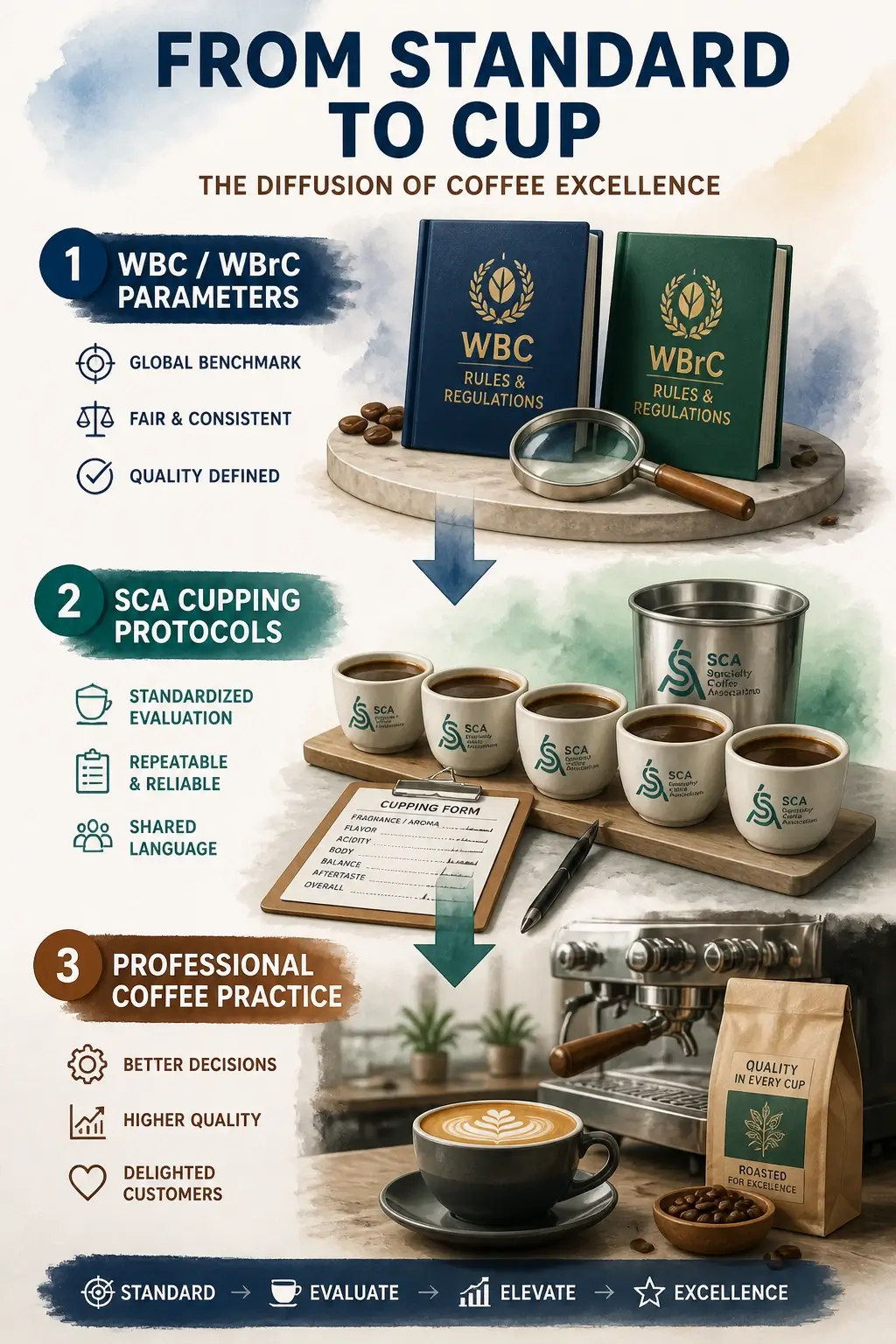
The second channel runs through language. Competition judging criteria force sensory attributes to become explicit and measurable. A judge can’t write “tastes good” on a scoresheet. They write acidity intensity, sweetness balance, aftertaste duration. That vocabulary doesn’t stay in the competition room either. It migrates into green coffee buying conversations, roast profile discussions, and quality control checklists because the people who learned it there are now doing those jobs.
The third channel is equipment. Gear that survives 15-minute WBC time pressure earns a credibility that no marketing campaign can manufacture. When a specific grinder or espresso machine proves reliable enough for a world-stage performance, commercial buyers take notice. Adoption follows. This isn’t theory. It’s the pattern that has repeated across multiple equipment categories over the past two decades.
The fourth channel is the professional network itself. Competitors become trainers. Trainers become consultants. Consultants write curricula for café chains. Each transition carries the competition protocol one step further from the stage and one step deeper into ordinary commercial practice. This is knowledge transfer through career movement, and it’s the most underappreciated diffusion mechanism in the entire system.
According to Valentina, Chief of Staff and Commercial Excellence at Dalla Corte, manufacturers who work closely with competition circuits observe these events functioning as active development environments rather than showcases. The pressure of competition accelerates the feedback loop between equipment performance and professional expectation, and the culture of open knowledge sharing that competitions encourage means findings spread faster than they would through conventional product testing channels.
That framing is useful because it names the mechanism precisely. Competitions don’t just display current best practice. They stress-test it in real time and broadcast the results to a professional audience that immediately begins applying what it learned.
Where the chain gets murkier is at the consumer end. The industry narrative holds that competition standards eventually reach home baristas through affordable precision gear, and that the sensory vocabulary developed in competition rooms eventually shapes how everyday coffee drinkers talk about their cups. That may be true in aggregate over time. But the evidence for it is largely anecdotal. The professional diffusion chain is documented. The consumer end of that chain is asserted.
According to Morgan Eckroth, 2022 US Barista Champion and content marketing specialist for Onyx Coffee Lab, the resource gap between independent competitors and those backed by well-funded operations is widening. High-end technology and access to exceptional competition lots increasingly require institutional support, which means the standards being set at the top of the competition circuit reflect what’s achievable with significant backing, not what’s replicable across the profession.
This is the tension the advocacy narrative tends to skip. The standards engine is real. But if the inputs required to compete at the highest level are increasingly out of reach for independent professionals, then the standards being set may be calibrating against a ceiling that most of the industry can observe but not reach.
The Innovation Pipeline: What Competition Breakthroughs Actually Reach the Market
Carbonic maceration is the one innovation from competition coffee that the entire industry agrees crossed into commercial adoption. Saša Šestić introduced the technique during his 2015 World Barista Championship win, and within a few years it appeared on roaster menus and café brew bars globally. That trajectory is real, documented, and genuinely significant.
It’s also the only example anyone can point to with that level of evidence.
Before examining what that means, the technique itself deserves a clear explanation. Carbonic maceration involves fermenting whole coffee cherries in a sealed, CO₂-rich environment before depulping. The process, borrowed from winemaking, produces distinct flavor compounds that don’t emerge through conventional wet or dry processing. Šestić didn’t just use an unusual coffee in his WBC routine. He introduced a processing methodology that roasters could adopt, producers could implement, and consumers could taste in the cup. That’s what made it transferable.
The WBC signature drink category offers a second, softer form of evidence. Trace the ingredient evolution from 2012 to 2024 and a pattern emerges: experimental flavor combinations that appear in competition routines show up on specialty café menus roughly 12 to 18 months later. Fermented fruit notes, savory additions, fat-washing techniques, unusual acidulants. The competition stage functions as a preview reel for where adventurous café menus are heading.
The industry treats this as a leading indicator. Whether it actually is one in a causal sense, or whether both competitions and forward-leaning cafés are simply drawing from the same pool of emerging ideas simultaneously, has never been systematically tested. The correlation is observable. The causation is assumed.
This distinction matters for how you interpret the “innovation” claim. There’s a meaningful difference between a competition technique that remains a performance artifact, executable only under controlled conditions with expensive inputs and weeks of preparation, and one that diffuses into commercial practice because it’s replicable at scale. Carbonic maceration cleared that bar. Most competition innovations don’t, and the ones that don’t are invisible in the published record precisely because nobody writes case studies about techniques that stayed on stage.
That’s survivorship bias operating as industry dogma. The carbonic maceration story gets cited repeatedly across specialty coffee literature as proof that competitions drive mainstream innovation. But it’s one data point being asked to prove a universal principle. The failed diffusion cases, the techniques that were spectacular in competition and commercially inert afterward, are absent from the record not because they didn’t happen but because the industry has no mechanism for documenting them.
For a professional evaluating competition-driven innovation as a business signal, the honest framing is this: competitions have demonstrated the capacity to generate commercially viable innovations. They have demonstrated it once, clearly and verifiably. The claim that they do so systematically requires more evidence than currently exists.
According to Vytautas, Founder of Huracán Coffee, the visible competition result is the surface of a much deeper system. The sourcing relationships, quality control infrastructure, logistics networks, and accumulated decisions from dozens of people over years are what actually produce the coffee that wins. The competition performance is the output of a system, not the system itself.
That reframe is important for understanding why innovation transfer is harder than it looks. When a competition technique succeeds commercially, it’s tempting to attribute that success to the competition exposure. But the underlying infrastructure, the producer relationships, the processing knowledge, the roasting precision, was already in place. Competitions accelerate visibility. They don’t always supply the capability.
Raising the Bar: Competition Standards as Quality Infrastructure
Cup of Excellence has built the most rigorous quality assessment infrastructure in the specialty coffee world, and its mechanics explain why competition-derived standards have genuine value beyond the stage.
The CoE protocol starts with an 87-point minimum score threshold. Coffees that don’t clear that bar don’t advance, regardless of origin story, producer reputation, or marketing. What survives that filter then faces multiple blind cupping rounds with international jury panels scoring against explicit sensory criteria. No name. No farm. No relationship. Just what’s in the cup.
That architecture does something specific. It decouples quality assessment from social capital. In a market where producer relationships, importer networks, and buying history heavily influence purchasing decisions, a blind multi-round jury system creates a data point that stands independent of those relationships. The score means something because the process that generated it was designed to resist the biases that typically contaminate quality claims.
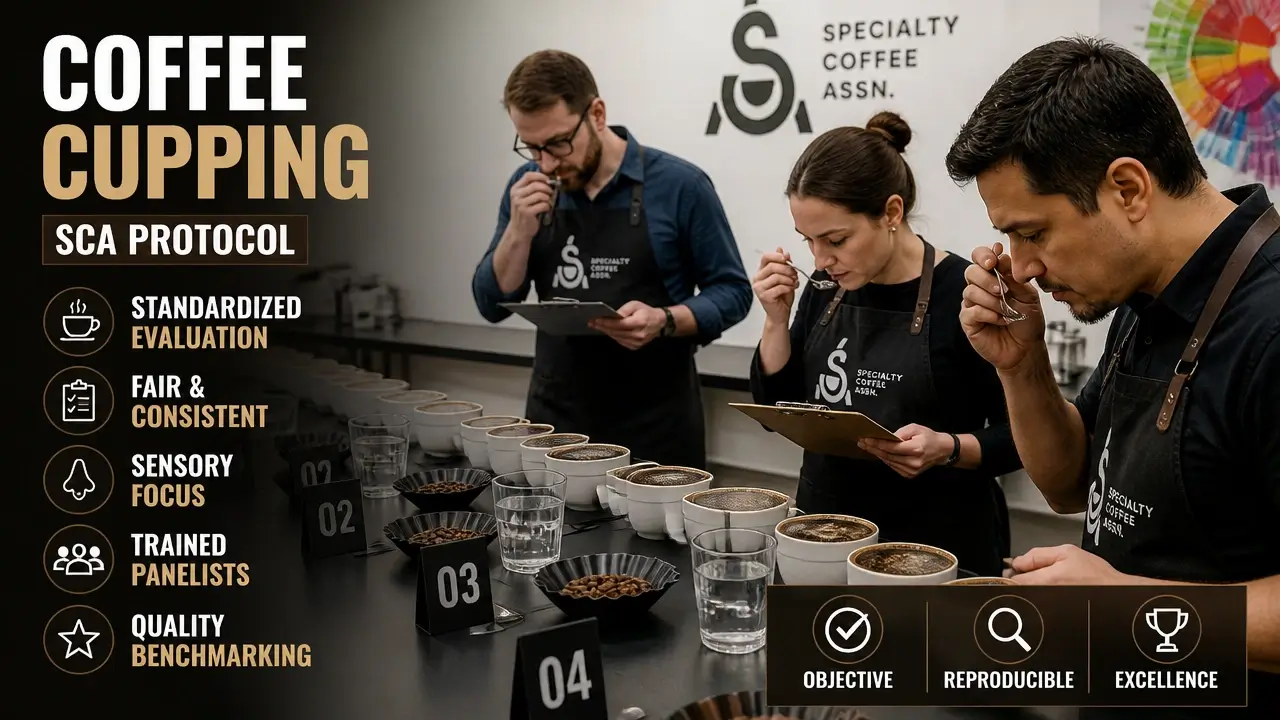
The calibration benefit extends beyond the competition itself. Competitors who train for WBC or WBrC events develop a specific skill: repeatable tasting accuracy. They taste the same coffee dozens of times and learn to describe what they perceive in terms that match what other trained tasters perceive. That skill transfers directly into buying decisions, roast profiling, and quality control because it’s the same cognitive operation applied to a different commercial context.
The vocabulary normalization effect compounds this. When competition judging criteria require measurable, communicable sensory attributes across international judging panels, they force the industry to agree on what words mean. “Bright acidity” has to mean the same thing to a judge in Seoul as it does to one in São Paulo. That standardization doesn’t happen automatically. Competition formats create the pressure that makes it happen.
The feedback loop to producers is where the system’s quality infrastructure function becomes clearest. As competition standards rise and producer knowledge of what “excellence” means becomes more specific, farming and processing decisions change. A producer who knows that fermentation control, cherry selection, and drying consistency are the variables that separate an 87-point lot from a 92-point lot has actionable information. The competition protocol converts sensory quality into a signal the supply chain can respond to.
According to Susie Spindler, Executive Director of the Alliance for Coffee Excellence and Co-Founder of Cup of Excellence, the program’s impact on information quality is as significant as its impact on price. Before CoE, the transparency of individual farm-level quality data simply didn’t exist at scale. The auction structure created a framework where that information became visible and tradeable, which changed what roasters could know about what they were buying.
The industry consensus, asserted by multiple sources across the specialty coffee literature, is that “the biggest beneficiary is the industry average” and that competitions “establish the current highest standard and build on it.” That framing is plausible given the mechanisms described above. But it’s worth noting that this is industry assertion. The claim that raising competition ceilings lifts the commercial floor has intuitive logic supporting it. It does not yet have longitudinal data confirming it.
According to Nestor Meneses, IHCAFE’s CoE Coordinator, the CoE process does more than measure quality. It documents the human effort behind it. The resilience and consistency that producers maintain through difficult conditions are made visible through the competition structure in a way that standard commodity trading never captures.
That visibility is itself a form of quality infrastructure. It creates a record that buyers, roasters, and consumers can reference. And it creates a reason for producers to maintain standards even when conditions make it difficult, because the documentation of that effort has market value.
The Producer Dividend: Economic Impact from Auction to Farm Gate
Cup of Excellence’s economic model is the strongest quantitative case for competition’s positive impact on producers, and the numbers are worth examining carefully, both for what they show and for what they leave out.
Since its founding, the Cup of Excellence program has distributed over $60 million in auction revenue directly to winning producers. – Source: Cup of Excellence
That figure is real and significant. The mechanism behind it is equally important to understand. CoE runs blind competitions that produce scored lots. Those lots then enter an international online auction where roasters bid against each other for limited quantities of verified, scored coffee. The highest bid for a single Panamanian Gesha lot reached $303 per pound at the 2021 auction. That number is a price signal, not an average. Most winning producers receive far less per pound. But even at moderate auction prices, the premium over commodity and standard specialty rates represents a substantial income difference for small-scale farmers.
The auction mechanism creates something that direct trade relationships don’t automatically provide: transparent price discovery. When multiple international buyers compete openly for the same lot, the price reflects genuine market demand rather than a negotiated arrangement between two parties with unequal information. For producers, this is the structural advantage. The competition doesn’t just validate quality. It creates a market event that converts that validation into revenue.
According to Darrin Daniel, ACE Executive Director, even in years of broader market uncertainty, CoE competition entries and auction participation have remained strong, suggesting that producers view the program as a viable economic pathway rather than a luxury exercise reserved for favorable conditions.
The investment incentive this creates runs in both directions. Producers who see the premium potential of auction-grade lots have a financial reason to invest in quality improvements: better cherry selection, more careful fermentation management, improved drying infrastructure. The competition doesn’t just reward existing quality. It creates an incentive structure that produces more of it.
The exclusivity premium extends into retail. Competition-grade cafés built around auction provenance and documented quality scores command prices that standard specialty cafés cannot. A $20-per-cup proposition only holds if the story behind the coffee is verifiable and differentiated. CoE auction documentation provides exactly that: a score, a farm, a country, a lot number, a price paid. That chain of custody has branding value that commands margin.
Here’s what the literature doesn’t tell you. There is no published break-even analysis for producers entering the competition circuit. The costs of preparing a competition lot, separating it from the rest of the harvest, maintaining the processing precision required to score above 87 points, and potentially losing that lot to a lower auction price than expected, are not documented anywhere in the specialty coffee literature. The $60 million is a gross revenue figure distributed across all winning producers since 1999. It says nothing about what producers spent to get there or whether participation is net-profitable for the majority of entrants.
For a roaster or café owner evaluating whether to build sourcing strategy around competition-grade lots, this gap matters. The auction mechanism works and the prices are real. The full economic picture for the producers at the other end of that transaction is simply not available in any published source.
Career Catalysts: Professional Trajectories After the Trophy
Competition visibility accelerates professional transitions in the coffee industry in ways that are observable even without systematic outcome data. The pathways are real. The conversion rates are unknown.
The most direct route runs from competition performance to brand representation. Equipment manufacturers, green coffee importers, and roasting companies all benefit from association with recognized competitors. A barista who places at WBC has demonstrated technical excellence under pressure in front of an international audience. That demonstration is worth more to a brand than most résumé credentials in the industry. Ambassador roles, sponsored appearances, and co-developed products follow from that visibility because the competition result functions as third-party validation.
Understanding the differences between major competitions matters here because the career trajectories they produce aren’t identical. The World Barista Championship creates espresso-focused visibility that maps directly onto equipment and espresso-centric brand partnerships. The World Brewers Cup opens different doors: filter coffee roasters, origin-focused importers, and the growing segment of cafés built around manual brewing programs. Competitors who understand which circuit aligns with their target career direction compete more strategically.
The training and consulting pathway is equally well-documented in practice if not in data. Competitors who develop systematic preparation methodologies, including the sensory calibration, extraction science, and presentation skills that competition requires, become valuable teachers. Café chains, roasting companies, and barista schools hire from competition circuits because the training rigor produces people who can articulate and transmit what they know.
The Starbucks Global Barista Championship demonstrates what competition infrastructure looks like at corporate scale. With approximately 14,000 managers participating as of June 2025, the program creates an internal career advancement structure that operates entirely outside the open-format specialty circuit. Performance in that system produces promotion pathways, recognition, and institutional credibility within one of the world’s largest coffee employers. This is a fundamentally different use case from the independent specialty circuit, but it illustrates how competition formats create career advancement mechanisms wherever they’re deployed.
The storytelling dimension of competition scoring is underappreciated as a career development tool. WBC judging criteria require competitors to communicate sensory experience, origin context, and processing decisions to non-specialist judges in real time. That’s a specific communication skill. The professionals who develop it through competition preparation find it transfers directly into consumer education, marketing content, and training delivery, roles that the growing specialty coffee market consistently needs filled.
The honest limitation is this: no published source tracks what happens to competitors after the trophy. What percentage remain in coffee five years later? At what income levels? Which competition backgrounds correlate most strongly with commercial success? The industry celebrates its champions without systematically studying their outcomes, which means the career catalyst claim is based on observable examples rather than population-level evidence.
The Unspoken Ledger: Costs, Gatekeeping, and the Consensus Problem
Every published source on coffee competitions presents the system as an unqualified positive force. That uniformity is itself the most important data point in this section.
Understanding the internal mechanics of scoring and the pressures of the evaluation panel often requires looking beyond the competitor experience toward the path to competition judge.
Financial Barriers, Gatekeeping, and Environmental Costs of Coffee Competitions
The financial barrier to serious competition participation is structural, not incidental. A competitive season involves international travel to regional and national qualifiers, accommodation, entry fees, and equipment transport. Coaching from experienced competition mentors commands professional rates. Green coffee sourcing for competition lots, where the goal is a genuinely exceptional and differentiated cup, means paying premium prices for small quantities from specific origins, often through relationships that take years to build.
No published source provides actual cost figures for a competitive season. That absence is itself informative. The industry discusses competition costs the way it discusses competition itself: in terms of value received rather than price paid. What’s clear from the cost categories alone is that a barista without employer sponsorship, established industry relationships, and access to capital faces a fundamentally different competitive landscape than one backed by a well-resourced roastery or equipment brand.
The gatekeeping dimension compounds this. International competition circuits require travel capacity that excludes large portions of the global coffee workforce. A skilled barista in a producing country faces visa barriers, airfare costs, and logistical challenges that a competitor based in a major specialty coffee hub does not. The result is a competition ecosystem that sets global standards while drawing its participants disproportionately from regions with the financial infrastructure to support competition careers.
The environmental cost sits alongside the economic one. Global competition circuits generate significant carbon footprints: international air travel for competitors, judges, and observers, plus the shipping of single-origin green coffee lots from producing countries to competition venues. The specialty coffee industry increasingly discusses sustainability at the farm level. The carbon accounting for competition logistics receives considerably less attention.
Sensory Mismatch, Consensus Problems, and Reform Trajectories in Coffee Competitions
The sensory profiles that win competitions and the flavor profiles that most consumers prefer are not the same thing. This isn’t a minor calibration issue. It’s a structural tension between what the competition system optimizes for and what the broader market actually buys.
Competition judging rewards complexity, clarity, and intensity, particularly the kind of brightness and acidity that trained palates identify as markers of quality processing. But consumer preferences for sourness are not uniform.
A peer-reviewed study published in Food Quality and Preference examining hedonic responses to sourness across U.S. and Italian cohorts identified three distinct consumer segments: a strong negative group whose preference declined as sourness increased, an intermediate group with a muted response, and a strong positive group whose preference increased with more sourness. These segments were consistent across both national cohorts and were not explained by age or gender. – From the study “Distinct sensory hedonic functions for sourness in adults“
What this means practically is that the acid-forward, fermentation-forward flavor profiles that dominate competition podiums actively repel a significant and measurable portion of potential coffee customers. The competition system is calibrating toward a sensory target that the majority of consumers may not share. For a café owner deciding whether to build a program around competition-grade profiles, that consumer segmentation data matters more than the industry’s enthusiasm for those profiles.
The consensus problem runs deeper than sensory preference. Every source in the published specialty coffee literature on competitions is an industry insider: manufacturers, competition organizers, champions, and advocacy organizations. The value of competing in coffee championships is a question that deserves independent analysis, but independent analysis doesn’t exist in the published record. What exists is a body of literature produced entirely by people who benefit from competition’s positive reputation.
This is manufactured consensus through selection bias. The absence of critical voices doesn’t mean the critics don’t exist. It means they haven’t been published in the venues where the industry reads about itself. For a professional reader, the correct response to unanimous praise from a single constituency is not confidence. It’s the recognition that you’re reading advocacy.
The reform trajectory is worth noting because it shows that even within the industry, the current model faces internal critique. The ongoing debate about shifting from individual-focused accolades to team-based recognition, and the growing pressure for structural inclusivity reforms, reflects an internal acknowledgment that the competition system has access and representation problems it hasn’t solved. Early adopters of reformed, more accessible competition formats may find themselves ahead of where the industry is heading rather than behind where it’s been.
Where the Value Actually Lives: A Critical Professional’s Framework
The professional’s task with coffee competitions is not to decide whether they’re good or bad. It’s to identify precisely which claims are supported by evidence and which are aspirational, then build strategy on the former while treating the latter as unconfirmed hypotheses.
Here’s what the evidence actually supports.
Sensory calibration infrastructure is the competition ecosystem’s most consistently documented contribution. The CoE blind cupping protocol, WBC extraction parameters, and competition judging vocabulary have produced measurable standardization of professional quality assessment. Professionals who train within these systems develop repeatable tasting accuracy and a shared language for communicating quality. These benefits are real and transfer directly into commercial practice.
Producer payment incentives are documented at the CoE level. Over $60 million distributed since 1999, transparent auction pricing, and a direct financial link between sensory excellence and farm-gate returns constitute genuine economic infrastructure. The mechanism works. The full cost-benefit picture for competing producers remains undocumented, but the payment mechanism itself is verified.
Professional network development is observable even without systematic outcome data. Competition circuits create professional communities that function as talent pools, training pipelines, and business development networks. The career pathways from competition to brand representation, training, and consulting are real and recurring.
Standards dissemination through the human diffusion channel, competitors becoming trainers becoming consultants, is the mechanism by which competition protocols reach commercial practice. This chain is traceable and plausible, even if the consumer endpoint of that chain remains anecdotal.
Now here’s what the evidence does not yet support.
The claim that competition innovation diffuses systematically into commercial practice rests on one documented case. Carbonic maceration is real. The universal principle it’s being asked to prove is not yet demonstrated. Treat innovation diffusion as a possibility with one proof of concept, not a reliable pipeline.
The claim that competition-grade business models are economically viable at scale has no supporting data. No published source provides profit margins, customer acquisition costs, or survival rates for cafés built on competition-grade exclusivity. The $20-per-cup proposition may work in specific markets for specific operators. Whether it works as a general model is simply unknown.
The claim that competition profiles align with consumer demand ignores the documented segmentation in consumer sourness preferences. Acid-forward competition profiles appeal strongly to trained palates and a minority of consumers. For a café owner, the question isn’t whether those profiles are objectively excellent. It’s whether your specific customer base is in the segment that prefers them.
The claim that competition access is broadly available is contradicted by the structural financial and logistical barriers that the industry acknowledges internally but rarely discusses publicly.
The framework for professional engagement looks like this. Before investing in competition participation, ask what the specific return mechanism is: sponsorship, training credibility, network access, or personal development. Each has a different cost-benefit profile. Before building sourcing strategy around competition-grade lots, verify that your customer base is in the sensory segment that values those profiles. Before accepting the industry’s innovation claims as business intelligence, ask for the second example.
The reform trajectory toward team-based recognition and structural inclusivity represents the industry’s own acknowledgment that the current model has gaps. Professionals who engage with reformed competition formats early may find they’re positioned ahead of where the conversation is heading.
The competition ecosystem has real value. It has concentrated that value in specific places: professional calibration, producer income at the CoE level, and network development. The most dangerous professional position is accepting the full advocacy narrative as verified fact. The most advantageous position is harvesting what’s proven while holding the untested claims to a higher standard of evidence than the industry currently applies to itself.
Frequently Asked Questions About the Impact of Coffee Competitions on the Industry
How long does it take for a competition technique to reach commercial café menus?
The carbonic maceration case took roughly two to three years from Šestić’s 2015 WBC win to meaningful commercial adoption. Signature drink ingredient trends appear on specialty menus faster, typically within 12 to 18 months, though whether competitions cause that shift or simply reflect it simultaneously is unconfirmed.
Do competition judges actually represent mainstream consumer preferences?
No. Competition judging panels are trained sensory professionals, not representative consumers. The profiles they reward, particularly acid-forward and fermentation-forward cups, reflect calibrated professional preference, which research shows diverges significantly from the preferences of a large segment of everyday coffee drinkers.
Can an independent barista without sponsor backing compete seriously at the WBC level?
It’s increasingly difficult. Morgan Eckroth, 2022 US Barista Champion, has noted directly that access to high-end equipment and exceptional competition lots now typically requires institutional support. Independent competitors aren’t excluded by rule, but the resource gap is structural and widening.
What’s the difference between CoE economic impact and WBC economic impact for producers?
CoE creates a direct, documented financial mechanism: blind competition, scored lots, transparent international auction, and verified payouts to winning producers. WBC’s economic impact on producers is indirect, running through roaster interest in competition-featured origins. The CoE model has quantified data; the WBC producer pathway does not.
Why doesn’t the specialty coffee industry track post-competition career outcomes?
There’s no institutional mechanism for it. Competition organizers measure performance during the event. What happens to competitors afterward falls outside their scope and funding. The result is an industry that celebrates champions without studying whether competition participation produces durable career advantages at the population level.
How should a café owner evaluate whether to build a menu around competition-grade profiles?
Start with your customer base. If your clientele skews toward trained specialty drinkers who actively seek complexity and brightness, competition profiles may align with their preferences. If your customer base is broader, the sensory mismatch between competition profiles and mainstream preference becomes a real commercial risk worth pricing into your sourcing decisions.
Are the reforms toward team-based competition formats actually gaining traction?
The internal industry debate about team-based recognition and inclusivity is real and ongoing, but no major international competition has yet restructured its core format around these principles. It’s a trajectory worth monitoring rather than a current reality to build strategy around.
What’s the most reliable use of competition data for a green coffee buyer?
CoE scores and auction results are the most reliable signals available: they’re blind, multi-round, and produced against explicit sensory criteria. WBC-featured origins are useful as discovery tools but should be treated as starting points for evaluation, not substitutes for direct cupping and sourcing assessment.
References
- Innovation, Creativity & Coffee Competitions | perfectdailygrind.com
- Winning Coffee Competitions & Baristas’ Personal Brands | perfectdailygrind.com
- How to Become the World’s Best Coffee Roaster | perfectdailygrind.com
- Cup of Excellence Auction Proceeds Top $40 Million Since Inception | dailycoffeenews.com
- Honduras Cup of Excellence 2024 | allianceforcoffeeexcellence.org
- Unparalleled Half-Year Cup of Excellence Results | allianceforcoffeeexcellence.org
- Cup of Excellence 20th Anniversary | cupofexcellence.org
- Distinct sensory hedonic functions for sourness in adults | Food Quality and Preference | doi.org