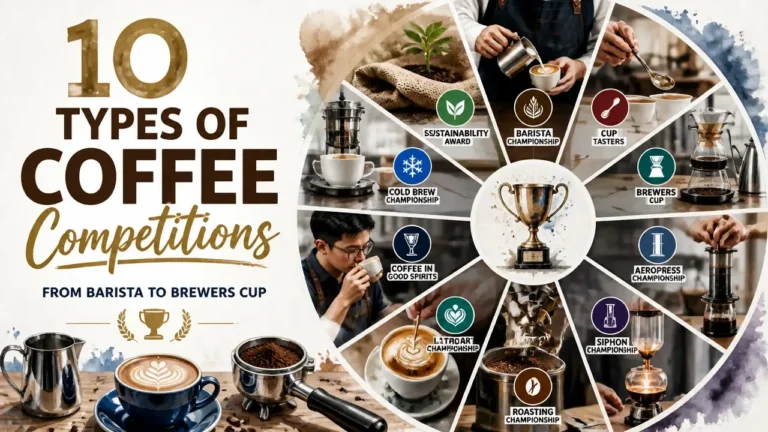

Modern coffee competitions are not a single event with a single winner. They are a structured ecosystem of nine distinct disciplines, each one demanding a fundamentally different combination of skill, temperament, and preparation. The World Coffee Championships alone spans seven official formats, governed by World Coffee Events and the Specialty Coffee Association.
What most coffee professionals don’t realize is that the most prestigious competition on paper is rarely the right one for their actual strengths. Understanding the full map, from roast profiling to triangulation speed to vacuum brewing theatre, is how you find the stage where your specific skills become an unfair advantage.
Key Takeaways on Types of Coffee Competitions
- The World Coffee Championships cover seven official disciplines, each governed by World Coffee Events and the Specialty Coffee Association, with a national champion qualification pathway.
- The World Barista Championship demands theatrical performance, time management, and espresso precision simultaneously, with an estimated personal investment of $10,000 to $50,000 and no guaranteed career ROI.
- The World AeroPress Championship requires no national title, making it the most accessible entry point to global competition for any coffee professional or enthusiast.
- Routine reliability and zero technical deductions consistently outweigh peak cup quality across WCC judging formats, making coffee selection strategy as important as the coffee itself.
- National competition circuits are the structural starting point for any WCC-bound competitor, providing mentorship, skill benchmarking, and local recognition regardless of whether a world title follows.
- The right competition is not the most prestigious one; it is the one whose core skill demands align with the skills you already practice and want to develop further.
What Defines a Coffee Competition? The Global Stage and Common Ground
Coffee competitions, at their most structural level, are timed, judged events where participants demonstrate technical skill, sensory evaluation, and presentation under a recognized governing body. The two primary institutions behind the world’s most credible competitions are World Coffee Events and the Specialty Coffee Association. Together, they administer the World Coffee Championships (WCC), which is the umbrella framework for seven official global titles.
If you want to understand what a coffee competition is at its core, start here: it is not an informal taste test. Every WCC event runs on a standardized judging architecture that includes technical judges (who evaluate process and execution), sensory judges (who evaluate the drink in the cup), and a head judge who manages scoring integrity. The weighting of taste, technical cleanliness, and presentation varies by discipline, but those three pillars appear across all seven.
The seven official World Coffee Championships are:
- World Barista Championship (WBC)
- World Brewers Cup
- World Latte Art Championship
- World Coffee in Good Spirits
- World Cup Tasters Championship
- World Coffee Roasting Championship
- World Cezve/Ibrik Championship
The qualification path into most WCC events follows a single structure: you win your national championship, sanctioned by an SCA-recognized national body, and that title earns you the right to represent your country on the world stage. Some events have exceptions for open rounds, but the national champion pathway is the dominant route.
Beyond the WCC umbrella, independent global events like the World AeroPress Championship and the World Siphonist Championship operate outside SCA governance entirely. They run their own formats, their own qualification rules (often none at all), and their own community culture. They are no less serious. They are just structured differently.
The critical thing to understand before going deeper is this: the shared framework of judges and scoring doesn’t mean shared skill demands. Each championship on this list rewards a genuinely different type of coffee professional. A world-class Cup Taster would likely crumble under a WBC performance format. A WBC finalist might not make it past the first round of a roasting competition. The format determines everything.
World Barista Championship: The Performance Pinnacle
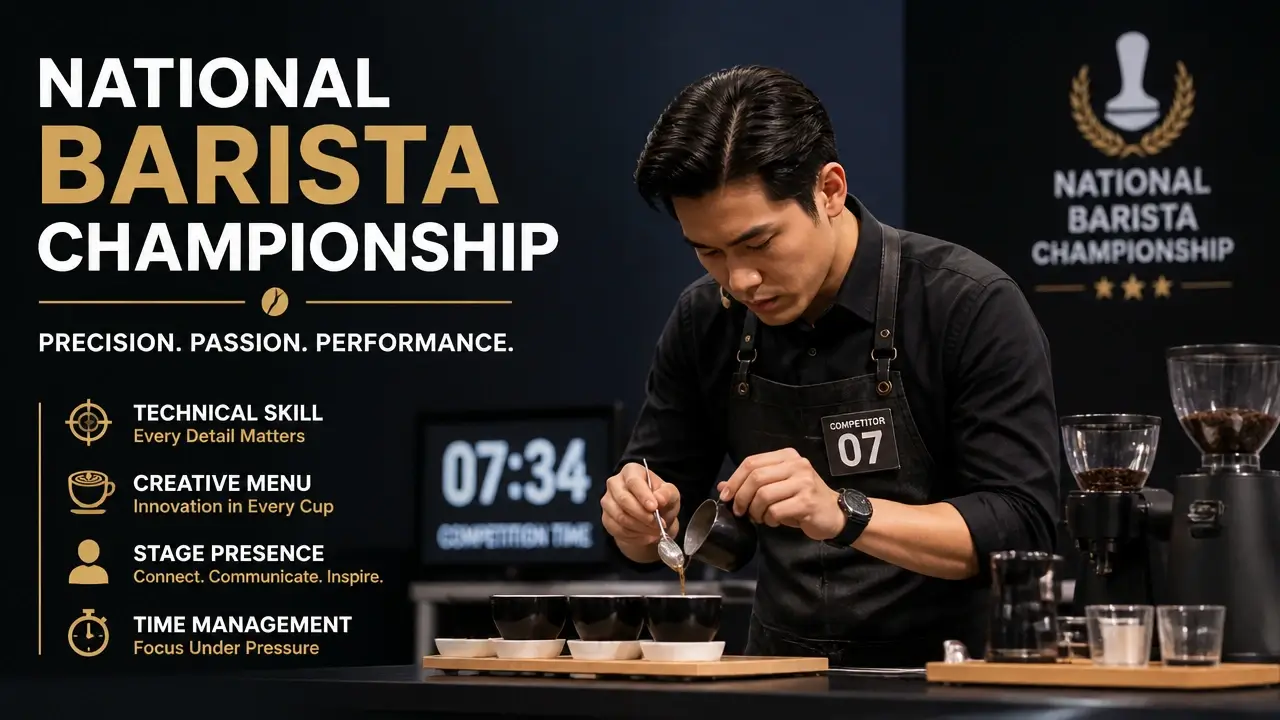
The World Barista Championship is the most recognized name in coffee competition. It draws the largest audience, attracts the most sponsorship, and generates the most industry press. But what actually happens on that stage is more complex, and more demanding, than its reputation suggests.
The WBC Format and Judging Architecture
The World Barista Championship, first held in 2000 and organized by World Coffee Events, gives each competitor exactly 15 minutes on stage. In that window, the competitor must prepare and serve four espressos, four milk beverages, and four signature drinks to four sensory judges, while simultaneously managing their workflow under the watch of two technical judges and one head judge.
The judging panel evaluates along these axes: taste balance and quality of each espresso, technical cleanliness of preparation, creativity and flavor logic of the signature drink, and the coherence of the overall presentation narrative. Sensory judges score the drinks blind to each other. Technical judges track everything from portafilter handling to cleanliness of the work station.
Qualification runs through national championships. Competitors win their national title, advance through preliminary rounds at the world event, and the top six compete in a final. Six minutes of prep, 15 minutes of performance, years of work behind it.
Evaluating these rigorous 15-minute sensory routines requires certified expertise, a standard you can master if you choose to become coffee competition judge.
Historical Evolution and the Winning Performance Reality
The WBC has changed meaningfully since its first edition. In 2016, the championship introduced partner-provided grinders and espresso machines, standardizing equipment across competitors. The intent was to level the playing field so that a barista from a smaller market wasn’t outgunned by a well-funded team’s gear. In 2023, a significant rule change allowed infused and co-fermented coffees, opening the door to a new category of signature drink creativity that has since dominated championship strategies.
Agnieszka Rojewska won in 2018, becoming the first woman to claim the WBC title. Champions have historically clustered from Australia, the United States, and Denmark. One data point worth flagging: Wikipedia’s listing of Martin Hildebrandt as champion across 2001 to 2017 is almost certainly a record-keeping error, not a reflection of a 16-year consecutive run.
The WBC demands simultaneous mastery of beverage production, technical workflow, public speaking, and time management. That combination is rare. But there’s a less-discussed tension at the heart of this competition.
The judging format requires 12 identical drinks served in sequence under pressure. A coffee with an extraordinary cupping score but a narrow extraction window becomes a liability, not an asset. The competitor who wins is often the one who chose a thermally forgiving, highly consistent coffee that can be replicated perfectly across all 12 serves, even if a higher-scoring micro-lot was available. Narrative coherence and zero technical deductions frequently outweigh peak cup quality.
The return on investment is also uncertain. No public data tracks post-championship career outcomes for WBC winners. The primary economic beneficiaries of the WBC ecosystem are equipment sponsors and the SCA through sponsorship fees and event revenue. A barista investing anywhere from $10,000 to $50,000 in coffee sourcing, travel, equipment, and lost wages faces no guaranteed career uplift. The promotional literature doesn’t address this gap.
World Brewers Cup: Manual Brewing Mastery
The World Brewers Cup tests a skill set that the WBC doesn’t touch: manual filter coffee preparation at its highest level. No espresso machines. No milk. No theatrical cocktail. Just a brewer, their coffee, and the cup.
The competition runs a two-service format. First is the compulsory service, where every competitor brews the same coffee provided by the organizer. This eliminates origin advantage and forces the evaluation onto pure brewing technique. Second is the open service, where competitors bring their own coffee, choose their brewing method, and walk the judges through the origin story, recipe rationale, and flavor notes they’re chasing.
Judging focuses on sensory evaluation of the brewed coffee, specifically aroma, flavor, balance, and mouthfeel, alongside the competitor’s ability to communicate their extraction logic and the coffee’s provenance. You are not just brewing well. You are demonstrating that you understand why the coffee tastes the way it does.
The typical Brewers Cup competitor is a brewing specialist, a roaster, a green buyer, or a coffee educator. Someone who has spent hours mapping extraction curves rather than steaming milk. Tetsu Kasuya of Japan, who won in 2016, is the clearest example of this profile: his victory popularized the 4:6 brewing method, a ratio-based pour-over approach that has since become one of the most widely replicated competition techniques in the world.
This competition rewards a scientific mindset. If your natural instinct when tasting a cup is to ask “what’s the TDS reading?” rather than “how do I make this look good on stage?”, the Brewers Cup is built for you.
World Latte Art Championship: Visual Art in a Cup
The World Latte Art Championship is an official WCC event with a deceptively demanding premise: make the most visually precise, technically clean milk drink possible, repeatedly, under competition pressure.
The structure runs across two types of rounds. Free-pour rounds require competitors to produce classic patterns like rosellas, tulips, and swans using only the motion of steamed milk poured directly into espresso. Design rounds allow the use of etching tools to create more intricate compositions. Both are judged on symmetry, contrast, definition, and overall visual impression.
What separates this from a café party trick is the technical floor required. Crema color, milk texture, and drink temperature are all evaluated alongside the pattern itself. A visually stunning rosette poured into a flat, pale espresso will score poorly. The art only works if the drink underneath it is also correct.
The participant profile is typically working baristas from specialty cafés where presentation standards are high and milk-steaming is practiced hundreds of times a week. The evolution of the competition has tracked the evolution of the craft: early championships were dominated by two-dimensional free-pour patterns, while recent editions have featured complex 3D designs that blur the line between latte art and sculpture.
The ongoing debate in the latte art community, free-pour purity versus etching assistance, reflects a genuine tension in how the discipline defines its own identity. Etching enables more complex imagery. Free-pour demands more raw motor control. Both are judged on the same stage, which keeps the competition broader than either camp would prefer.
World Coffee in Good Spirits: Mixology Meets Coffee
The World Coffee in Good Spirits championship occupies a distinct space in the WCC lineup: it is the only official event where alcohol is a required ingredient. The format blends barista skill with bartending instinct, and the atmosphere at competition is noticeably different from the clinical precision of a WBC final. It runs in the evening. It has a show quality to it.
Competitors typically present two drinks: a hot or warm coffee cocktail and a cold coffee cocktail. Both must feature coffee as a primary flavor, and both are judged on the balance between coffee and alcohol, the creativity of the flavor concept, the use of local or thematic ingredients, and the overall performance narrative.
The judging criteria make this competition genuinely difficult. Getting the coffee-to-spirit ratio right is harder than it sounds. Too much alcohol and the coffee disappears. Too much coffee and the drink reads as a spiked Americano rather than a crafted cocktail. The competitors who perform well are the ones who understand flavor layering, where each ingredient serves a purpose in the arc of the sip.
Typical participants are barista-bartenders, café owners running cocktail programs, and creative professionals who enjoy pushing sensory boundaries. This championship has a history of producing drinks that cross over into mainstream bar menus. When a winning recipe from a Good Spirits final starts appearing in independent cafés globally, it’s a signal that the competition is genuinely driving industry trends, not just rewarding insular skill.
World Cup Tasters Championship: Palate Precision at Speed
The World Cup Tasters Championship strips competition down to its most elemental form. No brewing. No presentation. No signature drink narrative. Just your palate and a clock.
The format is triangulation. Competitors face multiple sets of three cups. Two cups in each set are identical. One is different. The competitor must identify the odd cup correctly, and the faster they do it, the better their score. Ties are broken by time. The competitor who gets eight correct answers faster than everyone else wins.
This sounds straightforward. It is not. The differences between cups are often subtle: a slight variation in acidity from a different processing method, a marginal shift in body from a different roast level, a muted sweetness that signals a different varietal. Identifying these differences in a single sip, under time pressure, in a noisy competition hall, requires a calibrated sensory memory that takes years to build.
Typical participants are professional cuppers, quality control managers, green coffee buyers, and sensory trainers. These are people who cup dozens of coffees daily and have developed the kind of precise, repeatable taste memory that most coffee professionals never need to formalize.
This is the most “pure sensory” competition in the WCC lineup. It rewards the professionals who taste more than they make, who spend more time at the cupping table than behind an espresso machine. If your primary competitive advantage is in your palate rather than your hands, this is where that advantage becomes the entire game.
World Coffee Roasting Championship: Where the Profile Meets the Cup
The World Coffee Roasting Championship is the only WCC event that evaluates the full arc of production, from raw green bean to finished roasted coffee ready to cup. It is also the competition most directly connected to the commercial realities of the coffee industry.
The competition runs in distinct stages. First, green coffee grading: competitors evaluate and sort a raw green lot, identifying defects and assessing quality potential. Then, roast profiling: competitors roast that same lot on-site, developing their own profile with their chosen approach to heat application, development time, and drop temperature. Finally, cup evaluation: the roasted coffee is cupped by judges who score on flavor development, balance, roast consistency, and the roaster’s ability to communicate the decisions behind their profile.
Every competitor receives the same green lot. This is the competition’s great equalizer. You cannot hide behind a spectacular origin. Your score reflects how well you understood the bean and how precisely you executed your vision of what it could become.
Typical participants are professional roastmasters, quality managers, and production roasters who manage large-scale output. The championship’s growth as a standalone event has done real work in popularizing the concepts of light-roast precision and roast-color analysis. Early editions were dominated by roasters from Scandinavian markets, where light-roast specialty culture was already mature. More recent editions have seen winners from across Asia and North America, reflecting how roast science has globalized.
The outcome of this competition depends on two things simultaneously: machinery proficiency and deep green-bean knowledge. A roaster who understands their drum intimately but can’t read a green lot will underperform. A roaster who can identify every defect in a green sample but struggles with profile consistency under pressure will also underperform. Both skills need to be present at the same time.
World Cezve/Ibrik Championship: Traditional Brewing, Modern Competition
The World Cezve/Ibrik Championship answers a question that the rest of the WCC lineup doesn’t ask: can a brewing method that predates the espresso machine by four centuries compete on the same global stage as the most modern specialty techniques? The answer is yes, and the competition makes a strong case for why it should.
The format centers on a cezve (also called an ibrik), the small copper or brass pot used to brew finely ground coffee over direct heat. Competitors brew on an open heat source, managing the rise and fall of the liquid with precision, aiming for a cup that delivers perfect foam, full body, and clean flavor. There is no pump pressure. No steam wand. The tool is ancient. The precision required is not.
Judging evaluates the quality of the kaimaki (the foam that forms on top of a correctly brewed cezve), the clarity and balance of flavor, and adherence to traditional serving customs. Technical judges watch heat control and hand technique closely. The margin between a well-brewed cezve and an overextracted, bitter one is measured in seconds.
Participants typically come from regions with deep ibrik culture, Turkey, the Middle East, the Balkans, and Eastern Europe, as well as global specialty professionals who have dedicated time to mastering the method. The championship functions as a cultural ambassador, drawing a direct line between coffee’s origins in the Ottoman world and the contemporary specialty movement.
What this competition proves is that you don’t need high-tech equipment to compete at the world level. You need mastery of the fundamentals: heat, grind, time, and water. That makes it a unique entry point for tradition-minded competitors who want a world stage without a $20,000 espresso machine.
World AeroPress Championship: Accessible and Global
The World AeroPress Championship operates on a different philosophy than every WCC event on this list. It is independent. It is community-run. And it has no national champion requirement.
Organized by the AeroPress company and a global network of volunteer hosts, the championship runs on a head-to-head bracket system. Competitors bring their own recipe, brew on identical AeroPresses, and judges taste the results blindly. There is no theatrical narrative, no milk steaming, no roast profiling. Just a recipe and a cup.
The low barrier to entry is the defining feature. Local heats are typically open to anyone who registers online or buys a ticket. You do not need to win a national title. You do not need a sponsor. You need an AeroPress and a recipe you believe in.
This structure has produced a genuinely egalitarian competition culture. Home brewers compete alongside café professionals. Traveling coffee enthusiasts show up in cities they’ve never visited before and enter local heats. The inverted brewing method, which became one of the most widely discussed AeroPress techniques globally, was popularized in large part through competition experimentation rather than manufacturer instruction.
Winners of the World AeroPress Championship gain strong recognition within the specialty community, often launching careers as coffee educators, recipe developers, and brand collaborators. The prestige is real. It just operates through community credibility rather than institutional authority.
World Siphonist Championship: Theatrical Vacuum Brewing
The World Siphonist Championship is the most visually dramatic competition in the specialty coffee world. It is also one of the most technically demanding.
Siphon brewing, also called vacuum brewing, works through a pressure differential: water in a lower chamber heats and rises into an upper chamber through a tube, mixes with coffee grounds, then drops back down when heat is removed, filtered through a cloth or paper filter. The physics are elegant. The execution under competition conditions is not easy.
Competitors use halogen or alcohol burners to heat glass siphon vessels, managing the rise of water, the contact time with grounds, and the return draw with precision. Judges evaluate taste, cleanliness of the cup, and the overall performance narrative. This is a competition where understanding differences between WBC and Brewers Cup formats helps clarify where siphon sits: it shares the WBC’s theatrical register but demands the Brewers Cup’s extraction precision.
The participant profile is specific: siphon specialists, café owners who run theatrical brewing programs, and baristas who genuinely enjoy the intersection of chemistry and spectacle. The competition is held primarily alongside major coffee expos in Asia, where siphon culture has the deepest roots.
What makes this discipline technically unforgiving is the combination of variables in play simultaneously. Water chemistry, filter management, heat source stability, and timing all interact. A small error in any one of them produces a detectable flaw in the cup. Competitors who win here have typically spent years with siphon equipment specifically, not just as one brewing method among many.
National Coffee Competition Circuits: The Entry Point
Every world champion started at a national competition. That is not an inspirational observation. It is the structural reality of how the WCC qualification pathway works.
National coffee competition circuits are the network of country-level championships sanctioned by national SCA chapters. They are the feeder system for the WCC. Winning your national barista championship, your national brewers cup, or your national latte art title is the ticket to representing your country on the world stage.
Most national circuits mirror the WCC’s discipline structure. A country with a developed specialty scene will typically run national-level barista, brewers cup, latte art, roasting, cup tasters, and sometimes cezve/ibrik or good spirits competitions. Each crowns a national champion. That champion advances.
The experience at a national competition is different from the world stage in scale, but not in seriousness. Venues are smaller. Performance times may be shorter. Regional heats are common in larger countries. But the judging criteria, the scoring architecture, and the fundamental demands of the format are consistent with the WCC standard.
Statistical Data: 62 countries participate in the World Barista Championship circuit – Source: Specialty Coffee Association
That breadth matters. It means that in most parts of the world, a national circuit exists and is accessible. For many coffee professionals, competing nationally is an end in itself. It benchmarks skills against the best in your market. It builds local brand recognition. It creates mentorship relationships with coaches and previous champions. None of that requires a plane ticket to a world event.
The most competitive national circuits, Australia, the United States, and Japan, produce a disproportionate share of world finalists. Emerging coffee markets use their national circuits differently: as a professionalization tool, a way to raise technical standards across an entire industry rather than just crown a single champion.
If you are reading this and considering competition for the first time, this is where you start. Not with the WBC. Not with the World AeroPress Championship. With your national circuit.
Finding Your Stage: How to Choose the Right Competition
The full map of coffee competitions is now visible. The harder question is where you fit on it.
Competition Skill Profiles and a Matching Guide
Each competition in this ecosystem has a core skill demand. Matching that demand to your actual strengths, not your aspirational identity, is the only reliable way to make competition worth the investment.
Here is how the disciplines break down by profile:
| Competition | Core Skill Demand | Best Fit Competitor |
|---|---|---|
| World Barista Championship | Theatrical storytelling, espresso precision, time management | Performance-driven barista building a public brand |
| World Brewers Cup | Extraction theory, coffee communication, recipe precision | Brewing specialist, roaster, green buyer, educator |
| World Latte Art Championship | Milk chemistry, motor precision, visual design | Barista with advanced steaming control, presentation focus |
| World Coffee in Good Spirits | Flavor layering, mixology, showmanship | Barista-bartender, cocktail café professional |
| World Cup Tasters Championship | Sensory calibration, speed, palate memory | Professional cupper, QC manager, green buyer |
| World Coffee Roasting Championship | Roast profiling, green grading, machinery control | Roastmaster, production manager, quality-focused roaster |
| World Cezve/Ibrik Championship | Heat control, traditional technique, cultural knowledge | Ibrik culture specialist, heritage-focused professional |
| World AeroPress Championship | Recipe creativity, brewing fundamentals | Home brewer, café professional, low-barrier entry competitor |
| World Siphonist Championship | Vacuum brewing science, performance narrative, water chemistry | Siphon specialist, theatrical brewing enthusiast |
The Counterintuitive Truth About Competition Success
The conventional wisdom says: find the best coffee, win the competition. The actual evidence from the WCC’s structure says something more nuanced.
The 2016 equipment standardization removed one major variable from the WBC. The judging architecture across all WCC events then makes the rest clear: routine reliability, narrative coherence, and zero technical deductions consistently outperform peak cup quality in competition outcomes. A competitor who selects a thermally forgiving coffee that can be replicated identically across 12 consecutive serves, and who builds a clear, memorable story around it, has a higher probability of winning than the competitor chasing the highest-scoring, most temperamental micro-lot in the market.
There is also a structural access issue worth naming. The WBC’s emphasis on unique origin stories and direct producer relationships creates an implicit advantage for competitors with strong farm connections. The Brewers Cup and Cup Tasters rely less on that kind of origin access. The AeroPress Championship and national circuits are almost entirely independent of it. If you don’t have established relationships with producers, that is a real constraint in WBC preparation, and choosing a different competition format removes that constraint entirely.
The decision heuristic that actually holds up across all formats: don’t ask which competition is hardest to win. Ask which competition values exactly the skills you already love to practice. The competitor who enters the right format for their natural strengths, competes consistently over several seasons, and builds genuine mastery of that discipline’s specific demands will always outperform the competitor who chose the most prestigious title and spent three years fighting their own weaknesses.
Prestige is a poor substitute for fit.
Frequently Asked Questions About Types of Coffee Competitions
What is the most prestigious coffee competition in the world?
The World Barista Championship carries the most name recognition and media attention, but “most prestigious” depends on your discipline. A roastmaster would consider the World Coffee Roasting Championship the more meaningful credential.
Do you need to be a professional barista to enter coffee competitions?
For most WCC events, yes – the national champion qualification path assumes professional-level preparation. The World AeroPress Championship is the clearest exception, with local heats open to home brewers and enthusiasts without any formal credential.
How long does it take to prepare for a national barista championship?
Most serious competitors spend six to twelve months in dedicated preparation, involving coffee selection, recipe development, workflow drilling, and performance coaching. The investment scales up significantly for world-level competition.
Can you compete in multiple types of coffee competitions?
Yes, and many professionals do. A barista might compete in their national latte art and barista championships simultaneously. The disciplines are distinct enough that excelling in both requires genuinely different training tracks.
What happens to the coffee used in the World Cup Tasters Championship?
The organizers provide all the coffee, and competitors have no advance knowledge of what they’ll taste. The lots are selected specifically to create subtle but detectable differences across the triangulation sets.
Is the World Cezve/Ibrik Championship open to competitors outside of traditional ibrik-culture regions?
Yes. Any competitor who has won their national cezve/ibrik championship can compete at the world level, regardless of geography. Several non-Middle Eastern competitors have placed in top positions by dedicating serious study to the method.
Why did the WBC allow infused and co-fermented coffees starting in 2023?
The rule change reflected the reality that processed coffees with unusual flavor profiles had become a significant part of the specialty market. Banning them from competition created a disconnect between what judges were tasting in the real world and what was allowed on stage.
How does blind tasting work at the World AeroPress Championship?
Judges receive cups without knowing which competitor brewed them. In head-to-head rounds, two competitors brew simultaneously and judges pick the cup they prefer. The competitor whose cup is chosen more often advances through the bracket.
References
- Calling the Shots: 20 Years of the World Barista Championship | sca.coffee