
Fair trade coffee certification is one of the most recognised labels in the global food system, yet most consumers who seek it out can’t describe what it actually enforces. It appears on supermarket shelves and specialty roaster bags alike, attached to coffees that range from exceptional to forgettable, grown on farms that range from thriving cooperatives to struggling smallholders barely covering costs.
That gap between expectation and mechanism is exactly where this article lives. We’ll trace how the system works at its core – the price floors, the audit machinery, the democratic premium funds – and then lay out, without spin, what the evidence says about where it delivers and where it doesn’t.
While evaluating how ethical sourcing impacts the supply chain, it is also fascinating to explore the physical advantages highlighted in this coffee health benefits overview.
While fair trade focuses on trade practices, exploring high altitude coffee cultivation reveals how elevation shapes every sip.
Key Takeaways on Fair Trade Coffee Certification
- Fair trade coffee certification enforces a price floor, a collective premium fund, and democratic governance – it is a trading standard, not a quality grade.
- The Fairtrade Minimum Price only protects farmers when the market falls below it; above that threshold, conventional market prices apply.
- The Fairtrade Premium is a collective fund voted on by cooperative members, not a direct cash payment to individual farmers.
- Many certified cooperatives sell only 12–25% of their harvest on Fair Trade terms, which significantly limits the system’s real-world income impact.
- Fair Trade sets no cupping score or sensory requirement; a certified coffee can be excellent or mediocre – the label says nothing about taste.
- The Fairtrade International and Rainforest Alliance certifications address different problems; stacking them (FTO) covers more ground, but no single label eliminates the trade-off between economic and environmental outcomes.
While certification ensures foundational economic justice for producers, the broader specialty coffee movement extends all the way to the barista’s touch in latte art and craft.
What Is Fair Trade Coffee Certification?
Fair trade coffee certification is not a brand, a charity, or a quality grade. It is a set of independently audited production and trading standards designed to act as a structural safety net for smallholder coffee farmers operating in one of the most volatile commodity markets on earth. When you see the label, you are looking at a promise about how that coffee was traded – not about how it tastes, and not about the farming practices used to grow it.
The system rests on four core principles, and each one does a specific mechanical job.
The Fairtrade Minimum Price acts as a floor. When the global market price for arabica or robusta drops below a calculated threshold tied to average sustainable production costs, buyers are legally required under the standard to pay that floor price anyway. The market can crash. The Minimum Price does not move with it.
The Fairtrade Premium is a separate, fixed sum paid per pound of certified coffee sold – on top of the purchase price. This money does not go to individual farmers as a cash bonus. It flows into a collective fund that the cooperative’s members control and allocate through a democratic vote. School buildings, healthcare clinics, processing equipment, road infrastructure: these are the kinds of investments cooperatives have funded with Premium money.
The third principle is democratic organisation. Producer groups must be structured so that every member has an equal vote in governance decisions, including how the Premium is spent. This is not just a procedural box to tick; it is the mechanism by which the system is supposed to build collective power rather than dependency.
The fourth principle is a prohibition on forced labour and child labour. This is an audited, pass-or-fail requirement with no ambiguity.
Three certification labels dominate the coffee market. Fairtrade International is the most widely recognised globally, operating through a network of national organisations. Fair Trade USA split from Fairtrade International in 2011, a divergence that changed some rules – most notably around certifying estate-grown coffee – and created a genuine source of consumer confusion that we’ll examine in a later section. Fair for Life is a third, less common label with a broader ethical-sourcing scope. For a complete picture of how these fit into the wider ecosystem of ethical and quality labels, our complete guide to coffee certifications and standards maps the full terrain.
What the certification does not cover is worth stating plainly. It sets no cupping score requirement. It does not mandate organic farming practices. It is not a short-term aid programme, and the label is not owned or controlled by the coffee industry.
Fairtrade International describes its position this way: the organisation believes its regulations create a baseline for responsibility, and that it is uniquely positioned to produce more equitable outcomes for smallholder farmers through the combination of the Minimum Price, the Premium, Living Income Reference Prices, responsible purchasing practices outlined in its Trader Standard, independent verification, and producer participation in governance decisions.
That framing is important. Fairtrade International is explicit that its system is a baseline – a floor, not a ceiling. Every claim this article examines flows from that single honest admission.
The Certification Process: From Application to Ongoing Audit
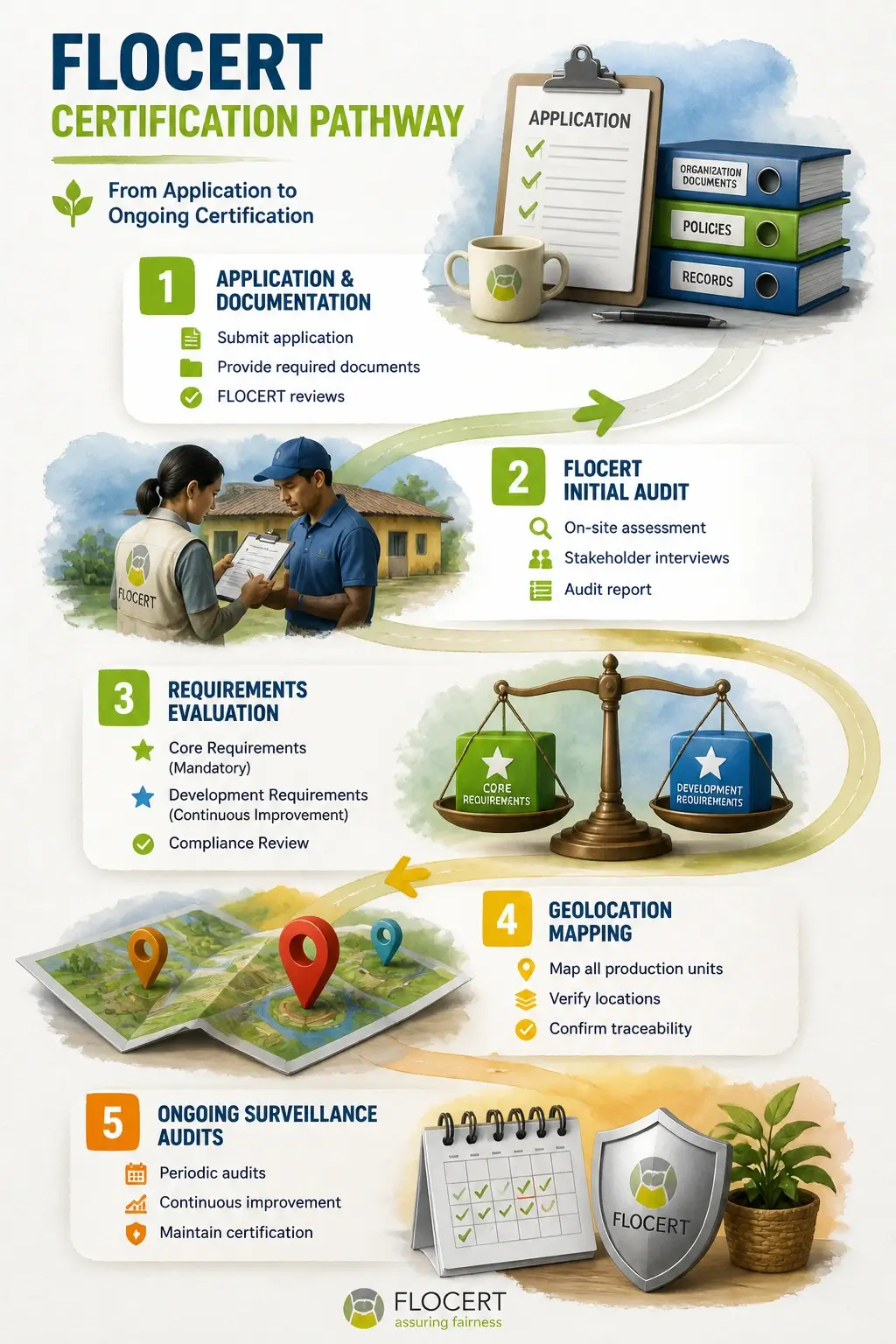
Certification begins when a producer organisation – almost always a cooperative of smallholder farmers – submits an application and undergoes an initial on-site audit conducted by FLOCERT, the independent certification body that Fairtrade International uses. FLOCERT is legally separate from Fairtrade International, which is the structural feature that gives the audit process its credibility. One body writes the standards; a different body checks compliance against them.
The audit evaluates two distinct categories of requirements. Core Requirements are binary: you either meet them or you don’t. Failure on a Core Requirement means no certification. These cover the non-negotiables – democratic governance, the labour prohibitions, traceability of the certified product through the supply chain.
Development Requirements work differently. They are points-based, and they require demonstrated improvement over successive audit cycles. A cooperative that scores below a threshold in one period has a defined window to close the gap. This design is deliberate: it treats certification as an ongoing trajectory rather than a one-time credential. A cooperative cannot rest on a passing score from three years ago.
The current standard has added a layer that shifts the audit scope well beyond social compliance. Producers must now supply geolocation data for all farm plots included in the certification, and the system has integrated deforestation-prevention criteria backed by environmental monitoring protocols.
Fairtrade International has acknowledged the administrative burden this creates and is actively working to automate the process for uploading, validating, and managing geolocation data – an improvement it anticipates will significantly reduce the time required for data validation and deforestation risk analysis.
This matters for the reader’s mental model of what “rigorous” means in practice. The audit is not a questionnaire. It now involves spatial data, satellite-linked environmental monitoring, and documented supply-chain traceability.
The practical barrier to certification is not the concept – it is the sustained operational capacity required. A well-organised cooperative with competent management, reliable record-keeping, and access to financial or technical support can navigate the process. A fragmented cooperative with weak internal governance will struggle, not because the standards are deliberately exclusionary, but because meeting them requires exactly the organisational strength the system is supposed to build. Auditing costs are real; cooperatives typically cover them through a portion of the Premium fund or through support from development organisations. For the smallest groups, these costs can be a genuine constraint.
FLOCERT conducts surveillance audits on a defined cycle after initial certification. Non-compliance on a Core Requirement triggers a corrective action process. Persistent or serious violations lead to suspension. Suspension without resolution leads to decertification. The exit mechanism exists and gets used.
Benefits for Farmers: Income Stability and Community Power
The Fairtrade Minimum Price is the most structurally significant benefit the system delivers, and understanding why requires a brief look at what it protects against. Global arabica prices are set on the New York “C” market, a commodity exchange where coffee trades alongside financial instruments. Prices swing on weather forecasts, currency movements, and speculative positioning. A farmer in Guatemala or Ethiopia has zero influence over that number. When the market collapses – as it did severely in the early 2000s and again in subsequent cycles – farmers locked into conventional contracts absorb the full damage.
The Minimum Price interrupts that mechanism. It doesn’t eliminate price volatility for the farmer, but it removes the floor from collapsing entirely. When the market price sits above the Minimum Price, the farmer benefits from the market rate. When the market falls below it, the certified buyer is contractually obligated to pay the floor. That asymmetry is the point.
The Fairtrade Premium adds a second layer, and its governance structure is what separates it from a simple price top-up. The Premium – currently set at $0.20 per pound for washed arabica – flows into a collective account. Cooperative members vote on how to spend it. This is not symbolic democracy; in well-functioning cooperatives, it has produced tangible infrastructure: primary school buildings, clean water systems, medical clinics, wet-processing mills that improve cup quality and therefore the cooperative’s ability to command higher prices in the future.
The organisational effect compounds over time. The requirement for democratic governance forces cooperatives to build functional decision-making structures, financial transparency, and accountability to members. These capacities extend beyond the certification itself. A cooperative that has learned to run transparent elections and manage a collective budget has built institutional muscle that outlasts any single Premium cycle.
The honest caveat is that these benefits are not uniformly distributed. The size of the impact depends heavily on cooperative management quality, the percentage of the harvest the cooperative can actually sell on Fair Trade terms, and the strength of its market relationships. A poorly managed cooperative with weak buyer connections may hold Fair Trade certification and still deliver minimal net benefit to its members. The label is a necessary condition for these outcomes. It is not sufficient.
For readers interested in how certification choices interact – particularly the common pairing of Fair Trade with organic practices – the organic coffee certification differences between these two systems are worth understanding separately, since they address entirely different problems.
Criticisms and Limitations of Fair Trade Certification
Fair trade certification has attracted serious, documented criticism from researchers and economists – not from industry actors with an interest in undermining it, but from academics who set out to measure whether the system delivers what it promises. The results are more complicated than the label’s marketing suggests.
The premium-leakage problem is the most structurally damaging finding. The Fairtrade Premium is paid to the cooperative, not to individual farmers directly. Between the cooperative’s operating costs, certification fees, and administrative overhead, the net cash benefit reaching individual farm households can be substantially smaller than the headline Premium figure implies. If the cooperative also sells a large portion of its harvest on conventional markets – which most do – the per-farmer benefit of the Premium shrinks further, because the Premium is only paid on certified volume sold.
That second issue is the limited-market-access ceiling, and it is arguably the system’s most stubborn structural constraint. Global demand for Fair Trade-certified coffee does not match certified supply. A cooperative that has gone through the full cost and effort of certification may find buyers for only a fraction of its certified harvest on Fair Trade terms. The rest sells at conventional commodity prices, which can be well below the Minimum Price floor.
Statistical Data: Research on Central American coffee cooperatives found that certified groups sold between 12.5% and 25% of their certified coffee at Fair Trade prices, depending on market conditions – Source: University of California San Diego, GPS Faculty Research
That figure reframes the entire benefit calculation. If a cooperative sells only one-fifth of its crop on Fair Trade terms, the Minimum Price and Premium apply to one-fifth of its revenue. The remaining four-fifths are exposed to the full volatility of the commodity market. The certification provides partial protection, not comprehensive coverage.
The price-ceiling paradox is subtler but real. Because buyers know the Minimum Price floor, they have less incentive to negotiate above it for quality differentiation. In a direct-trade relationship with no price floor, a cooperative producing exceptional coffee can negotiate a price that reflects its quality. Under the Fair Trade framework, some buyers treat the Minimum Price as the de facto market rate rather than a floor, which can cap the upside for cooperatives producing above-average quality. This is not universal, but it is a documented dynamic.
Certification costs – FLOCERT audits, paperwork systems, cooperative administration – can be disproportionately high for the smallest producer groups. For a large, well-funded cooperative with hundreds of members, these costs are manageable. For a small cooperative of thirty farming families with limited administrative capacity, the overhead can consume a meaningful portion of the Premium benefit.
The Fair Trade USA split from Fairtrade International in 2011 introduced a separate controversy. Fair Trade USA’s decision to certify estate-grown coffee – large plantations owned by a single entity, employing wage labourers – was a fundamental departure from the original model, which centred exclusively on smallholder cooperatives. Critics argued, with reasonable force, that applying the same label to plantation-grown coffee dilutes the certification’s core purpose: empowering marginalised small producers who own their land. This is one of the reasons the label landscape is genuinely confusing, and why Rainforest Alliance certification compared to Fair Trade reveals meaningfully different philosophical foundations rather than just branding differences.
Does Fair Trade Guarantee High-Quality Coffee?
Fair Trade certification sets no cupping score requirement, no green-grade specification, and no sensory evaluation threshold. A coffee can carry the Fair Trade label and score 72 points on a calibrated cupping table. It can also score 88. The certification does not distinguish between them because it was never designed to.
This is the most common consumer misconception about the label, and it matters because many buyers treat ethical sourcing and quality as proxies for each other. They are not. They operate on different axes.
There is an indirect quality link worth understanding. The Minimum Price and Premium can give cooperatives the financial stability to invest in better wet-processing equipment, post-harvest quality-control training, and cupping labs. These investments, over time, can improve the average cup quality coming out of a certified cooperative. But the causal chain runs through cooperative management decisions and capital allocation – not through any quality standard the certification enforces. The connection is real. It is not guaranteed.
A practical rule of thumb: Fair Trade tells you something about how the coffee was traded. It tells you nothing about how it was grown, sorted, processed, or roasted. If you care about both ethics and taste, the most reliable approach is to find a roaster who pairs Fair Trade sourcing with transparent, direct relationships with specific cooperatives or mills – and who publishes the details.
The clearest illustration of this gap is the micro-lot market. Some of the most exceptional coffees in the world come from farms or small producer groups that operate entirely outside the cooperative system. They command prices far above the Fairtrade Minimum Price through direct negotiation with specialty buyers. They carry no Fair Trade label. The price floor the certification provides is irrelevant to them because the market already values their coffee above it. This demonstrates, precisely, that a price floor is not the same thing as a quality ceiling – and that the two systems are solving different problems.
Fair Trade vs. Rainforest Alliance and Organic: Key Differences
Fair trade certification, Rainforest Alliance certification, and organic certification are three separate tools built to solve three different problems. Treating them as interchangeable – or as a hierarchy where one is simply “better” than the others – is a category error that produces bad purchasing decisions.
The primary focus of each breaks down cleanly. Fair Trade centres on social and economic justice: the price floor, the democratic premium, the governance requirements. It asks the question, “Are the people who grew this coffee being treated and compensated fairly?” Rainforest Alliance centres on environmental sustainability and farm-management practices, covering biodiversity, water use, soil health, and ecosystem protection – applicable to both smallholders and larger estates. Organic certification asks a different question entirely: “Was this coffee grown without synthetic pesticides, herbicides, or GMOs?” It is a farming-method standard, not a trading standard.
The verification mechanisms differ as well. Fair Trade uses FLOCERT audits with social-compliance checks against the Fairtrade Standard. Rainforest Alliance uses annual audits against its Sustainable Agriculture Standard, with a points-based scoring system. Organic certification runs through government-accredited certifiers and requires a multi-year conversion period during which the land transitions away from prohibited inputs before any certified crop can be harvested.
Rainforest Alliance is explicit that its Sustainability Differential and Sustainability Investment approach should not be directly compared with the Fairtrade Premium, because they are based on fundamentally different frameworks.
This is an important clarification. Rainforest Alliance does not guarantee a minimum price. Fair Trade does not mandate environmental farm-management practices. Organic certification does not address farmer income levels. Each label solves one problem well and leaves the others to the market, the buyer, or other certifications.
Label stacking is the industry’s response to this fragmentation. A coffee labelled “Fair Trade Organic” (FTO) carries both certifications simultaneously, addressing both trading equity and farming-method concerns. This combination is common in the specialty market and represents a genuine attempt to cover more ground.
A peer-reviewed study published in Global Environmental Change examined Fairtrade-Organic and UTZ-Rainforest Alliance certifications in Uganda using an interdisciplinary design that combined economic survey data with ecological field inventories. The findings showed that FT-Org certification improved ecological outcomes – biodiversity, carbon storage – but reduced yields and incomes. UTZ-Rainforest Alliance improved productivity and incomes but delivered fewer ecological benefits. Neither certification eliminated the trade-off between economic and environmental outcomes.
That finding is the honest anchor for this entire comparison. No single certification solves everything. Each one optimises for its own target variable, and the trade-offs are real and documented.
Rainforest Alliance also clarifies that its standard is built on integrated pest management – allowing targeted use of safe pesticides when pests cause economic damage – not a blanket prohibition. This is a meaningful distinction from organic certification, which prohibits synthetic inputs categorically.
The practical guide for a consumer or buyer: identify the problem you are trying to solve with your purchase, then select the certification that directly addresses it. If farmer income stability is the priority, Fair Trade is the relevant tool. If ecosystem health and biodiversity are the priority, Rainforest Alliance is more directly applicable. If farming-method transparency is the concern, organic certification answers that question. For a deeper examination of how these frameworks compare in practice, the linked articles on Rainforest Alliance and organic certification are the logical next step.
The State of Fair Trade Coffee Today: Relevance, Evolution, and Verdict
Fair trade coffee certification remains the most globally recognised ethical label in the coffee market. That recognition is not trivial. It represents decades of consumer education, retail infrastructure, and supply-chain development that alternative models have not yet replicated at scale. The label appears on shelves in mainstream supermarkets across Europe and North America alongside specialty roasters who use it as one component of a broader sourcing philosophy. The volume it moves still matters for millions of farming households.
The system is also not static. Fairtrade International has integrated requirements that would have been unrecognisable in the certification’s original form. Mandatory geolocation data for farm plots, satellite-linked deforestation monitoring, and organic-friendly development goals within the standard’s improvement pathway represent a genuine evolution in what the certification demands. The response to external pressure – from environmental advocacy, from supply-chain due-diligence legislation, from consumer expectations around climate – has been to raise the floor, not defend the original one.
The balanced verdict, earned by the evidence, is this: Fair Trade certification offers real but incomplete protection. It works best in a specific set of conditions: cooperatives with strong internal governance, reliable buyer relationships, and the capacity to sell a high percentage of their harvest on certified terms. Under those conditions, the Minimum Price, the Premium, and the governance requirements combine to produce measurable improvements in income stability, community infrastructure, and organisational capacity. Under weaker conditions – fragmented cooperatives, thin Fair Trade market demand, poor management – the same certification delivers marginal benefit at non-trivial cost.
For a professional buyer, the label is a starting point, not a conclusion. The more useful questions sit beneath the label: What percentage of this cooperative’s harvest actually sells on Fair Trade terms? What has the Premium funded in the last three years? What are the cooperative’s cupping scores and rejection rates? Complementary approaches – direct-trade relationships, transparent impact reporting, long-term purchasing commitments – address the gaps the certification cannot close.
For a consumer, Fair Trade is a reasonable minimum standard. A bag that carries the label was traded under audited conditions that prevented the worst price collapses from reaching the farmer. That is worth something. It is not worth everything. The roasters most worth seeking out are those who treat Fair Trade as a floor and build transparency on top of it – publishing their sourcing relationships, their farm-gate prices, and their cooperative partners by name.
The label is a tool. Like any tool, its value depends entirely on how it is used and what it is combined with. The reader who understands its actual mechanisms – the price floor, the audit cycle, the Premium governance structure, and the documented limitations – now holds the framework to evaluate any Fair Trade claim on its merits, not its marketing.
Frequently Asked Questions About Fair Trade Coffee Certification
What is Fair Trade certified coffee?
Fair Trade certified coffee is coffee that was traded under a set of audited standards requiring a minimum price floor, a collective premium paid to the cooperative, democratic producer governance, and prohibitions on forced and child labour. It’s a trading standard, not a farming or quality standard.
How hard is it for a cooperative to get Fair Trade certified?
The application and initial audit are manageable for well-organised cooperatives, but the real challenge is sustaining compliance across repeated surveillance audits and absorbing the ongoing cost of certification. Small cooperatives with weak internal governance often struggle more with the administrative burden than with the standards themselves.
Does Fair Trade certification guarantee farmers earn a living income?
No. The Minimum Price protects against the worst market crashes, but it doesn’t guarantee a living income. The actual benefit depends on how much of the harvest a cooperative can sell on Fair Trade terms – which is often a fraction of total output – and on how effectively the cooperative manages the Premium fund.
Can a coffee be both Fair Trade and Rainforest Alliance certified?
Yes, and it happens regularly. The two certifications address different concerns – Fair Trade covers trading equity and producer income, Rainforest Alliance covers environmental and farm-management practices – so stacking them addresses more of the supply chain simultaneously.
Why did Fair Trade USA split from Fairtrade International?
Fair Trade USA separated in 2011 partly over its decision to certify estate-grown coffee produced on large plantations, not just smallholder cooperatives. Fairtrade International maintained its focus on smallholder producer organisations. The split created two distinct labels with meaningfully different rules around who can be certified.
Is Starbucks coffee Fair Trade certified?
Starbucks sources some Fair Trade certified coffee, but the majority of its supply is sourced under its own internal standard called C.A.F.E. Practices, which is verified by a third party but is not a Fairtrade International or Fair Trade USA certification. The two systems are not equivalent.
If a coffee commands high prices through direct trade, does it need Fair Trade certification?
Not necessarily. A micro-lot coffee that sells well above the Fairtrade Minimum Price through direct negotiation with specialty buyers already exceeds what the price floor provides. For those producers, the certification may add administrative cost without adding meaningful price protection. Fair Trade is most valuable as a safety net for producers who lack the market relationships to command premium prices independently.
What happens if a certified cooperative fails an audit?
FLOCERT issues a corrective action requirement with a defined resolution window. If the cooperative addresses the non-compliance within that window, certification continues. Persistent or serious failures – particularly on Core Requirements – lead to suspension and ultimately decertification if unresolved.
References
- Fairtrade International Response to the Coffee Barometer 2026 | fairtrade.net
- SPO Guidance for Geolocation Data Submission and Deforestation Monitoring Workflow | fairtrade.net
- Difference Between Rainforest Alliance Certified and Fair Trade | rainforest-alliance.org
- Is Rainforest Alliance Certified Organic? | rainforest-alliance.org
- Fair Trade and Coffee Cooperatives, GPS Faculty Research | gps.ucsd.edu
- Do Private Coffee Standards ‘Walk the Talk’ in Improving Socio-Economic and Environmental Sustainability? | sciencedirect.com