
A coalition of NGOs says the global coffee trade is running on a dangerous chemical “double standard”, after a new report released in Berlin on 22 June 2026 found that more than half of the pesticides used on coffee are either highly hazardous or banned in the European Union.
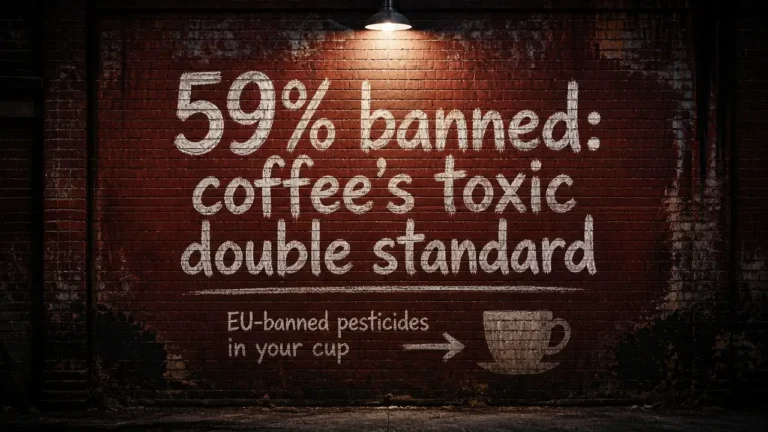
The report, titled Poison in Your Coffee and published by Coffee Watch alongside PAN UK, INKOTA-netzwerk and Deutsche Umwelthilfe (DUH), identified 159 pesticide active ingredients used in coffee production across major origins such as Brazil, Kenya and Colombia, according to a linked PAN Europe press release. Between 60% and 77% of these substances are classified as Highly Hazardous Pesticides, PAN Europe reported, and 59% are currently banned within the EU.
PAN Europe further stated that 14 of the pesticides identified fall into the World Health Organization’s Class 1A or 1B, denoting “extremely” or “highly” hazardous substances. The same release said another 22 are carcinogenic or probably carcinogenic, 40 are reproductive toxicants or endocrine disruptors, 29 are neurotoxic and 12 appear on the Rotterdam Convention’s Prior Informed Consent list.
On the residue side, PAN Europe reported that 19% of tested green (unroasted) coffee samples contained pesticide residues. A related Coffee Watch report summary stated that EU authorities tested only 44 green coffee samples in 2022, finding that 23% contained pesticides banned in the EU, and that the presence of banned pesticides in coffee imports increased tenfold between 2011 and 2022.
This pattern is part of what campaigners describe as a legal and ethical gap between producing and consuming regions. “The report makes the double standard in the coffee industry clearly visible: pesticides that are classified as too dangerous in the EU are exported to coffee-growing countries and used there under much weaker protection standards,” said Silke Bollmohr, Senior Policy Advisor for Global Food Policy & Agriculture at INKOTA-netzwerk, in the Coffee Watch press release. She added that coffee produced in this way then ends up on supermarket shelves in wealthy countries, while “workers, their families and the population in the growing areas… fall ill”, calling the situation “environmental injustice and a human rights issue”.
The new findings build on earlier work: PAN Europe’s 2024 report Double standards, double risk found that 23% of coffee samples already contained pesticides banned in the EU, according to the organisation’s 2026 press release. The same document highlighted glyphosate, classified as “probably carcinogenic”, as an example of a pesticide still widely used in coffee despite ongoing litigation in several jurisdictions.
Evidence gathered by the NGOs suggests heavy reliance on chemical inputs in key coffee origins. In a June 22 press release, Coffee Watch stated that Brazilian coffee farms used 19.8 million litres of pesticides on coffee in 2015, more per hectare than maize or soy. The same release reported that Vietnam’s pesticide use on coffee had increased three- to five-fold over 25 years, while in Kenya coffee accounted for 27% of national pesticide use despite taking up less than 1% of agricultural land.
Environmental monitoring data from producing countries also raise concerns. PAN Europe reported that 81.3% of surface water samples from coffee regions in Colombia contained pesticide residues. A summary of the Coffee Watch report added that in the Dominican Republic 87% of coffee farmers worked without masks or gloves, and in India around two-thirds of coffee workers lacked personal protective equipment.
At the consumer end, testing cited by Coffee Watch found residues not only in green beans but also in roasted coffee. According to the report summary, 72% of roasted coffee samples in the United States tested positive for AMPA, a breakdown product of glyphosate. In Egypt, 21% of roasted coffee samples contained residues, with chlorpyrifos, imidacloprid and cypermethrin commonly detected. Multi-residue contamination was reported in up to 79% of roasted samples, including mepiquat chloride, permethrin and methiocarb sulfone.
Industry and toxicological experts contacted by media have responded cautiously to the report’s implications for drinkers. An article in Athens News noted that chemical and agricultural corporations defend the safety of approved pesticide applications by arguing that residue levels generally remain within legal Maximum Residue Limits. The same report quoted toxicological experts who emphasised that trace residues alone do not automatically prove that brewed coffee poses an immediate health risk, while also pointing to the difficulty of assessing the cumulative “cocktail effect” of multiple low-dose chemicals.
Civil society groups behind the Berlin report dispute that compliance with residue limits is an adequate safeguard. PAN Europe argued in its press release that a focus on Maximum Residue Limits ignores the severe direct poisoning risk to plantation workers and local communities. In Germany alone, where DUH reports that around 1.1 million tonnes of green coffee are imported each year and trading firms generate up to €12.9 billion in profits, the NGOs are calling on national and EU authorities to end exports of pesticides already banned for domestic use, tighten import controls on residues and support a shift towards agroecological coffee cultivation.
Campaigners also challenge a common reassurance that roasting eliminates pesticide residues. The South China Morning Post reported that pesticides with high thermal stability can bind to the coffee bean matrix and survive roasting, citing the new investigation, and noted that civil society organisations are pressing the EU to expand laboratory testing of imported coffee and publish more detailed residue data.
With DUH estimating that 2.2 billion cups of coffee are consumed every day worldwide in a summary document linked from its website, the Berlin report’s authors and allied NGOs frame the widespread use of hazardous pesticides on coffee as a global supply chain issue rather than a niche concern, and are urging regulators in major consuming markets to address what they describe as an entrenched double standard in how chemical risks are distributed between drinkers and those who grow their coffee.