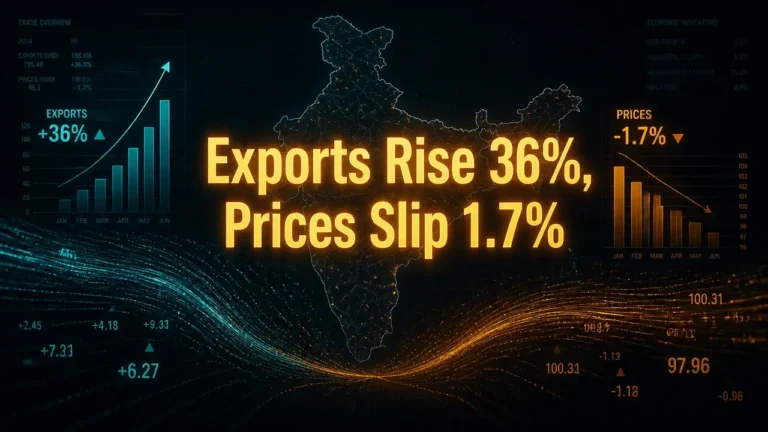

Indian coffee exports continued their recent surge in the opening months of the new fiscal year, with April–May 2026 shipments rising 20% in dollar terms to $503.77 million, even as exporters earned slightly less per tonne amid volatile global prices, according to data from the Coffee Board of India reported by The HinduBusinessLine on June 2, 2026.
The Coffee Board figures compiled by The HinduBusinessLine show that export volumes for April–May climbed 36% year‑on‑year to 92,903 tonnes, while realisations slipped 1.7% to ₹5,16,004 per tonne. In rupee terms, shipments were valued at ₹4,752 crore, up 33% from the same period a year earlier.
This early‑year performance follows a record financial year for Indian coffee. For FY 2025‑26, exports reached $2.136 billion (also reported as $2.13 billion) on 4.07 lakh tonnes (with some reports putting the figure at 4.05 lakh tonnes), delivering rupee earnings of ₹18,887 crore and an average per‑unit realisation of ₹4,64,041 per tonne, according to The HinduBusinessLine on April 6, 2026.
Calendar‑year data tell a similar story of value growth outpacing volumes. Coffee exports in 2025 totalled $2.058 billion, up 22% year‑on‑year, even though volumes declined 4.5% to 3.48 lakh tonnes, The HinduBusinessLine reported on January 1, 2026. Per‑tonne realisations in 2025 were ₹4.65 lakh, 33% higher than the previous year, while rupee earnings rose 27% to ₹17,911 crore.
April–May 2026 marks a reversal of that pattern, with buyers taking advantage of lower world prices to secure more coffee while paying a slightly lower average price per tonne. The HinduBusinessLine on June 2, 2026 noted that global coffee prices have shown volatile trends and linked the 1.7% fall in India’s per‑unit realisation to these market movements.
Exporters in Brazil, the world’s largest coffee supplier, are seeing similar pressure on prices. The Brazilian Coffee Exporters Council reported that Brazil’s coffee exports in April 2026 reached 3.122 million bags, just 0.6% higher than a year earlier, but revenues fell 17.7% to $1.109 billion, according to a May 14, 2026 report from Tridge. The Tridge article, citing the council, attributed the modest volume growth to new‑crop canephora (conilon/robusta) shipments and said the revenue drop reflected lower international prices.
India is currently the world’s seventh‑largest coffee producer and fifth‑largest exporter, and its beans reach more than 125 countries, The HinduBusinessLine reported on June 2, 2026, based on Coffee Board data. Italy is the largest single buyer, followed by Germany, Russia, Belgium and the United Arab Emirates, and the same article noted that India’s coffee exports have recorded a compound annual growth rate of 20% in recent years.
Instant coffee is an increasingly significant part of this export basket. For January–April 2026, India shipped 20,332 tonnes of instant coffee, up from 17,504 tonnes a year earlier, while re‑exports of instant coffee rose to 38,169 tonnes from 30,274 tonnes, according to a May 5, 2026 report by news agency PTI carried in The HinduBusinessLine. The same report said overall coffee exports for January–April stood at 1.74 lakh tonnes, 26.6% higher year‑on‑year, with an average unit value of ₹4,94,766 per tonne.
In calendar 2025, instant coffee exports combining India‑grown and re‑exported volumes reached 1.53 lakh tonnes, up 2.68% from the previous year, with 46,954 tonnes produced from India‑grown coffee and 1.06 lakh tonnes re‑exported, according to The HinduBusinessLine’s January 1, 2026 report.
Despite freight disruptions linked to the March 2026 Hormuz crisis, which Maritime Gateway on April 7, 2026 said left about 300 containers of Indian coffee, or roughly 6,000 tonnes, stranded and pushed up shipping costs, India still achieved its FY 2025‑26 export record.
The combination of strong volume growth and softer unit prices places India within a wider global context of adjusting coffee markets, as illustrated by Coffee Board and Brazilian Coffee Exporters Council data cited by The HinduBusinessLine and Tridge.