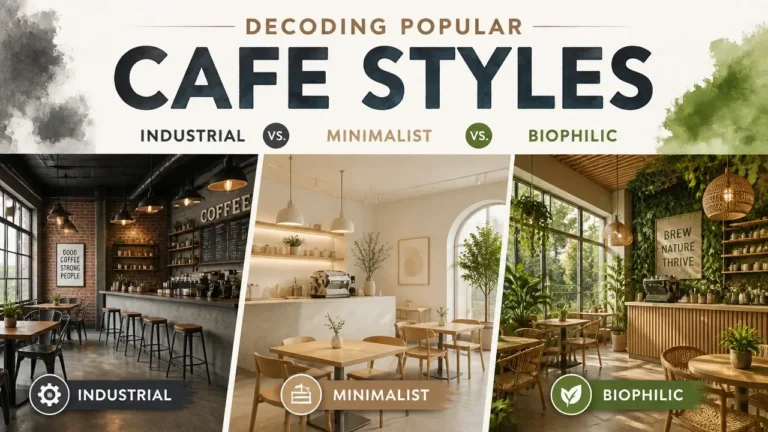

Three dominant cafe design languages are quietly running the business decisions most owners think are purely aesthetic. Industrial interior design signals grit and craft through exposed steel and polished concrete flooring. Minimalist cafe design whispers restraint through curated emptiness. Biophilic design pulls oxygen and living walls into the equation entirely.
Each style shapes dwell behavior, spending patterns, and brand identity before a single cup is poured. The walls aren’t decoration: they’re infrastructure for the customer experience you’re either building deliberately or leaving to chance.
Just as physical interiors dictate the customer journey, the physical coffee packaging design communicates the brand’s quality and values long before the beans reach the grinder.
These intentional design choices are now driving the modern coffee revolution, redefining how independent spaces compete in a crowded market.
What Makes a Cafe Style Actually Work?
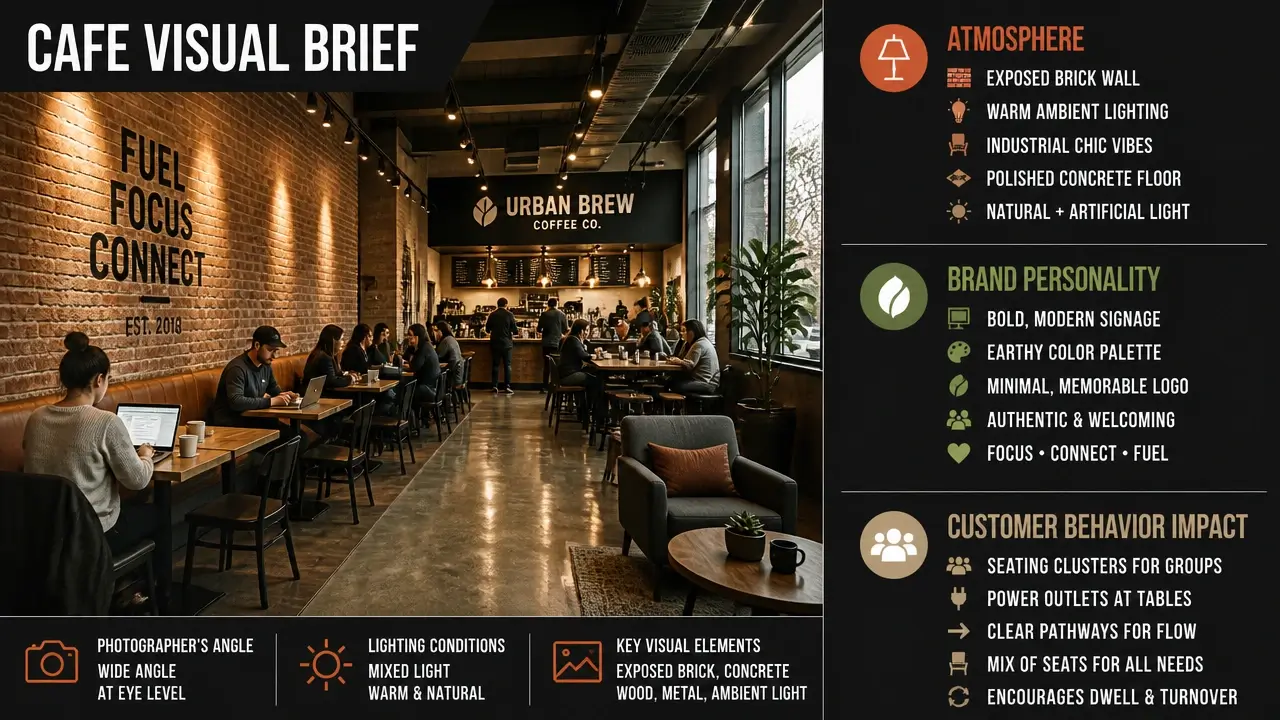
Thoughtfully executed cafe design shapes the entire customer experience before a single drink is ordered: it sets the sensory tone, signals brand identity, and quietly steers how long people stay and whether they return. Most of us register this as a feeling. You walk in and something just clicks. The air feels right. You want to sit down. That sensation isn’t accidental, and it isn’t decoration.
The problem is how we talk about it. Scroll through any cafe enthusiast forum and the conversation collapses into material aesthetics (exposed brick, poured concrete, trailing pothos, clean white walls). Those are real signals, but they’re proxies. They describe what a space looks like, not why it works. Instagrammability tells you a design photographs well. It tells you almost nothing about whether it builds loyalty, supports your price point, or keeps customers coming back on a Tuesday afternoon when no one’s shooting content.
To actually compare popular cafe styles (industrial, minimalist, biophilic), we need three lenses that go deeper than surface finish.
Beyond standard interior styling, some cafe owners even extend their artistic expression into creative coffee painting to decorate their walls with authentic brewed art. Those are real signals, but they’re proxies.
- Atmosphere: the layered sensory environment a customer physically inhabits: acoustics, temperature, light quality, spatial density, and how those elements combine to produce a mood. This is the felt experience, and it’s the one most designers get right on camera and wrong in person.
- Brand Personality: the identity a design projects and the customer it attracts. Every material choice, every spatial decision, sends a signal about who this place is for and what it costs. A brand mismatch here isn’t just an aesthetic problem: it’s a revenue problem.
To better understand how these sensory variables influence your patrons, you can explore the principles of cafe design lighting and layout to see how environmental cues directly impact mood and dwell time.
- Customer Behavior Impact: what the environment actually causes people to do: how long they linger, how quickly they turn over, whether they order a second drink, whether they tell someone else about the place. This is where design either earns its keep or quietly bleeds margin.
Bill Sleeth, Vice President of Design for the Americas at Starbucks, put the brand pillar as sharply as anyone has:
“Sometimes I walk into a space that I absolutely love, I could hang out here all day, but I wouldn’t do that design for Starbucks. I try and moderate my own personal preference in the whole thing. I think there’s something called the brand that’s outside of me. This brand is something that our customers hold in their mind. That’s the place I try and play in.”
That gap (between a design you personally love and a design that serves the brand your customers already carry in their heads) is exactly where most cafes lose the thread. The space looks stunning. The pillars don’t align. And the experience quietly falls apart.
Each of the three popular cafe styles makes real claims across these pillars. What follows is a head-to-head examination of where those claims hold up, where they don’t, and what the gaps reveal about the business model underneath the aesthetic.
Industrial Cafe Design’s Hidden Frictions
Industrial interior design earns its edgy, creative energy through a deliberate material honesty: exposed brick wall, polished concrete flooring, raw steel, and reclaimed wood working together to telegraph strength, maker-culture identity, and urban authenticity. That palette isn’t accidental. It’s a visual argument that says: we didn’t hide anything, and that confidence is the brand. The atmosphere it creates (loud, energetic, casually creative) pulls a specific demographic: the designer, the freelancer, the coffee-curious urbanite who reads a warehouse ceiling as a signal of taste.
Walk into a Brooklyn warehouse conversion or a Berlin courtyard roastery and you feel it immediately. Charcoal walls, matte black fixtures, Edison bulbs hanging from steel pendant clusters, layered industrial lighting that casts warm pools against cold surfaces. The contrast does real work. It creates visual depth without decoration, which is exactly why this aesthetic photographs so well and spreads so fast on social media. The brand personality lands without a single word of copy.
But here’s what you’re not seeing as a visitor.
What the Concrete and Steel Actually Do
The thermal mass of polished concrete flooring and brick wall gets praised endlessly in design blogs as a “natural temperature regulator.” That claim is technically valid, but only under one specific condition: high diurnal temperature swings with operable windows for night-flush ventilation. In a mall-embedded cafe, a sealed commercial unit, or a humid tropical city without cross-ventilation, that same concrete becomes a heat sink. It absorbs thermal load during peak hours and holds it. Your HVAC system works harder, not less. The passive comfort asset becomes a passive energy liability, and no mood board will tell you that.
The steel does something similar acoustically. Every hard, reflective surface in an industrial interior (the concrete floor, the brick wall, the steel fixtures, the glass) bounces sound rather than absorbing it. The result is a buzzing, reverberant room that feels alive during a Friday morning rush and genuinely exhausting during a quiet Tuesday afternoon.
Dr. Erik Lindborg, Soundscape Researcher and Associate Professor specializing in room acoustics, puts the mechanism plainly in a Frontiers in Built Environment study:
“restaurants are vibrant social places whose design is subject to competing requirements. Here, various practical demands and decisions driven by visual design can lead to room‑acoustical disadvantages. For example, the need to attract customers can lead to large windows toward the street, increasing the reverberation time… Similar effects can be attributed to the need to give an impression of cleanliness, leading to hard and acoustically reflective floors and tabletop materials.”
What Lindborg is describing isn’t a design flaw: it’s a design trade-off that most cafes make without fully understanding what they’re trading. The acoustic reflection isn’t incidental to industrial interior design. It’s structurally baked in.
Acoustic Reflection and Turnover Logic
That acoustic friction connects directly to the business model underneath the aesthetic. High noise levels and open sightlines in an industrial cafe aren’t oversights: they’re aligned with a turnover-optimized operation. A louder, more energetic room speeds up the social rhythm. Guests feel the pace, finish their coffee, and move on. That suits a high-volume, peak-hour business beautifully. It actively works against the cafe that wants long dwell times, laptop workers, or a third-place community identity.
The infographic below maps how these two hidden frictions (acoustic reflection and thermal mass) interact with the physical layout of a typical industrial space:
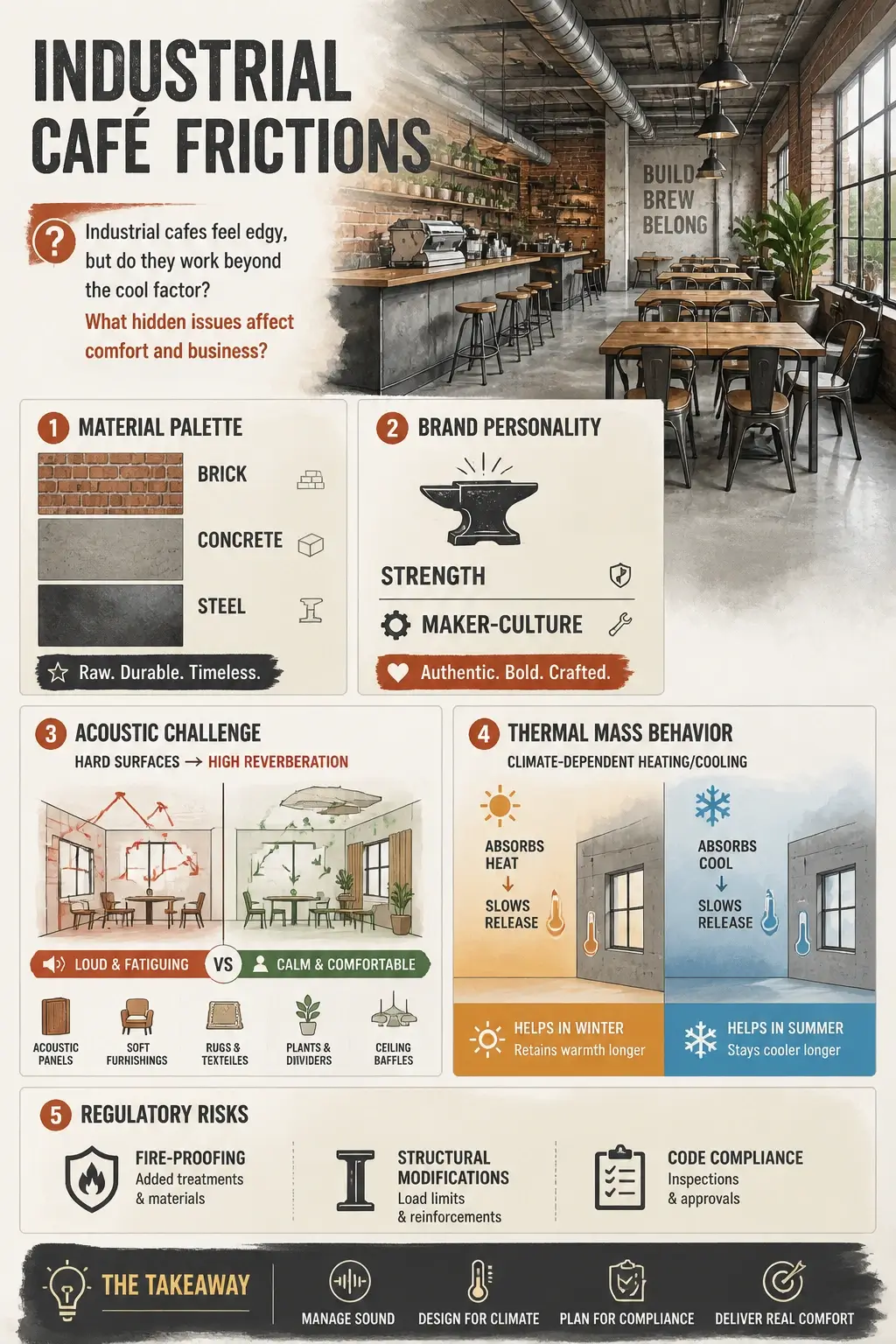
There’s one more blind spot worth naming: the exposed structural elements that define the style carry real regulatory weight. Fire codes in most jurisdictions require fireproofing on exposed beams, and any modification to load-bearing elements for aesthetic purposes needs a structural engineer’s sign-off. These aren’t edge cases: they’re line items that routinely surprise operators mid-renovation, and they never appear on the Pinterest board that started the whole project.
Industrial interior design, among all popular cafe styles, is the most honest about its materials and the least honest about its costs. The raw aesthetic is real. So is the climate dependency, the acoustic trade-off, and the regulatory fine print hiding behind those beautiful exposed beams.
Minimalist Cafe Design’s Hidden Sensory Cost
Minimalist cafe design earns its premium reputation by doing something deliberately counterintuitive: it removes almost everything, then asks you to trust that what’s left is enough. Muted earth tones, light woods, polished concrete flooring, and carefully rationed ambient light all serve a single philosophy: every object in the room has a reason to be there, and nothing else gets in.
That restraint is the whole point. Walk into a Japanese tea-inspired espresso bar or a Scandinavian-style roastery where the grinder sits on a single pale oak shelf, the menu is four items on a chalk panel, and the walls are the color of winter fog, and you immediately read it as intentional. Not sparse. Considered. That’s the emotional signal minimalism is engineered to send: this place knows exactly what it’s doing.
Among popular cafe styles, minimalism occupies the clearest brand lane. It speaks directly to a luxury mindset, a digital-nomad workspace culture, or a specialty coffee audience that treats the cup itself as the experience, not the backdrop. The design says we didn’t clutter this space because we didn’t need to. And for the right customer, that confidence is magnetic.
Where the Calm Starts to Crack
The sensory logic works beautifully in photographs and in the first thirty seconds of walking in. The problem surfaces when you sit down and the room starts talking back to you.
Polished concrete flooring, glass partitions, and bare walls (the core minimalist toolkit) reflect sound just as aggressively as any exposed brick industrial interior. The critical difference is that industrial spaces have visual noise to match: the clutter, the exposed pipes, and the layered textures absorb the acoustic chaos aesthetically, if not physically. Minimalist spaces don’t have that cover. The same hard surfaces that make the room look clean turn every clink of a ceramic cup, every chair scrape, and every ambient conversation into a sharp, unpadded echo.
The result isn’t serenity. It’s a library-like stiffness that can feel more tense than calm.
Dr. Erik Lindborg, lead researcher of soundscape studies in food services, puts it plainly:
“A primary hazard in minimal environments is the ‘sensory gap’ created by excessive silence combined with hard, reverberant surfaces. This environment can make guests highly uncomfortable. Citing a noted chef-entrepreneur, the research underscores that ‘the second worst thing to a restaurant that is too noisy is a restaurant that is too quiet.’ Without acoustic-absorbing panels disguised within the design, minimal spaces experience long reverberation times, ruining speech clarity and turning a calming space into an echo-prone, sterile room.”
Acoustic sterility isn’t a cosmetic flaw: it’s a structural one. And it lives directly inside the design choices that make minimalism look the way it does. You can’t fix it by adding a plant. You have to make deliberate decisions about material and texture early in the design process, before the concrete is poured and the glass is hung.
The Data Gap No One Talks About
Here’s the honest problem for anyone trying to evaluate minimalist cafe design seriously: we don’t actually know how customers behave in these spaces. Dwell time, average spend, and return visit frequency in stripped-back environments: none of it has been quantified in any major publicly available design research. The assumption that a clean, calm space naturally encourages longer, more peaceful stays is widely repeated and entirely untested.
That matters because the business logic behind minimalism depends on that assumption being true. If the aesthetic actually nudges customers toward quick, transactional visits (grab the flat white, sit for twenty minutes, leave), then the premium positioning is real but the revenue model might not be.
There’s also a maintenance reality that rarely gets discussed in design write-ups. A color palette built on off-whites and seamless surfaces looks effortless in a shoot at 9am. By 2pm on a busy Saturday, a single scuff on a matte wall or a smudge on a polished concrete counter reads like a wound. In a visually busy industrial space, that same scuff disappears into the texture. In a minimalist room, it becomes the only thing you notice. Maintaining the spotless illusion across a 12-hour service day is a real operational cost: one no one has quantified, but every minimalist cafe operator quietly knows.
This video from Ingrid Fetell Lee at Big Think captures the deeper psychological tension at play: why environments stripped of sensory input don’t just feel quiet, they can feel actively depleting:
Video: Ingrid Fetell Lee discusses how minimalist environments can lead to sensory depletion and how to re-awaken your senses.
The gap between how minimalism photographs and how it actually feels to sit in for an hour is where most of its design failures live. The color palette signals premium. The ambient light creates focus. But without acoustic softening woven into the material choices (fabric panels disguised as art, textile ceiling baffles, and upholstered seating that doesn’t fight the aesthetic), the same design that promises calm can deliver something closer to sensory isolation.
Done well, minimalist cafe design is one of the most powerful brand statements in the category. Done carelessly, it’s just an expensive echo chamber with good lighting.
To better gauge how patron behavior shifts across different spatial layouts, operators often cross-reference architectural dwell times with broader Coffee consumption stats overview.
Biophilic Cafe Design’s Real Cost
Biophilic design taps into something industrial exposed brick and minimalist white walls fundamentally can’t reach: an evolutionary comfort that’s been wired into us for roughly 300,000 years. Living green walls, raw timber, natural stone, water features, moss panels, terracotta, and sand tones don’t just look warm. They activate the same neurological calm that our ancestors felt near food, water, and shelter. That’s not marketing language. That’s the mechanism.
The atmosphere this creates (regenerative, organic, genuinely refreshing) sits in a category of its own among popular cafe styles. A Bali open-air cafe built into rice terraces or a London coffee shop centered around a preserved indoor tree doesn’t feel designed. It feels found. And that distinction is exactly what makes biophilic design so powerful as a brand identity: it projects wellness, environmental consciousness, and a “third place” authenticity that remote workers, slow-living regulars, and community-minded guests actively seek out.
Observational studies of hospitality venues back this up: venues with strong biophilic interventions like living walls and indoor canopy greenery show a 36% increase in average customer dwell time. On Instagram, those same spaces are magnetic. A living wall behind a latte is one of the most reliably shareable images in cafe culture. Water features add ambient sound that no speaker system can fake.
But here’s where we need to slow down and look at what the camera doesn’t show.
Creating a sensory-rich environment that enhances the appreciation of single-origin profiles requires looking closely at how natural elements complement Coffee Varieties An In Depth.
What Greenery Quality Actually Decides
Not all biophilic interventions are equal, and the gap between them is where most cafes quietly fail the style’s promise. A single immersive green wall with layered species, integrated drainage, and positioned natural light delivers measurably greater restorative effects than ten pots of succulents scattered across tables. The succulents aren’t biophilic design: they’re decoration wearing biophilic design’s clothes. They don’t produce the psychological benefits. They just photograph similarly.
This distinction matters because operators often invest in the quantity of greenery rather than the quality of intervention. The result is a space that looks the part on opening day and slowly degrades into a maintenance problem. Dead plants, yellowing leaves, and pest-prone soil are the quiet killers of biophilic authenticity. The vibe the brand promised becomes the eyesore the customer remembers.
Where Water Features Introduce Real Risk
Water feature integration is one of biophilic design’s most seductive signatures (the sound of moving water genuinely lowers perceived stress), but it carries operational liabilities that most design conversations skip entirely.
Standing water requires active anti-legionella treatment. That’s not optional; it’s a health code obligation in most jurisdictions. Unchecked humidity from poorly managed water features can damage electronics, warp timber, and create the moisture conditions that incubate mold inside walls. And the widely marketed claim that indoor plants “purify air” is, without active HVAC integration, functionally negligible. It’s a false promise that sets customer expectations the space cannot deliver.
Health code compliance isn’t a background detail here: it’s a load-bearing cost that needs to be priced into the business model before the first plant goes in the ground.
The Business Model Conflict No One Names
The industry’s working assumption (nature makes people stay longer, so revenue goes up) is only half an equation. The Sustainable Cafe Delphi Method Expert Panel, a 15-expert group of university professors, cafe operators, and interior environmental design researchers, put it plainly:
“Although introducing biophilic elements (such as plants, green walls, and water features) boosts hedonic customer value and return patronage, the economics of biophilic design are highly sensitive to labor wages, water logistics, irrigation maintenance, and high plant replacement costs. The expert panel warns that ‘café operators would need to invest heavily in marketing to attract consumers based on ambience’ and must evaluate regional target demographics, as the heavy continuous capital outlay conflicts with high‑turnover, low‑margin business models.”
That 36% dwell time increase is a genuine asset for a cafe whose model depends on long stays, community identity, and repeat regulars. It’s a liability for any operation that needs tables to turn fast during a two-hour morning rush. No publicly available data has cleanly measured whether the longer stays generated by a living wall translate to higher net revenue or simply fewer covers served. That gap in the evidence is something every operator needs to sit with before committing to the capital outlay.
Biophilic design, done right, is the most emotionally resonant of the three styles. Done halfway, it’s expensive decoration with a maintenance schedule and a health code exposure. The difference between those two outcomes isn’t the plants: it’s whether the business model was built to carry them.
Which Cafe Style Actually Fits Your Model
Popular cafe styles aren’t competing for a trophy: they’re competing for alignment with a specific business model, and the one that wins is the one whose hidden costs don’t quietly eat the margin.
That’s the reframe this whole conversation has been building toward. Industrial, Minimalist, and Biophilic each map to the same three pillars (atmosphere, brand personality, and customer behavior), but they do it through completely different operational logic. And that logic comes with a price tag nobody in the design world seems willing to print.
Here’s where each style actually lands:
Industrial Style
- Atmosphere: Urban, rugged, high-contrast, energetic; reads as a “lively” space suited to quicker visits and social buzz.
- Brand Personality: Authentic, edgy, contemporary, warehouse-inspired; strong for brands that want a raw, design-forward identity.
- Customer Behavior Impact: Tends to support high turnover and short-to-medium dwell times by signaling activity rather than retreat.
- Hidden Costs / Risks (Thermal & Acoustic Treatment): Often needs added thermal comfort control because hard materials and open volumes can feel drafty or cold; exposed surfaces can also require more acoustic treatment to reduce reverberation in noisy rooms.
- Hidden Costs / Risks (Maintenance): Can be easier to clean than plant-heavy concepts, but worn finishes, exposed fixtures, and textured surfaces still create upkeep around dust, scuffs, and finish preservation.
- Hidden Costs / Risks (Regulatory Compliance): Exposed systems, lighting, and circulation should still meet local safety/accessibility rules; the “unfinished” look does not reduce code obligations.
- Best-Fit Business Model: High turnover, urban grab-and-go, peak-hour espresso bars, music-led social cafés.
- Public Cost / ROI Data: Little public cost/ROI data is available in the article set; decisions are usually made from design intent and operational fit rather than published financial benchmarks.
Minimalist Style
- Atmosphere: Calm, uncluttered, bright, and restrained; creates a low-stimulus environment that feels orderly and efficient.
- Brand Personality: Refined, disciplined, premium, modern, and intentionally quiet; works well for brands that sell focus and simplicity.
- Customer Behavior Impact: Encourages premium calm: longer concentration-based stays, solo work, and a perception of quality through restraint rather than abundance.
- Hidden Costs / Risks (Thermal & Acoustic Treatment): Minimal surfaces can still produce echo, so acoustic softening is often needed even when the visual language is spare; thermal comfort is usually easier to manage than in fully open industrial schemes, but large glass or sparse interiors may still need compensation.
- Hidden Costs / Risks (Maintenance): Lower visual complexity can reduce ongoing cleaning burden, but premium finishes, custom joinery, and “nothing to hide” detailing can make defects more visible and costly to keep pristine.
- Hidden Costs / Risks (Regulatory Compliance): Minimalism often depends on precise lighting, circulation, accessibility, and safety detailing, so the simplicity must still satisfy full regulatory requirements.
- Best-Fit Business Model: Premium calm, specialty coffee, remote-work cafés, design-led spaces, boutique hospitality.
- Public Cost / ROI Data: Little public cost/ROI data is available in the article set; the case is typically framed through brand differentiation and operating efficiency rather than disclosed returns.
Biophilic Style
- Atmosphere: Natural, restorative, sensory-rich, and emotionally warm; uses plants, daylight, and natural materials to create a refuge-like environment.
- Brand Personality: Welcoming, wellness-oriented, sustainable, community-minded, and experience-led; strongest when the brand wants a nature-connected identity.
- Customer Behavior Impact: Supports a community “third place” model by increasing comfort, satisfaction, and loyalty; available evidence links biophilic features with stronger customer satisfaction and brand loyalty, and with longer stays.
- Hidden Costs / Risks (Thermal & Acoustic Treatment): Plants, daylight strategies, water features, and mixed natural materials can improve perceived comfort, but they may require more deliberate thermal and acoustic balancing to avoid humidity, glare, or uneven sound control.
- Hidden Costs / Risks (Maintenance): Usually the highest maintenance burden: plant care, irrigation, replacement, pest management, and upkeep of living or high-detail natural elements.
- Hidden Costs / Risks (Regulatory Compliance): Biophilic layouts still need code-compliant planting, egress, accessibility, fire safety, and material selection; greenery should not obstruct circulation or safety systems.
- Best-Fit Business Model: Community “third place”, destination cafés, wellness cafés, linger-friendly neighborhood cafés, hospitality concepts built around dwell time.
- Public Cost / ROI Data: Little public cost/ROI data is available in the article set; the evidence cited is stronger on customer response than on standardized capital-cost or payback reporting.
The Business Model Contradiction Nobody Names
The single most dangerous misfire hiding inside the cafe style decision framework isn’t choosing the wrong aesthetic: it’s choosing an aesthetic whose behavioral logic fights your revenue model.
Industrial design is built for speed. Hard surfaces, open sightlines, high-energy acoustics: everything in that environment signals activity, and activity moves people through. That’s not a flaw. For a peak-hour espresso bar in a dense urban block, it’s the whole point. But the moment an Industrial cafe owner starts layering in lush biophilic features (a living wall here, trailing plants there, a water feature by the window), they’re injecting dwell-time psychology into a turnover machine. The space starts pulling in two directions at once, and neither revenue model wins cleanly.
Biophilic design does the opposite. It’s optimized for the third-place model: people stay, order again, come back tomorrow because the space felt like a refuge. That only pencils out if the seat is generating repeat revenue across a longer visit window. Stack a high maintenance budget on top (plant care, irrigation, potential legionella protocols for water features, vertical gardens that can fall afoul of health codes if they’re not properly maintained), and the math only works when dwell time is the deliberate strategy, not an accident.
Minimalist sits between them, but don’t mistake “between” for “safe.” It’s actually the most technically unforgiving of the three. When there’s nothing to hide, everything shows. A scuff on polished concrete, a fingerprint on a matte wall, one dead bulb in a carefully calibrated lighting scheme: these aren’t small things in a space built on the promise of precision. The maintenance standard is relentless, and the brand prestige it builds collapses faster than either of the other styles when that standard slips.
The Cost Void Every Enthusiast Should Notice
Here’s something worth sitting with: across all the major design sources and reports that inform how cafes get built, there is essentially no published data on cost per square foot, lifecycle maintenance budgets, or financial ROI for any of these three styles. Zero.
That’s not a research gap. It’s a structural signal. Design media and design-forward branding are selling aspiration, not business plans. When a source doesn’t talk money, it’s not talking business reality, and any cafe owner who adopts a style based purely on visual appeal without pressure-testing the operational invoice is flying blind.
There’s also a regulatory layer that almost never gets mentioned. Exposed industrial structures may need fireproofing that the “raw” aesthetic actively obscures. Water features in biophilic builds carry legionella risk and demand documented maintenance protocols in most jurisdictions. Vertical gardens can violate health codes if they’re not properly contained and maintained. And every style, regardless of how stripped-back or organic it looks, has to meet ADA accessibility requirements. The aesthetic doesn’t reduce the code obligation. Not even close.
Why the Best Cafes You’re Seeing Are Hybrids
The cafe style decision framework that’s actually playing out in leading-edge spaces right now isn’t a pure-style choice: it’s a hybrid design conversation. Industrial-Biophilic combinations are showing up precisely because they address each style’s core weakness with the other’s strength: the warmth and dwell-inducing quality of natural materials softens Industrial’s acoustic harshness and thermal coldness, while the high-contrast energy of Industrial keeps Biophilic from feeling too slow for a working café environment.
Japandi Minimalism (the fusion of Japanese wabi-sabi and Scandinavian restraint) is doing something similar for the premium calm segment. It introduces enough warmth through natural wood tones and tactile texture to prevent the sterility trap, while keeping the visual discipline that makes the Minimalist brand identity legible.
These hybrids aren’t compromises. They’re what happens when someone understands the behavioral logic of each style well enough to borrow the mechanisms without inheriting the liabilities.
The Questions to Ask in Any Cafe You Walk Into
The cafe style decision framework isn’t just useful for owners. As an enthusiast, you now have a set of lenses that work from the customer side of the counter too.
Next time you walk into a beautifully designed space, run these:
- Is the noise helping or hurting? High energy in an Industrial space is intentional, but if you’re raising your voice to order a flat white, the acoustic treatment budget was cut somewhere it shouldn’t have been.
- Are the plants integrated or just propped? Genuinely biophilic design uses greenery as part of the spatial and sensory logic. If the plants look like they were delivered the week before the Instagram shoot and nobody’s watered them since, that’s prop-styling, not biophilic design.
- Does the polished concrete floor feel cold, and is that the point? Sometimes it is. Industrial spaces use thermal austerity to signal edge and keep visits brisk. But if the space is trying to feel warm and the floor is working against it, that’s a design-business misalignment you can now name.
- What’s the business model this space is actually built for? Look at table spacing, seating types, lighting zones, and how the staff moves. The physical layout almost always tells you whether the space is optimized for turnover, dwell time, or the premium solo-work experience, regardless of what the aesthetic is trying to say.
The best cafe style isn’t the one that photographs best. It’s the one whose hidden costs, behavioral logic, and regulatory obligations actually match the experience the owner intended to build, and that the business model can afford to sustain.
Key Takeaways on Popular Cafe Styles
- A cafe’s aesthetic should match its revenue model—turnover, dwell, or premium—not just a mood board.
- Industrial design’s noise and hard surfaces aren’t flaws; they’re built for fast-moving peak-hour rushes.
- Minimalist spaces hide nothing, which means maintenance costs rise as scuffs and smudges break the illusion.
- Biophilic design only pays off if longer customer stays generate repeat revenue; without that, it’s an expensive greenhouse.
- Hybrid styles like industrial-biophilic deliberately borrow strengths to cancel each other’s core weaknesses.
- No public cost data exists for cafe design styles, so always pressure-test the operational invoice behind the aesthetic.
Frequently Asked Questions About Popular Cafe Styles
Q: What health code risks do cafe water features introduce that owners overlook?
A: Most owners don’t realize that standing water in features requires active anti-legionella treatment—it’s a health code obligation, not an option. Unchecked humidity can also breed mold inside walls, so you’re risking both regulatory fines and structural damage if maintenance protocols aren’t airtight.
Q: Why does a minimalist cafe cost more to keep spotless than it looks?
A: Because there’s nothing to hide. Every scuff on polished concrete or fingerprint on a matte wall becomes a glaring defect. Maintaining that pristine illusion across a 12-hour service day demands relentless cleaning, which quietly adds operational labor that most opening budgets don’t account for.
Q: How do you tell if a cafe’s plants are actually biophilic design or just decoration?
A: Look for integrated, layered greenery—like living walls with drainage and natural light—not isolated pots. Genuine biophilic design uses plants to shape the sensory experience. If they look like they were delivered right before the Instagram shoot and barely survive, it’s prop styling.
Q: What happens when you add biophilic elements to an industrial cafe without adjusting the business model?
A: You get a space at war with itself. Industrial design drives fast turnover with energetic acoustics, while biophilic cues encourage lingering. Without aligning to one revenue model, you’ll confuse customer behavior and likely lose money on longer, low-spend stays during peak hours.
Q: Why is there almost no public data on cafe design ROI, and how should owners evaluate it?
A: Design media sells aspiration, not business plans. Without published cost-per-square-foot or lifecycle budgets, owners must pressure-test operational invoices themselves—factor in maintenance, compliance, and behavior-match to revenue model before signing off on an aesthetic.
Q: What’s the real difference between thermal mass in theory and in practice for a sealed cafe?
A: In a naturally ventilated building, concrete may regulate temps. In a sealed mall unit or humid city, that same concrete becomes a heat sink that overworks your HVAC. The passive asset turns into a liability unless you’ve engineered for the specific climate.
Q: Why do popular interior design rules like 70-30 miss the mark for cafe layouts?
A: Rules like 70-30 focus on visual balance, not acoustic or thermal reality. A visually balanced cafe can still be an echo chamber or heat trap if hard surfaces prevail. What matters is how materials behave over a workday, not just how they photograph in a portfolio shot.
References
- Bill Sleeth, Starbucks Vice President of Design for the Americas – Sprudge
- Room Acoustics and Visual Design Trade-offs in Food Services – Frontiers in Built Environment
- Bring Nature in with Biophilic Design – R&D Magazine
- Sustainable Cafe Delphi Method Expert Panel – MDPI