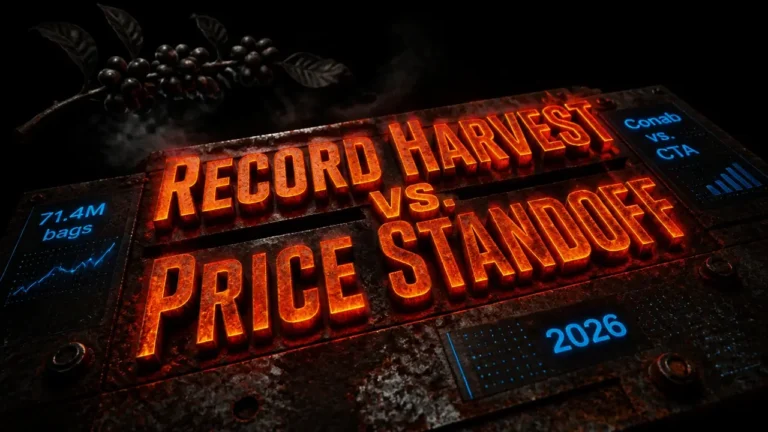

Brazil is heading toward what multiple surveys describe as a record coffee harvest for the 2026/27 season, yet official Brazilian projections and international futures prices suggest that roasters should not expect a surge of cheap coffee. The new crop year starts in July 2026, and government agency Conab and private forecaster Coffee Trading Academy (CTA) are already presenting differing views on total volumes.
A nationwide farmer survey conducted by CTA and reported by Reuters found that producers expect to grow 11.5% more coffee than in the previous season. Applying that increase to its own baseline, CTA projected a total crop of 71.4 million 60‑kilogram bags, which it described as a record. In the same survey, arabica production was projected at 47.9 million bags, up 13.5% year on year, while robusta output was estimated at 23.5 million bags, 7.6% higher than the prior crop.
Brazil’s official supply agency Conab has issued lower but still record‑breaking numbers. In its second estimate for the 2026/27 crop, released in May and reported by Comunicaffe, Conab forecast production at 66.701 million bags, an 18% increase over 2025/26 and 5.7% above Brazil’s previous record of 63.08 million bags set in 2020. Conab’s earlier February estimate, also cited by Comunicaffe, placed the crop at just under 66.2 million bags, already 3.1 million bags higher than the 2020/21 record of 63.1 million.
The gap between CTA’s and Conab’s projections highlights uncertainty over the size of Brazil’s upcoming harvest. Reuters reported that the 71.4 million‑bag figure is CTA’s third survey‑based estimate for this crop: it is higher than a November 2025 survey, which projected 69 million bags, but below an initial July 2025 estimate of 73.7 million bags. Conab’s estimates, by contrast, have moved only slightly upward between February and May.
Behind these numbers are signs of both higher yields and expanding planted area. Reuters noted that total acreage under coffee in Brazil expanded 2.97% year on year in CTA’s survey, with arabica area up 2.7% and robusta area up 3.6%. Conab’s May update, as reported by Comunicaffe, found an even larger 3.9% increase in total coffee area to 2.34 million hectares, with 1.94 million hectares in production, up 4.4% on the previous season. Conab also reported that national productivity has risen to a new high of 34.4 bags per hectare, a 13% increase compared with the prior crop.
Weather and input use also feature in farmers’ expectations. According to Reuters, 63.5% of Brazilian coffee growers surveyed by CTA said off‑season rain had a major positive impact on their crops, and fertilizer application rose 5.4% from the previous season. Comunicaffe, summarizing Conab’s analysis, reported that the biennial “on‑year” in the arabica cycle is boosting production, while robusta volumes face localized setbacks such as a 4.2% decline in Espírito Santo’s robusta output attributed to vegetative stress and below‑average temperatures.
Even as forecasts point to record or near‑record Brazilian production, price signals have been mixed. Comunicaffe highlighted that arabica futures fell to their lowest level since November 2024 around the time Conab published its second estimate. However, Global Coffee Report reported that Conab does not expect significant reductions in coffee prices. According to that report, Conab linked its view to the low level of remaining stocks from the previous cycle and to world coffee demand, which Conab projects will grow 1.3% to 173.9 million bags.
CTA’s farmer‑based projections and Conab’s official forecasts will be tested when Brazil’s 2026/27 coffee crop officially gets underway in July 2026, with Brazil already described by Reuters as the world’s largest coffee producer and exporter.