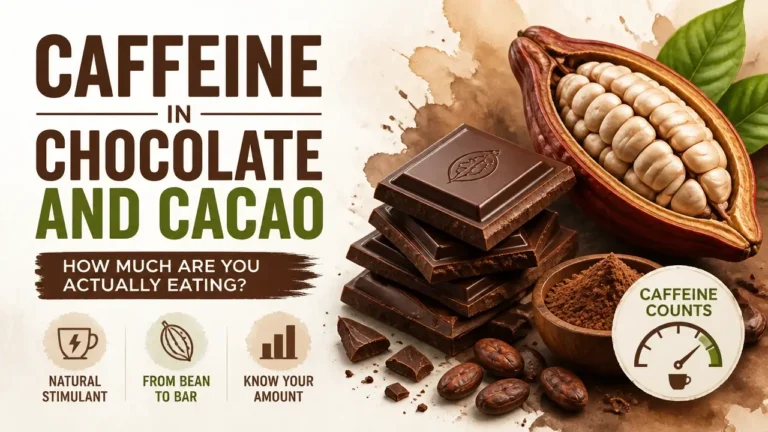

Surprising caffeine hides inside every cacao bean (not just in your morning cup). Dark chocolate carries a real stimulant load, milk chocolate less so, and white chocolate essentially none. The gap between them is wider than most people expect.
Theobromine complicates the picture further. This close chemical cousin of caffeine amplifies the effect, meaning your 9 p.m. square of 85% dark could be quietly wrecking your sleep before you’ve even noticed. Knowing your numbers keeps chocolate in your life (and caffeine from running it).
Understanding how your body processes these stimulants relies on the caffeine metabolism science that dictates how long these compounds remain active in your system.
If that late-night stimulant leaves you tossing and turning, methods for clearing caffeine fast can help restore your sleep cycle.
Caffeine in Chocolate Is Real (and Mostly Hidden)
Chocolate naturally contains caffeine because it comes directly from cocoa solids inside the cacao bean, and the more cocoa solids in your chocolate, the more caffeine ends up in every bite. Most people never connect the two because chocolate has been marketed as a comfort food, a sugar delivery system, a mood lifter. The stimulant riding along for the trip rarely gets mentioned.
That stimulant is real, though. Caffeine in chocolate works the same way caffeine anywhere else does: it blocks adenosine receptors in your brain, which slows the signal that tells your body it’s tired. The result is a subtle lift in energy and focus that most people attribute to the sugar hit or just the pleasure of eating something they enjoy. But the sugar spike fades fast. The caffeine keeps going.
The simplest rule you can carry out of this article: the darker the chocolate, the higher the caffeine content. Dark chocolate is dense with cocoa solids. Milk chocolate has fewer. White chocolate, which contains no cocoa solids at all (only cocoa butter) sits at the far low end. That one gradient explains most of what you need to know before we get into the actual numbers.
So why doesn’t anyone talk about this? Partly because chocolate’s caffeine is genuinely mild compared to coffee. A shot of espresso contains somewhere between 60 and 75 mg of caffeine. A square of dark chocolate might carry 12 mg. The gap is wide enough that most people never feel a sharp, identifiable buzz (they just feel fine, maybe slightly more alert, and move on). The effect is subtle enough to stay invisible.
Labels don’t help either. Manufacturers are only required to disclose caffeine on packaging when it’s been artificially added. Naturally occurring caffeine from cocoa solids? No disclosure required. So unless you already know to look, you’d have no reason to suspect your evening chocolate ritual is quietly nudging your stimulant intake upward (and potentially touching your sleep).
While chocolate offers a gentle lift, those seeking more substantial wellness advantages can explore the broader Coffee Benefits Unlocked The Definitive guide.
That knowledge gap is wider than most people realize. According to a 2025 IFIC Spotlight Survey on caffeine, 61% of consumers report having little or no confidence in their knowledge of the caffeine content in chocolate, a number that tracks closely with similar gaps around soft drinks (67%) and coffee (66%). In other words, most people are guessing.
Dr. Silvia Amelia de Oliveira, Food Scientist and Lead Researcher at the Federal University of Santa Catarina, Brazil, put it plainly in the Journal of Food Composition and Analysis:
“The results from the present study showed that stimulant foods other than energy drinks and coffee contain significant amounts of caffeine, and such data need to be disclosed to the general population.”
The gap between what’s in your chocolate and what you actually know about it is the whole problem. Closing it starts with one thing: the actual milligram counts, broken down by type and serving size, which is exactly where we’re going next.
Breaking Down the Bars: Caffeine in Every Bite
Familiar chocolate products carry wildly different caffeine loads depending on how much cacao they actually contain, and that single variable explains almost every number you’re about to see. The more cacao solids in the product, the more caffeine rides along with it. Strip the cacao out, and the caffeine disappears with it.
That’s the mechanical core of caffeine in chocolate: it lives in the cacao bean, not in the sugar, the milk, or the vanilla. So the question “how much caffeine am I eating?” is really just asking “how much cacao is in this thing?”
Caffeine in Chocolate Bars (Dark to White)
Chocolate bars are the easiest place to see this pattern play out in real numbers.
Dark chocolate sits at the high end, delivering roughly 12-25 mg of caffeine per ounce depending on cacao percentage. A standard 1.5 oz dark chocolate bar can put you somewhere between 18 and 40 mg before you’ve finished the wrapper. But here’s where the label becomes important: bittersweet chocolates (the kind used in baking and premium single-origin bars) consistently run higher in both caffeine and theobromine than standard sweet dark chocolate. A bar that says “dark chocolate” is not a single uniform product. A 70% bar and a 90% bar are not the same stimulant experience, even if both qualify as “dark.”
Milk chocolate drops sharply. Most of that cacao has been replaced by milk solids and sugar, which brings the caffeine down to roughly 5-10 mg per ounce. You’d need to eat a lot of milk chocolate to feel it in any meaningful way.
White chocolate sits at zero. It’s made from cocoa butter (the fat extracted from the cacao bean) and cocoa butter carries no caffeine. The cacao solids, where all the caffeine lives, are removed entirely in the process.
/* Khôi phục cấu trúc bảng chuẩn trong trường hợp môi trường hiện tại bị lỗi hiển thị */ .wp-block-table { margin: 2rem 0; overflow-x: auto; font-family: system-ui, -apple-system, “Segoe UI”, Roboto, Helvetica, Arial, sans-serif; }.wp-block-table table.has-fixed-layout { display: table; width: 100%; table-layout: fixed; border-collapse: collapse; background-color: #ffffff; border-radius: 8px; border-style: hidden; /* Ẩn viền bảng mặc định để dùng box-shadow */ box-shadow: 0 0 0 1px #e2e8f0, 0 4px 6px -1px rgba(0, 0, 0, 0.05); /* Đổ bóng nhẹ và viền tinh tế */ }.wp-block-table thead { display: table-header-group; background-color: #f8fafc; }.wp-block-table tbody { display: table-row-group; }.wp-block-table tr { display: table-row; border-bottom: 1px solid #e2e8f0; transition: background-color 0.2s ease; }.wp-block-table tr:last-child { border-bottom: none; }/* Hiệu ứng hover khi di chuột qua từng hàng */ .wp-block-table tbody tr:hover { background-color: #f1f5f9; }.wp-block-table th, .wp-block-table td { display: table-cell; padding: 16px 24px; color: #334155; font-size: 15px; line-height: 1.5; vertical-align: middle; }/* Định dạng riêng cho phần tiêu đề cột */ .wp-block-table th { font-weight: 600; color: #0f172a; text-transform: uppercase; font-size: 13px; letter-spacing: 0.05em; text-align: left; /* Lưu ý: Cột 2 sẽ tự động căn phải nhờ thẻ style inline trong HTML */ }| Chocolate Type | Caffeine per Ounce |
|---|---|
| Dark chocolate | ~12-25 mg/oz |
| Bittersweet chocolate | ~20-35 mg/oz |
| Milk chocolate | ~5-10 mg/oz |
| White chocolate | 0 mg/oz |
Cacao Powder and Nibs (Where Origin Changes the Numbers)
Cacao powder concentrates the cacao solids without the added fat or sugar, which makes it one of the more potent caffeine sources per unit weight in this whole category. A single teaspoon of cacao powder delivers roughly 12 mg of caffeine. That’s not dramatic on its own, but most recipes don’t stop at one teaspoon (a tablespoon in your morning smoothie is already in the same ballpark as half a can of cola).
Cacao nibs behave similarly to dark chocolate: they’re simply crushed cacao beans with nothing removed, so the caffeine per ounce tracks close to what you’d find in a high-percentage dark bar.
Here’s the layer most labels skip entirely: these are averages, and the actual number in your specific product can shift based on where the beans were grown and how they were processed. Research on imported chocolates has found caffeine levels around 0.1533 mg per gram alongside theobromine levels of roughly 1.141 mg per gram, a combined stimulant load that sits noticeably above what many mass-market domestic products deliver. The country of origin and the roasting and fermentation choices made along the way all nudge the final number in ways the nutrition panel rarely reflects.
So when you’re working with cacao powder or nibs from a specialty source, treat the label’s caffeine figure as a floor, not a ceiling.
Theobromine: Chocolate’s Longer-Lasting Partner Stimulant
Theobromine is the quiet stimulant sitting right next to caffeine in every piece of chocolate you eat (same chemical family, same cocoa source, but a completely different experience in your body). Most people track caffeine when they’re worried about sleep or jitteriness, and that’s a reasonable instinct. The problem is that in dark chocolate, theobromine isn’t a minor footnote. It’s the main event.
Both compounds belong to a class called methylxanthines: naturally occurring stimulants that work by blocking adenosine, the chemical your brain uses to build sleep pressure. Caffeine does this fast and hard. Theobromine does it slowly and for much longer.
How Theobromine and Caffeine Feel Different
Think of caffeine as a light switch: it flips on quickly, peaks within an hour, and fades out in roughly 2.5 to 5 hours for most people. Theobromine is more like a dimmer that someone turned up gradually and then forgot to turn back down. The lift is gentler, less sharp, and nowhere near as obvious. But its half-life runs 7 to 12 hours. That means if you eat a few squares of dark chocolate at 9 p.m., theobromine is still actively blocking adenosine receptors well past 3 a.m.
That’s the part that catches people off guard. The caffeine from chocolate might clear your system before midnight. The theobromine is still working the night shift.
The Real Stimulant Load in Dark Chocolate
Here’s where the numbers shift the picture entirely. In dark chocolate, theobromine is present at 10 to 20 times the caffeine content per ounce. So when you look at a label and see 20 mg of caffeine and think “that’s nothing,” you’re only reading part of the bill. The theobromine riding alongside it could be 200 to 400 mg in that same serving, and both compounds are blocking the same adenosine receptors at the same time.
A 2013 study on methylxanthine pharmacology published in PMC documented exactly this dynamic. The combined caffeine-plus-theobromine load from dark chocolate was linked to nocturnal sleep fragmentation and a measurable reduction in delta-wave deep sleep (the slow, restorative stage your body needs most). It wasn’t caffeine alone driving that disruption. It was the synergy of both methylxanthines working in parallel.
Dr. Rafael Franco, Professor of Biochemistry and Molecular Biology at the University of Barcelona, puts it plainly:
“The combination of caffeine and theobromine in the proportions found in cacao has psycho‑stimulant effects… the results showed that the psycho‑stimulant effect of chocolate is mainly due to the methylxanthines present.”
That word “mainly” is doing real work in that sentence. It means caffeine in chocolate is not even the primary driver of what you feel. Theobromine is.
Why Evening Chocolate Disrupts Sleep
A lot of wellness content waves this off: “chocolate has so little caffeine, don’t worry about it.” That reassurance is built on caffeine numbers alone, and it misses the theobromine half entirely.
That’s the mental shift worth making: chocolate isn’t a separate category. It’s a line item in the same budget as your coffee and tea.
A 3.5-oz bar of dark chocolate at 70-85% cacao can carry anywhere from 20 to 60 mg of caffeine depending on the cocoa content and origin. That’s roughly what you’d get from a small cup of black tea (easy to dismiss, but not nothing if your morning already included two coffees). A few squares here, a hot cocoa there, and those numbers start adding up in ways most people never track.
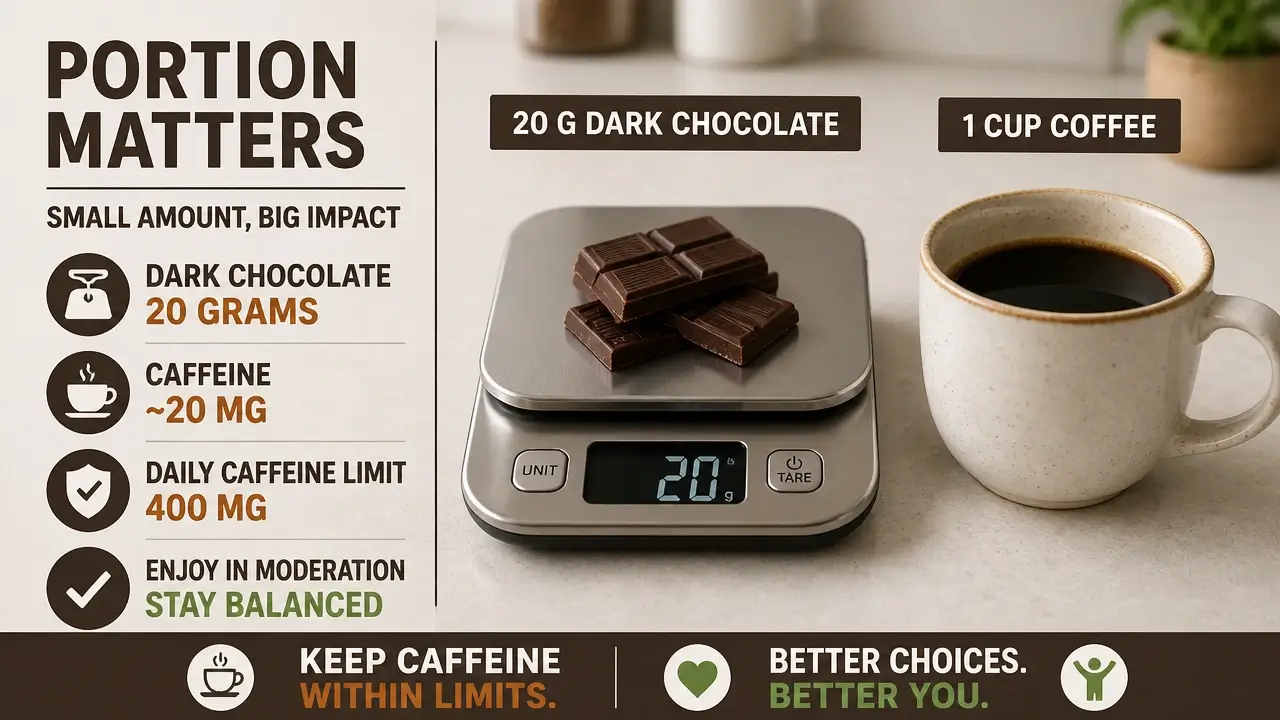
Timing is your simplest lever. If you know you’re sensitive to stimulants, the fix isn’t giving up dark chocolate: it’s moving it earlier. A couple of squares at 10 a.m. or right after lunch gives your body six to eight hours to clear most of the caffeine before bed. After dinner, if you want something sweet, reach for milk chocolate or a very small piece of dark. The caffeine load drops significantly, and the theobromine, which we covered in the last section, has more time to work through your system before you’re trying to sleep.
Become a label detective, but know the limits of the label. Here’s the frustrating reality: in most countries, manufacturers aren’t required to list naturally occurring caffeine on the nutrition panel. So if a chocolate bar feels more energizing than you expected, the packaging probably won’t explain why. What it will show you is the cacao percentage or the cocoa solids content (and that number is your proxy). Higher cocoa solids means more caffeine and more theobromine, full stop. A 45% cacao bar will hit softer than an 85% bar, even if neither one tells you the exact milligram count.
Real people run into this wall constantly. Someone searches for the exact caffeine count in a specific Milka bar or a grocery-store dark chocolate and comes up empty. The data simply isn’t there. That’s not a gap you can Google your way out of: it’s a gap you have to build your own framework around.
The DIY approach gives you actual control. If you want to know your caffeine dose down to the milligram, the most reliable path is making your own chocolate fix from scratch. Cacao powder averages around 12 mg of caffeine per teaspoon (a number you can actually work with). Two teaspoons stirred into a chia pudding with stevia and your choice of milk gives you roughly 24 mg: a mild, measurable lift with no hidden variables. One teaspoon brings you down to a near-negligible amount. You control the dose, you control the timing, and you’re not guessing at what the brand decided to put in the bar.
That said, no chart or framework replaces paying attention to your own body. Caffeine sensitivity varies more between individuals than most people realize: some people feel a 30 mg dose; others barely register 100 mg. Start with smaller amounts of darker chocolate, note how you feel two to four hours later, and adjust from there. Your personal threshold is the only number that actually matters for your daily plan.
Stubborn Chocolate Caffeine Myths That Wreck Sleep
Persistent chocolate caffeine myths are quietly undermining the smart choices you just built in the last section, and the two most dangerous ones target the people who are trying the hardest to be careful. White chocolate and Dutch-processed cocoa both carry a reputation for being “safe” options, and for most casual chocolate eaters, that reputation goes completely unchallenged.
Let’s fix that before it costs you a night’s sleep.
Why White Chocolate Still Deserves a Second Look
White chocolate carries the “caffeine-free” label in most people’s heads because it’s made from cocoa butter, not cocoa solids, and caffeine lives in the solids. That part is technically correct. A standard white chocolate bar made from pure cocoa butter, sugar, and milk has no meaningful caffeine to speak of.
The edge case worth knowing: cross-contamination.
Most white chocolate is manufactured on the same equipment as milk and dark chocolate. Trace caffeine from residual cocoa solids can transfer during production (not enough to matter for the average person, but enough to matter for two specific groups: people who are pregnant and people who are genuinely caffeine-sensitive and experiencing unexplained sleep disruption).
Dutch-Processed Cocoa Isn’t Decaffeinated
Dutch-processed cocoa is one of the most misread labels in the baking aisle, and the misread goes in exactly the wrong direction for sleep.
Here’s what Dutch processing actually does: it treats cocoa powder with an alkalizing agent (typically potassium carbonate) to neutralize the natural acidity. The result is a darker color, a milder, less bitter flavor, and a powder that dissolves more smoothly into liquids. That’s the whole point. It’s a flavor and texture modification, not a caffeine-removal process.
Alkalization does reduce caffeine somewhat (the chemistry involved in neutralizing acids also disrupts some of the caffeine-binding compounds in the cocoa matrix). But “somewhat” is doing a lot of work in that sentence. Residual caffeine levels of 30-50% of the original content can remain after Dutch processing. If you started with a cocoa powder carrying 12 mg of caffeine per tablespoon, you might be working with 6-9 mg after alkalization. Lower, yes. Zero, nowhere close.
The labeling problem compounds this. No regulatory body requires a chocolate product to carry a “contains caffeine” declaration, and none requires a “caffeine-free” claim to meet any specific threshold. A manufacturer can call their product Dutch-processed without any obligation to tell you what the residual caffeine level actually is. So when you see “Dutch-processed” on a bag of cocoa or a hot chocolate mix, treat it as a signal for slightly lower caffeine (a reason to be a little more relaxed about a single serving, not a reason to stop counting).
The same label-reading and portion-awareness habits from the last section apply here just as much. “Dutch-processed” is a clue, not a clearance.
Here’s a visual walkthrough of the alkalization reaction itself, including a UV-Vis spectroscopy test that shows exactly how much caffeine survives the process:
Video: Dutch-Processing Cocoa: Alkalization Reaction, UV-Vis Test and Caffeine Retention
The chemistry is harder to dismiss when you can see it. Caffeine doesn’t just disappear because the pH changed.
Your Personal Chocolate-Caffeine Game Plan
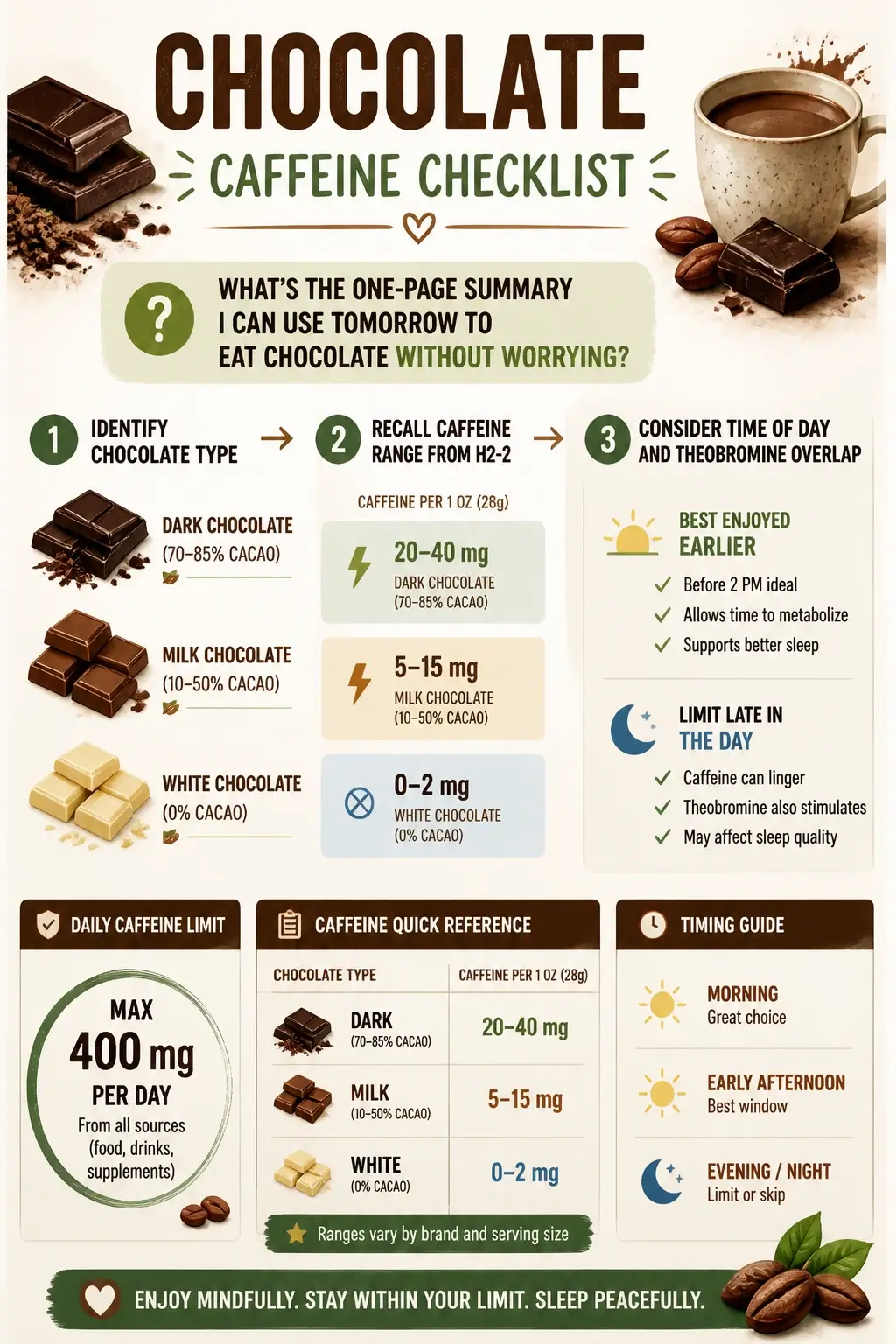
A well-built personal caffeine plan turns caffeine in chocolate from a mystery ingredient into something you can predict, adjust, and actually enjoy. You don’t need a spreadsheet. You need three quick questions you ask yourself before you reach for the bar.
Here’s how it works in practice.
Step one: What type of chocolate is this? Dark, milk, white, cacao nibs, hot cocoa mix? That single answer already tells you the ballpark. A square of dark chocolate sits somewhere between 12 and 25 mg of caffeine per ounce. Milk chocolate drops that range by more than half. White chocolate is near zero (but as we covered, not always exactly zero).
Step two: What’s the caffeine range for that type? You’ve already seen the numbers. Pull them from memory or bookmark the comparison table from earlier in this article. One ounce of dark chocolate is a safe daytime pleasure for the vast majority of adults (it won’t push you anywhere near the 400 mg daily guideline on its own). A full 3-ounce bar of dark chocolate eaten late at night is a different calculation entirely, and the risk isn’t caffeine alone. It’s the combined caffeine-theobromine load that can hold your nervous system in a low-level alert state for hours past when you thought the chocolate “wore off.”
Step three: What time is it, and when are you sleeping? This is the question most people skip. Theobromine has a half-life of 6 to 10 hours. If you’re eating dark chocolate at 9 p.m. and trying to sleep by midnight, the stimulant math isn’t done yet. The caffeine might be clearing. The theobromine isn’t.
Run those three steps and you have a decision in under ten seconds.
Why Sensitivity Changes the Whole Equation
Not everyone processes caffeine on the same timeline, and the reason goes deeper than tolerance. Dr. Leila Alouma, a neurogeneticist and clinical sleep researcher, explains it this way:
“ADORA2A has been shown to be responsible for the wakefulness‑promoting effect of caffeine… Our results identified ADORA2A polymorphism influences in the less‑than‑300‑mg‑per‑day caffeine consumers. This opens perspectives on the diagnosis and pharmacology of sleep complaints.”
What that means for you practically: if a small square of dark chocolate makes you feel wired, you are not imagining it and you are not being dramatic. Your ADORA2A gene variant may simply make you more responsive to caffeine’s adenosine-blocking effect (even at doses that other people shrug off). That’s your signal. Trust it. Shift your dark chocolate to the morning, drop down to milk chocolate in the afternoon, and watch whether sleep improves. That’s not elimination: that’s calibration.
Chocolate Stays. The Guesswork Goes.
The goal was never to make you afraid of chocolate. Milk chocolate, smaller dark portions, and morning timing keep your total caffeine intake well inside a healthy daily budget for virtually everyone. The myths (“white chocolate is always caffeine-free,” “Dutch-processed cocoa is safe at any hour”) are now exposed. The theobromine overlap is on your radar. The three-step check-in takes ten seconds.
What changes tomorrow is simple: caffeine in chocolate stops being a hidden variable and becomes a predictable, intentional part of your day. You know what you’re eating, you know when it makes sense to eat it, and you know that if your body responds strongly, that’s useful information (not a reason to give up the thing you enjoy).
Key Takeaways on Caffeine in Chocolate
- Dark chocolate’s theobromine, not just caffeine, is the real sleep disruptor—it lingers for hours after caffeine clears.
- White chocolate isn’t guaranteed caffeine-free; shared equipment can leave trace amounts that affect sensitive individuals.
- Dutch-processed cocoa still retains 30-50% of its original caffeine—it’s lower, not zero.
- Your genetic makeup determines whether a small chocolate square feels like nothing or keeps you wired.
- Labels rarely disclose natural caffeine, so use cacao percentage as your only reliable proxy.
- Timing is everything: eat dark chocolate before 2 p.m. to avoid theobromine’s overnight stimulation.
Frequently Asked Questions About Caffeine in Chocolate
Q: Does the roasting process destroy caffeine in cacao beans?
A: Roasting does reduce caffeine slightly, but not enough to make a meaningful difference. The heat degrades some caffeine, yet most survives. You can’t rely on roast level to gauge stimulant content; the bean’s origin and the final cacao percentage are far better predictors.
Q: Can you build a tolerance to theobromine like you do to caffeine?
A: Yes, your body can adapt to theobromine with regular exposure, but the process is slower and less studied than caffeine tolerance. If you eat dark chocolate daily, you might notice its stimulating effects diminish over time, though the sleep-disrupting synergy with caffeine can persist.
Q: Does the fat in chocolate slow down caffeine absorption compared to black coffee?
A: The fat in chocolate does slow gastric emptying, which can delay caffeine’s peak effect. You might feel a more gradual, sustained lift rather than the sharp spike from black coffee. This is why chocolate’s buzz often feels smoother and less jittery.
Q: Why do some chocolate bars list caffeine on the label while others don’t?
A: In most countries, labeling natural caffeine is voluntary unless it’s added artificially. Brands that market to athletes or highlight energy content sometimes disclose it voluntarily. For the rest, you’re left to estimate based on cacao percentage, which is always listed.
Q: Is there a difference in caffeine between raw cacao and roasted cacao?
A: Raw cacao typically has slightly more caffeine because roasting degrades a small fraction. However, the difference is minor—maybe 5-10%—and overshadowed by bean genetics and fermentation. Don’t choose raw over roasted solely for caffeine control; focus on portion size instead.
Q: How does the caffeine in chocolate affect people with genetically slow caffeine metabolism?
A: If you’re a slow metabolizer, even chocolate’s modest caffeine dose can linger in your system much longer. Combined with theobromine’s extended half-life, a small evening square might disrupt sleep significantly. Your genetic variant makes timing even more critical than for average consumers.
References
- 2025 IFIC Spotlight Survey on caffeine – ific.org
- Journal of Food Composition and Analysis (caffeine in stimulant foods study) – sciencedirect.com
- Methylxanthine pharmacology and sleep disruption study – pmc.ncbi.nlm.nih.gov
- The combination of caffeine and theobromine in cacao has psycho-stimulant effects – mdpi.com
- ADORA2A polymorphism influences caffeine sensitivity – mdpi.com
- Dutch-processed cocoa caffeine test (UV-Vis spectroscopy) – youtube.com