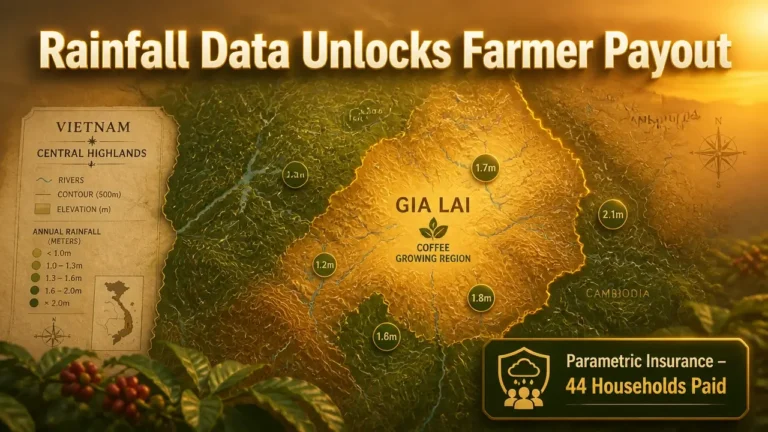

Coffee farmers in Vietnam’s Central Highlands have received parametric insurance payouts for severe flooding during the 2025/26 growing season, marking the second time in two years that such climate‑linked cover has paid out for this key origin. The latest compensation, tied to unusually high rainfall in Gia Lai province, follows an earlier drought‑related payout under the same programme.
Reinsurance News reports that payouts from an innovative high‑rainfall parametric policy have been distributed to coffee farmers in Vietnam’s Central Highlands who suffered losses during the 2025/26 coffee season. The policy was placed in late 2025 by Willis with local carrier Bao Minh Insurance Corporation, and its trigger was closely linked to Typhoon Kalmaegi, described by Reinsurance News as causing some of the worst flooding of modern times in the region.
According to Reinsurance News, rainfall in parts of the Central Highlands exceeded 1.7 metres, with some coffee farms completely submerged and yields significantly reduced. The outlet notes that the solution uses NASA satellite data to measure rainfall across three areas of Gia Lai province—West Ia Grai, East Ia Grai and North Chu Prong—and automatically triggers payouts when predefined thresholds are breached, avoiding lengthy claims or on‑the‑ground loss assessments.
Local coverage from Gia Lai Online Newspaper states that 44 households received compensation under the off‑season rainfall insurance programme, which covered the period from 1 November 2025 to 31 January 2026. The report situates the payouts within a wider rise in climate risks for coffee farmers in the province.
Insurance‑Edge explains that risk capacity for the high‑rainfall payouts was provided by the Natural Disaster Fund (NDF), a public‑private partnership managed by Global Parametrics, itself a subsidiary of CelsiusPro Group. The NDF is funded by the UK government’s Foreign, Commonwealth & Development Office and Germany’s development bank KfW, with Global Parametrics previously noting that Hannover Re offers matching reinsurance capacity to support NDF transactions.
Insurance‑Edge adds that these high‑rainfall payouts follow closely after funds were triggered under a separate parametric drought policy structured and placed by Willis in early 2024, also for Vietnamese coffee growers. In its earlier announcement, WTW stated that the 2024 parametric solution with Bao Minh protected farmers’ revenue against low rainfall during the critical flowering period, effectively covering opposite rainfall extremes across consecutive seasons.
Speaking at the time of the drought‑related payout, Claire Wilkinson, Managing Director for Alternative Risk Transfer Solutions at Willis, said in a WTW release that the programme “supports the resilience of coffee farmers in Vietnam against the impacts of an increasingly volatile climate, giving them much‑needed financial support and allowing them to recover quickly when adverse weather threatens their livelihoods.”
In the more recent high‑rainfall announcement, Willis analyst Nathan Pereira told Insurance‑Edge that the programme “delivers tailored and timely financial protection to vulnerable coffee farmers, while strengthening trust in insurance and improving understanding of how effective risk solutions can support their livelihoods.”
Mark Rueegg, Chief Executive of CelsiusPro Group, said in the same Insurance‑Edge report that “delivering rapid, reliable payouts after extreme weather events is exactly what parametric solutions are designed to do,” and described the Vietnamese programme as demonstrating how innovative risk transfer backed by public‑private partnerships can provide “meaningful financial resilience” to vulnerable farming communities.
Reinsurance News notes that the coffee insurance initiative in Gia Lai forms part of a broader programme supported by the InsuResilience Solutions Fund and delivered in partnership with Willis, ECOM Agroindustrial Corp., Bao Minh, the International Center for Tropical Agriculture in Vietnam and the University of Southern Queensland in Australia. WTW highlights that Vietnam is the world’s second‑largest coffee producer and that coffee plays an important role in the country’s export economy, underscoring the wider significance of keeping Central Highlands growers financially protected against weather shocks.