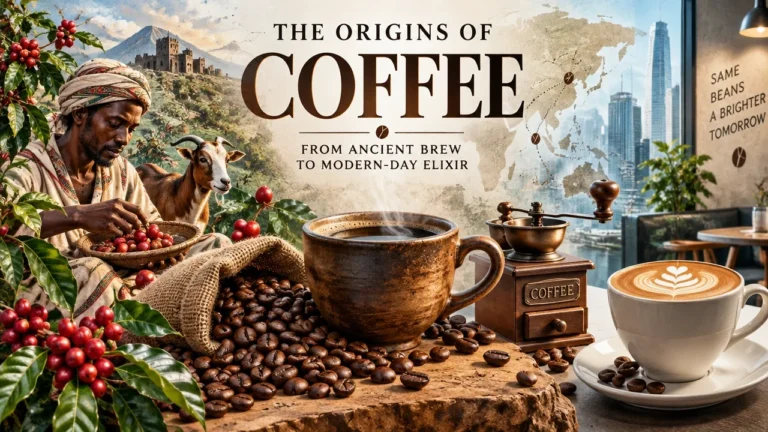

Serious coffee origin exploration starts with a simple admission: the country name on a bag is the least precise thing printed on it. Altitude, volcanic soil, a landrace variety, a processing decision made in high humidity – these are the actual variables. The country is just the address.
Understanding why Ethiopian Yirgacheffe tastes nothing like Sumatran Mandheling, or why Colombian and Brazilian coffees share Yemeni genetic ancestors yet land in completely different cups, requires tracing four intersecting systems: botanical lineage, geographic conditions, post-harvest processing, and the traceability chain that either confirms or obscures all of it.
Key Takeaways on Coffee Origin Exploration
- “Single origin” is a legal term that can describe a country-level blend; only a named farm lot with a lot number and harvest date confirms true single-source traceability.
- Every commercial arabica variety outside Ethiopia descends from a narrow Yemeni gene pool, which means most of the world’s coffee diversity traces to a single colonial-era bottleneck.
- Altitude raises the flavor ceiling by slowing cherry maturation; it is a heuristic, not a guarantee, and soil chemistry explains 84% of specialty quality variation in at least one peer-reviewed Ethiopian study.
- Processing method continues the farm’s influence after harvest: washed clarifies, natural amplifies fruit fermentation, and giling basah in Sumatra is a climate adaptation that produces its earthy profile by necessity, not design.
- The Kaldi goat-herder story is untraceable folklore; the actual origin record is genomic and geographic, placing wild arabica in the highland forests of southwestern Ethiopia.
- EUDR compliance costs can push smallholder farms out of the traceable supply chain entirely, meaning a bag with less origin specificity may reflect economic pressure rather than lower quality.
What “Coffee Origin” Actually Means: Terroir, the Coffee Belt, and the Words on the Bag
When a bag says “Ethiopia,” it tells you the country. That’s the origin of the information, not the end of it. Coffee origin is a layered concept, and the country name sits at the coarsest rung of a specificity ladder that runs all the way down to a single farm lot, a single varietal, a single harvest date. Most packaging is built around the country level. Most flavor is built somewhere far below it.
Environmental Conditions and Geographic Framework
Terroir is the French winemaking term that coffee borrowed, and it travels reasonably well across the analogy – up to a point. In both wine and coffee, soil composition, altitude, and local climate shape what the plant produces. Volcanic basalt soils drain well and supply minerals. Altitude slows cherry development and concentrates sugars and acids. Microclimate determines how consistently those conditions hold across a growing season.
Where the analogy breaks is at harvest. A grape goes from vine to glass through fermentation and bottling, and terroir speaks directly to the final product. Coffee goes from cherry to parchment to green bean to roast to brew, with each stage capable of amplifying or erasing what the farm produced. Terroir in coffee sets a ceiling. Whether the cup reaches it depends on every hand that touches the bean afterward.
The Coffee Belt is the tropical band running between the Tropic of Cancer and the Tropic of Capricorn. Commercial arabica doesn’t grow evenly across it. It grows at elevation inside it, typically above 1,000 meters, because sea-level tropical heat accelerates cherry maturation too fast to build complexity. The elevation requirement is a thermal one: cooler air slows the clock.
Label Specificity and Lineage Systems
Coffee origin, at the level most consumers hold it, means the country, region, or farm where the coffee was grown. That definition is accurate as far as it goes. The problem is that packaging uses it at all three levels interchangeably, without flagging which one applies.
Three distinct tiers deserve separate names. A regional blend aggregates coffee from multiple farms or cooperatives within a defined growing area. A single origin is the term specialty coffee uses to signal something more specific, but legally it can describe a country-level blend. A single farm lot is the most specific commercial unit: one farm, one harvest, one processing run, traceable to a named producer.
“Single origin” appearing on a bag tells you the roaster believes specificity matters. It does not tell you how specific the sourcing actually is.
Origin expresses itself through two parallel lineages. The botanical lineage is the cultivar: the genetic variety of the plant, which influences the raw material the cherry delivers. The geographic lineage is the place: the specific intersection of soil, elevation, rainfall, and microclimate where that plant grew. Neither one alone predicts the cup. A Typica planted at 900 meters in humid lowland soil will not perform like a Typica at 1,900 meters on volcanic basalt, even though they share the same botanical lineage. Both lines have to be read together.
Ethiopia: The Wild Highlands Where Coffea Arabica Began
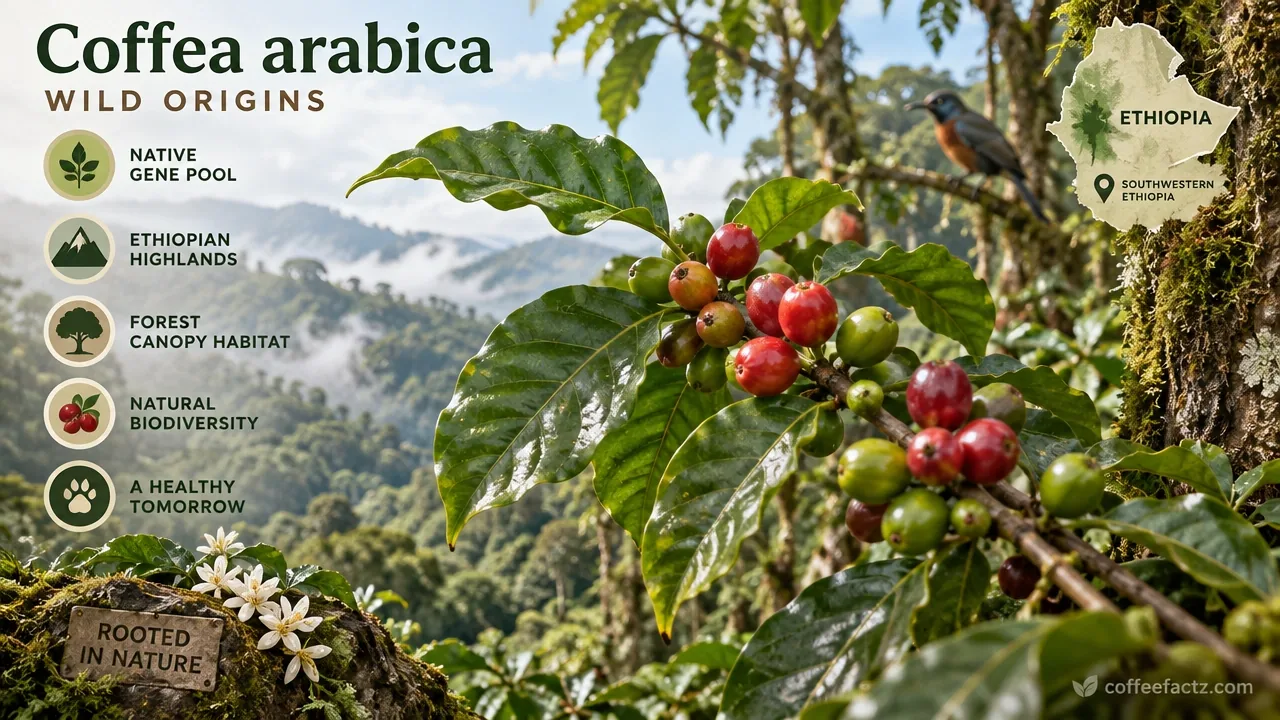
The goat herder story is folklore. Kaldi and his dancing goats is a transmitted cultural legend with no evidentiary weight, documented first in writing centuries after the events it supposedly describes. It should never be cited as botanical evidence. The actual record is genomic and geographic: Coffea arabica is indigenous to the highland forests of southwestern Ethiopia, and that is where the wild population still lives.
Indigenous Forest Genetics and Elevation Profiles
The Ethiopian gene pool is the deepest reservoir of wild arabica genetic diversity on the planet. No other origin comes close. Every cultivar grown commercially outside Ethiopia – every Typica, every Bourbon, every modern hybrid derived from them – traces its lineage through Yemeni exports back to this wild population. That lineage thread runs through the entire article.
Ethiopian production sits at roughly 1,800 to 2,300 meters, among the highest commercial brackets in the world. The altitude is not incidental. At that elevation, cherry maturation slows to a pace that allows sugars, organic acids, and aromatic precursors to accumulate in the seed. The result is a flavor architecture that reads as floral, tea-like, and bright in Yirgacheffe, and as citrus and stone fruit in Sidamo – two highland zones within the same country, separated by microclimate and soil variation.
The traditional landrace groupings of Ethiopia are genetically distinct from the Latin American cultivars introduced later. These are not selected varieties in the commercial sense. They are semi-wild populations that local farmers have collected, exchanged, and replanted across generations, producing a genetic mosaic that no breeding program has fully catalogued. This is the baseline from which everything in the cultivated world descends.
One natural transition into that forest context:
Cultural Consumption and Historical Documentation
Before coffee was a beverage, it was a food. Forest communities in southwestern Ethiopia consumed the cherry’s pulp and the seed together, sometimes mixed with animal fat, as a stimulant on long journeys or during labor. The roasted, brewed drink came later, and it came first not in Ethiopia but in Yemen. The Ethiopian coffee ceremony is the surviving cultural practice that connects the plant’s indigenous context to its present-day social role – a three-round ritual of roasting, brewing, and serving that functions as a marker of community and hospitality.
Harvest in Ethiopia runs roughly from October through January for most highland regions, with Yirgacheffe and Sidamo typically peaking between November and December. The dominant processing norm is washed in Yirgacheffe, where clean water access supports the method, and natural in lower-lying zones where drying on raised beds suits the drier post-harvest climate. Ethiopia’s harvest calendar and processing geography are well-documented by the Ethiopian Coffee and Tea Authority, though farm-level data remains inconsistently reported across the specialty trade.
Yemen deserves its accurate position in this sequence: it is diffusion history, not origin history. Coffee arrived in Yemen from Ethiopia, most likely through trade across the Red Sea, and Yemeni cultivators developed it into the first documented commercial beverage crop. Presenting Yemen as the birthplace of coffee is a sequence error that still appears frequently in popular writing. Ethiopia is where the plant evolved. Yemen is where the beverage began.
Here is a brief look at the Ethiopian coffee ceremony, which has shaped how the country’s coffee culture is practiced today:
Yemen and the Middle Eastern Monopoly: Mokha, Sufi Ritual, and the Seeds That Escaped
Coffee left Ethiopia and entered Yemen. From Yemen, it entered the world. That sequence matters because the genetic material that seeded every major commercial growing region outside Ethiopia passed through Yemeni hands first.
Documented Brewing and Port Commerce
The earliest documentation of coffee as a roasted, brewed beverage comes from 15th-century Yemen. Sufi communities used it to sustain alertness through night prayer, and from that ritual context it moved into secular use across the Arabian Peninsula. The port of Mokha on the Red Sea coast became the commercial hub for this trade, which is why a port name from southwestern Yemen became synonymous with coffee globally, and eventually lent its name to a chocolate-coffee flavor combination that has nothing to do with the port’s geography.
Yemen held a global production monopoly for roughly two centuries. Fertile seeds were not permitted to leave. The mechanism of enforcement was simple: beans were either roasted or boiled before export, rendering them sterile. The monopoly was not absolute in practice, but it held long enough to concentrate all commercial arabica genetics within a narrow Yemeni cultivated population.
One claim worth correcting directly: coffee is frequently described as the second most traded commodity in the world after crude oil. This figure circulates without a date, without a unit of measurement, and without a traceable source. It should not be repeated. Petroleum products, natural gas, pharmaceuticals, and automobiles all trade at volumes that dwarf coffee by any measure.
“A 2020 study of arabica coffee genetic diversity confirmed the story of Yemeni coffee and established definitively that Yemen is the secondary dispersal center for arabica coffee that originated in Ethiopia. Nearly all of the arabica coffee in the world (that is, all the coffee cultivated outside of Ethiopia), descends from the early coffee farms of Yemen.” – World Coffee Research
This finding has a direct structural consequence for the rest of this article. When we discuss Bourbon in Réunion, Typica in Java, Caturra in Colombia, or any of their descendants, we are discussing variations on a gene pool that was already narrow by the time it left Yemen. The genetic bottleneck is old.
Colonial Dissemination and Genetic Descent
The monopoly ended through smuggling. Dutch traders obtained fertile seedlings and established cultivation on Java in 1699, beginning the first sustained coffee agriculture outside the Arabian Peninsula. From Java, the Dutch expanded to Suriname and then to other colonial territories. The French carried seedlings to Martinique, from which Typica spread through the Caribbean and into Central America. A separate genetic line, Bourbon, was cultivated on the island of Réunion and moved independently through East Africa and Latin America.
The diffusion of coffee from Yemen operated through four distinct mechanisms: trade, coffeehouse culture, smuggling, and colonial cultivation. Each mechanism shaped a different geography. Trade routes carried coffee into the Ottoman Empire and North Africa. Coffeehouses became nodes of commerce and exchange that created demand. Smuggling broke the monopoly and seeded Java. Colonial cultivation industrialized production across three continents. The production geography we read today – Ethiopia as origin, Latin America as volume leader, Asia-Pacific as the third major system – is the direct result of which mechanism reached which latitude first.
Most modern arabica varieties cluster into two broad genetic groups: Typica and Bourbon. Both descend from the Yemeni export population. Both carry the genetic narrowing that the monopoly period imposed. When breeders today cross modern varieties with Ethiopian landraces, they are deliberately reintroducing diversity that the Yemeni bottleneck removed.
Ottoman Reception and Cultural Controversy
Coffee entered the Ottoman Empire through trade in the 16th century and spread westward into Europe through the same commercial networks. The coffeehouse became a site of commerce, political discussion, and intellectual exchange – a function that made it threatening to certain authorities. The description of coffee as “Satan’s drink” reflects a documented cultural reaction to a new stimulant entering a society that had no prior category for it. Pope Clement VIII reportedly tasted it before endorsing it for Christian use; whether or not that specific account is accurate, the European reception was genuinely contested. The controversy was social and political, not botanical.
Terroir Mechanics: Altitude, Volcanic Soil, Rainfall, and Bean Density
Geography doesn’t just locate a coffee. It builds the raw material. The variables are measurable, the mechanisms are biological, and the outcomes are predictable within ranges – though not with the precision that marketing language often implies.
Elevation Bands and Cherry Maturation
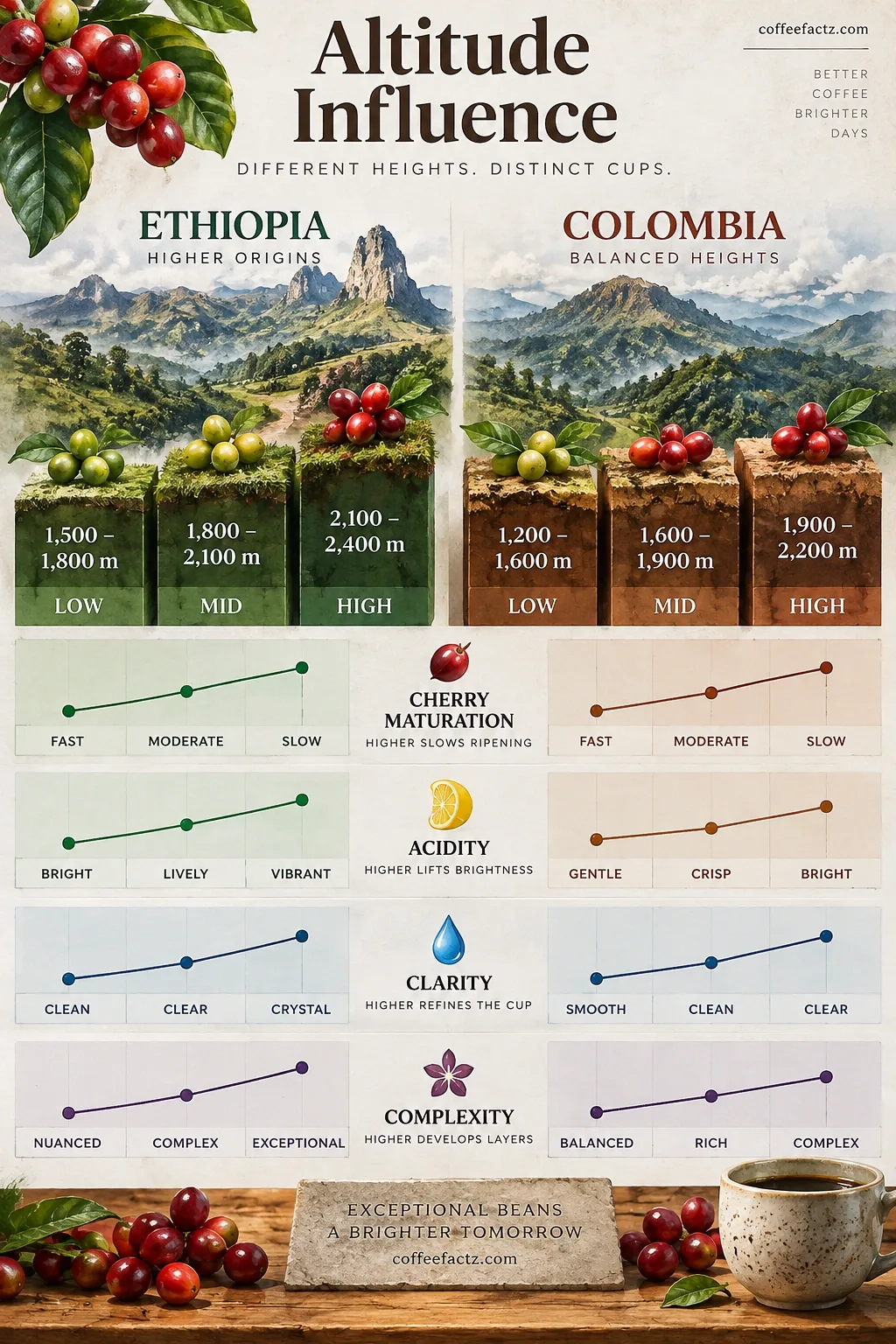
Altitude works through temperature. Above roughly 1,200 meters, cooler air slows the rate at which the coffee cherry matures. A slower maturation cycle gives the seed more time to accumulate sugars, organic acids, and the aromatic precursors that translate into complexity in the cup. The result, across multiple origins, is brighter acidity, greater clarity, and a more layered flavor profile compared to lower-grown coffee from the same variety.
Ethiopia’s 1,800 to 2,300-meter bracket and Colombia’s 1,200 to 2,000-meter bracket are useful reference points, not rules. The altitude effect is a heuristic. It describes a tendency that holds across a wide range of conditions, but exceptions exist in both directions. A high-altitude farm with poor soil management and uneven picking can underperform a well-managed farm at 1,100 meters. Altitude raises the ceiling. It doesn’t guarantee the ceiling is reached.
Substrate Composition and Microclimate Variables
Volcanic soil contributes to cup quality through two mechanisms: drainage and mineral supply. Andosols – the soils derived from volcanic ash and basalt parent material – drain well enough to prevent waterlogging at the root zone while retaining enough moisture to sustain the plant through dry spells. Their mineral profile, particularly phosphorus and potassium availability, supports the enzymatic processes that build bean density and aromatic complexity. Guatemala’s Antigua valley is the standard reference case: three surrounding volcanoes, andosol soils at roughly 1,500 meters, and a cup character marked by chocolate, spice, and restrained brightness.
Microclimate variables operate at a finer scale than altitude or soil type. Diurnal temperature swing – the gap between daytime highs and nighttime lows – functions similarly to altitude: a wider swing slows sugar metabolism and concentrates flavor compounds in the cherry. Cloud cover and shade management alter the light and thermal environment at the canopy level. Annual rainfall, measured in millimeters, determines how much water stress the plant experiences and when. These figures vary significantly across even short distances within a growing region, which is why farm-level data matters more than country-level averages.
A peer-reviewed study measuring shade canopy cover, soil temperature, and soil chemistry across 53 farms and 159 coffee trees in southwest Ethiopia found that total specialty quality was significantly associated with soil chemistry, with 84% of the variation in quality scores explained by soil chemical variables. Green bean biochemistry – caffeine, trigonelline, and chlorogenic acid content – showed a negative correlation with soil temperatures and a positive correlation with soil chemistry, providing direct evidence that microclimate and soil composition influence physical bean attributes and cup quality simultaneously.
Exact rainfall figures, soil classifications, harvest calendars, and varietal lineage are among the least documented variables in popular coffee writing. Every number in this section should be attributed to a named source. Presenting them as settled consensus is the most common error in origin-focused content.
Physical Structure and Harvest Timing
Bean density is the physical bridge between farm conditions and the roaster’s work. A denser bean, built by slow maturation at altitude on mineral-rich soil, responds differently to heat than a low-density bean. It requires more energy to reach the same internal temperature, holds that temperature more evenly through the roast, and tends to express a wider range of flavor compounds before the roast crosses into bitterness. Roasters calibrate their profiles to bean density; a profile designed for a dense Ethiopian highland lot will overdevelop a lower-density Brazilian natural.
The harvest cycle is a function of both latitude and altitude. Near the equator, some origins produce two harvests per year because the solar cycle is nearly constant. At higher latitudes within the Coffee Belt, a single distinct season is the norm. Within a harvest window, picking selectivity determines what the roaster receives. Selective hand-picking, which takes only ripe red cherries, delivers a more uniform raw material than strip-picking, which removes all cherries from a branch regardless of ripeness. The farm sets the flavor potential. The roast releases or amplifies it. A green coffee cannot exceed what its growing conditions built, and a roast profile can waste what the farm provided.
Processing Methods: How Washed, Natural, Honey, and Giling Basah Change the Cup
Processing is where the farm’s influence continues after harvest. The method chosen, or available, determines how much of the fruit’s chemistry transfers into the seed. This is not marketing language. It is fermentation biology.
Mucilage Retention and Drying Environments
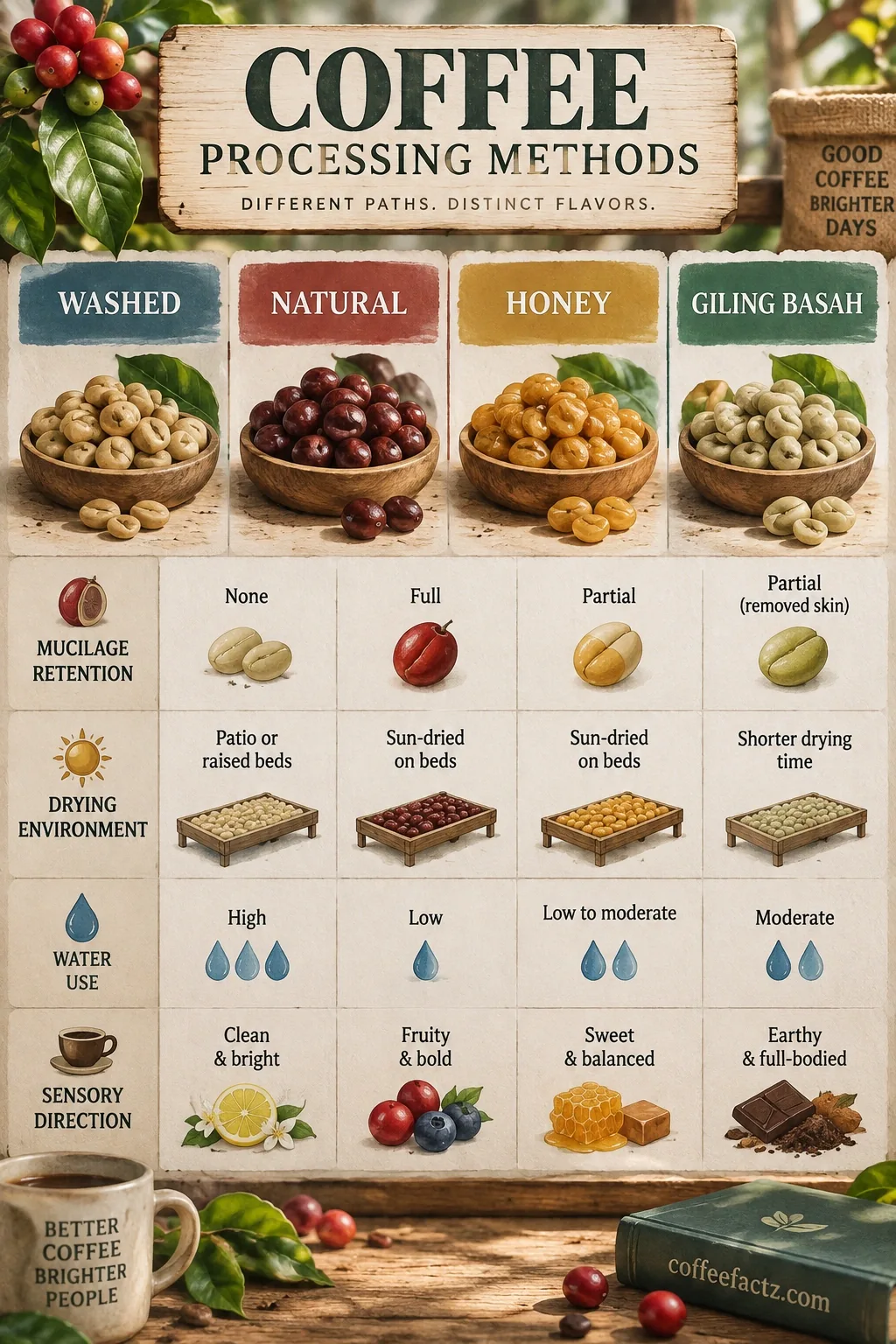
Four process families cover most of what happens between cherry and green bean. Washed processing removes the cherry skin and mucilage before drying, leaving a clean seed that expresses the bean’s inherent character with minimal fruit interference. Natural processing dries the whole cherry intact, allowing the mucilage and pulp sugars to ferment against the seed over weeks. Honey processing, also called pulped natural, removes the skin but leaves some or all of the mucilage on the seed during drying, landing between the other two in both fermentation intensity and cup character. Wet-hulled processing, known in Indonesia as giling basah, removes the parchment layer while the bean still holds significant moisture – a method driven by climate rather than preference.
The mechanical variable that separates all four methods is simple: how much fruit mucilage remains on the seed during drying, and under what conditions that drying occurs. Sun drying on raised beds, patio drying on concrete, and mechanical drum drying each produce different temperature and airflow profiles around the drying seed. The method and the drying environment together determine the fermentation trajectory.
Sensory Direction and Resource Footprint
Each method pushes the cup in a recognizable direction, though the industry is far less certain about exact outcomes than its marketing implies.
Washed coffees tend toward clarity and brightness: the terroir and cultivar character come through without fruit-derived sweetness layered over them. Natural coffees tend toward heavier body, wine-like or berry-adjacent fermentation notes, and sweetness that can read as jammy or boozy depending on fermentation control. Honey coffees sit on a spectrum between those poles, with the amount of mucilage retained shifting the cup toward either cleaner brightness or heavier sweetness. Wet-hulled coffees trend toward low acidity, heavy body, and earthy, cedar-like notes driven by the high-moisture hulling step.
These are directional tendencies. Fixed rules are not defensible. A poorly controlled natural process can produce off-flavors that have nothing to do with the terroir. A precisely managed washed lot can show fruit character that most people associate with naturals.
The environmental footprint differs sharply between methods. Washed processing requires significant water volume for fermentation tanks and washing channels. Natural processing uses almost none. This distinction matters beyond flavor: in regions where water access is limited or contested, processing method is an ecological and economic decision before it is a flavor decision. That connection runs directly into the regulatory questions in H2-8.
Nestlé Research scientists Sophia Jiyuan Zhang and Florac de Bruyn found that different coffee varieties show measurable differences in the mucilage and pulp chemistry of fresh cherries, and that these differences shape the microbial community and pH trajectory during fermentation. In their comparison of Typica in Latin America and Catimor in Asia, the Typica’s thicker, nutrient-richer mesocarp layer drove different fermentation dynamics than the Catimor – and external factors like local ambient temperature compounded those differences further.
The implication is direct: variety and terroir don’t stop influencing the coffee at harvest. They continue into the fermentation vessel. Processing method interacts with what the cherry already contains, which means the same washed protocol applied to two different varieties at two different altitudes will not produce the same result.
Terroir Interaction and Quality Limits
Processing can amplify terroir, mute it, or mask it entirely. The cleanest available test of this effect is two coffees from the same farm, same harvest, processed two different ways. When a producer offers both a washed and a natural lot from a single plot, the flavor difference between them is almost entirely attributable to the processing choice. The terroir is held constant. The method is the variable.
The practical limit deserves a direct statement: processing does not overwrite a bad farm, and it does not rescue an underripe cherry. Natural processing on underripe cherries produces harsh, astringent fermentation notes that no drying protocol can fix. Washed processing on a low-altitude, mineral-poor lot will produce a clean but thin cup – clean because the method works, thin because there was nothing more to extract. The ceiling is set at the farm.
The terminology gap in this area is a credibility signal worth knowing. “Single origin” appears constantly in specialty coffee marketing and almost never gets defined or distinguished from a regional blend. That ambiguity is exactly what the traceability ladder in H2-8 resolves.
Latin America: Altitude and Process Splitting One Genetic Lineage
Colombia, Guatemala, and Brazil share a largely common genetic ancestry rooted in those early Yemeni exports. They sit at opposite ends of the altitude and processing spectrum. That combination makes Latin America the clearest natural experiment in the article: hold the genetics roughly constant, vary the elevation and method, and read the cup difference.
Colombian Balance and Volcanic Valley Character
Colombia defaults to washed processing nationally, and the profile that results reflects that choice: balanced, clean, medium body, with the brightness and clarity that washed processing allows the terroir to express. The elevation bracket of 1,200 to 2,000 meters across the main growing departments – Huila, Nariño, Antioquia – supports the sugar and acid development that makes the cup readable without being aggressive. Colombia’s position straddling the equator creates two main harvest windows in a single year: the main crop running roughly October through February, and the mitaca or fly crop from April through June in some regions.
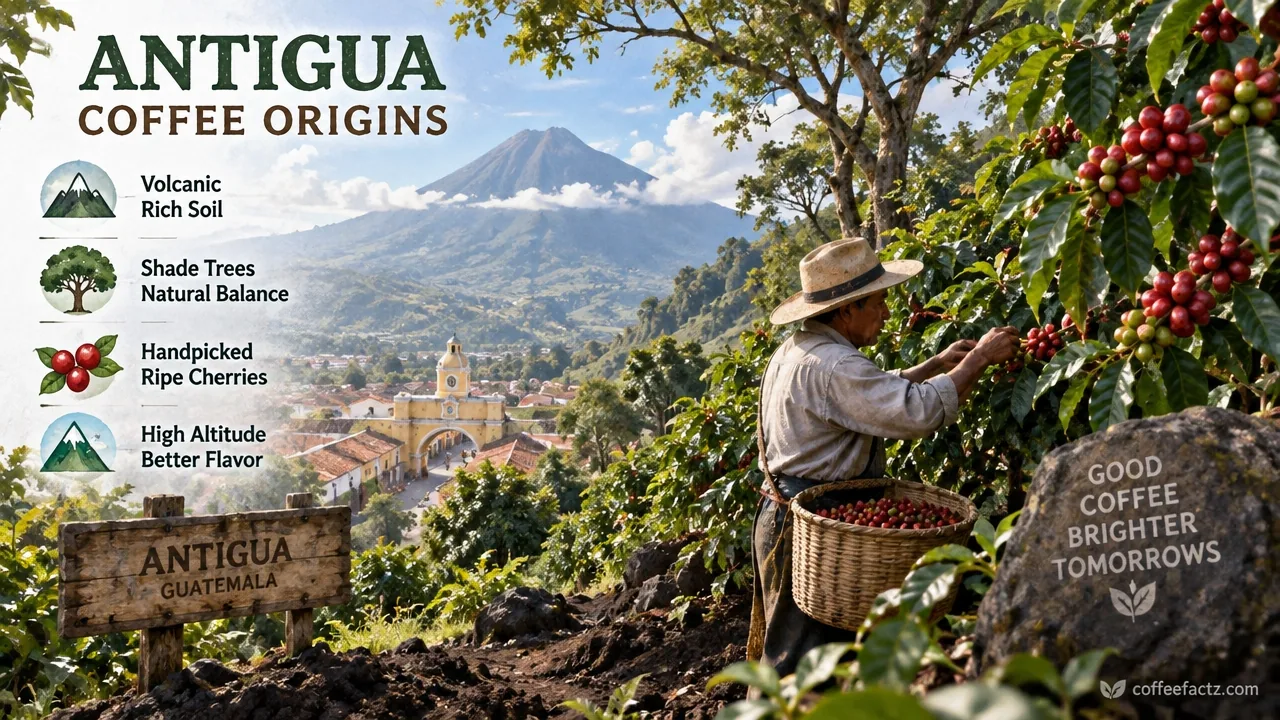
Guatemala’s Antigua valley is the most cited single terroir in Central America. Three surrounding volcanoes, andosol soils, and altitudes ranging from roughly 1,500 to 1,700 meters produce a cup marked by chocolate, mild spice, and a body that washed processing does not strip away. The volcanic mineral profile appears to contribute directly to the density and weight of the Antigua cup. Guatemala’s other distinct zones – Huehuetenango in the northwest, Cobán in the north – each carry their own microclimate signatures, but Antigua remains the reference case because its conditions are the most consistently documented.
Flavor differences between these two countries track the elevation bracket and process choice far more closely than the national border. That is the mechanism at work, not geography as a category.
Lowland Sweetness and Cultivar Ancestry
Brazil sits at the other end of the elevation axis. Most Brazilian production occurs between 800 and 1,200 meters – below the threshold where high-altitude acidity development kicks in. Pulp natural and natural processing dominate, and the cup reflects both variables: sweetness, low acidity, and notes that read as nuts, milk chocolate, or dried fruit depending on the lot. Brazil is the world’s largest coffee producer by volume, and its processing methods are calibrated to that scale as much as to cup character.
The varietal mix – Bourbon, Typica, Caturra, and their crosses – descends directly from the Yemeni export population described in H2-3. Caturra is a natural mutation of Bourbon, selected for its compact growth and higher yield. Mundo Novo is a Typica-Bourbon hybrid. The Brazilian varietal landscape is a direct genetic consequence of colonial-era planting decisions, not of local adaptation from a wild population. This is the structural difference between Ethiopian coffee and Latin American coffee at the genetic level: Ethiopia has wild diversity; Latin America has cultivated lineages derived from a narrow exported slice of it.
The colonial cultivation history that established Brazil, Colombia, and Guatemala as growing zones was a mechanism of spread – Portuguese and Spanish colonial agriculture moving plant material to new latitudes for economic extraction. Framing it as a botanical origin story would be a sequence error. The plants arrived. The terroir shaped what they became.
Asia-Pacific: Wet-Hulled Body and the Robusta Variable
Asia-Pacific runs on different rules. The species, the climate, and the dominant processing method all diverge from the African and Latin American patterns. The result is a cup profile that surprises readers who expect the altitude-brightness relationship to hold.
Sumatran Earthy Profiles and Humidity Adaptation
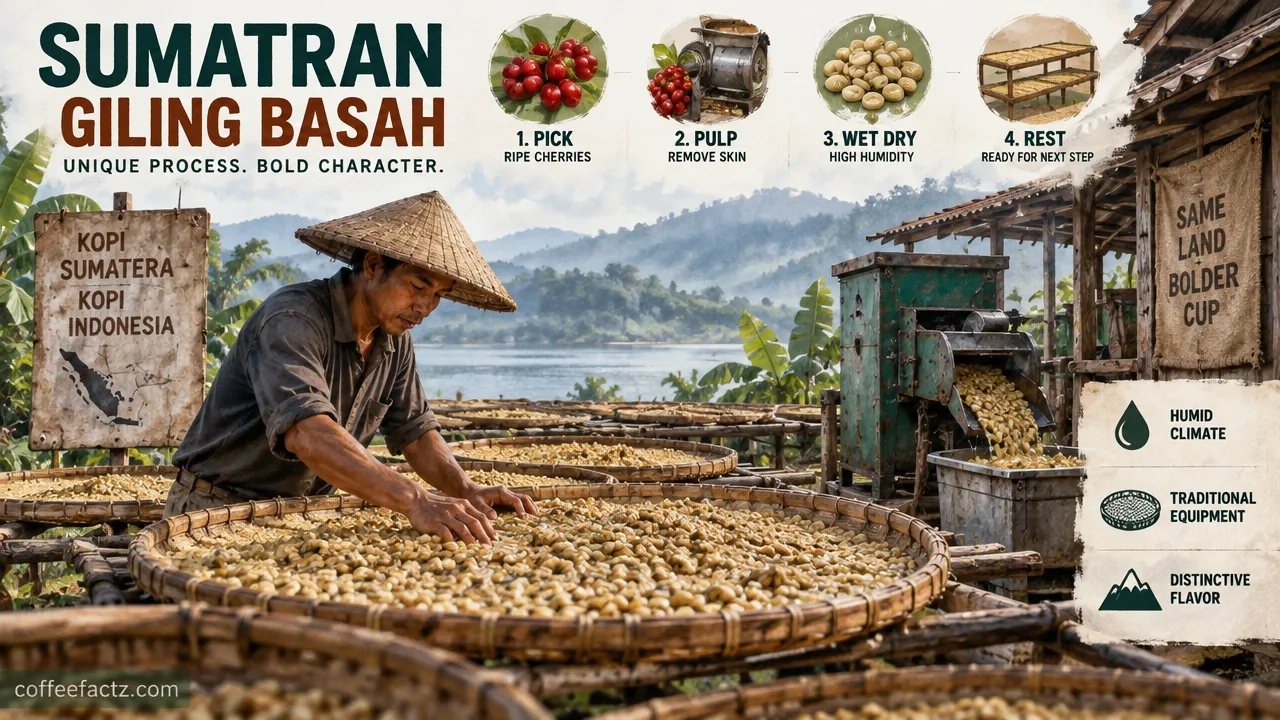
Sumatra produces some of the most distinctive cups in the world, and the mechanism is the processing method. Giling basah, or wet-hulling, removes the parchment from the bean while it still holds 40 to 50 percent moisture content, well above the 10 to 12 percent at which washed coffees are typically hulled. The beans are then dried to export moisture levels, but the high-moisture hulling step has already altered the cellular structure of the seed. The result is a characteristic earthy, cedar-like, low-acid, heavy-bodied cup that reads as mushroom, forest floor, or dark tobacco to different palates.
The method exists because of climate, not preference. Sumatra’s persistent high humidity and rainfall make extended parchment drying impractical. Coffee would mold before reaching safe moisture levels. Wet-hulling accelerates the process by removing the parchment earlier, allowing the naked bean to dry faster. The processing method is a climate adaptation first. The flavor it produces is a consequence of that adaptation.
In this region, processing method and species explain the cup profile more directly than elevation does. That is not a failure of the altitude model; it is the model correctly applied to a situation where a different variable dominates.
Vietnamese Production and Neighboring Profiles
Vietnam produces coffee at a scale that shapes global supply chains, and most of it is robusta (Coffea canephora) rather than arabica. Robusta grows at lower elevations, tolerates higher temperatures, and yields more per hectare than arabica. Its flavor profile reflects different chemistry: higher caffeine content, more bitterness, heavier body, and significantly less of the aromatic complexity that altitude-grown arabica develops. Vietnam’s robusta is the foundation of most global instant coffee and a key component in commodity espresso blends, where its body and crema-generating properties compensate for its flavor limitations in arabica blends.
Papua New Guinea represents the adjacent profile in the Asia-Pacific system. Its highland arabica production, centered in the Wahgi Valley at roughly 1,400 to 1,800 meters, produces a cup that reads closer to Latin American profiles than to Sumatran ones – fruity, mild acidity, medium body – because the processing is washed or semi-washed and the elevation supports slower cherry development. It occupies a distinct position within the Asia-Pacific category that wet-hulled Sumatran profiles tend to overshadow in market awareness.
Modern Specialty Terroir, Traceability, and the Economics Behind Your Bag
Knowing what altitude, soil, processing, and genetics do to a coffee is the first half of the problem. The second half is knowing whether the information on a bag reflects what’s actually in it.
Verification Signals and Specificity Ladders
The traceability ladder runs from least to most specific: country, region, cooperative or washing station, single farm lot, and single varietal. What a buyer can verify changes at each rung.
At the country level, the claim is simply that the coffee grew within a national border. No quality or process information is implied. At the regional level, a buyer can reasonably expect the general altitude and climate characteristics of that zone to apply. At the cooperative or washing station level, the processing method and some varietal information become available, and the chain of custody narrows to a defined group of producers. At the single farm lot level, farm name, lot number, harvest date, and stated elevation should all be present and verifiable through the importer’s documentation. At the single varietal level, the botanical lineage is specified, which allows the buyer to connect the cup to the genetic material described in H2-2 and H2-3.
The practical distinction between a single-origin bag and a regional blend is significant. A regional blend may be a deliberate quality decision: a roaster combining lots from the same zone to achieve a consistent profile that no single lot delivers across a full season. It is not inherently inferior. But it is a different product from a single farm lot, and packaging that uses “single origin” for both without distinction is using the term at its loosest legal definition.
Verification signals on a modern specialty bag include farm name, lot number, harvest date, stated elevation, varietal, and independent certification. Of these, farm name, elevation, and varietal are typically self-declared by the roaster based on importer documentation. Independent certification – Fair Trade, Rainforest Alliance, organic – involves third-party auditing, but certification scope varies widely. Certification confirms compliance with specific criteria; it does not independently verify cup quality or the accuracy of terroir claims.
Producer Pressures and Predictive Cues
The producer side of this system carries pressures that the bag rarely communicates. Climate change is shifting the elevation bands where arabica quality is achievable, pushing viable growing zones upward in most producing countries. Labor availability at harvest is a recurring constraint: selective hand-picking requires people, and rural labor migration is reducing the workforce available during peak harvest windows.
A systematic review on climate change and coffee quality published in Frontiers in Plant Science found that while higher altitudes benefit cup quality, relocating farms upward is not a viable option for most smallholder producers – particularly those whose land access, capital, and cultural identity are tied to existing landscapes. Among the most promising climate resilience strategies identified were shade-grown diversification, climate-resilient cultivar selection, incorporation of wild coffee germplasm, and innovations in processing.
The Ethiopian case makes the stakes concrete. Ethiopia’s coffee sector is built on approximately 15 million smallholders, with arabica accounting for 95 to 97 percent of national production. Export revenues run roughly $900 million to $1 billion annually. Nearly half of national production is consumed domestically, which means the export identity of one of the world’s most celebrated single-origin sources rests on a fragmented smallholder base with limited capital for climate adaptation or certification compliance.
P. Gijbels and colleagues, studying wild and managed Coffea arabica populations in southwestern Ethiopia’s Afromontane forests, found no evidence of genetic erosion despite severe forest fragmentation – but identified a different threat: wild populations are being replaced by or interbred with imported genotypes that local farmers prefer for specific agronomic traits. In-situ conservation requires actively avoiding the intensification of production in forest coffee systems.
The EU Deforestation Regulation (EUDR) adds another layer to this picture. The regulation requires importers to verify that coffee was not produced on deforested land. For large, well-documented estates, compliance is a documentation process. For smallholder cooperatives in fragmented forest systems, compliance costs can exceed what individual producers can absorb. When that threshold is crossed, farms exit the traceable supply chain rather than enter it. The regulation intended to protect forests may, in some cases, accelerate the disappearance of the documented sourcing it was designed to incentivize.
Brazil’s position illustrates a different tension. As the world’s largest producer, Brazil operates at a scale where volume and quality strategy pull in opposite directions at the producer level. High-volume commodity production optimizes for yield and processing efficiency. Specialty-grade natural and pulp natural lots require slower, more selective processing that reduces throughput. Individual producers navigate this trade-off based on their market access and price signals, not on a national quality strategy.
Climate adaptation, labor equity, farmer economics, and certification effectiveness are underdeveloped topics across the source literature. Greenwashing metrics – the gap between certification claims and verified outcomes – are largely absent from published research. Where a specific number or verified claim is not available, the honest position is to say so rather than imply consensus.
Reading a bag with these variables in mind produces a more reliable prediction than reading it as a flavor promise. Elevation bracket tells you the acidity and complexity ceiling. Processing method tells you the direction the fruit chemistry will push the cup. Species tells you whether you are reading arabica or robusta rules. Traceability rung tells you how much of that information has been verified and at what resolution. Four variables, all printed on most specialty bags in some form. The skill is knowing which ones are self-declared and which ones have been audited.
Frequently Asked Questions About Coffee Origin Exploration
How was coffee originally discovered?
There’s no verified account. The Kaldi goat-herder story is a cultural legend with no evidentiary trail. What the genomic record confirms is that Coffea arabica evolved in the highland forests of southwestern Ethiopia, and that forest communities consumed the cherry as a food before the roasted beverage existed.
Why does Ethiopian coffee taste so different from coffees grown in other countries?
Ethiopia’s wild landrace population carries the deepest genetic diversity of any arabica-producing country. Combined with elevations of 1,800 to 2,300 meters and washed processing in zones like Yirgacheffe, that genetic breadth expresses itself as floral, tea-like, and bright profiles that cultivated varieties derived from the narrow Yemeni export gene pool can’t fully replicate.
Why was coffee called “Satan’s drink” in Europe?
It was a social and political reaction, not a theological one. Coffee was a new stimulant that fueled coffeehouse culture – places where people gathered, debated, and organized outside church or royal oversight. The label reflected discomfort with what the coffeehouses enabled, not with the beverage’s chemistry.
What is the actual difference between single origin and a regional blend?
Single origin legally means coffee from one country. A regional blend aggregates farms or cooperatives within a defined zone. A single farm lot is the most specific: one producer, one harvest, one processing run. The same “single origin” label can appear on all three, which is why traceability signals like lot number and farm name matter more than the marketing term.
Does higher altitude always mean better coffee?
No. Altitude slows cherry maturation and supports sugar and acid development, but soil chemistry, picking selectivity, and processing control all determine whether that potential reaches the cup. One peer-reviewed study of Ethiopian farms found soil chemical variables explained 84% of specialty quality variation – altitude was a factor, but not the dominant one.
Who discovered coffee first?
No individual discoverer exists in the historical record. The earliest documented use of coffee as a brewed beverage comes from 15th-century Sufi communities in Yemen. Coffea arabica itself is indigenous to Ethiopia, where forest communities consumed it as a food long before the beverage form developed.
What does giling basah actually do to flavor that washed processing doesn’t?
Wet-hulling removes the parchment while the bean still holds 40 to 50% moisture. That step alters the cellular structure of the seed before it finishes drying, producing the earthy, low-acid, heavy-bodied profile associated with Sumatran coffee. It’s not a stylistic preference – it’s the only practical method in Sumatra’s persistently humid climate.
How do I know if the origin information on a specialty bag is verified or self-declared?
Farm name, elevation, and varietal are almost always self-declared by the roaster based on importer documentation. Independent certifications involve third-party auditing but cover specific criteria, not cup quality or terroir accuracy. The strongest verification signal is a named importer with published sourcing reports, a lot number, and a harvest date that allows the lot to be traced back through the supply chain.
References
- Yemeni Coffee: How Genetically Diverse Is It? | worldcoffeeresearch.org
- The Fermentation Effect | sca.coffee
- Climate Change and the Coffee Quandary | sca.coffee
- Genetic Differentiation of Wild and Managed Coffea Arabica Populations in Afromontane Rainforest Fragments in SW Ethiopia | nature.com
- The Relationship Between Elevation, Soil Temperatures, Soil Chemical Characteristics, and Green Coffee Bean Quality and Biochemistry in Southwest Ethiopia | hal.science