

Starbucks Venti cup sizes carry a quiet contradiction: the name literally means “twenty” in Italian, but order one iced and you get 24 ounces. That gap isn’t an accident. It’s a deliberate piece of cup geometry built around ice displacement, and it has real consequences for how much coffee you’re actually getting.
The bigger problem sits one level deeper. Most customers upgrading from a Grande to a Hot Venti latte pay more money for the exact same amount of espresso. The extra volume is steamed milk, not coffee. Once you see how the shot counts and milk ratios actually work across every size, you’ll never order on autopilot again.
Key Takeaways on Starbucks Venti Cup Sizes
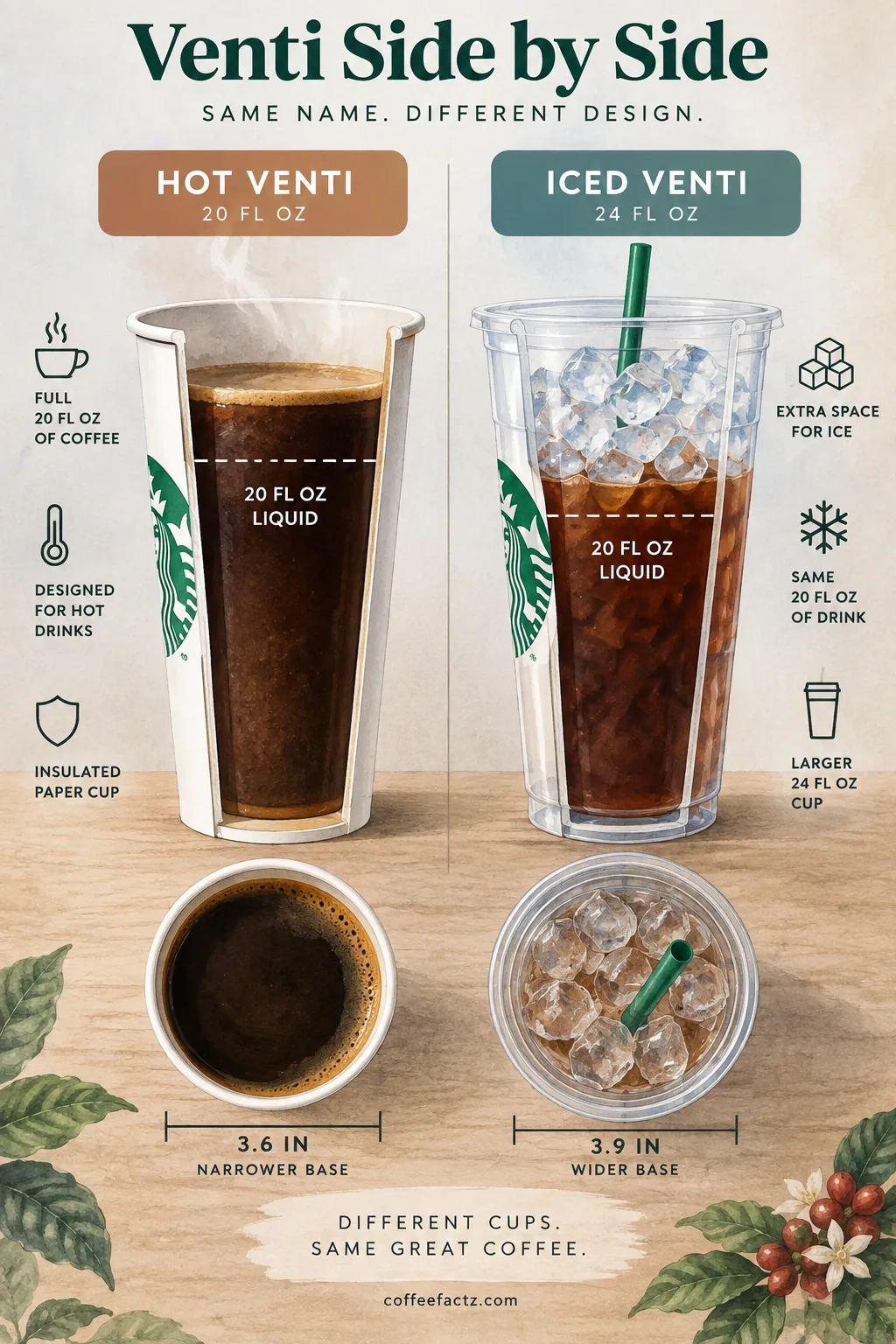
- A hot Venti is 20 fl oz; an iced Venti is 24 fl oz – same name, two different cup designs built around ice displacement geometry.
- Hot Venti and Hot Grande lattes both get 2 espresso shots, so sizing up hot costs $0.50–$0.70 more for zero extra caffeine.
- Iced Venti lattes get 3 shots by default, making cold the stronger and better-value format for caffeine-focused customers.
- The Hot Grande has the best espresso-to-milk ratio (1:7) of any standard hot latte size – stronger tasting than both Tall and Hot Venti.
- Asking for a triple shot in a Hot Venti restores the espresso intensity without paying for a separate size upgrade.
- Trenta (31 fl oz) is cold-only and limited to select beverages; Nitro Cold Brew is capped at Grande.
The Complete Starbucks Cup Size Chart: Ounces, Milliliters, and the Italian Naming Code
Starbucks cup sizes follow a specific progression that the menu board never fully explains. Five names, six distinct volumes. Here’s the complete picture before we get into why the numbers behave the way they do.
Capacity Translation Matrix
Every size Starbucks offers maps to a fixed fluid ounce and milliliter measurement, with one notable split at the Venti level.
| Size | Fluid Ounces | Milliliters | Notes |
|---|---|---|---|
| Short | 8 fl oz | 240 ml | Hot drinks only |
| Tall | 12 fl oz | 350 ml | Available hot and cold |
| Grande | 16 fl oz | 470 ml | Available hot and cold |
| Venti (Hot) | 20 fl oz | 590 ml | Hot drinks |
| Venti (Cold) | 24 fl oz | 710 ml | Iced drinks |
| Trenta | 31 fl oz | 920 ml | Cold only; select beverages |
The Trenta is the outlier on both ends. At 31 fl oz, it’s larger than the average human stomach capacity, and Starbucks limits it to cold beverages like Cold Brew, Iced Coffee, and select Refreshers. Not every drink qualifies, and not every store carries it for all eligible drinks.
“Cup/Size Short – 8 oz. Tall – 12 oz. Grande – 16 oz. Venti (hot) – 20 oz. Venti (iced) – 24 oz.” – From the Starbucks Beverage Resource Manual, published by Nestlé Coffee Partners
That table is the official record. The hot and cold Venti volumes are not rounding differences or regional variations. They are two separate cup designs with two separate capacities.
Linguistic Origins and Menu Semantics
The Italian nomenclature traces back to 1986, when Howard Schultz modeled his first coffee concept, Il Giornale, on the Italian espresso bar experience. He kept the Italian size names when Starbucks scaled. Most of them are intuitive: Grande means “large” in Italian, Venti means “twenty.”
That last one is where the naming logic holds for hot drinks and breaks for cold. A hot Venti is exactly 20 fl oz. The name is a literal volume declaration. But an iced Venti is 24 fl oz, which means the word “twenty” now refers to a container that holds four more ounces than it claims. The Italian origin didn’t account for ice.
The PAA questions reflect exactly this confusion:
- Is Venti 20 or 24 oz? Both, depending on temperature.
- Is 16 oz Grande or Venti? Grande. Venti starts at 20 oz.
- What’s a 12 oz size at Starbucks called? Tall.
The Short (8 oz) rarely appears on digital menu boards, which is why many customers don’t know it exists. It’s available for hot drinks only and primarily useful for espresso-based beverages where a smaller milk volume is actually the point.
Why Venti Hot Is 20 oz but Venti Iced Is 24 oz: The Ice-Displacement Geometry
Venti hot and Venti iced are not the same drink in different temperatures. They’re engineered differently from the cup outward, and the 4-ounce difference exists for a mechanical reason, not a marketing one.
A hot Venti cup holds 20 fl oz of liquid. Full stop. There’s no ice, no displacement, no headroom needed. The entire 20 oz is beverage.
An iced Venti cup holds 24 fl oz total, but a meaningful portion of that capacity is occupied by ice. Once you account for ice displacement, the actual liquid volume the customer receives sits somewhere between 16 and 18 fl oz. The larger cup isn’t generosity. It’s geometry. Starbucks built the extra 4 ounces into the cold cup specifically to accommodate the physical space ice cubes occupy without reducing the liquid yield below what a customer reasonably expects.
The second variable is time. Ice melts. As it does, it dilutes the drink and reduces the effective coffee concentration. So the 24 oz you start with is a starting condition, not a fixed state. By the time you’re halfway through an iced latte on a warm afternoon, the ratio of coffee to water has already shifted.
This is why “Venti hot” and “Venti iced” are not interchangeable when comparing ounces. They share a name and a general size tier, but they represent two different physical realities inside two different cup designs.
In the U.S., the cold Venti cup is a physically larger vessel than the hot Venti cup. The 4-ounce gap isn’t just ice displacement calculated into the same container. It’s a bigger cup plus ice displacement working together.
The Espresso Shot Trap: How a Hot Venti Latte Can Be Weaker Than a Grande
The espresso shot counts at Starbucks don’t scale linearly with cup size. That’s the fact the menu board never states directly, and it’s the reason a Hot Venti latte can deliver a weaker coffee experience than a Hot Grande at a higher price.
Warm Beverage Caffeine Distribution
Hot espresso drinks at Starbucks follow a shot count that plateaus at the Grande level and stays flat through the Hot Venti.
- Hot Tall (12 oz): 1 espresso shot, approximately 75 mg caffeine
- Hot Grande (16 oz): 2 espresso shots, approximately 150 mg caffeine
- Hot Venti (20 oz): 2 espresso shots, approximately 150 mg caffeine
The caffeine doesn’t move between Grande and Hot Venti. The cup gets 4 ounces larger. The espresso stays the same. That means the coffee-to-milk ratio actually worsens when you size up from a hot Grande to a hot Venti latte.
A former Starbucks barista writing for PureWow put it plainly: most customers assume the larger hot size comes with an extra shot, but nearly all hot Venti and Grande espresso drinks get the same two shots. The third shot only appears in the iced version.
The financial consequence is direct. Upgrading from a Hot Grande to a Hot Venti costs roughly $0.50 to $0.70 more, and that money buys zero additional espresso. It buys steamed milk.
It’s also worth noting that the roughly 75 mg per shot figure is a working average, not a fixed number. A peer-reviewed analysis published in Foods found that espresso caffeine content varies by a factor of six across preparations, ranging from 51 mg to 322 mg per cup, depending on grind, water temperature, pressure, and extraction time. Brewing at 92°C under 7 to 9 bars of pressure appears to extract the most caffeine, while temperatures at or above 98°C actually reduce yield. So “two shots” at Starbucks is a recipe instruction, not a guaranteed caffeine number.
Cold Beverage Recipe Calibration
Iced Venti drinks operate under a different recipe standard, and this is where the cold format earns its keep.
Because the iced cup is 24 oz and ice dilutes the drink over time, Starbucks standardizes iced Venti lattes with 3 espresso shots, delivering approximately 225 mg of caffeine. That third shot exists to maintain flavor concentration against the dilution effect of melting ice. Without it, an iced Venti latte would taste progressively weaker as the drink sat.

The broader principle: espresso shot count is not a simple size multiplier. Cup volume is one input, but temperature format and drink type both override it. A Venti Americano gets 4 shots. A shaken espresso gets an extra shot relative to standard. A Frappuccino gets a single shot regardless of size. A flat white uses a ristretto shot plus one additional. The recipe logic is drink-specific, not size-specific.
Milk Volumes Revealed: What the Menu Doesn’t Tell You About Latte Ratios
Milk volume is the number Starbucks never prints on the menu. You see total fluid ounces. You don’t see the espresso-to-milk split. Once you calculate it, the Hot Venti upgrade looks very different.
Dairy Proportion Metrics
The coffee-to-milk ratio shifts significantly across hot latte sizes, and not always in the direction you’d expect.
Using a standard doppio (2 shots) as a volume reference – approximately 1.5 fl oz of espresso – the estimated milk and foam volumes work out as follows:
| Size | Shots | Espresso Volume | Milk + Foam (est.) | Ratio |
|---|---|---|---|---|
| Hot Tall | 1 | ~0.75 fl oz | ~11.25 fl oz | 1:11 |
| Hot Grande | 2 | ~1.5 fl oz | ~14.5 fl oz | 1:7 |
| Hot Venti | 2 | ~1.5 fl oz | ~18.5 fl oz | 1:9 |
The Hot Venti contains roughly 4 more ounces of steamed milk and foam than the Hot Grande. The espresso is identical. So sizing up from Grande to Venti in a hot latte means you’re buying a milkier drink, not a stronger one.
The Hot Grande actually has the best espresso-to-milk ratio of the three standard hot sizes. The ratio worsens as you go down to a Tall (only one shot) and again as you go up to a Venti (same shots, more milk).
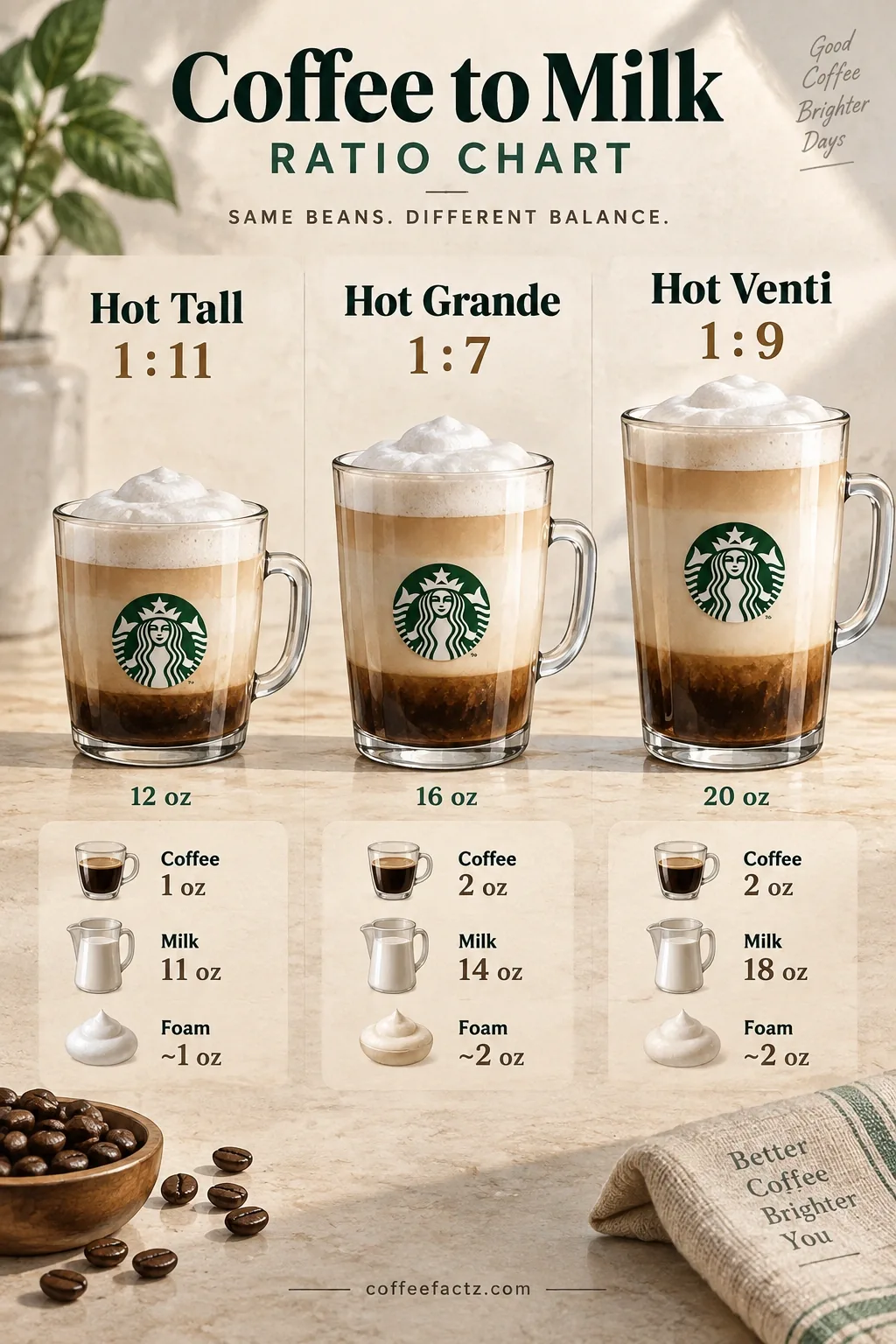
Starbucks doesn’t publish these milk volumes officially. The menu gives you total ounces. The split between espresso and dairy is a derived number, not a disclosed one.
Beverage-Specific Froth and Customization
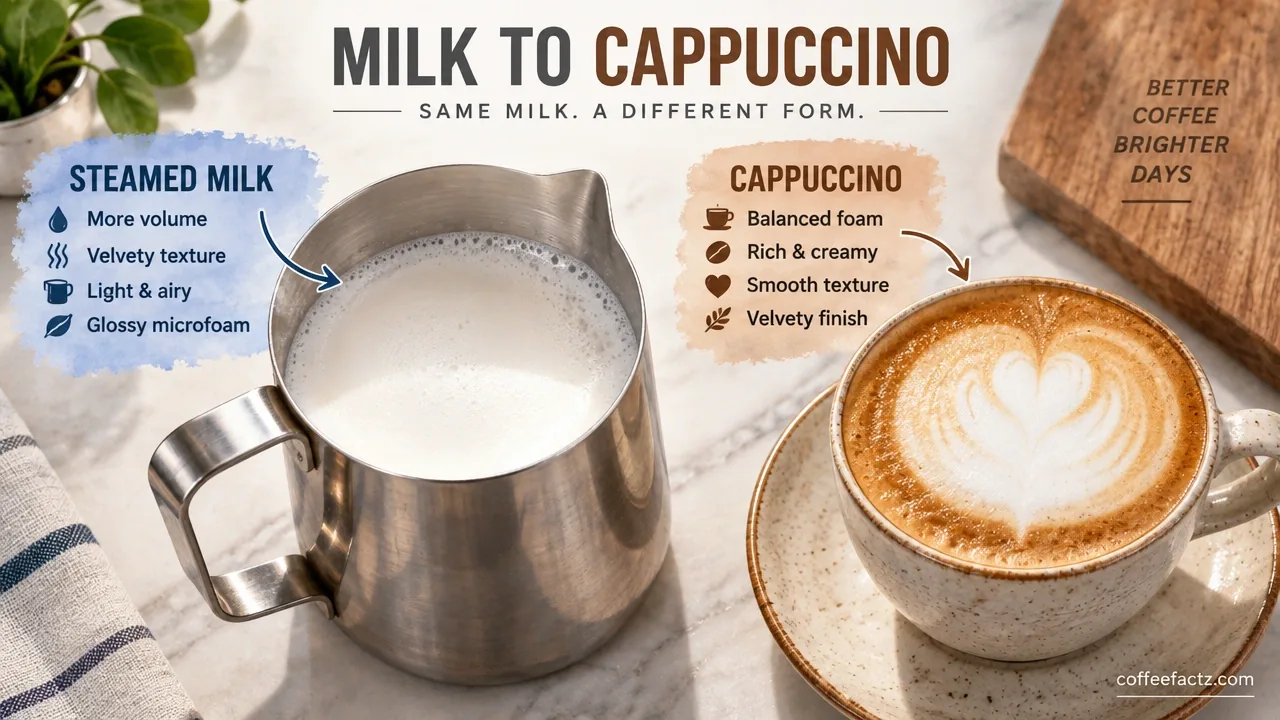
Milk volume also changes by drink type, independent of size. A latte and a cappuccino in the same cup size contain very different proportions of liquid milk versus foam. Lattes and flat whites are milk-heavy by design. Cappuccinos trade liquid milk for a thicker foam layer. Brewed coffee has no milk at all unless you add it.
Customizations complicate the picture further. Ordering light ice in an iced drink increases the liquid volume but doesn’t change the espresso count. Swapping milk types changes the texture and calorie load but not the coffee ratio. Adding an extra shot is the only customization that directly improves the espresso-to-milk balance. Each of these changes shifts the effective ratio, which means the number on the cup is a starting point, not the final composition of what you’re drinking.
Strategic Ordering Guide: How to Hack Your Venti Drink
The smart Venti order starts by deciding what you actually want: more volume, more caffeine, or more value. Those three goals don’t always point to the same cup.
If you want a Hot Venti latte that tastes as strong as a Grande, ask for a triple – three espresso shots instead of the standard two. The upcharge for an extra shot is typically less than the price difference between Grande and Venti, and you get a drink that matches the espresso intensity of the smaller size with the extra volume. You’re paying for the shot, not the milk.
If you want the volume without the Venti price, order a Grande in a Venti cup with extra ice. You pay the Grande price, get the Grande espresso count, and the larger cup with extra ice gives you a cold drink that fills the vessel without the size-up cost. This works best for iced drinks where the ice does the volume work.
For a value swap on hot drinks, consider a Caffè Misto instead of a latte. A Misto is half brewed coffee, half steamed milk. It’s cheaper than a latte, has a different flavor profile, but delivers a satisfying hot milk drink without the espresso shot premium.
For cold drinks, the math already works in your favor. The Iced Venti gets 3 shots by default. It’s the one size where Starbucks builds the stronger recipe into the standard order. If caffeine and volume are both priorities, the Iced Venti is the better default than the Hot Venti without any modification.
One additional workaround worth knowing: ordering light ice or no ice and requesting a side cup of ice increases the liquid volume in your cup, since less ice displacement means more room for beverage. You then add ice at your own pace. Availability varies by location, and not every barista will accommodate it during a rush, but it’s a documented option.
Cup Availability, Refills, and Value Perks: What You Can and Can’t Order
Cup availability at Starbucks isn’t uniform across the menu, and some of the most relevant limits apply directly to the larger sizes.
Menu Constraints & Regional Variance
The Trenta is the most restricted size on the menu. It’s cold-only, and even within cold drinks, it’s limited to Cold Brew, Iced Coffee, Iced Black Tea, and select Refreshers. Nitro Cold Brew sits at the opposite end of the restriction spectrum: it’s only available in Tall and Grande. The nitrogen infusion process and the specific pour equipment make larger formats impractical, so the size cap is structural, not arbitrary.

Customization availability also varies by store and region. One documented edge case involves drip coffee batch definitions: some regions reportedly treat a standard batch as a three-quarter batch using three scoops of beans rather than a full four-scoop batch, which affects the strength of brewed coffee even when the cup size is identical. This hasn’t been officially confirmed by Starbucks, but it’s a known variable among regular customers who notice strength inconsistencies across locations.
Loyalty Benefits & Complimentary Replenishment
Free refills apply to all customers during the same in-store visit, regardless of rewards status. Hot or iced brewed coffee and tea qualify. Espresso drinks, Frappuccinos, and cold specialty beverages do not.
The Starbucks Rewards program, updated as of March 2026, runs three tiers: Green, Gold, and Reserve. Members earn 2 Stars per $1 spent through the app. The most efficient redemption point is 200 Stars, which unlocks handcrafted drinks – the category where the per-dollar price is highest and the Star redemption delivers the most monetary value.
Bringing a reusable cup earns a $0.10 discount and double Stars on that transaction. Over time, the double Stars on expensive handcrafted drinks adds up faster than the per-visit discount suggests. For a daily Venti habit, the compounding Star rate on a reusable cup is worth the habit.
The Venti Value Verdict: When to Size Up, When to Hack, and When to Skip
The Venti decision comes down to temperature and what you’re actually paying for.
Hot Venti milk drinks get 2 espresso shots in 20 fl oz. Iced Venti milk drinks get 3 espresso shots in 24 fl oz. The word “Venti” means twenty, but only the hot version delivers exactly that volume, and neither version scales espresso proportionally with the cup size.
Here’s the decision rule:
Choose the Hot Venti if you want a milkier, softer drink and you’re not concerned about caffeine intensity. Or if you’re adding a shot anyway – in which case, ask for a triple upfront and the Hot Venti becomes a legitimate upgrade over the Grande.
Choose the Iced Venti if you want volume and caffeine. The third shot is built into the standard recipe. You get more liquid, more espresso, and a better value-per-ounce than the hot equivalent.
Choose the Hot Grande if you want an espresso-forward hot latte at a lower price. The 1:7 espresso-to-milk ratio is the best of the three standard hot sizes. It tastes stronger than both the Tall and the Hot Venti without any modification.
The bottom line: the Hot Venti upgrade is a milk upgrade. Four extra ounces of steamed milk, same espresso, higher price. The Iced Venti is a genuine size upgrade with a stronger recipe baked in. If you’re ordering hot and you want the Venti experience to actually deliver more coffee, hack the order – triple shot, Grande-in-Venti cup, or just switch to iced.
Frequently Asked Questions About Starbucks Venti Cup Sizes
Is Venti 20 or 24 oz?
Both, depending on the drink temperature. A hot Venti is 20 fl oz; an iced Venti is 24 fl oz. The larger cold cup is engineered to hold ice while still delivering 16 to 18 oz of actual liquid.
Is 16 oz Grande or Venti?
Grande is 16 oz. Venti starts at 20 oz for hot drinks and 24 oz for iced. Grande and Venti are two distinct size tiers, not regional variants of the same cup.
How many oz is a Venti size at Starbucks?
A Venti is 20 oz if you’re ordering a hot drink, or 24 oz if you’re ordering an iced drink. The official Starbucks Beverage Resource Manual lists both volumes separately.
What’s a 12 oz size at Starbucks called?
Tall. Despite the name, it’s the second-smallest size – 12 fl oz, sitting above the Short (8 oz) and below the Grande (16 oz).
Does a Venti have more caffeine than a Grande?
For hot lattes, no. Both get 2 espresso shots and roughly 150 mg of caffeine. For iced lattes, yes – an iced Venti gets 3 shots (approximately 225 mg), while an iced Grande gets 2.
Why does the Short size rarely appear on the menu board?
Starbucks doesn’t display the Short on most digital menu boards, but it exists and is available for hot drinks. It’s an 8 oz cup – useful if you want a small, strong espresso drink with minimal milk.
Is the Trenta worth ordering?
Only for specific cold drinks. At 31 fl oz, it’s available for Cold Brew, Iced Coffee, Iced Black Tea, and select Refreshers. It’s not available for lattes, Frappuccinos, or Nitro Cold Brew, so its usefulness depends entirely on what you’re ordering.
What’s the cheapest way to get a stronger Venti latte?
Ask for a triple shot when ordering a Hot Venti. The extra shot upcharge is typically less than the Grande-to-Venti price difference, and you get the same espresso intensity as a Grande in a larger cup. Alternatively, switch to an iced Venti – the third shot is already in the standard recipe at no extra cost.
References
- Starbucks Beverage Resource Manual | nestlecoffeepartnerssl.com
- Starbucks Sizes Explained by a Former Barista | purewow.com
- Influence of Various Factors on Caffeine Content in Coffee Brews | mdpi-res.com