
Commercially viable California coffee sits at the intersection of climate science, specialty marketing, and a moral economics debate the industry hasn’t fully resolved. It grows in a state where the tropical belt ends, frost is a real winter threat, and summer humidity routinely drops below 50% – conditions that would disqualify almost any other origin from serious consideration.
What makes it work isn’t luck. It’s a specific convergence of coastal fog, managed irrigation, and elevation that mimics the stress conditions responsible for the world’s most complex cups. Whether the cup quality justifies the price – and whether the local-sourcing narrative holds up under ethical scrutiny – is the more interesting question.
Key Takeaways on California Coffee
- California coffee works because coastal microclimates and elevation create thermal conditions that partially replicate high-altitude tropical growing zones, not because California’s latitude is suitable.
- Wide diurnal temperature variation – Pacific-driven night drops to 7–13°C – extends cherry maturation to 10–12 months, the primary driver of flavor complexity in California lots.
- Controlled water deficit during key development phases elevates sucrose content in the bean, directly improving roast development and cup brightness.
- Green bean prices of $10–$15/lb reflect genuine scarcity and US labor costs, but cup quality does not yet consistently outperform high-end imports at equivalent price points in blind evaluation.
- The ethical credibility gap is real: local-premium narratives carry an implicit moral valence that becomes problematic when the same roaster pays commodity-adjacent prices for the majority of its imported volume.
- California coffee’s most durable contribution to specialty coffee may be demonstrating that microclimate-driven arabica quality is possible outside the traditional belt, with implications for emerging origins globally.
Why Coffee Grows in a Belt – and How California Broke the Mold
The coffee belt runs between latitudes 23.5°N and 25°S, and for good reason: that band delivers the three non-negotiables arabica demands – consistent daily temperatures between 15–24°C, alternating wet and dry seasons to trigger uniform flowering, and zero frost. Step outside it, and you’re fighting the plant’s biology rather than working with it.
California sits at roughly 34–37°N. By that geography alone, it should be off the table.
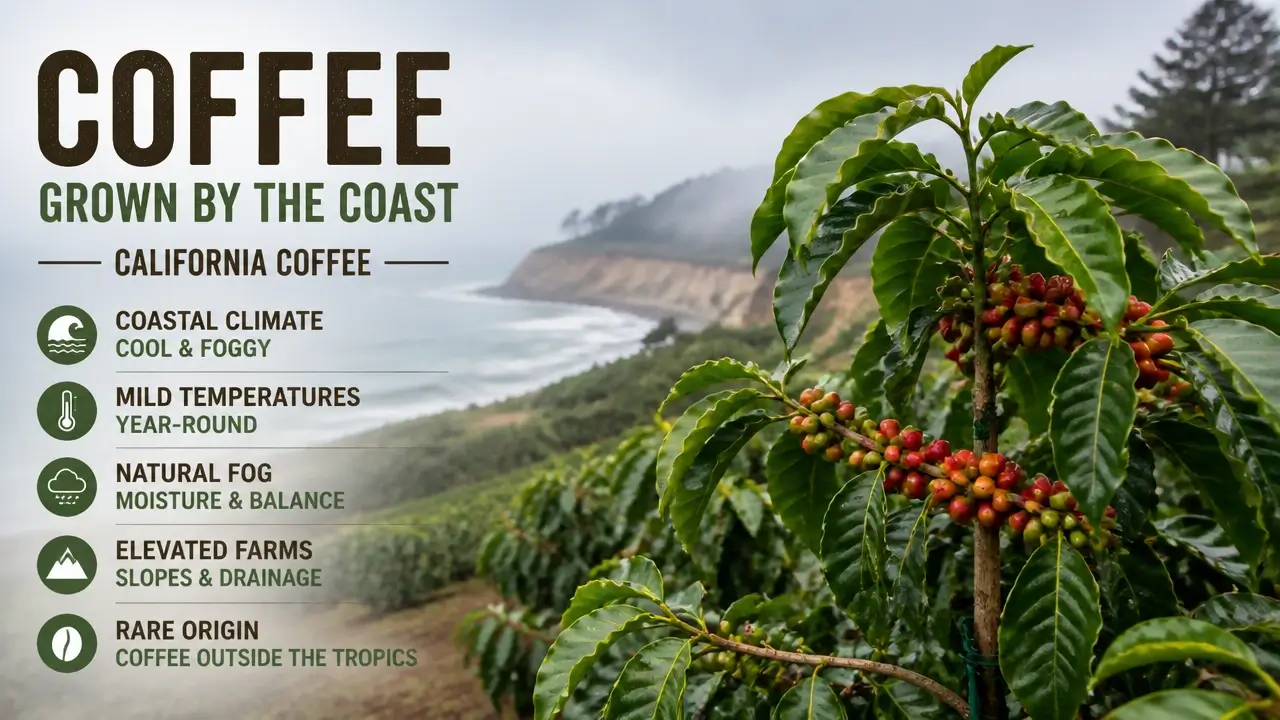
The reason it isn’t comes down to microclimates – specifically, the narrow coastal corridors from Santa Barbara south to San Diego where the Pacific Ocean acts as a thermal buffer. Cold offshore currents suppress summer highs and moderate winter lows, compressing the temperature range into something that, on the best sites, approximates what you’d find at 1,200 meters elevation in a traditional origin country. Pair that buffering effect with elevations of 500–1,500 feet in the foothills, and you’ve created a local altitude-latitude trade-off: what the farm loses by being too far north, the elevation and ocean proximity partially restore.
The hurdles are real and shouldn’t be minimized. California winters can push below 0°C, a hard frost threshold that kills arabica. Summer atmospheric humidity frequently drops below 50%, far drier than the humid tropics where coffee evolved. Annual rainfall in coastal Southern California averages 15 inches – roughly a quarter of what a Colombian origin farm receives. None of these problems disappear; growers simply have to engineer around them.
Serious commercial plantings began in the early 2000s, not as hobbyist experiments but as deliberate agronomic projects. They remain small-scale – total California production is a rounding error against Brazil’s 70-million-bag annual output – but they are real, they are improving, and they have produced enough verified quality to earn a seat at the specialty table.
Here’s a look at what these coastal farms actually look like in practice.
Temperature Swings and Fog: The Climate Recipe Inside California’s Coffee Regions
Diurnal temperature variation is the single most underappreciated variable in California coffee’s quality story. Most coffee professionals know it matters in Ethiopia or Colombia, but the mechanism is worth slowing down on because it’s doing heavy lifting in California specifically.
Arabica performs best when daily mean temperatures stay in the 15–24°C window. California’s coastal growing zones don’t exactly match that range – they exceed it. Summer days in the Goleta Valley and the San Luis Obispo hills regularly hit 24–29°C, and inland San Diego County valleys push higher still. What rescues the physiology is the night. Pacific marine influence drives nighttime temperatures down to 7–13°C, creating swings of 15–20°C within a single 24-hour period. That cold night temperature essentially hits the brakes on cherry development, extending the ripening window from the typical 8–9 months of a tropical origin to 10–12 months or longer in the coolest California sites.
Slow Ripening Builds the Flavor Foundation
That extended maturation window is where California’s cup quality originates. When a cherry ripens slowly, the sugars and organic acids accumulating inside the bean have more time to develop and concentrate. The plant isn’t rushing toward a synchronized harvest triggered by a single rainy season – it’s inching forward under thermal constraint. The result, when managed correctly, is a denser bean with a more defined biochemical profile before it ever reaches the roaster.
Humidity and Irrigation Dependency
California’s dry summers – with relative humidity often below 50% – create a disease environment that most tropical origins would envy. Fungal pressure, particularly from Hemileia vastatrix (coffee leaf rust), thrives in persistently humid conditions. California’s aridity largely eliminates that threat. The trade-off is complete irrigation dependency. Unlike a Colombian farm that can rely on bimodal rainfall, a California grower must deliver every milliliter of water the plant receives, which adds cost and operational complexity but also grants precise control over stress timing – a tool that, as we’ll see, directly influences cup quality.
Frost Risk and the Cost of Protection
Winter frost is the variable that keeps California coffee from expanding freely into the interior valleys where land is cheaper and more abundant. When temperatures dip below 0°C, arabica foliage and green wood die back within hours. Growers in viable microzones manage this with overhead irrigation systems that coat leaves in a protective ice layer (the latent heat of freezing water keeps plant tissue just above the damage threshold) and wind machines that circulate warmer air from above the inversion layer. Both systems work, but neither is cheap – and neither eliminates the risk entirely. A single hard frost event can set a farm back two to three years.
From Stress to Cup: How Climate Shapes Flavor in California Beans
Climate stress in coffee isn’t damage – it’s a dial. Turned too far, it produces flat, underdeveloped, or vegetal cups. Calibrated correctly, it produces something that specialty buyers pay a serious premium to find.
The density argument comes first. Cool, slow ripening builds harder, physically denser beans. Density matters to roasters because it correlates with structural integrity under heat – dense beans absorb energy more evenly, reducing the risk of scorching the exterior before the core develops. The flavor expression tends to be cleaner and more defined, with less muddiness in the cup. This is why high-altitude East African and Central American coffees – also products of thermal stress – dominate the top end of specialty scoring.
The water stress argument is equally important and more precisely documented. Controlled deficit irrigation – deliberately limiting water during key development phases rather than keeping the plant fully saturated – concentrates the sugars and organic acids inside the cherry.
Academic Evidence: Controlled irrigation during the dry period leads to higher sucrose content in non-irrigated coffee beans compared to continuously irrigated beans, with sucrose identified as a key precursor of coffee flavor and aroma that degrades during roasting to form essential flavor compounds – From a study published in the Journal of Agricultural Science
The practical translation: a California grower who deliberately withholds irrigation at the right development stage isn’t stressing the plant into decline – they’re loading the bean with the sucrose that will drive Maillard reactions and caramelization during roasting, producing the brighter acidity and sweeter cup that specialty buyers describe in tasting notes. The typical cupping profile for well-grown California arabica runs toward high clarity, stone fruit acidity (peach, apricot, nectarine), and floral aromatics – a profile that draws comparisons to high-elevation Ethiopian naturals or Panamanian Geisha, two of the most sought-after origins on the specialty market.
Quantitatively, carefully managed California lots have achieved scores in the 86–90 range in informal evaluations, placing them in the premium specialty tier. For context, the average well-sourced commercial arabica scores 80–84; anything above 85 is considered exceptional by Specialty Coffee Association standards. The caveat matters here: without precise irrigation scheduling and nutrient management, the same climate conditions that produce those 88-point lots can just as easily produce flat, underdeveloped cups. The climate creates the potential; the agronomic execution determines whether it’s realized.
The Rise of California Specialty Coffee: Farm-to-Cup Storytelling in Your Backyard
California specialty coffee as a commercial category traces back to a single farm and a grower willing to treat an agronomic long shot as a serious research project.
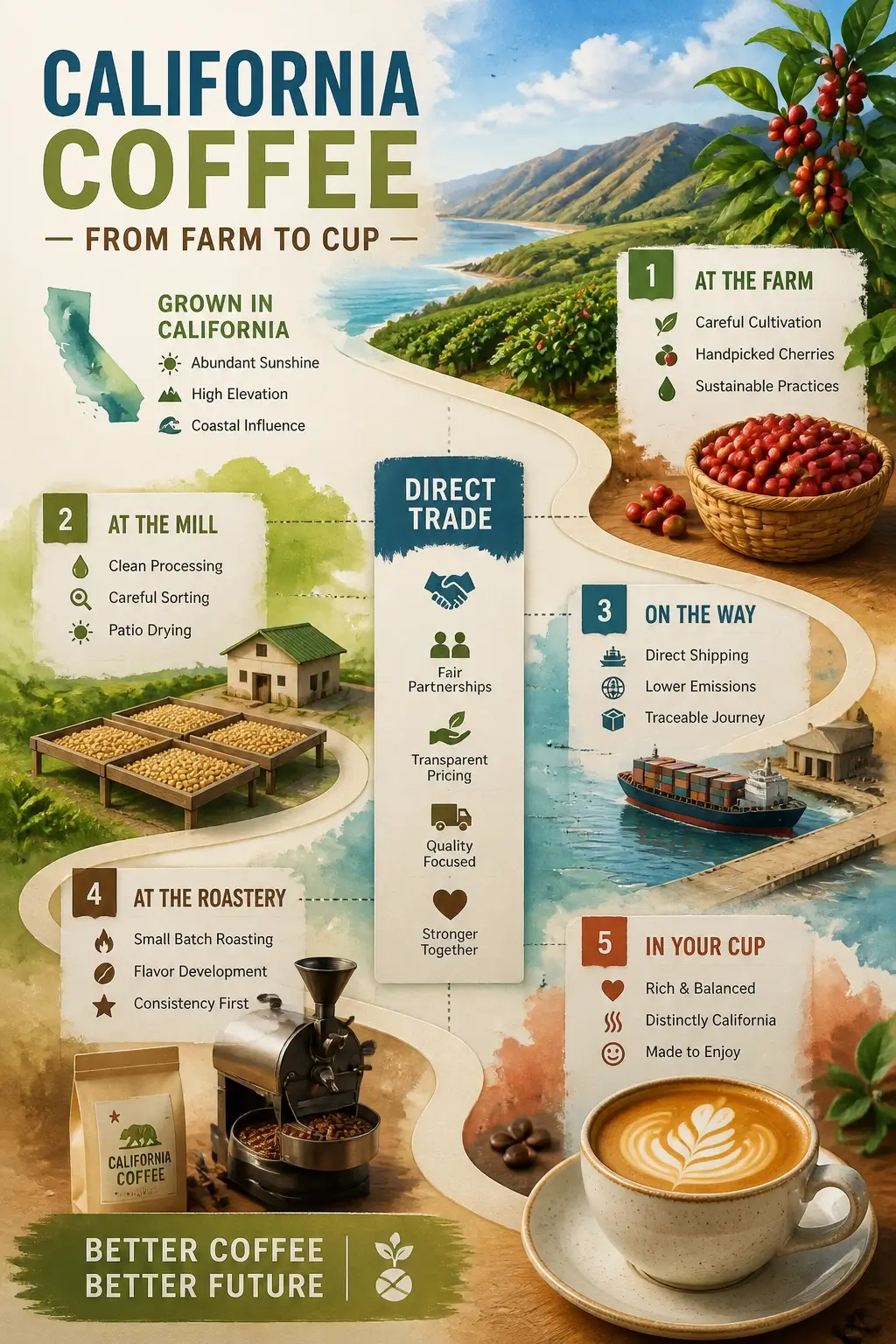
Jay Ruskey planted the first intentional commercial arabica at Good Land Organics in Goleta, Santa Barbara County, around 2002. The early years were experimental – testing varieties, irrigation strategies, and harvest timing against a climate that had no playbook for coffee. Ruskey’s subsequent venture, Frinj Coffee, became the platform that connected those early harvests to specialty roasters and gave California-grown beans a coherent commercial identity. The partnership with university-level coffee research extension programs added agronomic credibility to what could have remained a curiosity.
The business model that emerged is structurally unlike any other coffee origin. Green bean prices regularly exceed $10–$15 per pound – compare that to $2–$4 per pound for high-end Colombian or Ethiopian imports at the same quality tier. The premium rests on three pillars: genuine scarcity (total California production remains measured in thousands of pounds, not millions), US agricultural labor costs that are an order of magnitude above origin-country norms, and the “local” premium that American specialty consumers have demonstrated a consistent willingness to pay in food and beverage categories from wine to olive oil.
The promotional infrastructure built around this narrative has been deliberate and effective. The California Coffee Summit created an annual gathering point that positioned the origin as a serious agricultural category rather than a novelty. Collaborations with nationally recognized roasters – Blue Bottle, Klatch, Counter Culture – gave California beans distribution channels with built-in credibility and consumer trust. The terroir language borrowed directly from California wine: coastal fog, mineral-rich soils, specific valley appellations.
The honest industry whisper beneath all of this is worth naming directly: a segment of experienced coffee professionals argues that the cup quality, while genuine and improving, does not yet consistently justify the price differential. The story is real. The climate advantage is real. But at $15/lb green, the bean is competing against the world’s best-sourced Ethiopians and Colombians – and on blind cupping, the California lots don’t always win. What they do carry is a provenance narrative that resonates with a consumer culture already primed by Napa Valley and Sonoma County to pay for the story attached to the land.
The Ethical Credibility Gap: Can Ultra-Local Coffee Escape the “Ethical Wash” Label?
The quality and price debate is ultimately a market question – one the specialty coffee community is equipped to evaluate. The ethical dimension is harder to resolve, and it cuts closer to the identity California coffee has built for itself.
The Ethical Tension and Transparency Gap in California Coffee Sourcing
Buying California-grown coffee is a genuinely local-supporting act. The growers are American agricultural workers operating under US labor law, paying US wages, and contributing to a domestic farming ecosystem. That’s not nothing. But California coffee’s ethical positioning doesn’t exist in a vacuum – it exists alongside a global coffee supply chain in which roughly 125 million people in developing nations depend on coffee farming for their livelihoods, and in which the structural economics have historically kept smallholder farmers at the thinnest possible margins.
The transparency gap emerges when a roaster pays $15 per pound for California beans while simultaneously sourcing Ethiopian or Colombian coffee at $2 per pound. The arithmetic is visible to any informed consumer, and the contrast creates a credibility problem that local-origin storytelling alone cannot resolve.
Statistical Data: The median global C market price for green coffee was approximately $1.42 per pound in 2021 – Source: Perfect Daily Grind
At that baseline, a roaster who invests marketing energy in the premium California story while paying commodity-adjacent prices for the majority of their imported volume isn’t necessarily acting in bad faith – but they are creating a perception gap that a segment of their customer base will notice and resent. The term “ethical wash” captures this precisely: it’s not quite greenwashing, and it’s not quite a lie, but it is a selective framing that emphasizes the most flattering part of the supply chain while leaving the rest in shadow. The emotional charge here isn’t about cup quality – it’s about perceived deception, and in the specialty coffee world, where transparency is a core brand value, that perception is corrosive.
Greenwashing and Industry Concerns Over the California Coffee Narrative
The concern isn’t purely consumer-driven. Within the professional coffee community, a quieter worry has emerged: that the California coffee narrative – with its premium pricing, its wine-country aesthetics, and its media traction – absorbs consumer attention and discretionary spending that might otherwise flow toward origin-country development programs, direct trade relationships with smallholder cooperatives, or certification systems that genuinely improve farmer outcomes in producing nations.
Greenwashing in specialty coffee typically involves attaching sustainable or ethical labels to a product without addressing the structural inequities embedded in how the rest of the supply chain operates. California coffee doesn’t always claim those labels explicitly, but the local-premium narrative carries an implicit ethical valence – the suggestion that buying close to home is the more responsible choice – that can obscure rather than illuminate the full picture.
For California coffee to close this credibility gap, the path forward is concrete rather than rhetorical: transparent public reporting of what percentage of a roaster’s total green coffee volume is California-grown versus imported, combined with demonstrated commitment to above-market pricing for the imported majority. A brand that pays $15/lb for California beans and $4/lb for Ethiopian beans – when the global C market is at $1.42 – is making a defensible set of choices. But defensible and transparent are not the same thing, and the specialty consumer in 2024 is increasingly capable of telling the difference.
Verdict: Can California Coffee Secure a Lasting Place on the Specialty Map?
California coffee’s specialty future rests on a genuine agronomic foundation, and that’s worth stating plainly before the complications. The coastal microclimate advantage is not marketing language – the slow ripening driven by Pacific-moderated diurnal swings, combined with precisely managed water stress, produces measurably denser beans with elevated sucrose concentrations and cup scores that place them in the premium specialty tier. Connoisseurs who have cupped blind lots from Goleta or San Luis Obispo alongside high-elevation Colombians and Ethiopians have found the comparison credible. The climate does what the story claims.
The hard ceiling is equally real. California land prices, US agricultural labor costs, and the infrastructure required for frost protection and full irrigation dependency make this origin structurally expensive in a way that cannot be engineered away. Scalability isn’t coming. The market for California-grown green coffee will remain measured in thousands of pounds, not millions, and that scarcity is both its commercial protection and its growth constraint. This is a luxury niche – closer in economic structure to a single-vineyard Burgundy than to a commercial arabica origin – and the pricing reflects that reality whether or not every consumer finds it justified.
The ethical test is the dimension that will ultimately determine whether California coffee earns lasting respect or fades into a well-documented novelty. Climate advantage and cup quality can sustain a boutique appellation narrative for years. But the specialty coffee community’s core values – transparency, equitable sourcing, supply chain integrity – demand more than a compelling local story. California coffee brands that visibly and verifiably commit to fair pricing across their full sourcing portfolio, not just their California lots, will earn the credibility that the premium price implies. Those that don’t will remain vulnerable to the ethical wash critique, and correctly so.
The forward-looking case for California coffee may lie less in its own volume and more in what it demonstrates to the broader industry. A domestic origin that proves microclimate innovation can unlock arabica quality outside the traditional belt is a proof of concept with global implications – for climate-adjacent regions in Australia, South Africa, and Southern Europe that are watching carefully. The greater contribution of California coffee to the specialty world might not be the beans themselves, but the agronomic confidence that high-quality arabica can be coaxed from places the belt maps say shouldn’t work.
For the enthusiast or professional approaching California coffee: it is worth exploring, it is genuinely complex, and the best lots are as interesting as anything grown at comparable quality levels elsewhere. Approach it with a critical palate, an awareness of what the price premium actually reflects, and an honest accounting of whether the brand selling it has earned the ethical positioning it implies.
Frequently Asked Questions About California Coffee
How is California coffee affected by climate change?
Climate change cuts both ways for California coffee. Warming winters reduce frost risk in marginal sites, potentially opening new growing zones, but increasing drought severity and wildfire smoke exposure threaten water access and can impart off-flavors during critical ripening windows.
Could coffee be grown at commercial scale anywhere else in California beyond the current coastal zones?
Probably not at the same quality level. Interior valleys get too hot in summer and too cold in winter without the Pacific buffer, and the water costs in drier regions would make an already expensive crop economically indefensible. The viable geography is genuinely narrow.
What arabica varieties perform best in California’s climate?
Typica and Geisha have shown the most promise in early California plantings, likely because both are adapted to cooler, higher-altitude conditions. Caturra and Catuai, which perform well in warm tropical lowlands, are less suited to the thermal swings California produces.
Why does California coffee cost so much more than Ethiopian or Colombian specialty coffee at similar quality scores?
It’s almost entirely structural: US minimum wage laws, land values, and the full irrigation and frost-protection infrastructure required add costs that no origin-country farm faces. The coffee isn’t necessarily better – it’s more expensive to produce by an order of magnitude.
What does “diurnal temperature variation” actually do to the coffee bean?
It slows the enzymatic and metabolic processes inside the cherry, giving sugars and organic acids more time to accumulate and differentiate. Think of it as the difference between slow-fermented bread and fast-proofed dough – the extended timeline builds complexity that a faster process can’t replicate.
How do California coffee farmers protect crops from frost without losing the quality benefits of cool nights?
Overhead irrigation systems are the primary tool – a thin ice coating on foliage actually insulates plant tissue by releasing latent heat as water freezes, holding leaf temperature just above the damage threshold. Wind machines that pull warmer air from above the inversion layer are a secondary option.
Is California coffee certified organic, fair trade, or any recognized ethical standard?
Some farms, including Good Land Organics, operate under organic certification. Fair Trade certification is structurally designed for smallholder cooperatives in developing nations, so it doesn’t apply here. The ethical positioning of California coffee relies on the local-sourcing narrative rather than third-party supply chain standards.
What should I actually look for when buying California coffee to determine if it’s worth the price?
Look for a disclosed harvest date, farm-specific sourcing (not just “California-grown”), a published cupping score from a named evaluator, and transparency about the roaster’s full sourcing portfolio. A brand that’s proud of its California beans but silent about where its other coffees come from deserves skepticism.
References
- Journal of Agricultural Science Controlled irrigation and nitrogen, phosphorous and potassium fertilization affect the biochemical composition and quality of Arabica coffee beans | Cambridge University Press (doi.org)
- Median global C market coffee price data, 2021 | perfectdailygrind.com