
Espresso shot measurement is deceptively simple on the surface: one ounce, done. But that number quietly bundles together fluid volume, beverage mass, and dissolved coffee solids into a single figure, then expects them all to agree. They don’t. A freshly pulled single can read 1.25 fl oz the moment the pump stops and settle to 0.85 fl oz once the crema collapses, and both readings are technically correct.
The disagreement isn’t a calibration error. It’s a unit problem. Once you see which ounce everyone is actually talking about, the SCA standard, the Italian single, the chain benchmark, and your own machine’s output all start making sense at the same time.
Key Takeaways on Espresso Shot Measurement
- A standard single shot is 1 fl oz (30 mL) from 7 to 9 g of coffee; a double is 2 fl oz (60 mL) from 18 to 20 g, both pulled in 25 to 30 seconds at 9 bar.
- Fluid ounces and weight ounces measure different physical quantities and never convert 1:1; every espresso argument conflating them is arguing past itself.
- Crema is mostly CO2 gas, so a fresh pour can read 1.25 fl oz and settle to 0.85 fl oz once the foam collapses, with no change in dissolved coffee solids.
- Beverage mass in grams is the only measurement unaffected by foam collapse, making a 0.1 g scale the most reliable tool for consistent espresso.
- “Lungo” covers a 1.5 to 4 fl oz range, making the variant name less informative than a simple single or double designation backed by a scale reading.
- Chain benchmarks like the Starbucks single (~0.75 fl oz) reflect brand calibration programs, not universal espresso standards.
Fluid Ounces vs Weight Ounces: Two Different Units, One Confusing Word
When someone says a shot is one ounce, the answer to “do they mean the liquid in the glass or the grams on a scale?” is: they probably haven’t decided. Those are two different physical quantities, and conflating them is the root of almost every espresso measurement argument you’ll find online.
Here’s the split. One fluid ounce is a measure of volume: it tells you how much space a liquid occupies, roughly 30 milliliters. One ounce by weight is a measure of mass: it tells you how heavy something is, roughly 28 grams. Water at room temperature happens to weigh close to its volume in those units, so people treat them as interchangeable. With espresso, that assumption breaks immediately because crema is in the glass, and crema is mostly gas.
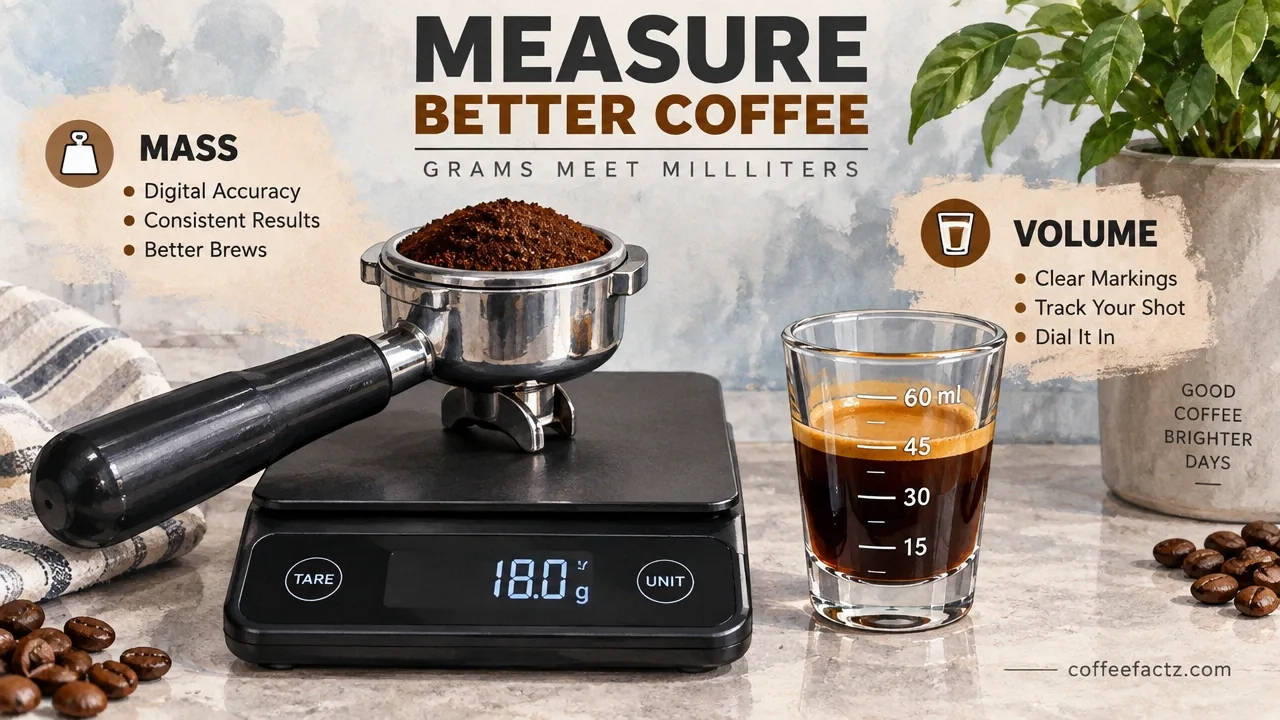
Every espresso “ounce” argument is really an argument about one of three separate quantities:
- The dry coffee dose in grams, measured before brewing
- The beverage mass in the cup in grams, measured after brewing
- The fluid volume in the glass in fluid ounces or milliliters, measured visually
These three numbers don’t move together. You can hold the dose fixed, change the grind, and watch the fluid volume shift while the beverage mass barely budges. Or you can pull the same recipe on a fresh bag versus a two-week-old bag and see the glass read differently because the crema volume changed.
So “Is a shot 1 or 2 oz?” is actually two questions layered on top of each other. The first is whether you’re talking about a single or a double. The second is whether you’re measuring volume or mass. Both pairings are legitimate. That’s why the internet never settles on one answer: different people are answering different questions with the same word.
In practice, this distinction matters to different people in different ways. A home barista setting a grinder needs to know whether their scale is reading dose or yield. A cafe apprentice writing a menu needs to know whether “1 oz” describes a glass fill or a brew ratio output. A drinker comparing a chain cup with a local one needs to know that both shops can call their product a single shot while pouring meaningfully different amounts of coffee.
The Standard Single Shot: 1 Fluid Ounce, 7 to 9 Grams In
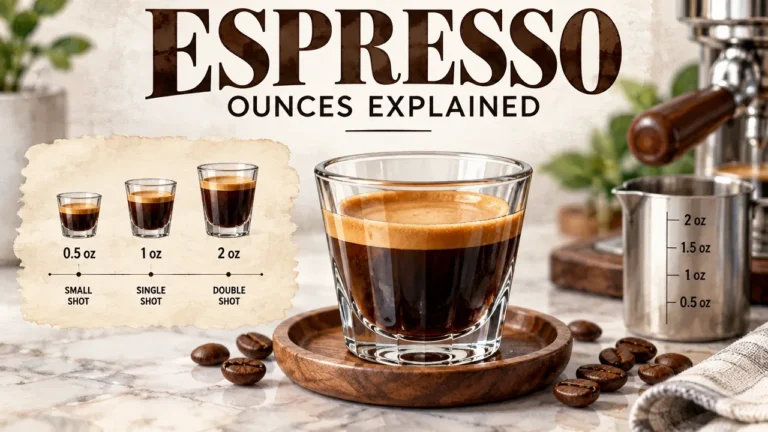
A standard single shot espresso is defined as 1 fl oz of beverage (about 30 mL), pulled from a dry dose of 7 to 9 grams of ground coffee, yielding roughly 14 to 18 grams of beverage mass in the cup, over an extraction time of 25 to 30 seconds.
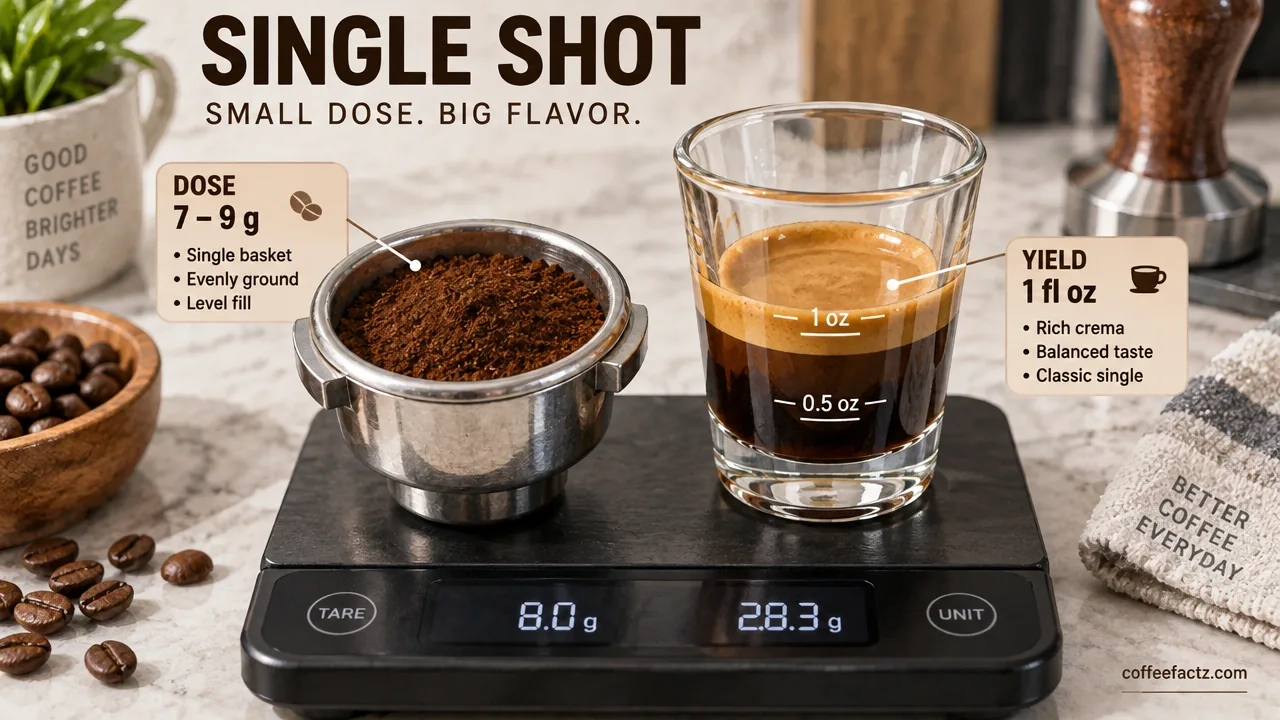
Two reference bodies sit behind that definition, and almost every guide copies their numbers without crediting either one.
The Specialty Coffee Association defines espresso as a 25 to 35 mL beverage prepared from 7 to 9 grams of coffee (14 to 18 grams for a double), brewed with water at 195 to 205°F forced through the grounds at 9 to 10 atmospheres of pressure over 20 to 30 seconds, where the flow resembles warm honey and the cup presents a thick, dark golden crema.
The SCA publishes the brew ratio band (1:1.5 to 1:2.5) and the extraction window. INEI (Istituto Nazionale Espresso Italiano) defines the Italian single espresso with similar parameters but tighter tolerances on roast and serving temperature. Between them, they represent the two citations that underpin nearly every “standard single” number in circulation.
The machine parameters that make those numbers repeatable: 9 bar pump pressure, water temperature of 90 to 93°C (195 to 200°F), and the 25 to 30 second window as the primary timing anchor. Change any one of those and the yield number moves, even if the dose doesn’t.
One thing worth stating plainly: a single shot is not one ounce of coffee. It is one ounce of extracted beverage, which includes dissolved coffee solids, water, emulsified oils, and the foam sitting on top of all of it. That foam is the seed of every measurement confusion that follows.
There’s also a yield disagreement hiding inside the standard itself. Standards-based write-ups land at 14 to 18 grams in the cup from a 7 to 9 gram dose. Practitioner write-ups frequently describe 25 to 30 grams for the same drink. That’s close to a twofold spread on one drink, using the same “single shot” label. When you quote an ounce figure, it’s worth attaching the body that published it, or labeling it clearly as an industry convention rather than a specification.
The Double Shot, or Doppio: 2 Fluid Ounces, 18 to 20 Grams In
A standard double shot (the Italian term is doppio) is 2 fl oz of beverage (about 60 mL), pulled from a dry dose of 18 to 20 grams, yielding 36 to 40 grams of beverage mass in the cup, over the same 25 to 30 second extraction window.
“Is a double shot 2 or 3 oz?” The answer is 2 fl oz by the standard. Readings near 3 oz usually mean a longer pour, an oversized glass portion, or foam that has inflated the reading before it settles. The glass says 3 oz; the scale still says 36 to 40 grams.
Most modern cafes pull doubles by default and only split them for milk drinks. So when a barista says “a shot,” they frequently mean a double. A cafe guest and a home barista can be discussing two different drinks using one word. The guest assumes a single; the barista poured a double.
The dose doubles, but the water doesn’t scale in a straight line. The double carries twice the coffee through a similar time window at a similar ratio. That’s why the glass number stays at 2 while the scale number is the variable that actually moves between recipes.
The “double” label covers more spread than most people realize. Third wave recipes in active use run from 18 grams in and 36 grams out, to 18 grams in and 45 grams out. That’s a 9 gram spread in the cup while the glass reading barely changes. If your double reads 3 fl oz, check yield and time before assuming the recipe is wrong. A longer pour puts more liquid in the glass with the same dissolved solids, and drinkers experience that as a thinner shot, not a stronger one.
Why Ounces Lie: Crema, CO2, and the Measurement Point Nobody Defines
Your shot filled the glass past the 1 oz line. The answer to whether you got more coffee or more foam: almost certainly more foam. Crema is gas, so the glass over-reports the actual liquid volume every single time. And because no widely cited standard specifies exactly when to take the volume reading, every ounce figure quoted so far is conditional on a measurement point that was never defined.
Foam Formation and Volume Distortion
Crema foam is a dispersion of CO2 gas bubbles in a liquid continuous phase, emulsified with coffee oils and water. The gas occupies volume in the glass without contributing liquid or dissolved solids. A fresh pour reads larger than the same beverage once the foam collapses.
A review published in Food Biophysics on espresso crema explains that the gas phase consists mainly of carbon dioxide generated during roasting and trapped within the coffee cell structure. Under brewing pressure, this CO2 dissolves in water, creating supersaturation and triggering bubble formation. The study reports that foam volume and foam weight are highly correlated with the CO2 content of the roasted and ground coffee, confirming that gas inflation increases apparent crema volume independently of how many dissolved solids are actually in the cup.
Work through the mental jam step by step. A freshly pulled shot can measure 1.25 fl oz at the moment the pump stops, then settle to about 0.85 fl oz of liquid once the crema dissipates. Neither reading is wrong. They are measurements of two different things at two different times. The commonly repeated figure that crema adds 10 to 15 percent apparent volume is a directional correction, not a conversion formula. It comes from a single source with no stated method or citation, so treat it as an indicator of distortion rather than a number to apply to your recipe.
Concentration Shifts and Bean Freshness
After the foam collapses, the same dissolved solids sit in less volume. The drink isn’t smaller or weaker. It’s more concentrated per ounce. Readers who chase the settled volume as a recipe target are optimizing the wrong number, because the settled volume is a byproduct of the gas content, not a direct function of the extraction quality.
Bean freshness makes this worse. Freshly roasted beans degas more aggressively and foam more, so the same recipe can read a different volume next week even when the scale reads identical mass. The crema volume shifts; the beverage mass doesn’t. The glass sees the shift. The scale doesn’t.
Timing Protocols for Glass Readings
If you’re still using a glass as your primary reference, the practical rule is simple: take the volume reading at a consistent, defined moment. Either right at the pump cut, or after a fixed settle time. Record which one you used. Never compare a fresh reading against a settled one, because those are measurements of different states of the same drink.
The infographic below maps the three distinct quantities across the life of a shot: fluid volume at the pump (inflated by gas), settled liquid volume (smaller, still measured in fluid ounces), and beverage mass (unaffected by foam collapse). Only the third stays stable across the life of the shot.
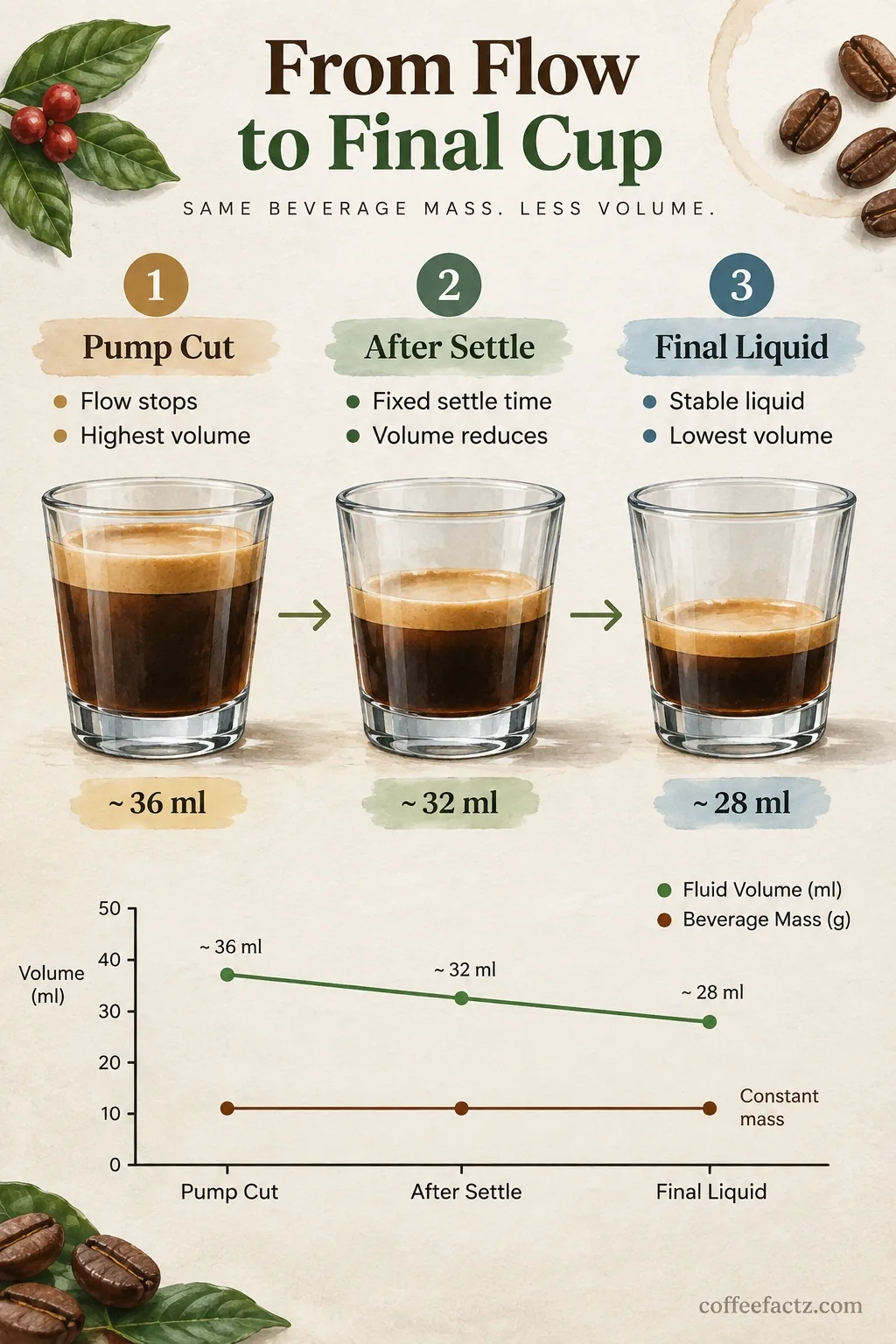
No widely cited source defines whether the 1 fl oz standard includes crema or refers to settled liquid. The published standards describe a beverage that can mean three different things depending on when the measurement is taken. Everyone repeats “1 fl oz” without specifying at which second they measured it, and that missing detail is the single biggest reason two people using the same recipe get different readings.
Ristretto, Normale, and Lungo: A Volume and Mass Comparison
Ristretto and lungo don’t just change the time. They change the yield, which means the dose stays roughly fixed while the amount of liquid in the cup moves. That’s the mechanism underneath the ounce count difference, and it’s why the same basket can produce four meaningfully different drinks.
| Variant | Volume (fl oz) | Volume (mL) | Beverage Mass | Extraction Time |
|---|---|---|---|---|
| Ristretto | 0.5 – 0.75 fl oz | 15 – 22 mL | Restricted yield | Shorter than normale |
| Normale (single) | ~1 fl oz | ~30 mL | ~14 – 18 g | 25 – 30 sec |
| Lungo | 1.5 – 4 fl oz | 45 – 120 mL | Extended yield | Longer than normale |
| Grand Lungo | ~3 fl oz | ~90 mL | Top of lungo range | Extended |
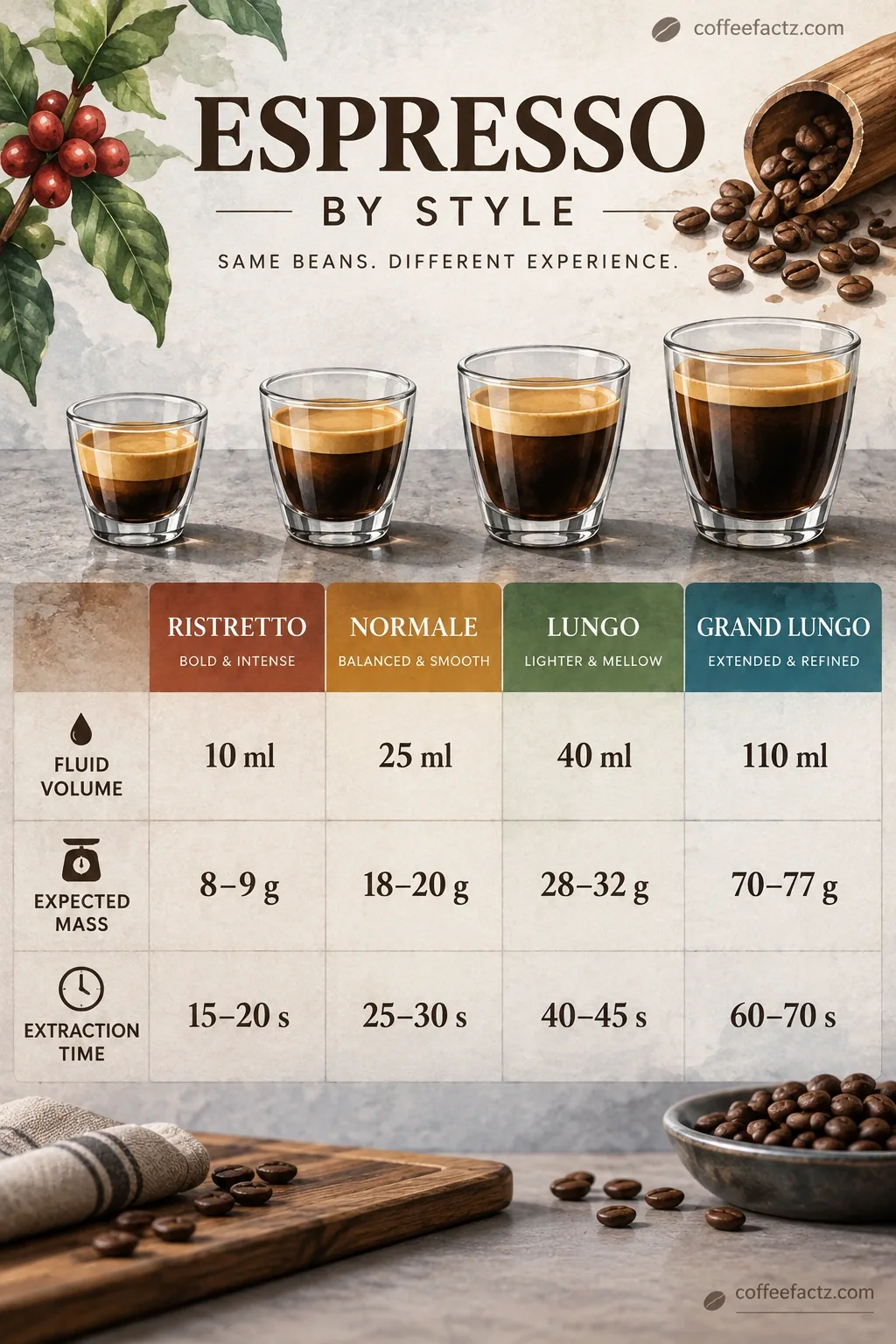
The everyday ordering problem with these names is real. A cafe’s “lungo” button may produce something closer to a normale. Some shops sell a long pour under a house name. Asking for yield in grams or in ounces, rather than by variant name, is the only way to know what you’re getting.
“Is an espresso shot 4 ounces?” sits right here. Four fluid ounces is at the extreme top of the lungo range. It’s not a standard shot. Drinking a 4 oz pour as your default espresso is what produces the watery cup people complain about, because the dissolved solids are spread across twice the liquid of a normale.
Precision matters less the shorter the pour gets, but the distortion problem gets worse. A glass that can read a 1 fl oz normale acceptably is a rough instrument for a 0.5 fl oz ristretto, because the foam takes up a proportionally larger share of what you’re looking at. The lungo range spans 1.5 to 4 fl oz, a spread wider than the entire gap between a single and a double. That means “lungo” tells you less about your cup than “single” or “double” does. The scale, not the menu name, has to settle it.
Regional, Brand, and Machine Variance: Why Your Shot May Not Be an Ounce at All
The cafe down the street pulls a smaller shot than the standard. Whether yours is wrong or theirs is comes down to one thing: who programmed the machine. No standards body is setting the pour on any given commercial espresso machine. The shop is.
Italian and Specialty Coffee Traditions
Italian espresso tradition built the drink around a small, fast, crema-intact single: low dose, quick pull, served immediately. Third wave specialty practice built around weighed doses, larger yields, and lighter roasts that extract differently. The result is that the same phrase, “a shot of espresso,” describes differently sized drinks on different continents.
The historical shift matters here. The older conventional single was literally 1 fl oz, calibrated to Italian practice. Modern equipment, smaller baskets in some specialty cafes, and lighter roast profiles have pushed toward smaller, denser pours in one direction, and toward larger ratio pulls in the other. That divergence is the reason older guides and newer guides disagree, not because either is wrong, but because they’re describing different points on a moving target.
One question that practitioner communities keep raising without resolution: do today’s smaller or larger pours deliver the same flavor intensity and caffeine load as the original 1 fl oz Italian single? It’s a fair question, and it hasn’t been settled. The chemistry of extraction at different ratios is documented; the equivalence claim is not.
Corporate Benchmarks and Equipment Calibration
The chain benchmark readers search for most often: a Starbucks single is approximately 0.75 fl oz (roughly 22 mL), and a Starbucks double is approximately 1.5 fl oz. Those numbers reflect a brand program, not the industry standard. That’s why a chain shot tastes and measures differently from a local shop’s, even when both call it a single.
The mechanism behind the variance is straightforward. What lands in your cup is set by whoever programmed the grinder and the volumetric dosing button on the machine. Two branches of the same chain can pour different masses from the same button if the grinder calibration drifted or was set differently at installation. Volumetric dosing buttons on commercial machines are programmed in fluid ounces, which means the menu figure is a label attached to a calibration, not a specification attached to a recipe.
Brand numbers are labels attached to a program. The only measurement that travels between two cafes is a scale. A shop’s “single” is whatever their machine is set to deliver, and that number can be anywhere in a range that the customer never sees.
Measuring What You Actually Pull: Dose, Yield, Ratio, and a 0.1 g Scale
What goes on the scale, and how do you know when to stop the shot? Two numbers: dose (dry coffee in grams, before brewing) and yield (liquid coffee in grams, after brewing). Tracking both consistently removes the ambiguity that fluid ounces can’t resolve.
Equipment Setup and Dialing Procedure
Equipment first. You need a digital scale with 0.1 gram resolution, placed under the cup or used to tare the portafilter before dosing. A graduated glass works as a backup reference, but only as a backup. Tare zeroes out the weight of the vessel, so the number you read is only the coffee dose or only the beverage mass, not the container plus the coffee.
The dialing-in loop, in order:
- Fix the dose: 7 grams for a single basket, 18 to 20 grams for a double.
- Set a target yield in grams (see ratio formula below).
- Run the extraction for 25 to 30 seconds.
- Taste the result.
- Adjust grind to move the time while holding the ratio steady. Finer grind slows the shot; coarser grind speeds it up.
The video below from James Hoffmann walks through this exact procedure with the tools and technique that make it repeatable at home.
One calibration caution worth separating out: zeroing a scale, taring, and cleaning the group head are safe daily habits. Adjusting the internal calibration of the machine itself is a different operation entirely. Social media advice to “calibrate daily” sometimes refers to the latter, which can affect the warranty on a home machine. Keep internal machine calibration with the manufacturer’s procedure or a qualified technician.
Brew Conversions and Extraction Signals
The brew ratio formula: target a ratio between 1:1.5 and 1:2.5, with 1:2 as the everyday default. That means 18 grams in, 36 grams out. For readers who want to translate back to ounces: divide grams by approximately 28 to return to weight ounces, or measure the glass in fluid ounces separately as a serving size check.
Under-extraction signals: too little coffee or too coarse a grind produces a fast, watery, sour, thin shot. The solution is a finer grind or a slightly higher dose.
Over-extraction signals: too much restriction produces a slow, bitter, harsh shot. The solution is a coarser grind.
Fix dose and grind before touching the pump or the yield target. Those are the two variables that actually control extraction. The pump pressure and water temperature should already be set to spec (9 bar, 90 to 93°C) and left there.
Glass Mark Accuracy and Timing
Printed calibration marks on a shot glass assume a settled liquid at a particular foam state. They’re approximate.
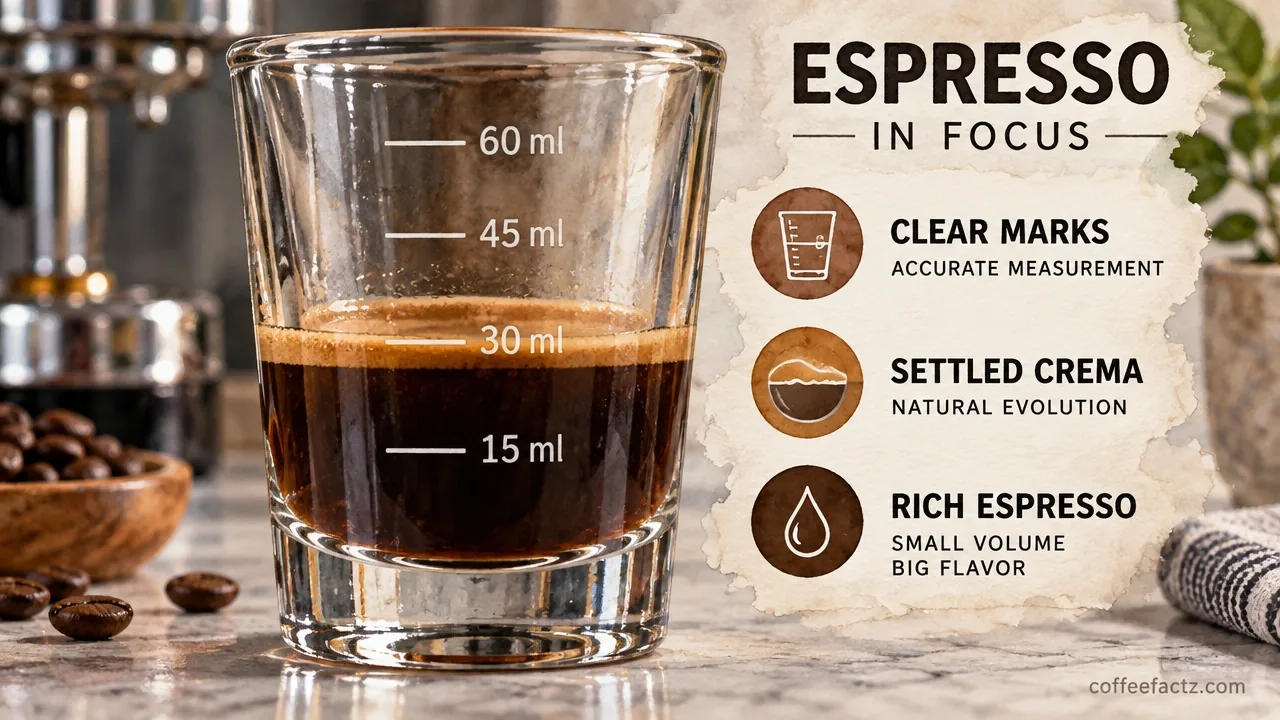
If you’re using the glass as your reference, wait for the crema to collapse before comparing to the mark, or use the same timing condition every single time. A fresh reading and a settled reading of the same shot can differ by 30 to 40 percent of the total volume. Comparing them as if they’re equivalent is the single most common measurement error at the home machine.
Don’t chase a volume target on the glass while you’re dialing in by mass. Pick one reference number, record the other only for information, and change one variable at a time.
The Answer: What to Write Down When Someone Asks How Many Ounces Are in a Shot
Here’s the conditional answer in one clean pass.
A standard single is 1 fl oz (about 30 mL) pulled from 7 to 9 grams of coffee, yielding roughly 14 to 18 grams of beverage in the cup, in 25 to 30 seconds at 9 bar and 90 to 93°C. A standard double is 2 fl oz (about 60 mL) pulled from 18 to 20 grams, yielding 36 to 40 grams, in the same time and pressure window.
Now the direct questions, in the order readers ask them:
Is a shot 1 or 2 oz? Both, depending on whether it’s a single or a double.
Is an espresso shot 4 ounces? No. Four ounces sits at the extreme top of the lungo range. A standard shot is nowhere near 4 oz.
Is a double 2 or 3 oz? 2 fl oz is the standard. A 3 oz reading points to a long pour, foam inflation, or a non-standard recipe.
How many espresso shots is 8 oz? Most 8 oz drinks carry a double shot. So do most 12 oz and 16 oz drinks. What changes between cup sizes is the milk, not the espresso. A 16 oz drink sometimes gets a double plus a split shot, but that’s a shop-by-shop decision. The implication surprises most people: the amount of coffee per ounce of drink falls as the cup grows.
Here’s the cheat sheet:
| Shot Type | Fluid Volume | Beverage Mass |
|---|---|---|
| Single (standard) | ~1 fl oz / 30 mL | 14 – 18 g |
| Double (standard) | ~2 fl oz / 60 mL | 36 – 40 g |
| Starbucks Single | ~0.75 fl oz / 22 mL | Brand program |
| Starbucks Double | ~1.5 fl oz / 45 mL | Brand program |
| Ristretto | 0.5 – 0.75 fl oz / 15 – 22 mL | Restricted yield |
| Lungo | 1.5 – 4 fl oz / 45 – 120 mL | Extended yield |
The final decision rule: if you’re buying, order by name and accept the shop’s program. If you’re brewing, target mass and let the fluid ounce be a serving size description rather than a recipe target.
A 0.75 fl oz chain single, a 1 fl oz Italian single, and a 1.25 fl oz fresh pour out of your own machine can all be correct at the same moment. Fluid ounces describe a glass that contains gas. Grams describe coffee that doesn’t move. The number worth repeating is the one the scale gives you.
Frequently Asked Questions About Espresso Shot Measurement
Does the 1 fl oz standard include crema or just the settled liquid?
No widely cited standard specifies this, which is the core problem. The SCA defines the beverage by its appearance during the pour and the time window, not by a post-settle volume, so the 1 fl oz figure is best treated as a general serving size rather than a precise post-crema measurement.
Why do two baristas using the same recipe get different volume readings?
They’re almost certainly measuring at different moments. A reading taken right at the pump cut includes all the crema gas volume; a reading taken 60 seconds later reflects settled liquid. Those two numbers can differ by 30 to 40 percent of the total pour.
Is caffeine content affected by whether I measure by ounces or grams?
Caffeine tracks dissolved solids, not volume. A shorter, denser pour (ristretto) and a longer, thinner pour (lungo) from the same dose can have similar total caffeine but very different concentrations per ounce. Volume tells you nothing about caffeine content without knowing the yield ratio.
Can I trust the calibration marks on my shot glass?
Only as a rough guide. Those marks assume a specific foam state at a specific moment. They’re useful for spotting a wildly off-ratio pour, but not precise enough to replace a scale when you’re dialing in a recipe.
Why does my shot look bigger some mornings than others with the same settings?
Bean freshness is the most likely cause. Fresher beans degas more CO2 during extraction, producing more crema and a larger apparent volume. The beverage mass may be identical; the glass just looks fuller because there’s more gas in the foam.
If most milk drinks use a double regardless of size, why do larger cups cost more?
The price difference is almost entirely in the milk volume and the labor to steam it. The espresso content is typically the same double shot across 8, 12, and 16 oz drinks at most cafes. You’re paying for a larger milk-to-coffee ratio, not more coffee.
What’s the practical difference between targeting 1:2 and 1:2.5 brew ratio?
At 1:2 (18 g in, 36 g out) you get a denser, more concentrated cup. At 1:2.5 (18 g in, 45 g out) the shot is longer, lighter in body, and slightly less intense. Neither is wrong; they’re different recipes. The 1:2 default works well as a starting point before you decide which direction your palate wants to go.
How does a home machine compare to a commercial machine for hitting these standards?
Most home machines can reach 9 bar and the right temperature range, but they’re less consistent about holding them across the full 25 to 30 second pull. That inconsistency shows up as shot-to-shot variation in yield, which is exactly why a scale matters more on a home machine, not less.
References
- Defining Ever-Changing Espresso | sca.coffee
- Neglected Food Bubbles: The Espresso Coffee Foam | link.springer.com