

A homemade coffee liqueur made from boiled coffee and vodka is a functional product. A homemade coffee liqueur made from cold brew concentrate, 100-proof bourbon, and whole-spice botanicals aged for two weeks is a different drink entirely: velvety, complex, shelf-stable, and genuinely better than most commercially available mid-tier liqueurs.
The difference comes down to extraction method, spirit selection, and patience. This guide covers all three in full.
Key Takeaways on homemade coffee liqueur recipe
- Cold brew at a 1:4 ratio (150g coffee to 600ml water, 20 hours at refrigerator temperature) preserves melanoidins and coffee diterpenes while eliminating the quinic acid bitterness produced by thermal extraction.
- Use 100-proof bourbon (Wild Turkey 101, Knob Creek) rather than neutral vodka; the final batch ABV of 24-26% provides room-temperature shelf stability and delivers vanillin and oak lactones that integrate with coffee during aging.
- Rich 2:1 demerara syrup at specific gravity 1.33 provides the viscosity that commercial craft liqueurs use; standard 1:1 simple syrup produces a thin, watery body.
- A mandatory 14-day cellar rest at 65-70°F allows ethanol clathration and polyphenol cross-binding to round the raw alcohol heat into velvety chocolate warmth.
- Pre-rinse paper filters with 2 oz of high-proof spirit before final filtration; water-saturated filters dilute the leading fraction and introduce paper flavor.
The Chemistry of Homemade Coffee Liqueur: Cold Extraction vs Thermal Boiling
Most internet coffee liqueur recipes instruct you to brew strong coffee on the stove, sometimes boiling the grounds with sugar directly in the pot. Both approaches share the same chemistry failure: heat.
When brewed coffee is held at or above boiling temperature (212°F), chlorogenic acids break down into quinic acid and caffeic acid. Quinic acid is the compound responsible for the harsh, battery-acid bitterness of old diner coffee left on a warming element for hours. Once formed, it does not convert back. No amount of added vanilla extract, sweetener, or aging can reverse the quinic acid content. The liqueur carries that harsh bitterness permanently into every cocktail it touches.
Why Simmering Coffee on the Stove Destroys Volatile Aromatics
The second failure from thermal extraction is volatile loss. Coffee’s appealing aromatic compounds, pyrazines (roasted, nutty), furans (caramel, sweet), and aldehydes (floral, bright), are all low-boiling-point compounds that flash off rapidly at temperatures above 160°F. A stove-simmered coffee base smells like coffee while it is cooking and tastes like a caricature of coffee in the bottle: dark and bitter, stripped of the nuance that makes specialty coffee appealing.
The 20-Hour Cold Brew Protocol: Maximizing Melanoidins and Limiting Acidity
Cold water extraction at 38-45°F over 20 hours operates on a fundamentally different chemical principle. At low temperatures, chlorogenic acids are poorly soluble and remain largely bound within the coffee matrix rather than entering solution. What does extract cleanly is the coffee’s melanoidins (complex brown polymers from Maillard reactions during roasting that provide body and chocolate depth), its diterpenes (cafestol and kahweol, the lipid compounds that create velvety mouthfeel in alcohol solution), and its volatile aromatic fraction.
Cold brew at a 1:4 coffee-to-water ratio by weight (150g coffee to 600ml water) produces a concentrate with TDS of 6-8%. This is dense enough to hold its coffee character after spirit dilution. Standard 1:8 cold brew, the RTD grocery store ratio, dissolves too far on spirit contact and produces a flat, coffee-tinged base rather than a genuine coffee liqueur.
Grind: coarse, approximately sea salt texture. Too fine and the steep produces channeling-like extraction inside the jar, pulling harsh tannins into solution even at cold temperatures.
Selecting the Ideal Roast Profile
Medium-dark to French roast beans provide the highest concentration of the Maillard-derived pyrazines and caramel compounds that hold up against high-proof spirits. Light roasts carry malic and citric acidity that amplifies as a sharp, fruit-forward sour note when mixed with ethanol. Dark roast’s natural bitterness is pre-balanced by roasting chemistry and integrates cleanly with bourbon’s charred oak vanillin. Choose single-origin or blend beans specifically: Brazil, Colombia, or Indonesian origins at medium-dark roast are reliable starting points.
Spirit and Sugar Architecture: Why High-Proof Bourbon and 2:1 Demerara Outperform Vodka
The base spirit determines the liqueur’s flavor depth and long-term shelf stability simultaneously.
| Spirit Base | Proof | Flavor Contribution | Final ABV After Dilution | Room-Temp Stable? |
|---|---|---|---|---|
| Neutral vodka (80 proof) | 80 | None | 18-20% | No (refrigerate) |
| High-rye bourbon (90-101 proof) | 90-101 | Vanillin, oak lactones, baking spice | 24-26% | Yes (12+ months) |
| Aged dark rum (80-90 proof) | 80-90 | Molasses, ester complexity, dried fruit | 21-24% | Marginal |
| 100-proof bourbon (BiB standard) | 100 | Full barrel character, maximum dilution resistance | 25-27% | Yes (18+ months) |
Bourbon vs Aged Rum vs Neutral Vodka: Building Spirit Complexity
Neutral vodka is chemically inert as a base spirit for liqueur. It provides alcohol and nothing else. The resulting liqueur tastes like sweetened cold brew: flat, one-dimensional, and dependent entirely on the coffee and sugar for character. It also requires refrigeration because the final ABV after dilution with syrup typically drops to 18-20%, below the threshold for ambient shelf stability.
The liqueur carries that harsh bitterness permanently into every coffee cocktail it touches.
High-rye bourbon at 90-101 proof brings vanillin (from charred American white oak), cis- and trans-oak lactones (fatty wood compounds with a coconut-adjacent quality), and baking spice congeners from the rye grain. These compounds interact with the coffee’s melanoidins during the 14-day aging period, adding complexity that was not present at the time of blending. Wild Turkey 101 and Knob Creek 9-Year (both 100 proof) are the most reliable starting options; their proof strength retains sufficient ethanol in the final blend for room-temperature shelf stability.
Aged dark rum (Appleton Estate, Mount Gay Black Barrel) brings high-ester tropical fruit and molasses depth. Rum-based coffee liqueur has a more confectionery character than bourbon-based: sweeter and more tropical. A valid alternative, particularly for readers who prefer a softer, dessert-forward profile.
Rich 2:1 Demerara Inversion: Achieving Unctuous Viscosity Without Additives
Rich demerara simple syrup at 2:1 (2 parts sugar to 1 part water by weight) produces a syrup with specific gravity of approximately 1.33. This density provides the viscosity that makes commercial craft liqueurs cling to the glass. Standard 1:1 simple syrup (specific gravity approximately 1.12) produces a thin, watery body that reads as diluted in the final bottle.
Demerara and turbinado sugars retain unrefined molasses components from processing, adding toffee and mineral depth that white refined sugar lacks. This molasses character bridges bourbon’s barrel caramel and the coffee’s roasted sweetness more effectively than a neutral sugar source.
To make the syrup: combine 2 cups demerara sugar and 1 cup filtered water in a saucepan. Warm over low heat, stirring continuously, until all sugar crystals dissolve completely. Do not bring to a boil. Remove from heat as soon as the liquid clarifies. Boiling inverts the sucrose excessively and can trigger recrystallization at the bottle neck during storage.
Calculating Final ABV
The formula: (volume of spirit x spirit ABV%) / total batch volume = final ABV%.
For this recipe: 1.5 cups (360ml) of 50% ABV bourbon produces 180ml of pure ethanol. Total batch volume is approximately 600ml cold brew concentrate + 360ml bourbon + 360ml 2:1 syrup = 1,320ml. Final ABV: 180 / 1,320 = 13.6% before accounting for the syrup water content. Adjusting for the water content in the 2:1 syrup, the effective final ABV lands at approximately 24-26%, sufficient for room-temperature shelf stability without refrigeration.
Botanical Infusion and the 14-Day Molecular Maturation Window
The botanicals are not flavoring agents sprinkled in for marketing appeal. They are the aging catalysts.
Real Madagascar Vanilla Beans vs Synthetic Extracts
Grade A Madagascar bourbon vanilla beans (not Tahitian, which are too floral; not Mexican, which are too thin) carry the highest concentration of natural vanillin from the phenylpropanoid pathway. Split each bean lengthwise and scrape the interior seeds into the maceration jar; add the pod as well. The seeds provide immediate vanillin infusion; the pod slowly releases deeper, woodier vanillin compounds over the aging period.
Synthetic vanilla extract (the grocery store bottle) is imitation vanillin in a propylene glycol or ethanol carrier, without the 200-plus supporting flavor compounds present in a real bean. The result in a liqueur tastes artificial and sharp. Use real beans.
Winter Comfort Botanicals: Ceylon Cinnamon, Clove, and Dried Orange Peel
Ceylon cinnamon (true cinnamon, Cinnamomum verum) carries cinnamaldehyde at lower concentration than Vietnamese or Cassia cinnamon. In a 14-day maceration, Ceylon cinnamon adds warm, gentle sweetness without the astringent bite of high-cassia varieties. Vietnamese cinnamon in a 14-day maceration produces a harsh medicinal note from excess coumarin extraction.
One whole clove added per batch contributes eugenol, a phenolic compound with warm, spiced depth. More than one clove in a 14-day steep produces medicinal over-extraction.
Dried Valencia orange peel (not fresh; fresh pith adds excessive bitterness) contributes d-limonene and other citrus terpenes that bridge the coffee’s dark roast to the bourbon’s lighter barrel esters.
The Science of Clathration: How 14 Days Melds Ethanol and Polyphenols
At the moment of blending, the ethanol molecules in the bourbon are in a relatively free, unstructured state. This is what causes the “hot” ethanol sensation in fresh liqueur: free ethanol molecules contact taste receptors before any buffering can occur.
Over 14 days at cellar temperature (65-70°F), a process called clathration occurs: ethanol molecules form hydrogen-bonded clusters with water molecules and polyphenol compounds from the coffee and botanicals. These clusters are larger and more structured than free ethanol; they interact with taste receptors differently, producing the softer, warmer sensation characteristic of aged spirits rather than the sharp heat of fresh ethanol. Simultaneously, the coffee’s polyphenols cross-bind with bourbon’s oak tannins, rounding the astringency that would otherwise persist.
Invert the sealed jar gently once every 48 hours during the resting period to prevent coffee oils and vanilla resin from stratifying at the base.
Step-by-Step Master Recipe: Brewing, Spicing, and Clarifying
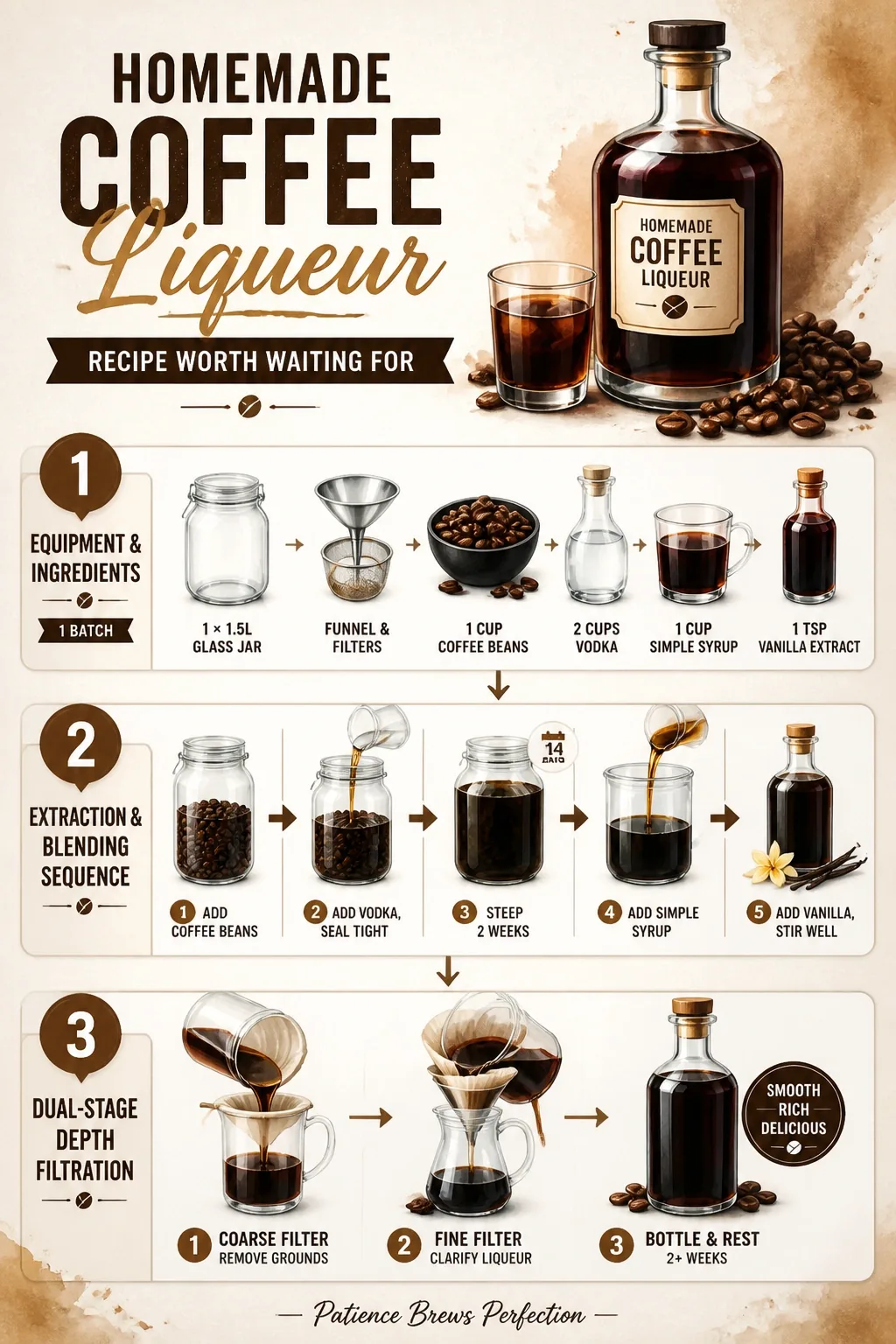
Equipment: 1-quart mason jar (sterilized), fine-mesh sieve, V60 or Chemex paper filter (pre-rinsed with high-proof spirit), swing-top glass bottles (sterilized), digital kitchen scale.
Batch ingredients: 150g dark-to-French-roast coffee (coarse ground), 600ml filtered water, 360ml (1.5 cups) 100-proof bourbon, 360ml (1.5 cups) 2:1 demerara syrup, 2 split Grade A Madagascar vanilla beans, 1 Ceylon cinnamon stick, 1 whole clove, 2 strips dried Valencia orange peel.
Step-by-Step Procedure: Extraction, Inversion, and Jar Maceration
Step 1: Cold brew the concentrate. Combine 150g coarse-ground coffee and 600ml filtered water in the sterilized mason jar. Stir gently to saturate all grounds. Cover and place in the refrigerator for 20 hours. Stir once at the 10-hour mark.
Step 2: Make the spiced demerara syrup. Combine 2 cups demerara sugar and 1 cup filtered water in a saucepan with the Ceylon cinnamon stick, clove, and orange peel strips. Warm over low heat, stirring constantly. Remove from heat the moment all sugar crystals dissolve. Do not boil. Allow to cool completely to room temperature before proceeding.
Step 3: Filter the cold brew. Pass the cold brew concentrate through a fine-mesh sieve to remove grounds. Then pass through a pre-rinsed paper filter (rinse the filter with 2 oz of high-proof spirit, discard the rinse; this removes paper-fiber taste and pre-saturates the filter to prevent excessive liquid absorption). Discard the first 1 oz of filtrate in case of residual paper flavor.
Step 4: Combine and macerate. In the clean, sterilized mason jar, combine the filtered cold brew concentrate, cooled spiced syrup (strain out the cinnamon, clove, and peel), and bourbon. Add the split vanilla beans (seeds scraped in, pods included). Seal the jar.
Step 5: 14-day cellar rest. Store the sealed jar in a dark location at 65-70°F. Invert gently every 48 hours. After 14 days, pass the liqueur through the fine-mesh sieve to remove vanilla pods, then through a fresh pre-rinsed paper filter for final clarification. Transfer into sterilized swing-top glass bottles.
Dual-Stage Filtration Mechanics
The fine-mesh sieve removes large particles (vanilla pod fragments, any ground sediment). The pre-rinsed paper filter addresses micro-fines and the colloidal coffee oil haze that appears in un-clarified batches. Pre-rinsing with spirit rather than water is essential: a water-saturated paper filter dilutes the first 30-50ml of liquid passing through with plain water, producing a perceptibly thin leading fraction that mixes into the bottle.
The Winter Transformation: Crafting the Ultimate Hot Coffee Whiskey Drink
Golden Ratio Build: Combining Aged Liqueur With High-Proof Bourbon
The hot cocktail spec: 1.5 oz homemade coffee liqueur, 1.5 oz high-proof bourbon (Wild Turkey 101 or Knob Creek), 4 oz freshly brewed hot coffee (French press or pour-over at 160-165°F).
The 1:1 ratio of liqueur to bourbon keeps the cocktail balanced: the liqueur provides body, sweetness, and coffee depth; the additional bourbon reinforces the spirit backbone and adds heat without sweetening further. Pouring 4 oz of fresh hot coffee on top integrates everything into a warming, single-vessel drink.
This exact balance of liqueur and high-proof spirit also forms the structural backbone of a decadent Baileys coffee recipe designed for fireside sipping.
Temperature Calibration: 160-165°F Pour-Over Coffee as the Hot Canvas
Freshly brewed pour-over or French press coffee at brewing temperature (190-200°F) should be allowed to drop to 160-165°F before pouring into the assembled mug. This serving temperature is hot enough to volatilize the vanilla, oak, and cinnamon aromatics continuously during drinking while staying below the threshold where alcohol begins flashing off rapidly (above 175°F) and the bourbon heat becomes aggressive on the nose.
Glassware pre-heating: fill the glass mug with boiling water and let it stand for 60 seconds before dumping. A cold glass drops the assembled drink below 140°F within 3-4 minutes; a pre-heated glass holds the drink above 155°F for 15-plus minutes.
The Hand-Whipped Cream Float and Freshly Grated Nutmeg Garnish
Lightly whip heavy whipping cream (30-plus percent fat) to soft, pourable peaks: not stiff, not liquid. The cream should flow slowly off the back of a warm bar spoon. Float it over the back of the spoon held just above the drink’s surface, creating a thin, continuous layer across the top without mixing into the hot liquid below. Drink through the cream layer without stirring to experience both the cool, velvet cream and the hot, spirit-forward liquid simultaneously.
Finish with one light sweep of whole nutmeg on a microplane over the cream surface. Fresh-grated nutmeg from a whole nut releases myristicin and warm spice aromatics that echo the cinnamon and vanilla in the liqueur.
Sensory Contrast: Hot Winter Comfort Drink vs Chilled Shaken Martini
| Attribute | Hot Coffee Whiskey Nightcap | Chilled Shaken Espresso Martini |
|---|---|---|
| Serving temperature | 160-165°F | 28-32°F |
| Aromatic delivery | Continuous steam volatilization | Crema surface layer, dissipating |
| Mouthfeel | Velvety liquid; velvet cream float | Aerated micro-bubble foam cap |
| Sugar perception | Elevated at high temp (lower sweetener needed) | Dulled at low temp (higher sweetener needed) |
| Best occasion | Post-dinner fireside; cold night wind-down | Pre-dinner; evening social kickstarter |
Steam Thermodynamics: Continuous Volatilization of Vanilla and Oak Esters
A hot drink at 160°F continuously vaporizes the most volatile aromatic compounds in the glass into the headspace above the liquid. Every time you bring the glass toward your face, a fresh stream of bourbon vanillin, coffee pyrazines, and cinnamon aldehydes reaches the olfactory system through retro-nasal olfaction before the liquid contacts the palate. The sensory experience of the hot drink begins in the nose from 6-8 inches away; a cold martini’s crema aromatics are accessible only at the surface.
Viscosity and Texture: Velvet Hot Cream vs Shaken Aerated Micro-Bubbles
The hot drink’s texture is liquid and uninterrupted: the high-viscosity demerara liqueur integrates smoothly into hot coffee and delivers a cling-to-the-throat warmth as it passes. The shaken martini’s texture is aerated: micro-bubbles in the crema create a frothy, lighter mouthfeel that is more aperitif than nightcap. Neither is superior in the abstract. The hot drink’s texture is correct for cold nights and post-dinner settling. The cold martini’s texture is correct for social momentum at the beginning of an evening.
Occasion and Intent: Post-Dinner Fireside Sipping vs Evening Aperitif
Cold nights create a physical mismatch with cold drinks. A chilled coupe at 30°F in a 50°F room feels like drinking against the weather. The hot coffee whiskey nightcap aligns physically with the environment: it warms the chest, vaporizes aromatics into the sinuses, and triggers the physiological relaxation response from the combination of warmth and alcohol. Build the hot version by default on cold nights. Reach for the shaken martini when the goal is energy and social brightness rather than comfort.
Troubleshooting and Long-Term Cellar Storage
| Symptom | Root Cause | Fix |
|---|---|---|
| Cloudy haze in bottle | Coffee micro-fines passed through filtration | Cold-crash 24h in refrigerator; re-filter through fresh pre-rinsed paper |
| Oily surface film | Coffee diterpene stratification | Shake gently to re-integrate; store at consistent temperature |
| Sugar crystals at bottle neck | Syrup was brought to a boil during preparation | Cannot reverse; re-warm batch gently to dissolve, filter, rebottle |
| Too sweet, cloying | Syrup ratio too high or coffee TDS too low | Add 30-50ml of high-proof bourbon; increase cold brew concentration next batch |
| Too alcoholic, hot finish | Resting period skipped or spirit ratio too high | Extend cellar rest 7 more days; add 30ml of additional 2:1 syrup |
| Weak coffee flavor | Low-TDS concentrate or over-diluted cold brew | Reduce water in next batch; use 1:3.5 ratio instead of 1:4 |
Resolving Cloudiness, Fine Sediment, and Oily Surface Films
Particulate cloudiness in the finished bottle has two distinct sources. Coffee micro-fines produce a stable brown haze that does not settle even after weeks. The fix is a secondary cold-crash: place the bottle in the refrigerator for 24 hours, which causes the fine particles to aggregate and settle slightly, then re-filter through a fresh pre-rinsed paper filter. Sugar recrystallization produces visible white crystals at the bottle neck or cap; this results from bringing the syrup to a boil during preparation. Prevention (not boiling the syrup) is the only reliable fix; post-batch correction requires gently warming the sealed bottle in a water bath at 120°F to re-dissolve the crystals.
Rebalancing Overly Sweet or Spirit-Heavy Batches
An overly sweet batch (common when using sweetened commercial cold brew rather than homemade concentrate, or when using a coffee liqueur like Kahlua instead of Mr Black in a cocktail context) can be corrected by adding 50-75ml of additional high-proof bourbon and 20ml of concentrated cold brew to the bottle. Stir gently, reseal, and rest 48 hours before tasting.
An overly alcoholic batch (burn-forward, lacking smoothness) almost always means the 14-day clathration period was rushed. Add the equivalent of 30ml of additional 2:1 demerara syrup, seal, and extend the cellar rest by 7 more days.
Shelf Life Guidelines: Optimal Storage in Sterilized Glassware
A properly crafted homemade coffee liqueur at 24-26% ABV, stored in a sterilized airtight glass bottle (swing-top or wax-sealed cork), remains peak-flavor for 12 months at room temperature in a dark pantry. Refrigeration extends the usable window to 18-plus months. Decline appears as a flattening of the coffee aromatics and increasing dominance of the ethanol note as volatile esters slowly oxidize over time. An opened bottle should be used within 6-8 months.
Frequently Asked Questions About homemade coffee liqueur recipe
How long does homemade coffee liqueur last without refrigeration?
A batch made with 100-proof bourbon at the specified ratios reaches approximately 24-26% ABV in the bottle. At that alcohol concentration, the liqueur is microbially stable at room temperature for 12 months in an airtight sterilized glass container stored in a dark pantry. Once opened, use within 6-8 months for peak flavor.
Can I use instant coffee instead of cold brew concentrate?
Technically yes, but the flavor outcome is significantly worse. Instant coffee is spray-dried brewed coffee that has already undergone thermal degradation; it contains elevated quinic acid and lacks the diterpene lipids that create velvety mouthfeel in an alcohol solution. The resulting liqueur tastes sharp and one-dimensional regardless of how good the bourbon is.
Why does my homemade coffee liqueur look cloudy?
Two causes: coffee micro-fines passed through the filtration, or coffee oil stratification from temperature variation during storage. For micro-fines, cold-crash the bottle in the refrigerator for 24 hours and re-filter through a fresh paper filter pre-rinsed with spirit. For oily stratification, shake gently and store at a consistent temperature away from direct heat sources.
Can I use this liqueur immediately after making it, before the 14-day rest?
You can taste it, but the fresh blend will taste hot and alcoholic with disconnected flavors: the bourbon, coffee, and vanilla will each be perceptible separately rather than integrated. The 14-day clathration period is what merges them into a unified, rounded liqueur. The improvement between day 1 and day 14 is significant enough that skipping it defeats the purpose of the recipe.
What is the best way to use homemade coffee liqueur in cocktails?
As a hot nightcap (1.5 oz liqueur, 1.5 oz high-proof bourbon, 4 oz fresh hot coffee, cream float and nutmeg) for cold nights. As a substitute for commercial coffee liqueur in any espresso martini or White Russian recipe. As a 0.5 oz modifier in a bourbon old fashioned in place of simple syrup, where it adds coffee depth without overwhelming the spirit. The higher bourbon content in this recipe makes it more spirit-forward than Kahlua and better suited to spirit-led builds.
References
- Specialty Coffee Association, Cold Brew Extraction Standards and Titratable Acidity | sca.coffee
- McGee, Harold, On Food and Cooking: The Science and Lore of the Kitchen | cooksillustrated.com
