

Cortado vs cappuccino is one of those comparisons that looks simple on a menu but hides a surprisingly precise set of distinctions underneath. Both drinks start with espresso. Both use steamed milk. But the ratio, the milk texture, and the resulting flavor are engineered for completely different drinking experiences.
One is a tight, espresso-forward shot of clarity. The other is a slow, creamy, foam-cushioned sipper. Know the three differences, and you’ll never second-guess your order again.
What Cortado and Cappuccino Actually Are
Cortado and cappuccino are both espresso-based drinks that use steamed milk, but they were built on different philosophies from the start. The cortado comes from Spain – its name derives from cortar, meaning “to cut” – and the idea is simple: a small amount of lightly steamed milk cuts the espresso’s acidity and bitterness just enough to smooth the edges without burying the coffee underneath. The cappuccino has an Italian identity, though its roots trace back even further.
James Hoffmann, author of The World Atlas of Coffee, World Barista Champion, and co-founder of Square Mile Coffee Roasters, traces the cappuccino’s lineage to the Viennese kapuziner – a small drink from the 1800s made by mixing brewed coffee with milk or cream until the color matched the brown robes of Capuchin monks. The Italian cappuccino inherited that name and spirit, eventually formalizing into the three-part structure we know today: equal volumes of espresso, steamed milk, and thick milk foam.
That structural difference is the whole story. Both drinks share an espresso base – the coffee itself is not what separates them. What separates them is what happens to the milk: how much of it there is, how it’s treated, and where it sits in the cup.
A cortado runs 3.5 to 4.5 oz total, built on a 1:1 espresso-to-milk ratio with minimal to no foam. A cappuccino runs 5 to 8 oz, following a 1:1:1 split between espresso, steamed milk, and foam, served in a wider ceramic cup. Either drink can be made with a single or double shot, though specialty cafés tend to default to a double for the cortado and offer both options for the cappuccino depending on cup size.
The drinking ritual reflects the architecture. A cortado is a quick, focused pause – you’re in and out in a few minutes. A cappuccino is a slower mid-morning commitment, something you settle into with the foam dissolving into the milk as you work through the cup.
Here’s a side-by-side look at how both drinks compare before we get into the mechanics of each difference.
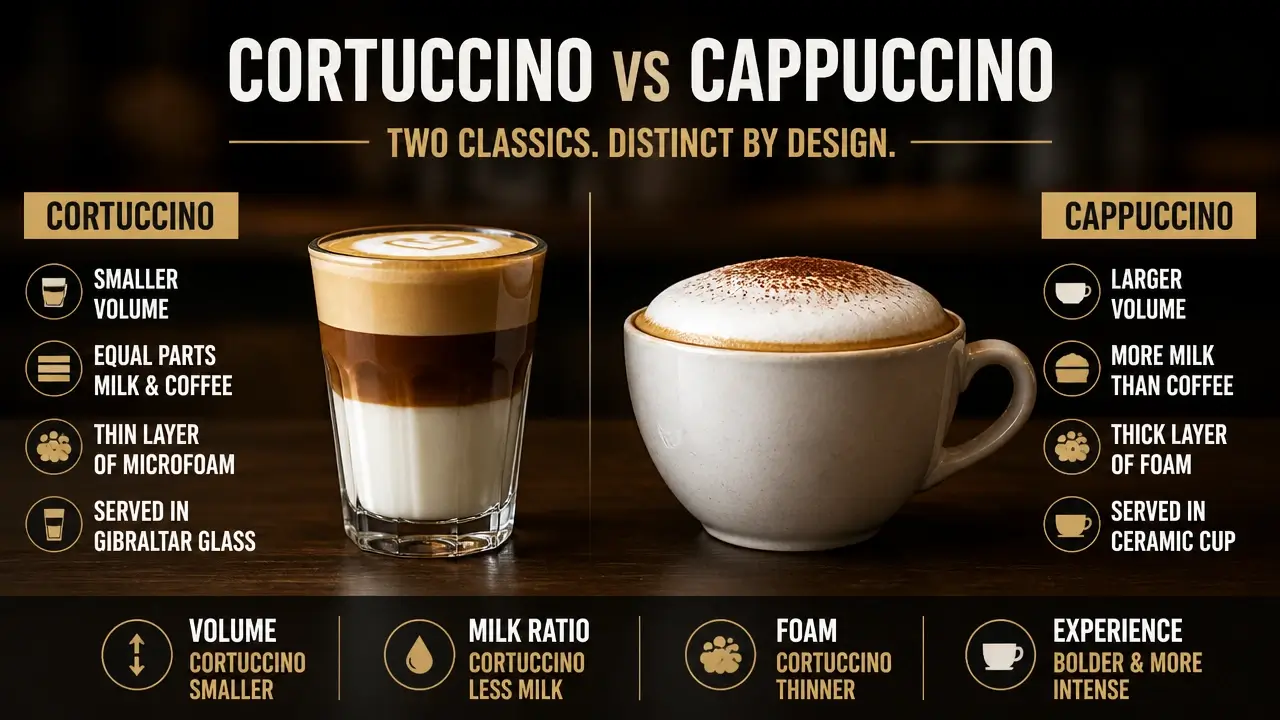
If cortado isn’t listed on the menu, ask for “a double espresso with an equal amount of steamed milk, no foam” – any barista will know exactly what you mean.
Understanding how steamed milk tempers the espresso shot requires comparing espresso and cortado to appreciate where milk-based dilution actually begins.
Difference #1: The Ratio and Size Gap
The milk-to-espresso ratio is the single most concrete difference between these two drinks, and it explains everything downstream – the volume, the vessel, the pace, and the intensity. A cortado holds to a strict 1:1 balance: one part espresso, one part lightly steamed milk, no foam layer factored in. A cappuccino divides into three equal thirds: one part espresso, one part steamed milk, one part thick foam.
In practice, that translates to a cortado landing around 4 to 5 oz total and a cappuccino coming in at 6 to 8 oz – sometimes pushing past that in chain cafés that inflate everything. The difference sounds modest until you’re holding the cups side by side.
The volume gap changes how you drink, not just how much. A cortado’s small footprint means every sip is espresso-concentrated and the drink is gone before it has a chance to cool. There’s no evolution in the cup – what you taste in the first sip is what you taste in the last. The cappuccino rewards a slower pace. As you work through it, the foam gradually integrates with the milk below, and the flavor softens and sweetens as the temperature drops slightly.
Serving vessels reinforce this. The cortado arrives in a small glass – often a Gibraltar, the 4.5 oz double-walled glass that became its signature vessel in American specialty coffee – which signals its no-fuss, drink-it-now character. The cappuccino comes in a wider ceramic cup, specifically shaped to accommodate the foam dome and give you room to scoop and sip.
One thing worth noting: the foam in a cappuccino occupies real volume. A 6 oz cappuccino with a substantial foam cap may contain only 3 to 4 oz of actual liquid, which puts the liquid coffee content surprisingly close to a cortado. The sensory dilution is still greater – the foam contributes sweetness and airiness that changes the perception – but you’re not always getting dramatically more liquid coffee than you think.
Here’s a direct comparison of both drinks across every key parameter.
Maintaining this precise equilibrium depends heavily on selecting the proper cortado cup size to preserve thermal mass and fluid dynamics.
| Parameter | Cortado | Cappuccino |
|---|---|---|
| Espresso-to-milk ratio | 1:1 | 1:1:1 (espresso : milk : foam) |
| Total volume | 4–5 oz | 6–8 oz |
| Milk texture | Velvety microfoam, minimal | Steamed milk + thick foam cap |
| Serving vessel | Gibraltar glass or small glass | Wide ceramic cup |
| Drinking pace | Quick, 2–3 minutes | Leisurely, 5–10 minutes |
Difference #2: Milk Texture Changes Everything
Milk texture is where the cortado and cappuccino diverge most dramatically in terms of what you actually feel when you drink them – and it’s the detail most people gloss over when comparing the two. The cortado uses milk steamed only to the point of fine, velvety microfoam. There’s barely a visible foam layer. The milk integrates fully with the espresso, creating a dense, silky liquid that moves and tastes like a cohesive whole.
The traditional cappuccino goes in the opposite direction. The milk is aerated more aggressively to produce a thick, airy foam cap – one that sits clearly separated from the liquid milk beneath, can be dry enough to hold a spoon on its surface, and in classic Italian preparation, makes up a full third of the drink by volume.
The mouthfeel contrast is immediate. A cortado feels substantial and round without any fluff – there’s a richness that coats the palate cleanly, almost like melted ice cream. A cappuccino feels light and cloud-like on the first contact. The foam hits first, coating the tongue with sweetness and air before the milky espresso arrives underneath. It’s a two-stage experience by design.
There’s also a practical thermal difference. The cortado has no dry foam acting as an insulating lid, so it cools faster – which is fine, because you’re meant to drink it quickly. The cappuccino’s foam cap slows heat loss, keeping the drink warmer through the longer drinking window.
Carmen, a specialty coffee trainer and professional barista educator, notes that a proper cappuccino requires at least 1 cm of microfoam – a baseline that signals the distinction between a properly textured drink and a flat, under-aerated one. That minimum foam depth is what gives the cappuccino its characteristic lightness and insulation.
Now, here’s where your real-world experience may not match the textbook definition – and it’s worth knowing before you order. In many third-wave specialty cafés, the traditional “equal thirds” structure has been quietly set aside. Modern cappuccinos in these shops are poured with uniform, glossy microfoam from top to bottom, much like the milk texture in a flat white, just in a larger volume. The dry, spoonable foam cap is treated as an artifact of older preparation styles.
This means the textural gap between a cortado and a cappuccino at a specialty café may be less about foam distinctiveness and more about size. If you order a cappuccino expecting a traditional dry cap and get a latte-like pour in a smaller cup, that’s not a mistake – it’s a deliberate style choice. Asking your barista whether they pour traditional dry foam or integrated microfoam takes three seconds and saves the confusion.
Is a cortado bigger than a cappuccino?
No, a cortado is smaller. A cortado typically runs 4–5 oz while a cappuccino ranges from 6–8 oz. The cortado’s compact size is part of its design – it’s built for a quick, concentrated drinking experience rather than a leisurely one.
Is a cortado just a small flat white?
Not quite. A cortado and a flat white are close cousins, but a flat white is slightly larger (usually 5–6 oz) and uses a higher milk-to-espresso ratio with velvety microfoam poured over a ristretto-style double shot. A cortado is stricter about the 1:1 balance and is generally smaller with less milk sweetness.
What type of person orders a cortado vs. a cappuccino?
Someone who orders a cortado usually wants the espresso itself to be the point – they’re tasting the bean, not the milk. Someone who orders a cappuccino tends to enjoy the texture and comfort of the milk as much as the coffee. Neither preference is more sophisticated; they’re just optimized for different things.
Can you make a cortado or cappuccino without a steam wand?
You can get close with a handheld milk frother, but neither drink is fully replicable without a proper steam wand. The cortado’s integrated microfoam and the cappuccino’s aerated foam both require pressurized steam to achieve the right texture. A frother produces larger, less stable bubbles that collapse quickly.
Does the type of espresso roast matter more in a cortado than a cappuccino?
Yes, noticeably. Because a cortado uses so little milk, the bean’s origin character – roast level, acidity, sweetness – comes through with very little filtering. A light or medium roast with bright notes will taste more expressive in a cortado. In a cappuccino, the milk volume and foam smooth over those distinctions, so roast origin matters less to the final cup.
Why does my cappuccino sometimes taste more like a latte?
Most likely because the barista poured integrated microfoam rather than building a traditional dry foam cap. Many specialty cafés have moved away from the classic three-layer structure toward a uniform microfoam pour, which produces a creamier, less airy drink that sits closer to a latte in texture. Asking specifically for “traditional dry foam” will get you the classic version if that’s what you’re after.
Is a cortado a good choice for non-dairy milk drinkers?
Yes – actually better than a cappuccino in many cases. The cortado’s microfoam-only requirement is easier to achieve with non-dairy milks like oat milk, which steams well and holds stable texture. Traditional cappuccino foam is harder to build with almond or soy milk because they tend to separate under heat and produce less stable foam structure.
References
- What Is a Cappuccino & How Has It Developed Over Time? – perfectdailygrind.com
- What Is Microfoam? A Guide to Milk Texturing for Latte Art – perfectdailygrind.com
- Cortado vs Cappuccino: What’s the Difference? – coffenzo.com
What Is a Cortado comes from Spain – its name derives from cortar, meaning “to cut” – and the idea is simple: a small amount of lightly steamed milk cuts the espresso’s acidity and bitterness just enough to smooth the edges without burying the coffee underneath.