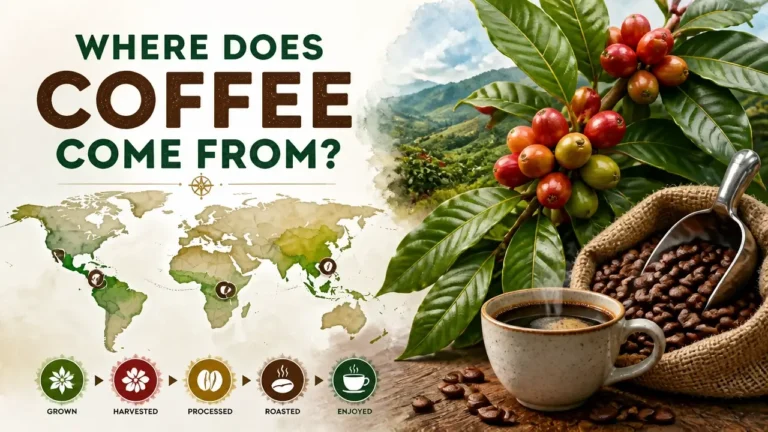

The famous Coffee Belt is a thin tropical ring circling the globe, and almost nobody drinking a latte this morning could point to it on a map. That band holds every coffee cherry ever harvested for trade, stretching from Brazil to Ethiopia to Vietnam.
Trace it back far enough and you land in a wild Ethiopian forest, then in a Yemeni port, then on colonial plantations built by force. The map you know today was carved by climate and human hands alike.
While global supply chains span continents, regions like Hawaii shape unique local traditions through specialized Kona coffee production.
As global temperatures rise, understanding climate change impacts becomes crucial for predicting the future of these historic growing regions.
Key Takeaways on the Coffee Belt
- All commercial coffee grows in one tropical band between 23.5°N and 23.5°S, never in temperate regions.
- The Coffee Belt is not the equator; coffee needs high altitude, distinct seasons, and volcanic soil, not just heat.
- Coffee began wild in Ethiopia’s Kefa region, but Yemen turned it into a commercial crop and a global drink.
- The belt’s current map was carved by colonial power and forced labor, not by climate advantages alone.
- Over 50 countries grow coffee, yet just five, led by Brazil and Vietnam, supply roughly two-thirds of the world.
- Climate change may erase about 50% of today’s suitable coffee land by 2050, pushing growing zones uphill and poleward.
What Exactly Is the Coffee Belt?
The Coffee Belt is the tropical zone stretching between the Tropic of Cancer at 23.5°N and the Tropic of Capricorn at 23.5°S. Every commercial coffee bean on the planet grows inside this band. Nowhere else. If you drew a line around the middle of a globe and let it fatten out toward those two tropics, you’d have it: a green ribbon cinching Earth’s waist.
Here’s the first thing that trips people up. The Coffee Belt is not the same as the equator. The equator is a single line. The belt is a wide strip that runs both north and south of it, and much of the equator itself sits too low and too hot to grow good coffee. What coffee actually wants is altitude, and it wants it inside the tropics.
That’s the real trick of this band. Being warm isn’t enough. Coffee is a fussy plant with a short list of non-negotiable demands:
- Stable warm temperatures year-round, roughly 60–70°F, with no frost
- Distinct wet and dry seasons so the plant can flower and fruit on schedule
- High elevation, roughly 700 m to 2,200 m, for quality Arabica
- Volcanic or well-drained soils that feed the roots without drowning them
Miss one of these and the crop fails. That’s why the belt isn’t a solid sheet of coffee. It’s scattered clusters on the right slopes, in the right dirt, at the right height. When you plot every one of those clusters on a world map, they line up into a continuous band that touches parts of Latin America, Africa, and Asia. Somebody, at some point, looked at that shape and called it a belt. The name stuck.
I want to plant one idea before we go further. The belt looks like a neutral fact of nature, a tidy accident of climate. It isn’t only that. The belt you see on a map today is as much a human creation as a climatic one. Centuries of power and trade carved coffee into that tidy ribbon, displacing people and reshaping whole landscapes to plant a single crop. Hold onto that. We’ll come back to it.
Even within those broad regional clusters, the actual flavor in your cup is heavily influenced by local coffee microclimates shaped by unique valley positions and canopy cover.
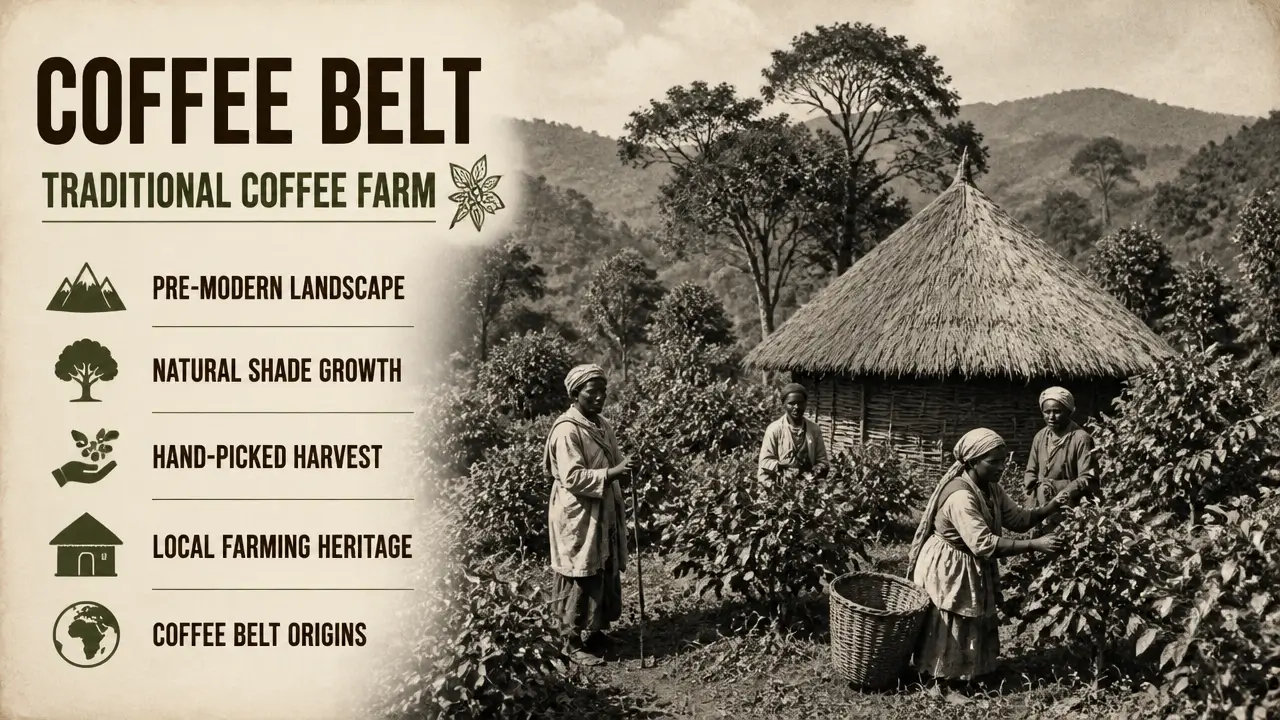
Here’s what a working farm inside that band actually looks like.
The Ethiopian Origins: Myth, Mystery, and the First Coffee Drinkers
Coffee started in the highland forests of Ethiopia, and the most famous version of that story stars a goat herder named Kaldi. The legend goes like this: Kaldi noticed his goats bouncing around with strange energy after nibbling bright red cherries off a wild shrub. He tried the fruit himself, felt the same jolt, and coffee was born. Charming. Also almost certainly not literal history. Treat it as folklore, not fact.
Strip away the goats and you’re left with something real. Coffee traces back to the Kefa region of southwestern Ethiopia, a place where the coffea arabica plant still grows wild in the forest understory today. Picture an evergreen shrub with glossy leaves and red fruit, each coffee cherry holding two seeds. Those seeds are what we now roast and call beans.
The first people to use coffee here almost certainly didn’t brew it. They chewed the raw cherries, or crushed them with fat into a kind of energy ball, for the stimulant kick. Historians generally tie this early use to around the 9th century CE, though the Kaldi tale itself carries no date at all.
And that missing date matters more than it looks. The Kaldi story is a single, tidy narrative that got repeated until it became “the” origin. Some historians suspect coffee was used long before that tale suggests, but the oral traditions of pre-Islamic Ethiopian communities were lost when the story was rewritten by later chroniclers. The cheerful goat legend is a simplification standing in for centuries we simply can’t recover.
So the Ethiopian highlands are the true birthplace of coffee. But being born somewhere and becoming a global drink are two different things. For that next leap, and for the very name “coffee,” we have to cross the Red Sea.
From Yemen to the World: The First Global Journey
Coffee became a global commodity because of trade, not discovery. Ethiopia gave the world the plant. Yemen gave the world the habit of drinking it and then sold that habit to everyone within reach. The path from a wild African forest to your local café runs straight through a Yemeni port and, later, through the ships and account books of European empires.
The Birth of Commercial Coffee in Yemen and the Sufi Connection
The decisive shift happened in Yemen, where coffee was first grown as a commercial crop by the 15th century. This is the moment coffee stopped being a wild-foraged curiosity and became a farmed product with a market behind it. Yemeni growers cultivated it deliberately, and the port of Mocha turned into the world’s first coffee-trading hub.
The early drinkers who made it matter were Sufi mystics. They brewed coffee to stay awake through long nights of prayer and chanting, folding the drink directly into religious practice.
According to Tim Schenk, author of Holy Grounds, Sufi devotional gatherings paired coffee-drinking with the recitation of a ratib, invoking the divine name “Ya Qawi” 116 times, so the cup and the prayer moved together as a single ritual act.
That ritual use tells you why coffee spread so fast through the Muslim world. It wasn’t just a stimulant. It became woven into worship, which gave it social permission and a built-in reason to gather. But that same power triggered a fight. Some Islamic authorities declared coffee an intoxicant and therefore haram, forbidden. Yet many Muslims embraced it for the opposite reason: it was a stimulant they could enjoy where the Qur’an already forbade alcohol. Religious law, daily habit, and simple pharmacology collided, and coffee won.
The Global Spread of Coffee via Trade, Empire, and Coffeehouses
From Mocha, coffee moved out along established trade routes. It crossed the Red Sea and Persian Gulf into the Ottoman Empire, reached Constantinople, and by the 17th century had landed in Venice, Amsterdam, London, and Paris. Wherever it arrived, a new kind of building followed it: the coffeehouse.
These places were engines of information. People came to argue, trade news, and cut deals. In 17th-century London, a coffeehouse was as much a communication network as a place to get a drink. Merchants used them as informal post offices and business hubs, which is exactly why some of them grew into institutions we’d recognize today.
Then the European powers noticed the money. The Arab world had guarded its monopoly by only exporting roasted or boiled beans that couldn’t sprout. Europeans broke it by smuggling live seeds and seedlings out to their tropical colonies. The Dutch planted Java in the 1600s. The French pushed coffee into the Caribbean. The Spanish and Portuguese carried it into Latin America. Each empire deliberately filled its slice of the belt with plantations.
Lay the timeline out and the pattern is clean:
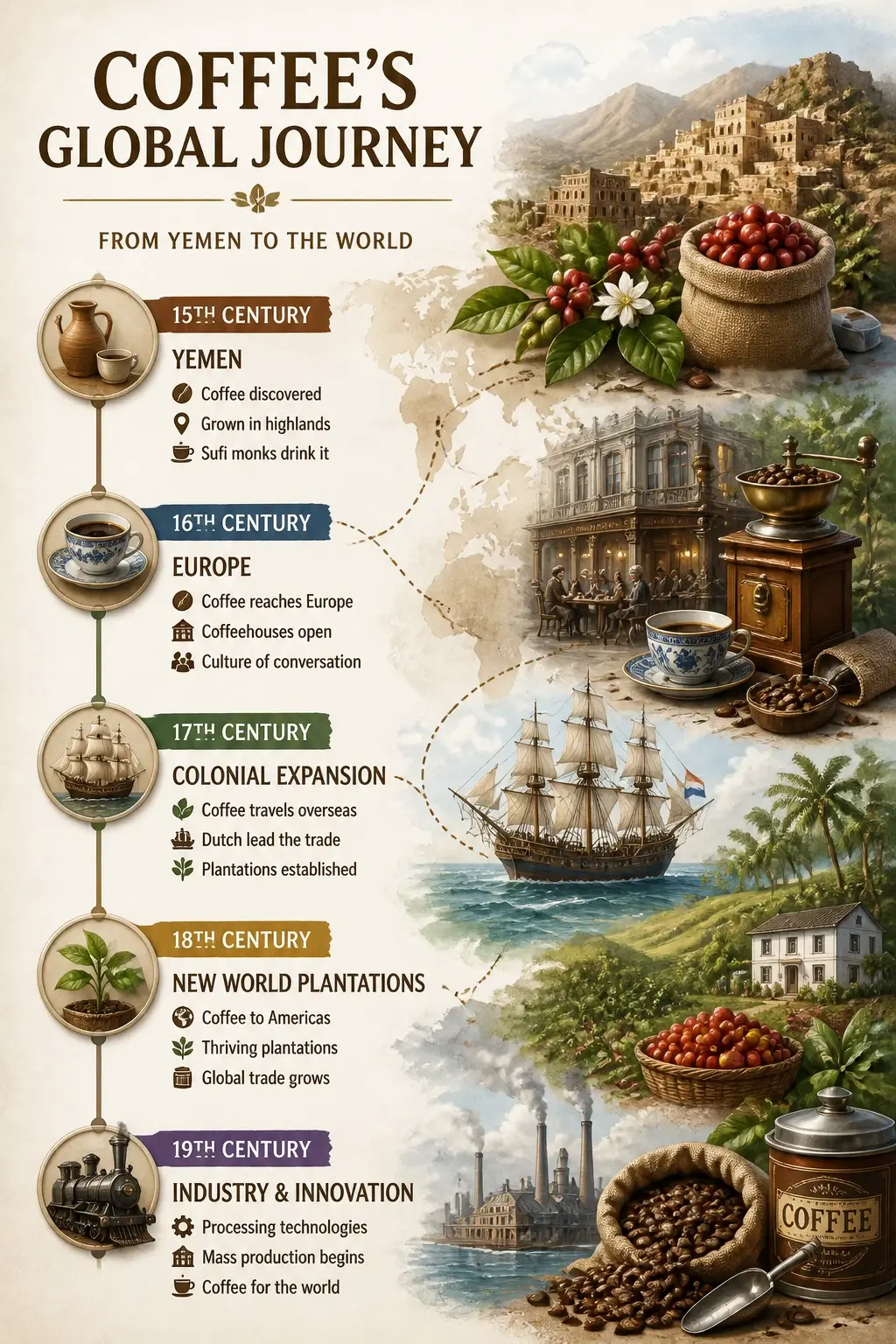
- 15th century: commercial cultivation begins in Yemen
- 16th–17th century: coffee reaches the Ottoman Empire and Europe, coffeehouses boom
- 18th–19th century: massive colonial expansion plants the belt across the Americas and Asia
That last phase is where the modern map really took shape. It’s also where the story gets darker.
The Rise of the Coffee Giants: How Brazil and Others Came to Dominate
Only a handful of belt countries flood the world market, even though dozens sit on the same band. Brazil stands at the top. It has produced roughly a third of the world’s coffee for over a century, an output no rival has come close to matching for that long.
Statistical Data: Brazil accounted for 37.08% of global coffee production in 2024/2025 – Source: Statranker
That single figure explains why the belt has a lopsided center of gravity. Vietnam ranks second, but its climb is recent, taking off only in the late 20th century. Colombia, Indonesia, and Ethiopia round out the top tier. And here’s a fact worth sitting with: Ethiopia, coffee’s actual birthplace, exports far less than Brazil. Being first didn’t make it biggest.
So why the split? Over 50 countries grow coffee commercially, yet a small cluster grows most of it while the rest produce modest volumes that often never leave their own regions. The easy answer is soil and climate. Brazil got lucky with land, the story goes. That answer is incomplete, and the incompleteness is deliberate.
Almost every beginner article credits Brazil’s rise to nature and stops there. That silence erases how the production was actually built. Coffee’s dominance in Latin America and the Caribbean was fueled by enslaved African labor and the dispossession of indigenous land. Vast plantations required vast forced workforces, and colonial policy supplied both the land and the people to work it.
According to Mark Pendergrast, author of Uncommon Grounds: The History of Coffee and How It Transformed Our World, by the late 1700s European colonial powers recognized coffee’s profitability and met soaring demand by importing enslaved Africans to work plantations across the Caribbean, Asia, and the Americas as part of the Triangular Trade.
That’s the missing paragraph in most coffee histories. Brazil’s position as the coffee engine of the planet wasn’t a crop’s happy adaptation alone. It was the result of colonial policy, enormous plantations, and human exploitation that carved a production system so entrenched it still defines the market today. The belt’s current map records who colonized which land, and with whose labor, as much as it records rainfall and altitude.
The Economic Map of Coffee Today: Who Grows and Who Exports
Coffee exports today concentrate in a short list of countries spread across three regions. If you want to know which nations actually carry the global supply, it helps to sort them by where they sit on the belt.
The Top Coffee Producing Countries and Their Production Volumes
The leading producers group cleanly by region:
- Latin America: Brazil, Colombia, Honduras, Guatemala, Peru
- Africa: Ethiopia, Uganda, Côte d’Ivoire
- Asia-Pacific: Vietnam, Indonesia, India
The volume gap between them is enormous. Brazil produces over 50 million bags a year. Vietnam runs around 30 million. Colombia lands near 13 million. Nearly every other belt country sits well below 10 million. That’s not a gentle slope from big to small. It’s a cliff.
Put the two facts side by side and the picture snaps into focus: more than 50 countries grow coffee commercially, yet just five account for roughly two-thirds of global production. The belt is crowded. The market is not.
Visualizing the Coffee Belt: Geography and the Five-Country Dominance
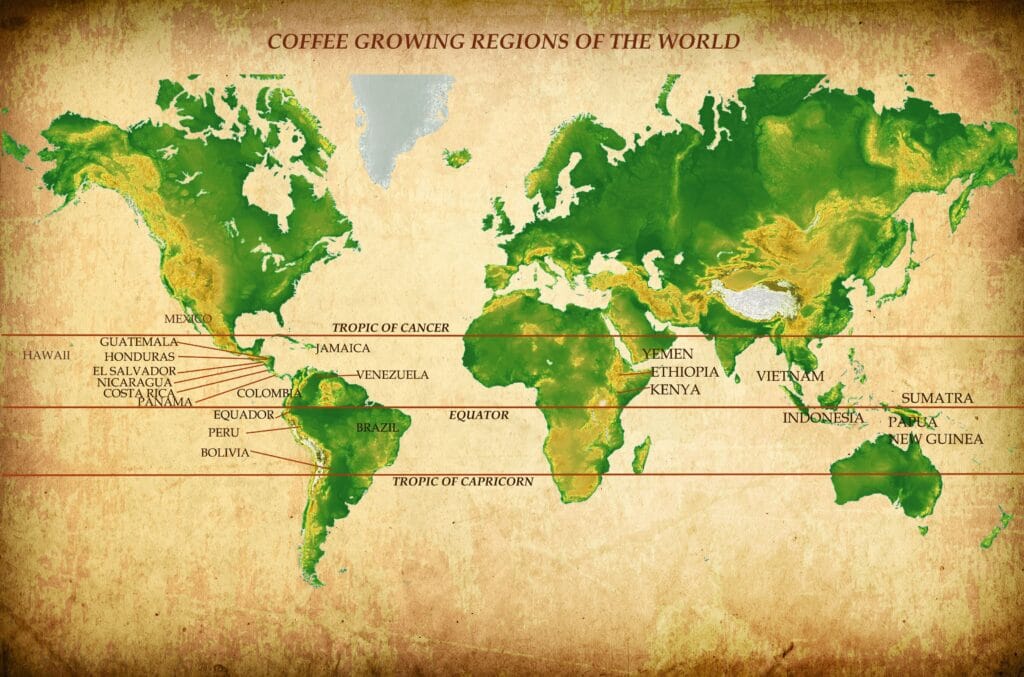
The belt also draws a hard line around where coffee can exist at all. No temperate country grows commercial coffee. Every bean in world trade can be traced back to this one tropical band, which makes the map easier to picture than you’d think.
Trace it on a globe with your finger. Start in Mexico and run south through Central America into Colombia and Brazil. Jump across the Atlantic to Ethiopia and Kenya. Slide east to Yemen, then across to India, Southeast Asia, Indonesia, and finally Papua New Guinea. That loop, riding both sides of the equator, is the entire coffee world.
Inside that loop, quality and variety swing wildly from one slope to the next. A washed Ethiopian and a Brazilian natural taste like different food groups. But the economic weight barely notices those differences. It sits squarely with the handful of mass producers moving tens of millions of bags. Which raises a sharper question. What happens to this map if the band itself moves?
The Future of the Coffee Belt: A Geography on the Move
The Coffee Belt is not a permanent line, and climate change is already redrawing it. Rising temperatures and shifting rainfall are pushing suitable growing land to higher altitudes and toward the poles. Calling it the “coffee belt” suggests permanence, but the belt is more like a weathervane, spinning toward the hills and away from the equator as temperatures rise.
The scale of the threat is not a guess.
Academic Evidence: Climate change will reduce the global area suitable for coffee by about 50% across emission scenarios – From the study “A bitter cup: climate change profile of global production of Arabica and Robusta coffee“
That study combined machine-learning models with global climate simulations to project where coffee will and won’t survive, and it lands on a blunt number: roughly half of today’s suitable land could be gone by mid-century. In practice, that means some traditional producing countries may lose the ability to grow quality coffee at scale, while cooler ground at the belt’s edges, higher slopes and slightly higher latitudes, may open up. The map redraws itself under pressure.
That redrawing won’t hit every region the same way, which is exactly what makes planning hard.
According to Dr. Peter Läderach, Senior Climate Change Specialist at the International Center for Tropical Agriculture and a co-author of the report, the research offers the first location-specific view of what adaptation each zone needs, because hot-dry regions will have to respond in completely different ways than hot-wet ones.
That distinction changes how growers prepare. Earlier work could only say whether a region would get better or worse for coffee. This kind of mapping tells a farmer in a hot-dry zone that shade trees and water management matter most, while a grower in a hot-wet zone faces a different fight against disease and excess moisture. The threat is uneven, so the response has to be too.
According to Christian Bunn, lead author of the study and a researcher at the International Center for Tropical Agriculture, the Arabica market is under severe strain: demand keeps climbing while the land able to grow the crop keeps shrinking.
That’s the squeeze that ends the story. Demand up, land down, and no easy way to close the gap. The answer to “where does coffee come from?” will not be the same map in 30 years that it is today. The Coffee Belt is a living, shifting geography, shaped first by human hands and now by a warming planet. Every cup you drink is a snapshot of a particular place at a particular moment in a story that refuses to hold still.
Frequently Asked Questions About the Coffee Belt
Why is it called the Coffee Belt?
Because when you plot every coffee-growing region on a world map, they line up into a continuous band that wraps around the planet’s middle, like a belt cinched at Earth’s waist.
Is the Coffee Belt the same as the equator?
No. The equator is a single line, while the belt is a wide strip running both north and south of it. Much of the equator itself is too low and hot, since coffee really needs altitude.
What countries are in the Coffee Belt?
Dozens, spread across three regions: Brazil, Colombia, Honduras, and Peru in Latin America; Ethiopia, Uganda, and Kenya in Africa; and Vietnam, Indonesia, and India in Asia-Pacific.
Why does Ethiopia produce less than Brazil if coffee started there?
Being coffee’s birthplace didn’t make Ethiopia its biggest grower. Brazil’s dominance came from colonial-era plantations built on massive scale and forced labor, a production system Ethiopia never developed the same way.
What happens to coffee if the belt shrinks?
Some traditional producers could lose the ability to grow quality coffee at scale, while cooler land on higher slopes and slightly higher latitudes may open up. Expect a redrawn map and tighter supply.
Can coffee ever grow outside the tropics?
Not commercially. A few hobby growers manage small crops in greenhouses or mild spots like parts of California, but every bean in world trade still comes from that tropical band.
Why did Yemen matter so much if coffee is from Ethiopia?
Ethiopia gave the world the plant, but Yemen was the first place to farm it as a commercial crop and trade it widely through the port of Mocha, which launched coffee’s global spread.
How fast is climate change actually affecting coffee?
It’s already underway. Growers are seeing shifting rainfall and rising temperatures now, and projections point to roughly half of current suitable land becoming unfit by around 2050.
References
- Holy Grounds Project | specialprojects.sprudge.com
- Slavery in Specialty: Discussing Coffee’s Black History | perfectdailygrind.com
- Global Coffee Production in 2025: Major Producers, Exporters, and Market Trends | statranker.org
- A bitter cup: climate change profile of global production of Arabica and Robusta coffee | link.springer.com
- Climate Change: Pinpointing the World’s Most Vulnerable Coffee Zones | worldcoffeeresearch.org
- New Study Maps Dramatic Projected Decreases in Suitable Coffee Land | dailycoffeenews.com