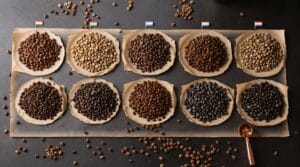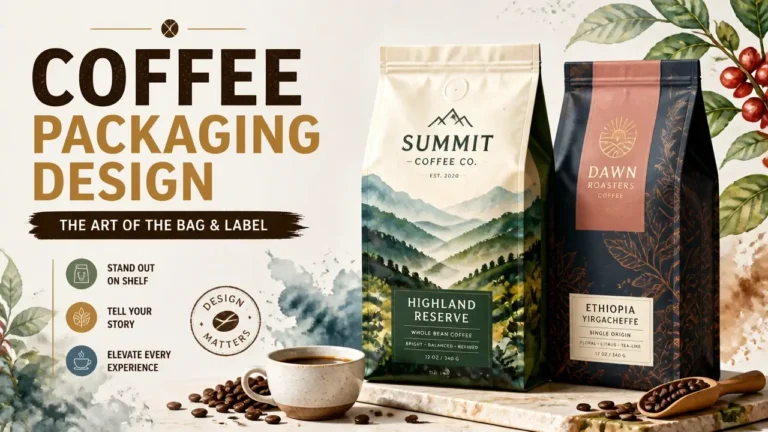

Thoughtful coffee packaging design is a silent salesman, the first thing a customer touches, reads, and judges before a single cup is brewed. Kraft paper signals craft. A one-way degassing valve signals seriousness. Gold foil signals occasion. Every material choice tells a story the roaster may never get to speak out loud.
The bag isn’t just a container. It’s the handshake, the pitch, and the promise, compressed into label hierarchy, texture, and typography that either earns trust or loses it in three seconds flat.
As these visual and tactile brand strategies continue to evolve alongside 2024 coffee market innovations, the bag remains much more than just a simple container.
Just as packaging shapes your expectations before the first sip, cafe layout and lighting psychology works behind the scenes to influence how you perceive your entire coffee experience once you step inside.
The Silent Salesman: Why the Bag Matters Before You Ever Taste the Coffee
Distinctive coffee packaging design is the roaster’s only voice in a room full of strangers: it has to convey quality, origin, and brand personality before a single bean is ground, sniffed, or sipped. Think about the last time you picked up a bag at a specialty shop. You didn’t taste it first. You touched it, looked at it, and made a judgment call in about three seconds.
That judgment call is worth taking seriously, both for roasters and for you as a buyer.
Amcor’s 2023 Coffee Packaging Insights study found that 70% of consumers say they purchase coffee based primarily on its packaging, at least sometimes. That’s not a niche behavior. That’s most of the people standing in the aisle with you.
To understand how these purchasing decisions shift across global markets, industry researchers rely on comprehensive coffee consumption analytics.
So what exactly is the bag doing in those three seconds?
It’s running three jobs at once. First, it’s protecting the beans (but we’ll get to the engineering behind that in a moment). Second, it’s projecting the roaster’s story. Third, it’s signaling the character of the coffee itself. A matte-black bag with gold foil trim doesn’t just look expensive: it tells you the roaster wants you to think of this as a luxury product before you’ve read a word. A kraft paper bag with hand-stamped lettering says something completely different: small batch, hands-on, no-frills craft. Neither is lying. Both are communicating a real philosophy through material choices alone.
The tactile signals go even deeper than most people realize. Heavier paper stock, a soft-touch matte finish, tidy typography with generous white space; these cues trigger a quality association that happens below conscious thought. Consumers equate the weight of the bag with the weight of the roaster’s care. It’s not rational, but it’s real, and good packaging design leans into it deliberately.
Then there’s the narrative layer. Picture a bag with a painted Ethiopian landscape across the front, the name of a specific farmer’s co-op printed below it, and a short paragraph about the village where the cherries were hand-sorted. That bag isn’t selling coffee anymore: it’s selling a place, a relationship, a story you get to be part of every morning. An Ethiopian landscape illustration doesn’t just decorate the shelf; it collapses the distance between your kitchen and the origin, transforming what would otherwise be a commodity into something with a face and a geography.
Mark Zhou, Founder and CEO of MTPak Coffee, puts it plainly:
“The marketing potential of coffee packaging is limitless. Roasters need to convey their brand identity to consumers, and they have seconds to do this successfully.”
Seconds. Not minutes. The entire promise of the brand (quality, origin, values) has to land before the shopper even flips the bag over.
Now, here’s where I’ll meet the skeptics directly: beautiful packaging cannot rescue stale beans. A stunning Ethiopian landscape illustration on a bag of two-year-old coffee is just a pretty lie. The design makes the promise. Something else entirely has to keep it. That’s where the real engineering begins, and it’s hidden in the layers of material you can’t see from the outside.
The Invisible Shield: Freshness Engineering Inside the Bag
The beautiful bag on the shelf is a promise, but coffee freshness engineering is what keeps that promise from expiring before you get home. Coffee packaging design doesn’t stop at the artwork. The real work happens in the laminate layers you can’t see, the valve you can hear when you squeeze, and the invisible atmosphere locked inside before the bag ever hits a shelf.
Here’s the thing most people don’t realize: oxygen is the enemy, and it doesn’t need much of an opening to win.
Multi-Layer Laminates, Valves, and Nitrogen Flush
A serious multi-layer barrier laminate is built like a sandwich with a specific job at each layer. The outer layer (usually printed PET or kraft paper) carries the artwork and takes the physical abuse of shipping and shelving. Beneath that sits the aluminum foil core, which is the real workhorse: it blocks oxygen, moisture, and light at near-absolute levels. Then comes the inner food-grade sealant layer, typically LDPE or LLDPE, which is what melts together under heat to create the airtight seal when the bag is closed.
Each layer performs a specific function effectively. Pull any one of them out and the system starts to fail.
Now, here’s where a lot of packaging claims get slippery. You’ll see bags marketed as “high-barrier” that use metallized film instead of a true aluminum foil core. Metallized film is thinner, lighter, and cheaper, and it’s meaningfully less effective at blocking oxygen and light, especially over weeks on a warm shelf. If a roaster’s packaging spec says “foil barrier,” that’s a specific, verifiable claim. If it just says “barrier layer” or “multi-layer film,” ask yourself why they’re being vague.
The one-way degassing valve mechanism solves a problem that most people never think about: freshly roasted beans are still actively off-gassing CO₂ for 10 to 15 days after roast. Seal a bag without a valve and it balloons, or worse, the seams fail. The valve lets that CO₂ escape while a membrane physically blocks outside air from entering. It’s a one-directional gate: pressure can push out, but nothing flows back in.
Modified atmosphere packaging (MAP) takes this a step further. Many specialty roasters inject food-grade nitrogen into the bag just before sealing, flushing out whatever residual oxygen remained after filling. Nitrogen is inert: it doesn’t react with the volatile aromatic compounds that make your coffee taste like something. Oxygen does. So by replacing the air inside the bag with nitrogen, you’re dramatically slowing the oxidation clock before the valve even has work to do.
Adam Carr, Coffee Science and Education Centre Manager at Seven Miles Coffee Roasters, put it plainly:
“Before working on the project, we understood the general effects of different packaging types and gas flushing, but we didn’t have systematically derived data that informed us on when was best to drink it… For the most part, to ensure a consistently shelf-stable product, we gas-flush (i.e., infuse pure nitrogen/inert gas) all of our coffees, with a couple of exceptions. We’ve done this for a long time.”
That last line matters. Nitrogen flushing isn’t a marketing feature at serious roasters: it’s standard operating procedure, done quietly and consistently. What Carr’s research added was the when: understanding the post-roast degassing curve well enough to know the optimal window for sealing and drinking. The engineering doesn’t end at the seal.
One more thing worth flagging: an airtight bag sitting on a warm shelf for eight months is still going to deliver stale coffee. The bag buys time: it doesn’t stop the clock entirely. Storage temperature and time since roast matter just as much as what’s inside the laminate. A bag with both a one-way valve and a “roasted on” date is telling you the roaster thought about both sides of the equation. A bag with only a “best by” date is telling you they didn’t.
Here’s a quick demonstration of how the degassing valve mechanism actually works: the movement makes it click in a way that a description can’t fully capture:
Video: One-Way Coffee Degassing Valve – How It Works (demonstrates valve action and nitrogen flush)
Bag Architectures and In-Store Freshness Validation
Coffee bag architecture types do more than hold the beans: the structure itself signals how seriously a roaster thought about the full shelf-to-cup experience. The three formats you’ll encounter most often each make a different set of trade-offs.
/* Khôi phục cấu trúc bảng chuẩn trong trường hợp môi trường hiện tại bị lỗi hiển thị */ .wp-block-table { margin: 2rem 0; overflow-x: auto; font-family: system-ui, -apple-system, “Segoe UI”, Roboto, Helvetica, Arial, sans-serif; }.wp-block-table table.has-fixed-layout { display: table; width: 100%; table-layout: fixed; border-collapse: collapse; background-color: #ffffff; border-radius: 8px; border-style: hidden; /* Ẩn viền bảng mặc định để dùng box-shadow */ box-shadow: 0 0 0 1px #e2e8f0, 0 4px 6px -1px rgba(0, 0, 0, 0.05); /* Đổ bóng nhẹ và viền tinh tế */ }.wp-block-table thead { display: table-header-group; background-color: #f8fafc; }.wp-block-table tbody { display: table-row-group; }.wp-block-table tr { display: table-row; border-bottom: 1px solid #e2e8f0; transition: background-color 0.2s ease; }.wp-block-table tr:last-child { border-bottom: none; }/* Hiệu ứng hover khi di chuột qua từng hàng */ .wp-block-table tbody tr:hover { background-color: #f1f5f9; }.wp-block-table th, .wp-block-table td { display: table-cell; padding: 16px 24px; color: #334155; font-size: 15px; line-height: 1.5; vertical-align: middle; }/* Định dạng riêng cho phần tiêu đề cột */ .wp-block-table th { font-weight: 600; color: #0f172a; text-transform: uppercase; font-size: 13px; letter-spacing: 0.05em; text-align: left; /* Lưu ý: Cột 2 sẽ tự động căn phải nhờ thẻ style inline trong HTML */ }| Criteria | Stand-up pouch | Quad seal | Flat-bottom bag |
|---|---|---|---|
| Stability | Good; stands upright with a bottom gusset, widely used for shelf display | Very good; reinforced by four corner seals, suited to heavier fills | Excellent; true flat base gives the strongest upright stability |
| Cost | Lower to medium; most cost-effective of the three for broad retail use | Medium; more premium than stand-up pouches, can be cost-competitive with flat-bottom | Highest; complex construction, typically the premium-cost option |
| Resealability | Strong; commonly paired with zippers and convenience closures | Moderate; reseal features are possible but less common in this format | Strong; often paired with zipper closures, valued for repeat-use |
| Tactile signals | Moderate; flexible, softer hand-feel than box-like formats | High; more structured and reinforced, gives a sturdier premium cue | High; crisp, rigid, box-like feel that signals premium shelf presence |
| Typical use case | Versatile retail packs (coffee, snacks, granular foods) | Heavier dry goods (premium coffee, pet food, granola, bulk dry goods) | Premium specialty products where shelf stability and branding space matter most |
The stand-up pouch is the workhorse of the category: economical, lightweight, and functional. The quad seal bag steps up in rigidity, with four reinforced corner seals that give it a more structured, premium feel in hand. The flat-bottom bag, sometimes called a block-bottom, is the most expensive to produce and the most impressive on a shelf: five printable panels, a true flat base, and a box-like stance that communicates “we spent money on this” before you’ve read a word.
What each format signals about the roaster is worth paying attention to. A flat-bottom bag doesn’t automatically mean better coffee, but it does mean the roaster made a deliberate investment in presentation and shelf presence. That kind of intentionality tends to correlate with the same attention applied elsewhere in the process.
Here’s a quick in-store test worth adding to your routine: squeeze the bag gently near the valve. If it has a working one-way degassing valve, you’ll feel slight resistance and possibly hear a soft hiss as CO₂ escapes. No valve, or a valve that feels completely rigid with no give, is worth noting. Then check the resealable zipper: run your fingers along the track and make sure it closes cleanly without gaps or misalignment. These are small things, but they’re the kind of small things that tell you whether a roaster sweated the details or just ordered the cheapest bag that fit the budget.
Visual Language in Coffee Bag Design
Every design choice on a coffee bag is a deliberate shortcut, a way of telling you what the coffee tastes like before you’ve opened the bag. The aesthetic style you’re drawn to isn’t random. It usually maps pretty closely to the kind of coffee experience you’re already looking for.
That’s the quiet intelligence behind strong coffee packaging design. The art isn’t decoration layered on top of the product: it is the product’s first impression, and roasters who understand that treat every font, color field, and illustration as a flavor signal.
Minimalist Coffee Bag Design
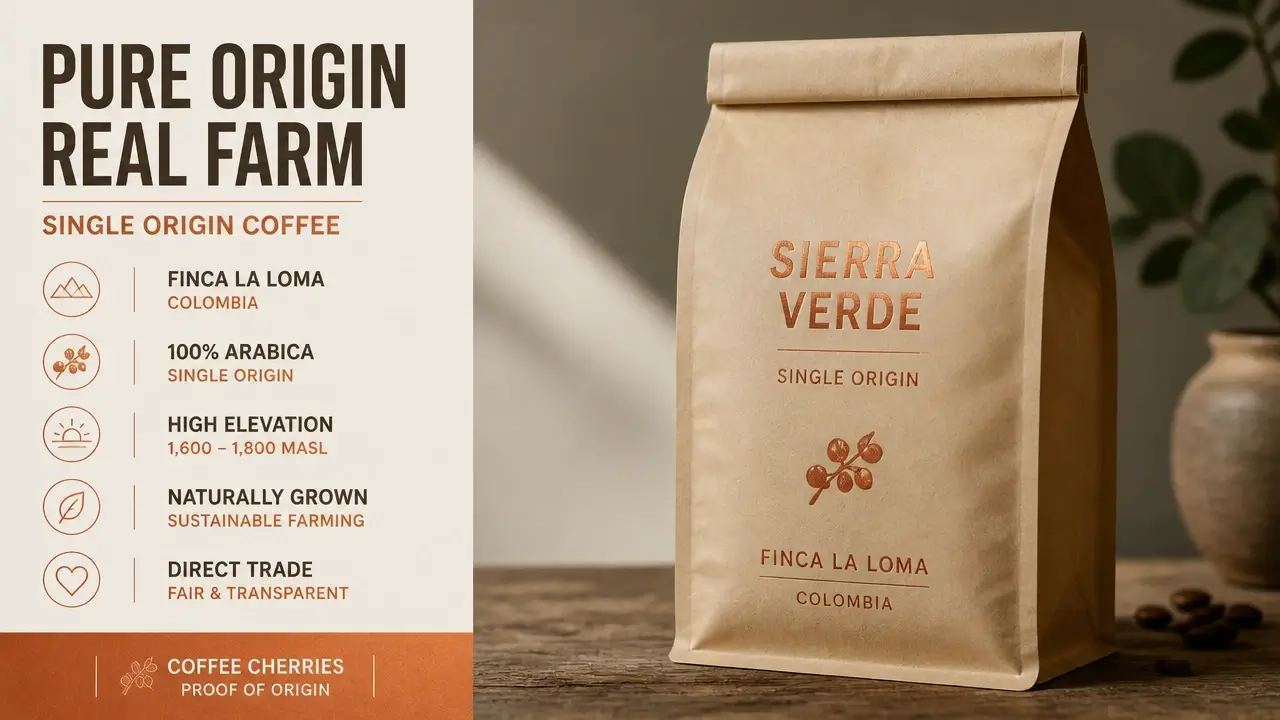
Minimalist coffee bag design strips everything back to what actually matters: origin, clarity, and trust. Ample negative space, clean sans-serif type, muted natural tones or crisp white fields; this style speaks to drinkers who want transparency over theater.
Picture a single-origin bag printed on unbleached kraft paper. Just the farm name, a tiny copper-foil coffee-cherry icon, and nothing else competing for your attention. That restraint is a statement: the bean is the story. No mascot needed.
That same restrained aesthetic often bleeds out from the retail shelf and into physical shop spaces, where a comprehensive Cafe style cost breakdown helps interior designers weigh clean lines against actual build-out budgets.
Nostalgic Style and Heritage Cues
Nostalgic coffee bag design does the opposite: it fills the surface with history. Retro serif fonts, sepia or faded palettes, postage-stamp motifs, illustrated trade routes that look lifted from a 1940s travel poster. This style isn’t trying to look old. It’s borrowing the emotional weight of craft and continuity.
A Colombian single-origin bag with a hand-drawn map illustration and a “Roasted by Hand” stamp doesn’t just describe the coffee, it places you in a small-batch apothecary where someone cared enough to do things the slow way. That feeling is the point.
Illustrative and Bold Typography Styles
Artistic illustration takes the bag in a completely different direction. Hand-drawn, painterly, or character-driven artwork tends to show up on coffees with bold or experimental flavor profiles: naturally processed, high-fermentation, fruit-forward. The bag becomes a collectible canvas, not a commodity wrapper. A folklore-inspired phoenix illustration on an Ethiopian natural processed coffee isn’t arbitrary. Intense berry notes and wild fermentation character deserve that kind of visual energy.
Bold typography style works from the opposite aesthetic but lands the same directness. Oversized, high-contrast typefaces (think “DARK ROAST” in 72-point Helvetica across the entire front panel) project confidence and urban clarity. No illustration, no origin story, no apology. This bag is talking to the drinker who knows exactly what they want and doesn’t need the romance.
When those painterly expressions extend beyond the bag and into fine art, mastering Coffee painting step-by-step transforms leftover brews and espresso shots into rich, sepia-toned watercolor masterpieces.
Cylindrical Tin Canisters as Premium Packaging
Cylindrical tin canisters are carving out their own category above all of these. Aluminum or steel canisters give roasters a continuous wraparound design surface that a flat pouch simply can’t match: the artwork has no seam, no fold, no interruption. Beyond the visual advantage, tins are infinitely recyclable and durable enough to live on a countertop long after the coffee is gone. For micro-lot releases or limited editions, that keepsake quality turns the packaging into part of the product’s value.
Mark Zhou, Founder and CEO of MTPak Coffee, frames the stakes well:
“Younger consumers are driving a huge shift in how roasters present their coffee. The rise of unboxing culture means packaging has to be exciting, shareable, and visually striking; it’s part of how people experience and talk about coffee online.”
The visual language of the bag has become part of the coffee ritual itself: before the grinder, before the kettle, before the first sip. Once you can read what a design style is actually saying, you’ll notice that the bag you keep reaching for usually matches the cup you keep coming back to.
Decoding the Label: What Real Quality Looks Like
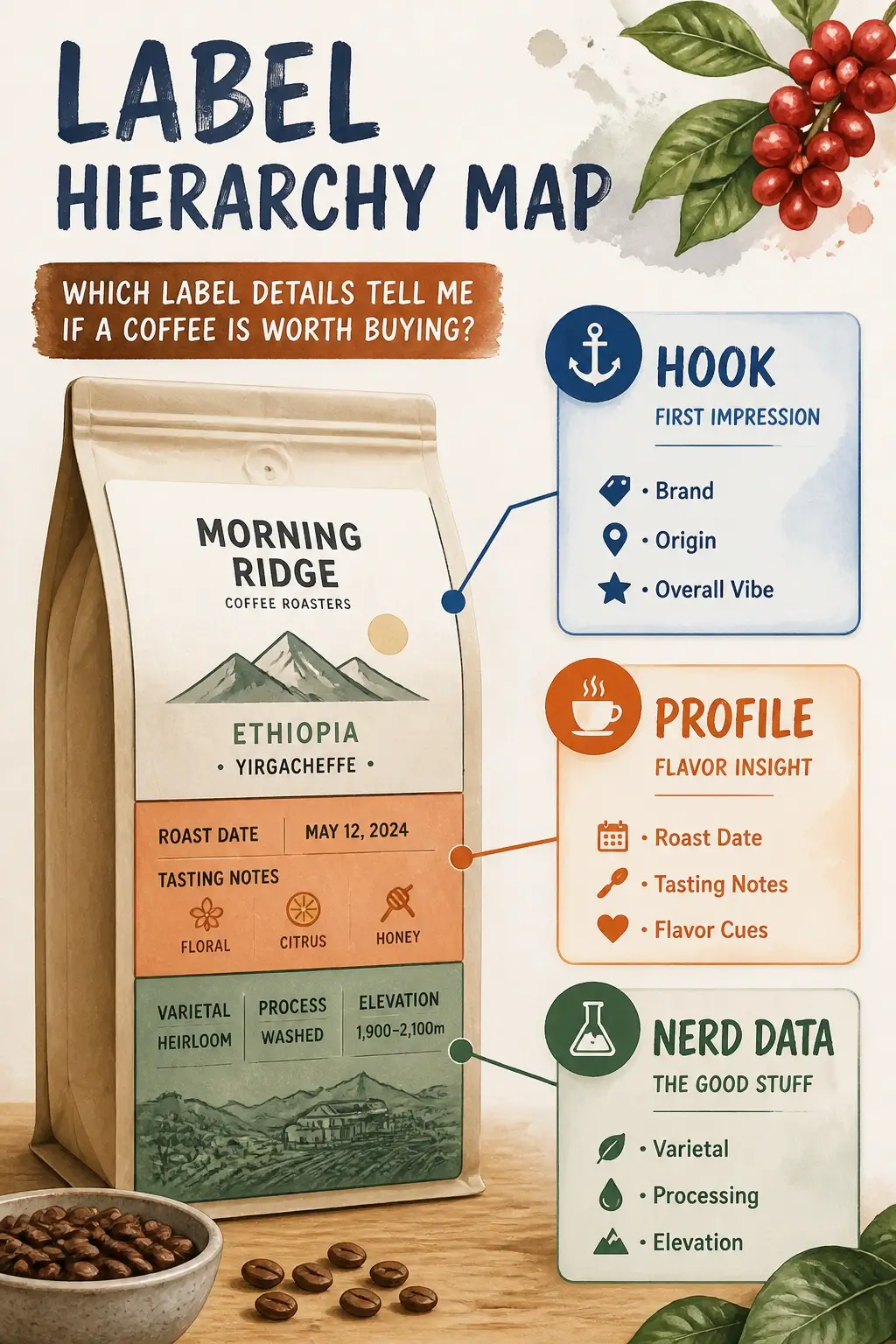
The well-designed coffee label information hierarchy is a structured reading system: it moves you from brand identity at the top, through sensory profile in the middle, down to granular origin data at the bottom. Most people scan the front art, flip the bag, read a few words, and put it back. But once you know what each layer is actually telling you, you can audit any bag in about thirty seconds and know whether the roaster is proud of their sourcing or hiding behind clever fonts.
The Three-Tier Label Hierarchy
Tier 1: The Hook lives at the top of the visual stack. It’s the largest text on the bag: brand name, macro coffee identity (“Ethiopia Yirgacheffe”), and the single-origin or blend callout. This tier answers one question from across a shelf: what is this, and who made it? If the brand name is the only thing you can read at arm’s length, that’s a deliberate choice. It means the roaster is betting on brand recognition over bean transparency.
Tier 2: The Profile is where the sensory story lives. Roast depth (Light, Medium, Dark) and tasting notes translate the roaster’s intention directly to your palate before you’ve spent a dollar. But the single most important piece of information in this tier (maybe on the entire bag) is the roast date.
Not the “best by” date. The roast date.
A bag that lists only an expiration date is telling you something: the roaster doesn’t want you doing the math. Specialty roasters print the roast date because they’re proud of it. Everyone else hides behind a “best by” window long enough to cover slow distribution.
Tier 3: The Nerd Data is where transparency either shows up or doesn’t. This is the granular origin layer: varietal, processing method, and elevation. Each one pulls real weight.
- Varietal is the botanical subspecies (Gesha, Bourbon, Typica). Like grape variety in wine, it shapes the fundamental cup character before processing or roasting touches it.
- Processing method (Washed, Natural, Honey, Anaerobic) tells you how the fruit was removed from the seed and how much fermentation influenced the flavor. A washed Ethiopian and a natural Ethiopian from the same farm can taste like completely different coffees.
- Elevation in meters above sea level (masl) matters because altitude is a proxy for bean density. Higher elevations mean cooler temperatures, slower cherry development, and denser beans, which generally translates to more acidity, complexity, and shelf stability under roasting heat. When a roaster prints “2,100 masl,” they’re not padding the label. They’re telling you they know exactly where this coffee came from and they’re not embarrassed by the details.
If a roaster provides all three willingly, that’s not just transparency, it’s confidence. It signals they trust their sourcing and respect your ability to use the information.
Mark Zhou, Founder and CEO of MTPak Coffee, frames the decision well:
“The process of designing packaging for your coffee beans starts with the bag’s structure. This will shape how much information and detail you can share on your packaging, so you’ll need to decide what you want your customer to know about your offering. If your brand is well known you might prominently display your logo. If not, you’ll need to highlight your coffee’s attributes, such as its roast profile, origin, and recommended brewing methods.”
That last part is the tell. A roaster who leads with attributes is making a bet that the coffee can carry its own weight. A roaster who leads only with a logo is betting you already trust them, or that you won’t look too closely.
Here’s how those three tiers map onto the bag visually:
Practical Roast Date Auditing
The roast date audit is simple: buy coffee roasted within the last two to three weeks. That’s the window where CO₂ is still slowly releasing from the bean, the aromatics are at their sharpest, and the oils haven’t begun to oxidize. After about four to six weeks off roast, most coffees are still drinkable, but the peak has passed.
Here’s the friction point most people miss: a degassing valve on a bag without a roast date is a contradiction. The valve signals the roaster understands freshness science. The missing date signals they don’t want you holding them to it. Those two things shouldn’t coexist on the same bag, but they do, constantly.
As for where this information physically lives on the bag, the layout follows a predictable pattern. Tier 1 is always front panel: it’s the billboard. Tiers 2 and 3 migrate to the back or side panel, sometimes formatted as a tasting card, sometimes compressed into a small origin block. Higher-end roasters increasingly route Tier 3 data through a QR-linked digital page, which lets them update lot-specific information (harvest date, producer name, cupping score) without reprinting the bag for every micro-lot.
That QR approach is worth pausing on. When a roaster builds a living digital page behind that code instead of pointing it at a generic homepage, they’re treating traceability as a feature, not a formality.
Beyond freshness and origin, a coffee label is also a regulated food package, and what’s missing can tell you as much as what’s there. In the US and EU, food-contact materials, net weight declarations, origin designations, and allergen statements are subject to legal standards. A bag that clearly states net weight, carries a proper country-of-origin designation, and includes manufacturer contact details is a bag made by a roaster who treats their product as a professional food item. When those basics are absent, the charming hand-drawn illustration on the front might be covering a compliance gap rather than a craft philosophy.
The Green Shift in Coffee Packaging
“Eco-friendly” is one of the most overworked phrases in the coffee aisle right now. Every bag seems to wear it. So the real question isn’t whether a roaster says they care about the planet: it’s whether the bag in your hand can actually prove it.
Here’s what’s worth understanding: sustainability in coffee packaging isn’t one thing. It’s a spectrum of approaches, each with real trade-offs, and the gap between a genuine commitment and a marketing halo can be invisible to the naked eye. Let’s close that gap.
Compostable, Recyclable, and Refill Options
Sustainable packaging options in specialty coffee have converged around three distinct paths, and they work very differently from each other.
The first is compostable packaging, typically built from plant-based films like PLA (polylactic acid) derived from corn starch, or newer cellulose-based materials. These bags are designed to break down biologically rather than persist in landfill. Roasters who go this route often pair the film with uncoated kraft paper and soy-based or water-based inks. That combination matters: petroleum-based inks release volatile organic compounds (VOCs) during printing, and a glossy, solvent-coated exterior can contaminate an otherwise compostable package. Keeping the whole structure in one material stream (film, paper, ink) is what makes composting actually work end-to-end.
The second path is mono-material PE (polyethylene) structures. Instead of the traditional multi-layer laminate that bonds incompatible materials together and makes recycling nearly impossible, mono-material pouches are made entirely from one polymer family. That single-material construction is what recycling facilities need to process flexible films. Post-consumer recycled (PCR) content takes this further: incorporating plastic already recovered from the waste stream into the new bag, reducing the demand for virgin material.
The third path is the one that changes the relationship entirely: refill systems. The model works like this: a roaster sells you a beautiful, durable canister or glass jar once. It lives on your counter. Every subsequent order arrives as a lightweight, minimal refill pouch shipped in a biodegradable mailer. The pouch does one job (protect the beans in transit) and the canister does the other (store them at home). What you’re buying shifts from a disposable container to a keepsake, and the total packaging footprint per pound of coffee drops significantly over time.
Each approach is a real step forward. But “a real step forward” and “problem solved” are not the same thing.
What Certifications Actually Verify
It’s easy to assume that moving away from multi-layer laminates is automatically a win for the planet, but the real picture is more nuanced than that, and this is where the gap between genuine sustainability and green marketing lives.
Start with compostable bags. A bag certified as compostable doesn’t necessarily break down in your backyard. Most certified compostable films require an industrial composting facility (sustained temperatures around 58°C, controlled moisture, and a specific timeframe) to fully mineralize. Drop that same bag in a home compost pile or, worse, a landfill, and it may behave more like conventional plastic than you’d expect.
That gap between lab conditions and real-world performance is well-documented. Research published in the Journal of Material Cycles and Waste Management examined ASTM D6400 and EN 13432 certification standards (the two benchmarks most compostable packaging claims rest on) and found that the tests are conducted under ideal laboratory conditions that don’t reflect the shorter, less controlled cycles of actual commercial composting facilities. The study identified a particularly troubling blind spot: standards require 90% of material to pass a 2mm sieve after the test period, but fragments smaller than 0.2mm are never quantified. That means certified bags can leave behind persistent microplastic film particles (CFMPs) that escape detection entirely. Field measurements in the same research showed less than 10% surface reduction of certified films after 12 months in soil, with residual microplastics supporting toxin-producing fungi. The authors recommend adding chloroform extraction, NMR spectroscopy, and pyrolysis-GC-MS analysis to actually verify full biodegradation (methods that current certification protocols don’t require). You can read the full study here.
This isn’t a reason to distrust compostable packaging, it’s a reason to read past the front of the bag.
The same logic applies to recyclable mono-material pouches. Whether that bag is recyclable in practice depends entirely on whether your local facility accepts flexible films. Most curbside programs don’t. Store drop-off programs (like those at certain grocery chains) do, but only in specific regions. A bag that’s technically recyclable and a bag that gets recycled are two different things.
So what should you actually look for? Certification marks with disposal pathway instructions: not just words.
- BPI Certification (Biodegradable Products Institute) verifies compostability to ASTM D6400 in North America.
- OK Compost / TÜV Home Compost (from TÜV Austria) is the stricter standard: it certifies that a material breaks down in home composting conditions, not just industrial ones.
- How2Recycle labels provide specific, standardized instructions for how to actually dispose of the packaging in your region, including whether it needs a store drop-off.
- EN 13432 is the European equivalent of ASTM D6400 for industrial compostability.
A bag that carries one of these marks and tells you where to dispose of it (“drop off at store,” “industrial compost only,” “check locally”) is doing the honest work. A bag that just says “biodegradable” or “earth-friendly” without a certification number is asking you to trust the marketing department.
One more thing worth noting: a roaster that voluntarily prints the specific certification number and a clear disposal instruction on the bag is demonstrating a level of accountability that vague halo language never can. That accountability is the same instinct that shows up in a precise roast date, a specific farm name, and an elevation printed on the label. It’s a roaster who believes the details matter.
And that brings us to the full picture. The best coffee packaging does four things at once: it pulls you in visually, it protects the beans with real engineering, it tells you the honest truth on the label, and it carries a realistic environmental footprint you can actually verify. When you find a bag that achieves all four (the silent salesman, the invisible freshness system, the transparent label, and the accountable green claim) you’ve found a roaster who sweated every detail from the farm to your counter. That’s worth your loyalty.
Key Takeaways on Coffee Packaging Design
- A degassing valve without a roast date is a contradiction that hides the coffee’s true age.
- Flat-bottom bags signal deliberate investment, often correlating with overall quality commitment.
- Compostable claims mean nothing without BPI or TÜV Home Compost certification marks.
- The bag’s design style is not random; it’s a flavor signal that matches what’s inside.
- Elevation, varietal, and processing on a label prove a roaster’s sourcing confidence.
- Recyclability depends on local facilities, not just the bag’s material composition.
Frequently Asked Questions About Coffee Packaging Design
Q: Why would a roaster use a degassing valve but hide the roast date?
A: It’s a contradiction: the valve shows they understand freshness science, but omitting the roast date often means they’re selling older beans or don’t want you to calculate shelf age. It signals a half-commitment to quality, so trust the date over the hardware.
Q: What if my local facility won’t recycle ‘recyclable’ coffee bags?
A: Many flexible pouches require store drop-off programs, not curbside pickup. Check the How2Recycle label for specific instructions. If no program exists, consider brands offering take-back or refill systems to reduce waste.
Q: How much does the bag material actually affect coffee flavor after opening?
A: Once you break the seal, the coffee’s flavor degrades from air exposure regardless of material. Even the best laminate can’t stop oxidation after opening, so your home storage habits matter more than the original packaging.
Q: Can a coffee bag be both truly compostable and still protect freshness?
A: It’s a trade-off. Plant-based compostable films are more permeable to oxygen than aluminum foil laminates, so they can’t match the shelf life. Most compostable bags are best for coffee you plan to drink quickly.
Q: Why does a flat-bottom bag feel more premium than a stand-up pouch?
A: Flat-bottom bags have a rigid, box-like structure from complex construction and reinforced seals. They sit solidly on shelves, offer more printable panels, and signal intentional design investment—making them feel like luxury packaging.
Q: What does it mean if a coffee bag uses metallized film instead of real aluminum foil?
A: Metallized film is a thin, often cheaper barrier layer that looks like foil but provides less oxygen and light protection. True aluminum foil cores block almost all outside elements, so metallized bags usually indicate a roaster cutting corners on freshness.
References
- Coffee Packaging Insights study (2023) – Amcor
- How roasters use packaging to sell coffee for more – Perfect Daily Grind
- Seven Miles freshness in coffee – Barista Magazine
- How to design exceptional coffee packaging – Perfect Daily Grind
- Designing the perfect packaging for your roasted coffee beans – Perfect Daily Grind
- One-Way Coffee Degassing Valve – How It Works – YouTube
- Study on certified compostable packaging degradation – Springer