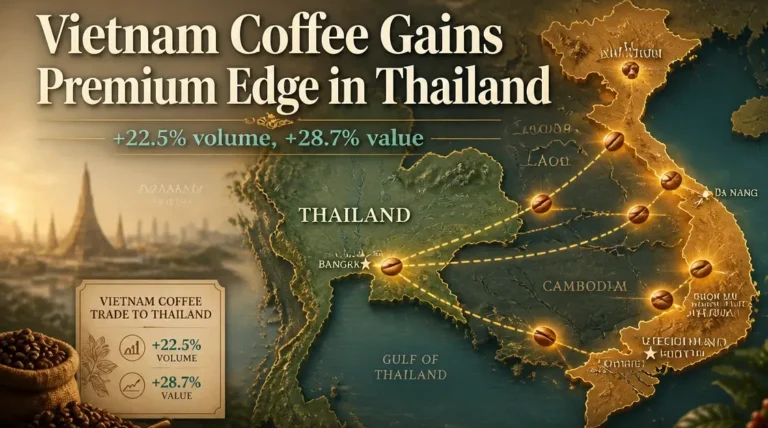

Vietnam shipped approximately 9,900 tonnes of coffee worth US$80.6 million to Thailand in the first quarter of 2026, a rise of 22.5% in volume and 28.7% in value compared with the same period a year earlier, according to Vietnam Customs data reported by Vietnam+ on 2 May 2026.
The shipment figures arrive against a backdrop of sharp swings in Vietnam’s standing as a supplier to Thailand. Voice of Vietnam reported in April 2025 that Vietnam’s share of Thailand’s coffee imports had fallen from 54.54% to 24.29% the previous year, with Laos rising to claim 61.7% of the market. By the time of the Q1 2026 data, Vietnam+ reported Vietnam’s share had recovered to 35.7%, making it one of Thailand’s leading suppliers once more.
A structural shift in what Vietnam is selling appears to be central to the rebound. Processed products — including roasted and ground coffee, instant coffee and private-label goods — accounted for 83.6% of Vietnam’s coffee export revenue to Thailand in the first two months of 2026, Vietnam+ reported. That figure reflects a broader national trend: the Vietnam Investment Review reported in December 2025 that processed coffee generated US$1.46 billion in export revenue in the year to mid-November 2025, up 58% year-on-year, and described Vietnam’s export structure as undergoing a significant transformation toward higher-value, deep-processed formats.
On the demand side, Vietnam+ reported that Thai consumers — particularly in major cities — are increasingly moving away from instant coffee toward roasted and ground coffee, espresso-based drinks and specialty varieties. The expansion of modern coffee chains in Bangkok, Chiang Mai and key tourist destinations has boosted demand for higher-quality, traceable coffee products, the same report stated. Thailand’s domestic coffee market was estimated at 65 billion Thai baht (approximately US$2 billion) in 2025, up 8.3% from the prior year, according to Vietnam+.
Vietnam+ also cited market researchers projecting that coffee consumption in Thailand could grow by 7–8% annually through 2032, potentially exceeding 120,000 tonnes by the end of that period. Thailand currently produces roughly 35,000 hectares of coffee under cultivation with an annual output of 40,000–50,000 tonnes of green beans, and consumption already averages more than 340 cups per person annually, according to the same source.
Vietnam’s competitive position in the Thai market is supported by geographic proximity, lower logistics costs and tariff advantages within the ASEAN trade bloc, Vietnam+ reported. However, the report also noted that competition is intensifying as suppliers from Brazil, Malaysia and Indonesia expand their presence in Thailand.
The Thailand figures sit within a mixed overall picture for Vietnamese coffee exports. VnEconomy reported that Vietnam’s total coffee exports in Q1 2026 reached 577,300 tonnes worth US$2.71 billion — volume up 12.6% year-on-year but value down 6.4% over the same period. Nationally, the Saigon Giai Phong newspaper reported in April 2026 that Vietnam’s average coffee export price rose from US$2,000 per tonne to US$5,660 per tonne between 2021 and 2025, while deeply processed coffee still accounts for only about 15% of total output.