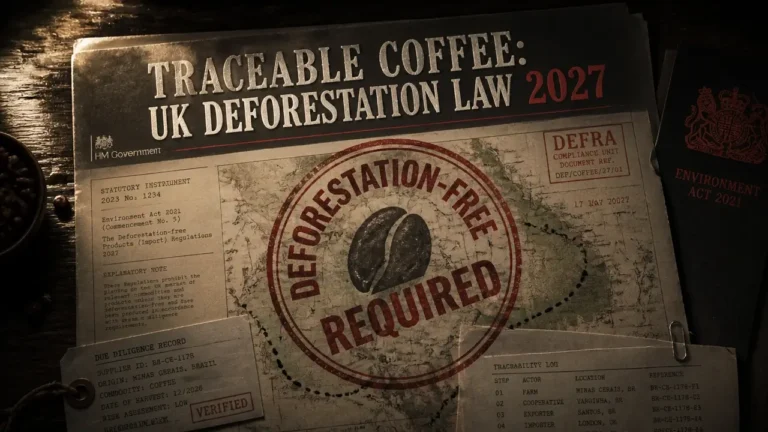

The United Kingdom has confirmed plans to introduce mandatory deforestation due‑diligence rules for coffee and other forest‑risk commodities in Great Britain from 2027, signalling a decisive turn from voluntary corporate pledges to legally enforced traceability in one of Europe’s larger coffee markets.
The policy, announced during London Climate Action Week on 23 June by Nature Minister Mary Creagh and detailed in a Department for Environment, Food & Rural Affairs (Defra) paper, would require Great Britain businesses with annual turnover above £1 million that use forest‑risk commodities such as coffee, cocoa, palm oil, rubber, soy, cattle and wood to carry out due diligence and prove compliance with producer‑country laws. According to the government, the framework will build on a timber regime that has been mandatory across the UK since 2013.
Under the proposal, businesses in scope must set up a due‑diligence system, report on their activity, and hold evidence of compliance, including geolocation data showing where relevant products originated, Defra said. First placers of coffee and other covered goods on the Great Britain market would have to ensure each batch is backed by a due‑diligence statement, while downstream businesses would face reduced requirements.
The measures arrive as external assessments suggest much of the global coffee industry is still not demonstrating deforestation‑free supply chains. The 2026 Forest 500 report from Global Canopy, summarised by Daily Coffee News, found that only 47% of major coffee‑linked companies it tracks had any public deforestation‑free commitment for coffee in 2025, up slightly from 44% a year earlier. Just 18% had coffee traceability mechanisms in place, and only 5% publicly reported that more than half of their coffee volumes were deforestation‑ and conversion‑free.
“While some battles have been won, this year’s Forest 500 data shows that the fight against deforestation is still being needlessly lost,” the report’s executive summary stated, noting that many corporate targets set for 2025 had already been missed. The study evaluates 500 companies across nine forest‑risk commodities, including coffee, based solely on information they publish on their own websites.
The UK move is also unfolding alongside the European Union Deforestation Regulation (EUDR), which will apply in Northern Ireland but not in Great Britain. According to UK government guidance for Northern Ireland, EUDR will start to apply there to coffee and other specified commodities from 30 December 2026 for medium and large operators, with later deadlines for smaller actors. The Great Britain regime is expected by Defra to be delivered through secondary legislation in 2027 after a formal consultation in 2026.
In its June policy documents, the government said it intends the Great Britain rules to cover the same core commodities and underlying information requirements as the EUDR in Northern Ireland, aiming to reduce divergence and support trade with the EU. It also confirmed that the information Great Britain businesses must hold for due diligence is intended to be broadly the same as what is needed for an EUDR due‑diligence statement when exporting to the EU or sending goods to Northern Ireland.
However, there will be an important difference in scope. As reported by Daily Coffee News and The Coffee Post, the proposed UK Great Britain rules would focus on “illegal” deforestation under local law, whereas EUDR applies regardless of whether forest clearance was legal in the producing country. At the same time, the UK government has stated an ambition to transition “in due course” to a stricter deforestation‑free standard requiring products to be free from any deforestation.
For coffee, these emerging rules intersect with a significant trade flow. The United States Department of Agriculture’s Foreign Agricultural Service estimates that the UK imported 2.4 million 60‑kilogram bags of green coffee in the 2024/25 market year, equivalent to roughly 10% of US green coffee import volume, according to Daily Coffee News. The UK government has said that operators may benefit from simplified due diligence for goods produced in Great Britain and exported to the EU or moved to Northern Ireland, as the UK is currently classified as a low‑risk country under EUDR.
NGOs and retailers have welcomed the UK announcement as a clear signal that supply chains will need to be cleaned up. “This is a strong signal to business that supply chains need to be deforestation‑free,” said Cassie Dummett of NGO Forest Coalition in comments reported by Foodservice Footprint, while Andrew Opie of the British Retail Consortium said his organisation had “long called for UK deforestation regulation” and stressed the importance of alignment with the EU to avoid unnecessary costs and complexity.
Announcing the policy, Nature Minister Mary Creagh said in a government news release that tackling global deforestation is “one of the most effective ways we can address climate change,” adding that eliminating products linked to illegal deforestation from UK supply chains is intended to protect ecosystems while improving the long‑term resilience of trade.