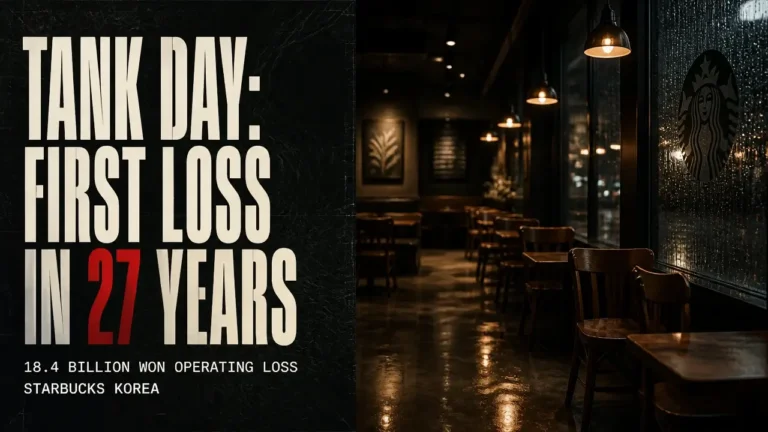

Starbucks’ South Korean business has reported its first quarterly loss in 27 years of operations after a widely criticised “Tank Day” tumbler promotion, marking a sharp reversal in one of the global coffee chain’s most important international markets.
SCK Company, which operates Starbucks Korea, disclosed an operating loss of 18.4 billion won (about US$13.4 million) for the second quarter of 2026, swinging from a 40.3 billion won profit a year earlier as revenue fell by 58.7 billion won, according to Asia Business Daily. The unit’s sales declined 6.1% to 747.3 billion won in the quarter, the paper added, citing regulatory filings.
For the first half of 2026, SCK’s operating profit dropped 85.5% year-on-year to 10.9 billion won, while sales inched up just 0.5% to 1.5651 trillion won, Asia Business Daily reported. By comparison, SCK’s first-half 2025 operating profit stood at 75.4 billion won, according to MK and Korea JoongAng Daily. The Straits Times noted that this was Starbucks Korea’s first quarterly loss since it launched in 1999 and described the country as Starbucks’ largest market outside the United States and China.
The financial slump followed a May marketing campaign built around a large “tank” tumbler and a designated “Tank Day” on May 18, the anniversary of the 1980 Gwangju pro-democracy uprising in which troops and tanks attacked protesters, according to NBC News. Asia Business Daily reported that between May 15 and May 26 Starbucks Korea used phrases such as “Tank Day” and “Bang the Desk” on promotional posters. NBC News wrote that the slogan “Thwack it on the table” recalled a 1987 police claim that student activist Park Jong-chol had died suddenly after investigators “hit the desk with a thwack,” rather than from torture.
The campaign drew swift criticism from civil society and political figures, and boycott calls spread across the country, according to The Investor and The Straits Times. Starbucks Korea halted the promotion and issued an apology, CNA/Reuters reported. The US-based Starbucks later called the campaign “unacceptable,” according to The Straits Times.
On the day the controversy erupted, parent conglomerate Shinsegae Group dismissed then-CEO Sohn Jeong-hyun and the responsible executive at SCK, and began disciplinary procedures for other employees involved, Asia Business Daily reported. The Investor wrote that Starbucks Korea’s division leader and CEO were fired shortly after, and that five employees linked to the marketing campaign were removed from their posts while the company cooperated with a police investigation.
Shinsegae chairman Chung Yong-jin delivered a televised apology in which he said, “All members of the Shinsegae Group, including myself, will remember the history and sacrifices of our society and strive to deeply understand and respect the feelings of the people,” according to NBC News. In a separate statement reported by The Investor, he added that he “wholeheartedly” bowed in apology to the bereaved families of the May 18 Democratic Movement, the late activist Park Jong-chol, the citizens of Gwangju and the Korean people.
Even as management changed, spending patterns at the café counter shifted rapidly. Estimated payment volume on Starbucks credit and debit cards in the second quarter fell 18.5% compared with a year earlier, with May down 17% and June down 36% year-on-year, Asia Business Daily reported, noting that these figures excluded membership payments. Over the same period, estimated card payment volumes at rival chains Twosome Place and Mega MGC Coffee grew by 28.5% and 34.1%, respectively, the outlet said. A related Korea JoongAng Daily headline stated that Twosome Place transactions had topped Starbucks’ for a third consecutive month as the fallout continued.
The political response extended those market pressures beyond individual consumers. Boycott calls were promoted by political circles and government organisations, according to Asia Business Daily. NBC News reported that the interior minister said his ministry would no longer offer vouchers from companies that “make light” of South Korean history. The Straits Times added that police searched Starbucks Korea’s Seoul headquarters in August as part of the investigation.
The company has also taken steps inside the stores themselves. The Straits Times reported that Starbucks Korea closed all of its more than 2,000 outlets early on June 22 so staff could receive training in modern Korean history and social sensitivity, describing the move as unprecedented for the chain. Shinsegae officials said Starbucks Korea’s sales had dropped “very significantly” after the controversy, without disclosing specific figures, according to CNA/Reuters and The Straits Times.
Beyond the coffee shops, the impact has reached Starbucks Korea’s main shareholder. Seoul Economic Daily reported that retailer E-Mart, which owns 67.5% of Starbucks Korea, posted a consolidated operating loss of 43 billion won on net revenue of 6.92 trillion won in the second quarter, missing market expectations for 7.04 trillion won in revenue and 46 billion won in operating profit. The Straits Times, citing Shinsegae Group, noted that SCK will “concentrate on business stabilisation by restoring brand trust,” with the company saying it plans to strengthen its review processes and focus on preserving historical values through social-contribution activities.