
South Korea’s coffee industry has entered a new phase in which roasted coffee and cafes are pulling away from traditional instant mixes, creating a 3.7 trillion won market that is growing in both premium and value segments, according to a joint analysis released in Seoul on 11 August by the Ministry of Agriculture, Food and Rural Affairs (MAFRA) and the Korea Rural Economic Institute.
Yonhap reported that the total domestic coffee market reached about 3.7 trillion won (US$2.61 billion) in 2024, while Aju Press cited a more precise figure of 3.7359 trillion won from the same government study. Yonhap said this represented a 35.6% increase from 2.75 trillion won in 2018, with an average annual growth rate of 5.2% over six years.
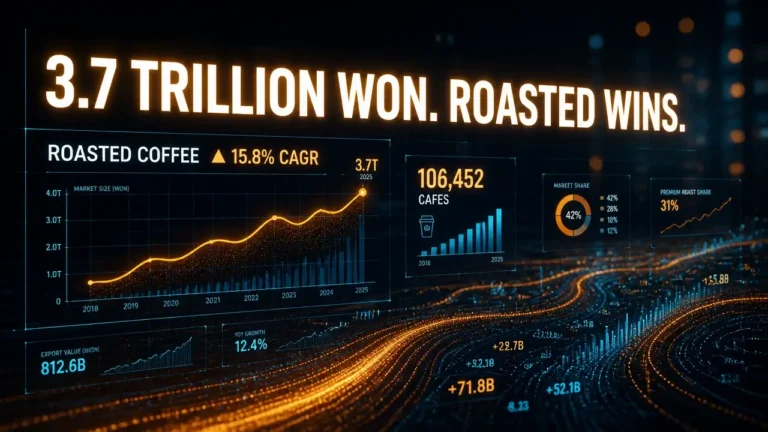
The study shows roasted coffee has become the engine of that expansion. According to Yonhap and Aju Press, the roasted-coffee segment was projected at 1.3225 trillion won in 2024, with Yonhap stating that roasted coffee recorded an average annual growth rate of 15.8% between 2018 and 2024. Over the same period, Yonhap reported that the market for processed and blended coffee, including three-in-one mixes, declined by an average of 0.5% per year, and said consumer preference has shifted from instant coffee mixes to roasted beans.
This structural change is visible in the country’s food-service landscape. Yonhap reported that South Korea had 106,452 coffee shops in 2023, up 5.7% year-on-year, and that cafes accounted for 13.4% of all food-service establishments, compared with 9.3% in 2018, meaning roughly one in seven outlets is now a coffee shop. In coverage of the same analysis, Herald Business said coffee-shop share rose by 4.1 percentage points over five years.
At the same time, the production side is tightening. Aju Press reported that the number of coffee-processing businesses fell to 1,660 in 2023, an 8.0% year-on-year decline and the first drop since tracking began, even as the cafe sector continued to expand. Herald Business noted that the industry remains structurally dependent on imported raw materials, with 204,841 tons of coffee imported in 2024, up 5.8% from the previous year and valued at US$1.3709 billion.
Officials describe the outcome of these shifts as a polarized but “dynamic” ecosystem. In an assessment of the findings published by Aju Press, the ministry said the roasted-coffee market is polarizing, with low-cost coffee shops and bulk-product markets both growing. Herald Business reported that MAFRA also sees simultaneous growth in demand for specialty coffee and for budget or large-volume coffee, while Asia Business Daily said demand is increasing both for specialty coffees and for convenient coffee consumed during commutes or after meals.
Jeong Gyeong-seok, Director General for Food Industry Policy at MAFRA, told Herald Business that “the domestic coffee industry has built a highly dynamic ecosystem in which the premium and value markets are growing together, underpinned by increasingly diverse consumer preferences.” Aju Press quoted him, under the spelling Jung Kyung-seok, as saying the ministry would support the integration of food technology and seek to elevate coffee as a key export item in the government’s K-Food+ initiative.
Despite its reliance on imported green coffee, South Korea is also expanding its role in finished coffee exports. Citing the MAFRA–KREI analysis, Yonhap reported that coffee-related product exports reached US$229.6 million in 2024, up 4.6% from a year earlier, while Herald Business said export volume totaled 35,349 tons and that instant coffee accounted for 98% of that tonnage. Asia Business Daily reported that roasted-bean export volume was up 46.8% year-on-year as of May 2025 and that export markets have shifted since 2023, with Israel now the top destination at 18.1% of export value, followed by China at 15.4%, Australia at 7.1%, the Philippines at 6.5%, and Chile at 5.7%.
Summarizing the trend, an unnamed MAFRA official told Asia Business Daily that over the past six years the Korean coffee industry’s 5.2% average annual growth shows coffee has “firmly established itself as a core growth area within the domestic food industry,” and added that with one in seven food-service establishments now a cafe, “the industry is shifting from processing to specialty coffee shops.”