
A new four-year investment platform launched in Hanoi is positioning regenerative agriculture and shared, pre-competitive funding as a central organizing model for the global coffee sector.
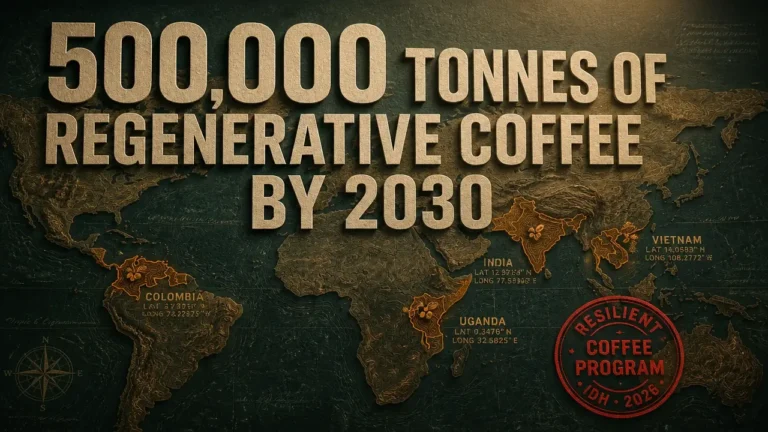
The Resilient Coffee Program (RCP), created by IDH, aims by 2030 to support approximately 300,000 coffee farmers across Vietnam, India, Colombia and Uganda and to generate around 500,000 tonnes of regenerative coffee annually, according to launch coverage from Comunicaffe, Daily Coffee News and World Coffee Portal. The program was announced at a sustainable coffee round table in Hanoi on 11–12 August 2026, and will run through 2030.
In Vietnam, the first country component, RCP targets about 75,000 coffee farmers over the next four years — roughly 10% of the country’s coffee-growing households and 14% of its coffee area — with the goal of introducing regenerative practices on up to 70% of participating farms, Comunicaffe and Daily Coffee News reported. World Coffee Portal noted that Vietnam is the world’s second-largest coffee producer, while IDH chief executive Daan Wensing described it on LinkedIn as the world’s largest Robusta producer.
The scale of the regenerative target has been described inconsistently: World Coffee Portal’s headline referenced a program “targeting half a billion tonnes of regenerative coffee annually,” while the body of the same article, along with Comunicaffe and Daily Coffee News, cited a goal of 500,000 tonnes per year by 2030. None of the reports provided additional detail to reconcile this discrepancy.
According to Comunicaffe, Vietnam’s RCP component aims to reduce approximately 240,000 tonnes of CO₂ emissions, around 15% below a 2026 baseline, and to raise farmer incomes by about 15%. On LinkedIn, Wensing linked the program’s urgency to recent climate impacts, stating that a 2024–25 drought cut Vietnam’s national coffee output by around 20%, with some Central Highlands farms needing up to two crop cycles to recover.
RCP is built as a pre-competitive platform where roasters, traders, retailers and governments can co-invest, with shared measurement, reporting and verification (MRV), traceability and co-claiming systems, according to Comunicaffe, Daily Coffee News and World Coffee Portal. Comunicaffe reported that the program will use jurisdictional “Compacts” — joint investment plans that align governments, companies and local institutions — and will apply the Sustainable Agriculture Initiative Platform’s Regenerating Together Framework as its guiding reference for regenerative practices.
At the Hanoi launch, Wensing framed the initiative as a response to sector-wide challenges. “A resilient coffee sector cannot be built by any one company, or any one country, alone,” he said, quoted by Comunicaffe. “Climate pressure, shifting market expectations and the need to support farmers all call for a different approach – one built on collaboration and shared investment. That is what the Resilient Coffee Program offers: an open, pre-competitive platform where roasters, traders and governments can co-invest in resilient coffee value chains, together.”
The first front-runner investor in RCP is the ALDI SÜD Group, which has not disclosed financial terms of its participation, according to Daily Coffee News and World Coffee Portal. Both outlets reported that ALDI SÜD’s investment aligns the company’s sourcing strategy with the European Union’s Deforestation Regulation (EUDR) and emerging EU corporate due-diligence requirements.
In a statement to World Coffee Portal, Rachel Vujovic, Sustainability Director at ALDI SÜD Group, linked the company’s involvement to wider sector dynamics, saying that “the long-term resilience of the coffee sector depends on supporting the farmers and communities at its foundation” and that by investing together with partners, the company aims to promote regenerative farming practices, strengthen livelihoods, and support transparency and emissions reduction in coffee production.
Other supply-chain actors present at the Hanoi round table included Intimex Group, Simexco Daklak Ltd., JDE Peet’s, Sucden Coffee, Tuan Loc Commodities, and representatives from the embassies of Switzerland and the Netherlands, according to Wensing’s LinkedIn post. Comunicaffe reported that Sy Do, Sustainability Manager APAC at JDE Peet’s, described building coffee-sector resilience as a “shared responsibility” and said the company supported the program’s direction and would explore how it could contribute.
Wensing characterized climate risk as a current rather than future concern for producers, writing on LinkedIn that “climate is no longer a future risk for coffee. It’s a present one to manage, and this week in Vietnam, we launched something built to respond to it at sector-level.”
Beyond Vietnam, Wensing stated on LinkedIn that coffee farmers in India’s Karnataka and Kerala regions are already contending with erratic monsoons, mounting pest pressure and stagnating yields, while Daily Coffee News noted that RCP is being launched amid a wider industry push toward regenerative agriculture linked to soil health, biodiversity, climate resilience and farmers’ connection to land.
Comunicaffe, Daily Coffee News and World Coffee Portal all reported that IDH is now inviting additional roasters, traders, governments and buyers in Europe and the Americas to join the platform, with Wensing writing on LinkedIn that IDH is “looking forward to more roasters, traders and buyers joining the platform in the months ahead.”