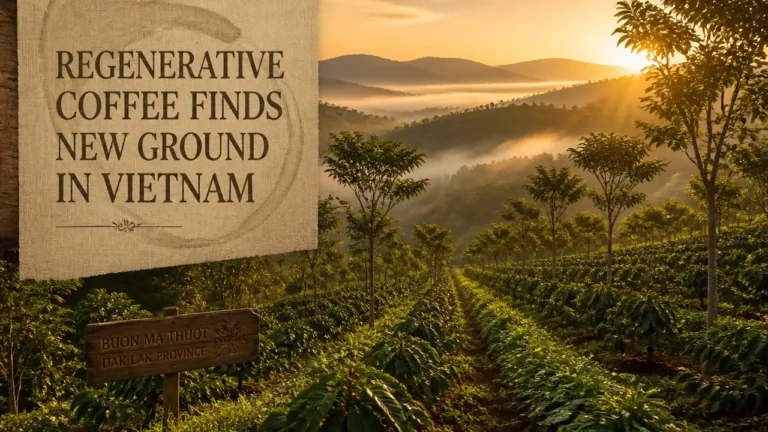

Vietnam, the world’s leading Robusta producer and a cornerstone of global coffee supply, is emerging as a test bed for regenerative and resilience-focused farming as climate stress and decades of deforestation squeeze its high-yield model.
On 6 August 2026, UCC Group announced a coffee-production project in Vietnam built around regenerative agriculture in partnership with Atlantic Commodities Vietnam Ltd. (ACOM), the Vietnam arm of ECOM Group, according to the company’s official press release and reporting by Daily Coffee News. Pilot farms will test shade trees, cover crops and organic compost containing biochar, with stated aims of improving coffee-tree growth and yields, boosting adaptation to climate-related stress, and reducing dependence on chemical fertilizers, the UCC release said.
The pilot will also serve as a proving ground for a carbon “inset” model within UCC’s own supply chain, using biochar application and lower chemical-fertilizer use to encourage greenhouse-gas reduction and absorption on farms, according to the UCC announcement and coverage by AgNavigator. UCC stated that findings from the farms will be shared with local producers to help strengthen resilience across Vietnam’s coffee-growing regions.
UCC’s figures on initial field activity differ by source. The company’s official release reported the delivery of approximately 1,000 shade-tree seedlings to about 100 farms, while Daily Coffee News cited 1,757 seedlings distributed to 38 farmers. Both agree that the effort remains at pilot scale, and Daily Coffee News noted that the project “does not yet appear to be tied to large-scale green coffee sourcing” and has no announced targets for farmer participation, investment level or green coffee volumes.
Despite its modest size, partners have framed the project as part of a larger strategic turn. Thuan Sarzynski, Sustainable Management Services Manager for ECOM Vietnam, said in comments reported by Jiji and AgNavigator that, “Through this project, we will document our carbon emission reduction efforts, which can be scaled over the next few years. We are committed to reducing carbon emissions throughout the coffee supply chain and contributing to UCC’s achievement of its net-zero target.” UCC has set group-wide goals of sourcing 100% of coffee for its own-brand products from “sustainable” supply chains by 2030 and reaching carbon neutrality by 2040, according to its press release and Daily Coffee News.
The regenerative pilot lands in a landscape already undergoing change. A report by Coffee Watch, cited by Coffee Geography Magazine, found that nearly 60% of tropical forest cover in Vietnam’s key coffee region vanished over three decades, with forest cover in the Central Highlands dropping from 42.8% in 1990 to 19% by 2020. The same report described a “nutrient treadmill” in which farmers rely on ever-greater quantities of chemical fertilizer to maintain yields on exhausted soils. The Central Highlands produce 95% of Vietnam’s coffee and Vietnam supplies nearly 40% of global Robusta exports, Coffee Geography reported.
In response to those findings, an unnamed representative of Vietnam’s Ministry of Agriculture and Rural Development told Coffee Geography that “the coffee sector is now shifting its focus toward improving the productivity, resilience, and sustainability of existing coffee-growing landscapes rather than further expansion.” The ministry statement places official backing behind a move away from the expansionary model that Coffee Watch linked to environmental and social costs in the Central Highlands.
Climate-related stress is sharpening that shift. The United States Department of Agriculture’s Foreign Agricultural Service (USDA FAS) reported that high temperatures and extended dry seasons have stressed coffee plants and farmers in Vietnam, with groundwater levels dropping in many areas and making irrigation more difficult, in its Coffee Annual. The agency said the MY2023/24 harvest was negatively affected by high temperatures and droughts, and that such conditions are expected to become more frequent due to climate change.
Alongside environmental pressure, water use is a key concern in Vietnam’s largely monocrop Robusta systems. USDA FAS, citing an International Union for Conservation of Nature (IUCN) analysis, reported that coffee monoculture in the highland region requires about 1.12 billion cubic meters of water annually, and that irrigation improvements could save approximately 290 million cubic meters a year, a 26% reduction. Combining water-saving irrigation with intercropping could save an estimated 407 million cubic meters—about 36%—according to the same report.
Intercropping and shade are already part of the adaptation toolkit described by USDA FAS. The agency estimated that roughly 30% of coffee area in the highlands is mixed with other crops, and said that pairing coffee with shade-providing plants such as pepper, avocado, durian and peach can reduce the effects of high temperatures and disease while also providing additional income streams. However, the report noted that modern irrigation systems remain expensive, and are installed on only about 5% of coffee farms by area, even after projects such as the World Bank’s VnSat program, which deployed 316 water-saving systems.
The new UCC–ACOM pilot is not the only regenerative initiative arriving in Vietnam. At a sustainable coffee roundtable in Hanoi on 11 August 2026, IDH (the Sustainable Trade Initiative) and partners launched the Resilient Coffee Program (RCP), a four-year pre-competitive investment platform focused on Vietnam, India, Colombia and Uganda, according to Daily Coffee News. IDH’s goal is to support production of approximately 500,000 metric tons of “regenerative coffee” annually, and in Vietnam specifically it aims to reach about 75,000 coffee farmers over the next four years, representing around 10% of coffee-growing households and 14% of national coffee area, Daily Coffee News reported.
Present at the Hanoi roundtable was JDE Peet’s, which has worked with IDH on compliance with the European Union Deforestation Regulation (EUDR) in Vietnam, according to the same report. IDH CEO Daan Wensing said, “A resilient coffee sector cannot be built by any one company, or any one country, alone. Climate pressure, shifting market expectations and the need to support farmers all call for a different approach — one built on collaboration and shared investment.”
While Coffee Watch’s criticism of Vietnam’s volume-driven Robusta model was aimed at the broader sector rather than any single company, the combined emergence of UCC’s regenerative pilot, the IDH RCP targets, and government-encouraged practices such as intercropping and water-saving irrigation suggests that the country’s coffee landscape is being reshaped around resilience and sustainability rather than further expansion, according to the cited reports from UCC, Daily Coffee News, Coffee Geography Magazine and USDA FAS.