Local governments in eastern Nepal are pushing coffee from experimental plots to commercial scale, backing farmers with budgets, free saplings and an employment drive that officials say is already engaging dozens of people each day. In Dolakha and Khotang districts, municipal leaders and cooperatives are using coffee to reduce imported purchases and keep more value and work within their communities.The
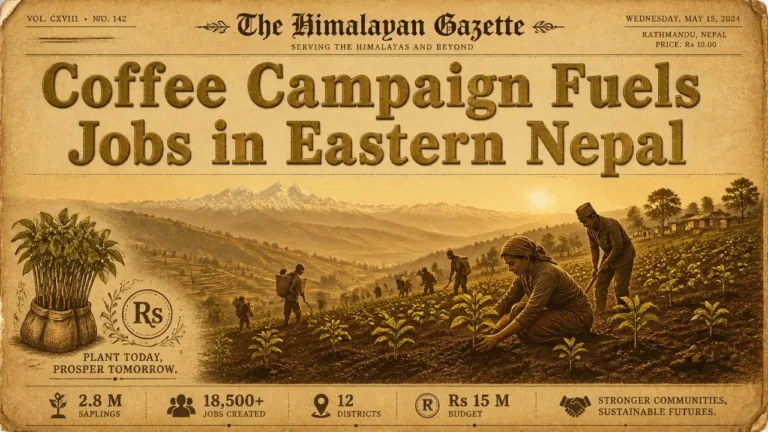
Deputy Mayor Production Campaign in Diktel Rupakot Majhuwagadhi Municipality has been launched with a budget of Rs 15 million for the current financial year, according to
Ratopati. Deputy mayor Bishon Rai stated that 70–80 local people are getting employment daily through the program, which aims to mobilise village labour in coffee-related activities. Rai said the municipality is preparing to plant 2.8 million coffee saplings on at least eight hectares of land this year.Rai explained that the municipality, which has 28,703 hectares of cultivable land, ultimately targets planting 14 million coffee saplings under the same campaign. He told Ratopati that 82,000 saplings were distributed free of charge to farmers last year, while about three lakh saplings have already been distributed this year, with a plan to distribute 2.2 million saplings free of cost. The campaign’s goal is to produce ten lakh kilograms of processed coffee annually and, as reported by Ratopati, to earn up to [UNVERIFIED] Rs 2 billion each year from coffee.Rai also linked the initiative to existing coffee demand. He said that the demand for coffee in the district has increased significantly and reported that capital exceeding Rs 200 million flows out of the district annually for coffee purchases. According to Ratopati, he described the Mahabhiyan, or major campaign, as a way to provide employment to youth in the village, utilise barren land and increase local incomes.In neighbouring Dolakha district, a much smaller but symbolically important coffee story is unfolding in Kattike, Bhimeshwar Municipality-5. Farmer Ram Sharan Budhathoki told the
Kathmandu Post he received a single coffee sapling from a Swiss government-supported horticulture centre in Kirantichhap about 45 years ago. According to the Post, he now has 40 mature coffee plants and 100 new saplings in the ground, and commercial farming has only recently begun.That early experiment has evolved into a cooperative-backed pocket area project. The
Kathmandu Post reports that Hamro Janakalyan Saving and Credit Cooperative supplied 1,700 saplings to 13 farmers in June 2025, helping launch commercial coffee farming in Kattike. Manager Deepak Basnet said farmers in the Kiranteshwar Organic Coffee Farmers’ Group are currently cultivating coffee on 15 ropanis of land and plan to expand to 50 ropanis, with a goal of involving all 30 group members in coffee cultivation.Basnet told the Kathmandu Post that around 7,000 coffee saplings will eventually be planted in Kattike alone. He noted that farmers have shifted towards commercial farming as the market for coffee continues to grow, although he also said that coffee produced in the area has not yet reached the market. To support the transition, the Post reports that Bhimeshwar Municipality has allocated Rs 1 million as a 50 percent contribution to a Rs 2 million project aimed at developing Kattike as a designated coffee pocket area.Beyond Nepal, local leaders elsewhere in Asia are also reshaping their crop mix to include coffee. In Vietnam’s Central Highlands, the People’s Committee of Dong Giang commune told state outlet
Vietnam that the commune currently has about 62 hectares of coffee and about 440 hectares of durian. By the end of 2025, the committee forecasts more than 1,740 hectares of perennial crops and more than 2,120 hectares of annual crops across the commune, supported by red basalt and sandy loam soils and abundant water resources that the same source describes as favourable for perennial agriculture.Chairman of the Farmers’ Association of Dong Giang commune, Mr. Bo Rong Thiet, confirmed to Vietnam that the coffee and durian areas are part of a broader shift towards perennial crops, with the commune also maintaining a stable 400 hectares of rubber plantations and about 400 hectares of specialised durian farming in the Buon Cui area.

 By | May 23, 2026